Commercial Foundation Repair in Cedar Park, TX
Fast, Reliable Commercial Foundation Repair in Cedar Park, TX — Licensed & Insured
Need commercial foundation repair in Cedar Park, TX? Round Rock Foundation Repair Group delivers expert inspections, pier installation & slab repair. Call (512) 220-3502.
Commercial Foundation Repair in Cedar Park, TX is a specialized structural service designed to identify, address, and permanently resolve foundation movement, settlement, and deterioration in business properties, retail centers, office buildings, and industrial facilities. Unlike residential work, commercial foundation repair demands a higher level of engineering precision, minimal operational disruption, and compliance with Texas commercial building codes.
Cedar Park’s rapid commercial growth, combined with its expansive clay-heavy soils and dramatic seasonal moisture swings, creates uniquely challenging conditions for business property foundations. From the bustling retail corridors along US-183 to the industrial parks near Whitestone Boulevard, commercial structures throughout Cedar Park face ongoing foundation stress that, left unaddressed, escalates into costly structural failures.
Read moreShow less
Round Rock Foundation Repair Group brings deep local expertise to every commercial project in Cedar Park and surrounding communities. Our team understands the specific geological and environmental pressures your building faces, and we deliver engineered solutions built to last. Call us today at (512) 220-3502 to schedule a commercial foundation inspection.
Understanding Commercial Foundation Repair in Cedar Park, TX
Commercial foundation repair encompasses a broad range of structural interventions intended to stabilize, restore, and reinforce the load-bearing foundations beneath business properties. These foundations support not only the structural weight of a building but also the operational equipment, inventory loads, and occupant safety that define a functioning commercial enterprise. When a commercial foundation fails, the consequences extend far beyond cosmetic damage — they threaten business continuity, tenant safety, and long-term property value.
Commercial foundations in Central Texas are predominantly concrete slab-on-grade systems, though older commercial buildings in established districts may feature pier-and-beam or spread footing foundations. Slab foundations, while cost-effective during construction, are particularly vulnerable to the volume changes in the expansive Vertisol soils that underlie much of Williamson County, including Cedar Park. As these soils absorb moisture, they expand with measurable force — sometimes exerting upward pressures exceeding 10,000 pounds per square foot — and contract sharply during drought conditions, leaving the slab without uniform support.
Read moreShow less
Historically, Cedar Park’s commercial development accelerated significantly after the early 2000s, when the city’s population began doubling and then tripling within single decades. Many of the commercial structures built during this rapid growth phase were constructed on sites with inadequate soil preparation or insufficient pier depth, creating a legacy of foundation vulnerability that building owners are still contending with today. Strip malls along Whitestone Boulevard, office campuses near the 1431 corridor, and warehouse facilities throughout the city’s industrial zones all reflect this history.
Understanding the difference between residential and commercial foundation repair is essential. Commercial projects typically involve larger slab areas, heavier structural loads, stricter permitting requirements, and more complex engineering documentation. The repair methods must account for active business operations, meaning work is often phased to keep portions of a building open during the repair process. Round Rock Foundation Repair Group is specifically equipped to manage this complexity, coordinating with property managers, tenants, and city inspectors throughout every commercial project in Cedar Park.
Schedule a Commercial Foundation Inspection
Why Commercial Foundation Repair Is Needed in Cedar Park, TX
Expansive Clay Soils: The Root Cause
The predominant soil type beneath Cedar Park is Austin Clay and Houston Black Clay, both classified as highly expansive Vertisols by the USDA Natural Resources Conservation Service. These soils have a Plasticity Index (PI) commonly ranging from 30 to 50 in Williamson County, well above the threshold of 20 that engineers consider problematic for foundation design. During wet periods, these clays can expand vertically by 4 to 6 inches in poorly drained areas, then shrink back by an equivalent amount during dry spells. This repeated cycle — technically called “shrink-swell” activity — progressively fatigues concrete slabs and the reinforcement within them, leading to cracking, differential settlement, and eventual structural compromise.
Drought Cycles and Moisture Extremes
Cedar Park and the broader Central Texas region experience pronounced drought-to-flood weather cycles. The exceptional drought of 2011, which was the worst single-year drought on record in Texas, caused widespread foundation damage across Williamson County as soils lost moisture at unprecedented depths — in some locations, soil moisture deficits extended 10 to 12 feet below grade. Commercial properties that survived visible damage during that drought often have stress fractures that have been slowly propagating ever since. More recently, the February 2021 Winter Storm Uri introduced a new failure mechanism: rapid freeze-thaw cycling caused water-saturated soils to heave, then collapse, further destabilizing foundations that were already marginally supported.
Rapid Commercial Development and Site Preparation
Cedar Park’s commercial districts — particularly the areas around US-183A, Whitestone Boulevard (FM 1431), and the 620 corridor near Anderson Mill — were developed quickly to keep pace with the city’s explosive population growth, which increased from approximately 26,000 residents in 2000 to over 82,000 by 2023. In the rush to build, some commercial sites received minimal pre-construction soil treatment. Inadequate moisture conditioning, insufficient compaction, and undersized piers are common findings during foundation inspections on commercial properties built between 2002 and 2014.
Tree Root Intrusion and Landscaping Moisture Zones
Cedar Park’s commercial landscaping requirements encourage tree planting in parking islands and along building perimeters. Live oaks, cedar elms, and the invasive Ashe juniper — all prevalent in the area — develop extensive root systems that draw moisture from the soil beneath foundations, accelerating differential settlement. Foundation inspections in neighborhoods like Avery Ranch Commercial District and along the Brushy Creek retail corridor frequently reveal root-related desiccation extending 8 to 15 feet from the foundation edge.
Drainage and Impervious Cover
Dense commercial development creates extensive impervious cover — parking lots, rooftops, and hardscaped areas — that redirects stormwater in ways the original site drainage was not designed to handle. This concentrates moisture at certain foundation zones while leaving others chronically dry, creating the uneven moisture conditions that cause differential settlement in commercial slabs.
Free, no-obligation estimates
Talk to Round Rock Foundation Repair Group
Tell us what you need and we’ll take it from there.
Signs You Need Commercial Foundation Repair in Cedar Park
Structural Warning Signs
- Diagonal cracks radiating from the corners of doors and windows, particularly those wider than 1/4 inch
- Horizontal cracks in masonry or concrete block exterior walls, indicating lateral soil pressure
- Visible separation between the building slab and exterior walls or curbs
- Bowing or buckling in interior walls and load-bearing partitions
- Gaps appearing between the roofline and exterior walls
Operational and Interior Signs
- Doors and windows that stick, jam, or no longer close squarely — a common complaint in Cedar Park commercial suites during summer dry spells
- Uneven or sloping interior floors detectable when rolling equipment or noticing water pooling
- Cracked ceramic tile floors, particularly in grid patterns indicating slab movement below
- Visible separation at interior wall-to-floor joints
Exterior and Site Signs
- Separation between exterior walkways, sidewalks, or parking aprons and the building foundation
- Standing water around the building perimeter after rain events
- Sinking or heaving sections of the parking lot near the building
Urgency Indicator: Cracks wider than 1/2 inch, sudden door jamming, or visible structural separation require immediate inspection — call (512) 220-3502 now.
Get a Free Commercial Foundation Inspection
Our process
Our Commercial Foundation Repair Process in Cedar Park
Round Rock Foundation Repair Group follows a structured, engineering-backed process for every commercial foundation repair project in Cedar Park. We understand that your business cannot simply shut down for weeks, so our process is designed to be both thorough and minimally disruptive to your operations.
- 01
Comprehensive Site and Foundation Inspection (Day 1–2)
Our process begins with a detailed on-site inspection conducted by an experienced foundation specialist. We use laser-level elevation mapping to document differential settlement across the entire slab, photograph all visible cracks and structural anomalies, re
- 02
Engineering Analysis and Repair Planning (Days 3–7)
Inspection data is analyzed to determine root causes and define the optimal repair strategy. For commercial projects in Cedar Park, this often involves consulting with a licensed structural engineer to develop a stamped repair plan that meets Williamson County
- 03
Permitting and Scheduling (Days 5–14)
We handle all commercial building permit applications with the City of Cedar Park Development Services. Commercial permits for foundation work typically require engineering documentation and may involve a plan review period. We coordinate scheduling around you
- 04
Site Preparation and Crew Mobilization (Day 1 of Construction)
Our commercial crews arrive fully equipped. We establish clear work zones that protect tenant areas, customers, and employees. Utility locates are confirmed before any excavation begins — a critical step given the density of underground utilities in Cedar Park
- 05
Foundation Repair Execution (Variable: 2–10 Days Depending on Scope)
Repair work proceeds according to the engineered plan, using the appropriate method — pressed steel piers, helical piers, slab lifting, or a combination — based on the specific conditions of your Cedar Park property. Work is phased where necessary to keep port
- 06
Post-Repair Elevation Verification (Final Construction Day)
Upon completion, we conduct a final laser-level elevation survey to verify that all repaired areas meet design specifications and that the slab has been uniformly restored to within accepted tolerances.
- 07
Final Inspection and Documentation (Within 5 Days of Completion)
City inspection is scheduled, project documentation is compiled, and our team provides the property owner with a complete repair record including before-and-after elevation maps, pier logs, and permit close-out documentation.
Commercial Foundation Repair Methods Used in Cedar Park
Steel Push Piers (Pressed Piling)
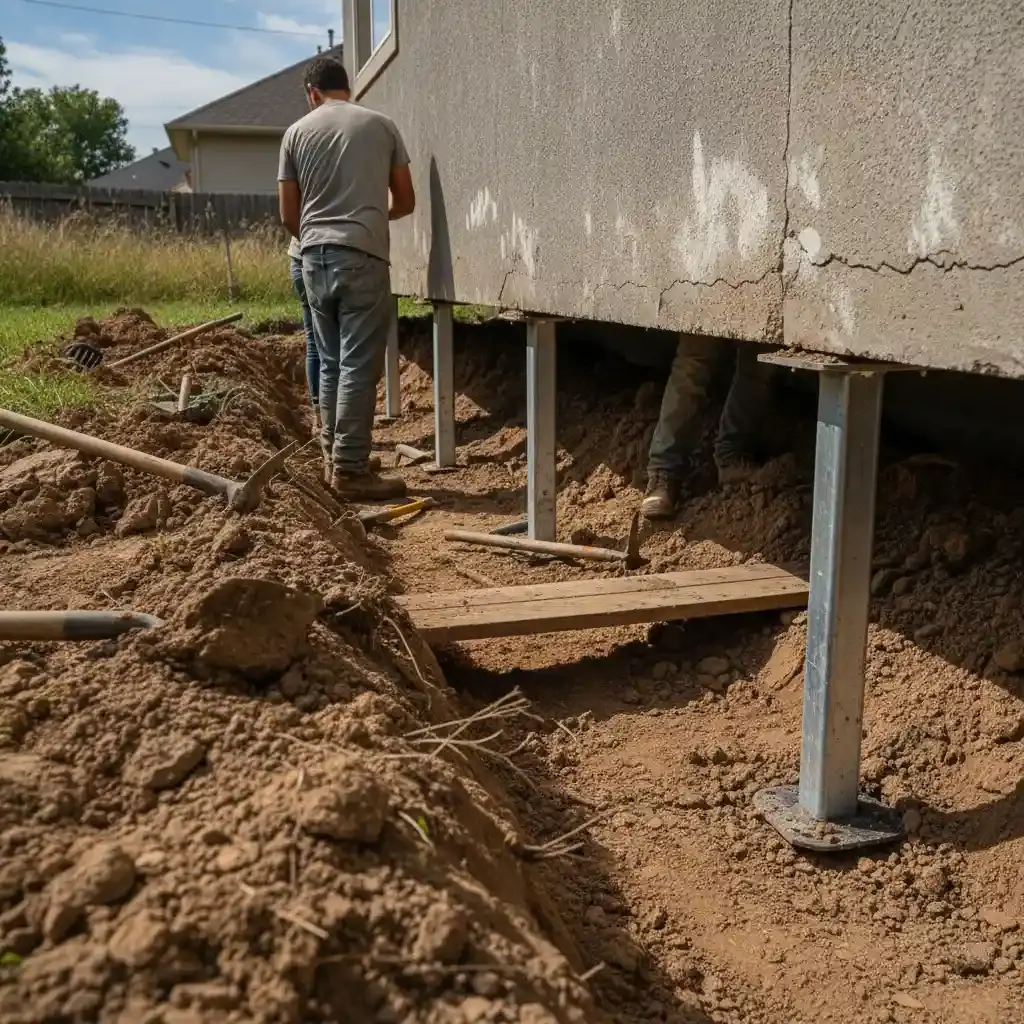
Steel push piers are driven hydraulically through unstable soils until they reach load-bearing bedrock or a competent stratum — in Cedar Park, this is typically the Austin Chalk formation, found at depths of 15 to 30 feet depending on location. Push piers are ideal for heavily settled commercial buildings where significant load transfer is needed. They are installed with minimal excavation and work well in active commercial environments.
Helical Piers
Helical piers are screwed into the ground using hydraulic torque equipment, making them ideal for new construction stabilization or lighter commercial loads. They are particularly effective in areas with high moisture variability, such as along Brushy Creek drainage corridors in Cedar Park, where soil conditions can change significantly with depth.
Slab Lifting and Polyurethane Foam Injection
For voided or settled slab sections that do not require deep underpinning, polyurethane foam injection fills sub-slab voids and lifts settled concrete. This method is minimally invasive, allows same-day return to service, and is well-suited for interior slab repairs in active retail and office environments.
Foundation Patching and Crack Repair
Structural epoxy injection and polyurethane crack sealing are used to restore the integrity of concrete foundations following settlement correction. Learn More About Foundation Patching Services
Crawl Space Repair and Encapsulation
Older commercial buildings in Cedar Park with pier-and-beam foundations may require crawl space repair, including beam replacement, pier shimming, and moisture encapsulation. Explore Crawl Space Repair Options
Commercial Foundation Repair Cost in Cedar Park, TX
One of the most common questions we receive from Cedar Park business owners is: “How much does commercial foundation repair cost?” The honest answer is that costs vary widely based on the size of the building, the severity of the damage, the repair method required, and the specific site conditions. Below is a realistic overview of what to expect.
Typical Cost Ranges
- Foundation Inspection: $300–$700 for a comprehensive commercial inspection with elevation mapping
- Minor Slab Repair and Crack Injection: $1,500–$5,000 for isolated crack repairs and void filling
- Polyurethane Foam Slab Lifting: $3,000–$12,000 depending on the number of injection points and slab area affected
- Steel Push Pier Installation: $1,200–$1,800 per pier installed, with most commercial projects requiring 15–40 piers depending on building size
- Full Commercial Foundation Restoration: $20,000–$100,000+ for large commercial buildings with extensive settlement and multiple repair zones
Read moreShow less
Factors That Affect Cost in Cedar Park
- Soil Conditions: Properties in Cedar Park’s high-clay zones near Brushy Creek or the Avery Ranch area may require deeper piers, increasing per-pier cost
- Austin Chalk Depth: Depth to bedrock varies significantly across Cedar Park; deeper chalk means longer piers and higher material cost
- Permitting Complexity: Commercial permits in Williamson County require engineering documentation, which adds $1,500–$4,000 to project costs
- Business Continuity Requirements: Phased construction to keep your business open may extend the project timeline and add 10–20% to labor costs
- Building Size and Load: Multi-story commercial buildings require heavier-duty pier systems with higher load ratings
We provide detailed written estimates following every inspection so you have complete cost transparency before any work begins. Call (512) 220-3502 to discuss your specific situation and get a no-obligation cost assessment.
View All Commercial Foundation Repair Services
Cedar Park Neighborhoods and Commercial Areas We Serve
Whitestone Boulevard Corridor
The commercial strip along Whitestone Boulevard (FM 1431) features a mix of retail centers, restaurants, and office buildings constructed primarily between 2000 and 2015. Many of these structures sit on poorly conditioned clay-heavy soils and experience significant differential settlement, particularly at building corners.
US-183 and 183A Commercial District
One of Cedar Park’s most active commercial corridors, the 183/183A area includes large-format retail, medical offices, and mixed-use developments. Buildings here face compounded challenges from heavy impervious cover and concentrated stormwater drainage that saturates soils at foundation edges.
Avery Ranch and Anderson Mill Adjacent Commercial Areas
Commercial properties serving the dense residential communities of Avery Ranch and Anderson Mill, including neighborhood retail centers and professional offices, frequently show foundation distress due to the highly expansive clay soils characteristic of these northwestern Cedar Park zones.
Brushy Creek Commercial Properties
Businesses near the Brushy Creek greenbelt and drainage corridor experience elevated moisture variability that drives some of the most pronounced shrink-swell foundation movement in the region. View All Service Areas
Commercial Foundation Maintenance Tips for Cedar Park Business Owners
Proactive maintenance is the most cost-effective strategy for protecting your commercial foundation in Cedar Park’s challenging climate. Follow these location-specific recommendations to reduce your risk of costly foundation damage:
- Maintain Consistent Soil Moisture: During Cedar Park’s summer dry periods — typically June through September — use a soaker hose system placed 18 inches from the foundation perimeter to prevent excessive soil desiccation beneath the slab.
- Clean and Redirect Gutters and Downspouts: Ensure all roof drainage is directed at least 6 feet away from the building foundation to prevent moisture concentration at the perimeter.
- Inspect Irrigation Systems Quarterly: Leaking irrigation lines are a leading cause of localized soil saturation and foundation heaving in Cedar Park’s commercial landscaping areas.
- Monitor Tree Proximity: Keep large trees, especially live oaks and cedar elms, at least 15–20 feet from the building perimeter. Remove any dead trees immediately to prevent soil moisture rebounding and heaving.
- Grade the Site Properly: Maintain a positive slope of at least 1 inch per foot for 6 feet away from the building on all sides to ensure surface drainage flows away from the foundation.
- Schedule Annual Foundation Inspections: Cedar Park’s soil conditions warrant at least one professional foundation inspection per year, ideally in early fall after the summer drought stress period.
- Repair Plumbing Leaks Immediately: Slab plumbing leaks are a primary cause of foundation movement in Cedar Park commercial buildings — address any wet spots or unexplained water bills without delay.
Why Choose Round Rock Foundation Repair Group for Commercial Foundation Repair in Cedar Park
When it comes to your commercial property — your investment, your tenants, your business — you need a foundation repair partner who understands the unique demands of Cedar Park’s geology, its building stock, and its regulatory environment. Round Rock Foundation Repair Group is that partner.
We have extensive hands-on experience repairing commercial foundations throughout Cedar Park, Round Rock, Georgetown, Austin, and the surrounding communities of Williamson County. Our team has worked on properties ranging from small neighborhood retail centers to large multi-tenant office complexes, and we bring the same level of engineering rigor and professional communication to every project regardless of size.
Read moreShow less
We work with licensed structural engineers to ensure every commercial repair meets Texas engineering standards and City of Cedar Park permitting requirements. Our repair methods are proven, our materials are commercial-grade, and our project management approach is specifically designed to minimize disruption to your business operations.
We back our work with detailed written documentation, post-repair elevation verification, and a commitment to transparency throughout the process. From the first inspection call to the final permit sign-off, you will always know exactly what we are doing, why we are doing it, and what it costs.
Call Round Rock Foundation Repair Group at (512) 220-3502 to speak with a commercial foundation specialist today.
Learn More About Round Rock Foundation Repair Group
FAQ
Frequently Asked Questions: Commercial Foundation Repair in Cedar Park, TX
How much does commercial foundation repair cost in Cedar Park, TX?
Commercial foundation repair costs in Cedar Park typically range from $3,000 for minor slab repairs and crack injection up to $100,000 or more for large commercial buildings with extensive settlement requiring deep steel pier systems. The most significant cost variables are building size, depth to stable bedrock (Austin Chalk), and the number of piers required. We provide detailed written estimates following every inspection so there are no surprises.
How long does commercial foundation repair take in Cedar Park?
Most commercial foundation repair projects in Cedar Park take between 3 and 10 business days of active construction, depending on the scope. Smaller slab repairs and foam injection work can often be completed in one to two days. Larger projects involving 20 or more piers may take a full week or more. The permitting process typically adds 5 to 14 days before construction begins.
Can my business stay open during foundation repair?
In most cases, yes. We design our commercial repair plans to phase the work in a way that keeps unaffected portions of your building operational. We work with property managers and tenants to establish clear safety zones and minimize disruption to customers and employees. In Cedar Park’s active commercial districts, we often schedule heavy equipment work during early morning hours to reduce parking lot disruption.
What causes commercial foundation problems specifically in Cedar Park?
Cedar Park’s commercial foundation problems are primarily driven by the city’s expansive Vertisol clay soils, which have a Plasticity Index of 30 to 50 and expand and contract dramatically with moisture changes. The prolonged drought of 2011 and the freeze-thaw events of Winter Storm Uri in February 2021 caused significant foundation stress across Williamson County. Rapid commercial construction from 2002 to 2014 on inadequately prepared sites also contributes to widespread foundation issues in the city.
How do I know if my Cedar Park commercial building needs foundation repair?
Common warning signs include diagonal cracks at door and window corners, sticking or jamming doors and windows, uneven floors, gaps between walls and the floor or ceiling, and exterior cracks in masonry or stucco. If you notice any of these symptoms, particularly after a dry summer or a major weather event, schedule a professional inspection promptly. Early intervention significantly reduces repair costs.
Does commercial foundation repair require a permit in Cedar Park?
Yes. Commercial foundation repair in Cedar Park requires a building permit from the City of Cedar Park Development Services Department. Projects involving structural modifications typically also require a stamped engineering plan from a licensed Texas structural engineer. Round Rock Foundation Repair Group manages the entire permitting process on your behalf.
What is the difference between foundation repair and foundation restoration?
Foundation repair typically refers to targeted interventions — installing piers, injecting cracks, or lifting settled slabs — to correct specific areas of damage. Foundation restoration is a broader term encompassing a comprehensive approach to returning the entire foundation system to its original design condition, including drainage correction, soil moisture management, and structural reinforcement across the full building footprint. For heavily damaged Cedar Park commercial properties, a full restoration approach is often the most cost-effective long-term solution. Learn About Our Foundation Restoration Services
Do you serve commercial properties beyond Cedar Park?
Yes. Round Rock Foundation Repair Group serves commercial properties throughout the greater Central Texas region, including Round Rock, Georgetown, Austin, Pflugerville, Brushy Creek, and many surrounding communities. View Our Complete Service Area
Contact Round Rock Foundation Repair Group for Commercial Foundation Repair in Cedar Park, TX
Do not wait for a small crack to become a structural emergency. Commercial foundation damage in Cedar Park’s expansive clay soils progresses faster than most property owners expect — especially during the extreme moisture fluctuations that define Central Texas weather patterns.
Round Rock Foundation Repair Group is ready to inspect your commercial property, identify the root cause of any foundation issues, and deliver a clear, engineered repair plan with transparent pricing. We serve Cedar Park and the entire surrounding region with professional commercial foundation repair services built to last.
Call us now at (512) 220-3502 to schedule your commercial foundation inspection. Our team is available to answer your questions and get your property assessment on the calendar quickly. You can also reach us through our website to request a callback or submit your property information for a preliminary assessment.
Request a Free Commercial Foundation Assessment Today
Get in touch
Find foundation repair help near you
Request a free estimate online or give us a call — our team will follow up quickly.
- Call us(512) 220-3502
- Visit1 Chisholm Trail Rd suite 450 room j, Round Rock, TX 78681
- HoursMon-Sat: 7:00 am – 7:00 pm