Foundation Repair Methods in Round Rock in Cedar Park, TX
Fast, Reliable Foundation Repair Methods in Round Rock in Cedar Park, TX — Licensed & Insured
Explore proven foundation repair methods in Round Rock serving Cedar Park, TX. Call Round Rock Foundation Repair Group at (512) 220-3502 for expert local service.
- Licensed & Insured
- Locally Owned & Operated
- Free Inspection & Estimate
Request Your
Free EstimateFoundation repair methods encompass the specialized engineering techniques and physical interventions used to stabilize, lift, and restore a home or commercial building’s structural base. In Cedar Park, TX — a rapidly growing community in Williamson County situated just northwest of Austin — the combination of expansive clay soils, prolonged drought cycles, and aggressive storm seasons creates some of the most demanding foundation conditions in Central Texas. Round Rock Foundation Repair Group brings deep regional experience to every project, diagnosing underlying soil and structural issues before recommending the most appropriate repair strategy. Whether your property sits in a newer Avery Ranch subdivision or an older established neighborhood near Anderson Mill, our team understands how local geology, drainage patterns, and construction eras influence which repair method will perform best for the long term. Call us today at (512) 220-3502 to schedule your foundation assessment.
Understanding Foundation Repair Methods in Round Rock
Foundation repair is not a single procedure — it is a family of engineering solutions developed over decades in response to the diverse ways that soil movement, water infiltration, and structural loading interact beneath a building. The practice evolved significantly in the mid-twentieth century when post-tension slab construction became the dominant residential building method across Texas, replacing the pier-and-beam systems common before the 1960s. Today, contractors and structural engineers draw from a toolkit that includes steel pier installation, helical pier systems, pressed concrete pilings, slab foam lifting (slabjacking), wall anchoring, and carbon fiber reinforcement, among others.
In the Central Texas region that includes Round Rock, Cedar Park, Georgetown, and surrounding communities, the dominant foundation type for homes built after 1975 is the post-tension concrete slab. These slabs are reinforced internally with tensioned steel cables and are designed to flex slightly with soil movement. However, when the expansive Blackland Prairie clay soils common to Williamson County undergo extreme shrink-swell cycles — sometimes shifting vertically by two or more inches in a single season — even well-engineered post-tension slabs can experience cracking, differential settlement, and perimeter beam failure.
Older properties, particularly those built before 1970 in neighborhoods like parts of Austin’s Anderson Mill area and original sections of Round Rock, frequently use pier-and-beam construction. These foundations rest on a network of concrete or masonry piers with a wood subfloor suspended above a crawl space. While pier-and-beam systems offer the advantage of easier access for repair, they are susceptible to moisture damage, wood rot, shifting piers, and inadequate ventilation problems — all of which are common in Cedar Park’s humid subtropical climate where summer humidity can remain above 70 percent even during drought months.
Commercial buildings across the Cedar Park and Round Rock corridor — from the retail centers along US-183A to the office parks near Brushy Creek — frequently employ drilled pier foundations or spread footings that require their own specialized repair approaches. Understanding the construction era, soil type beneath the specific property, drainage history, and building use is essential before any repair method is selected. This diagnostic-first approach is the foundation of every project Round Rock Foundation Repair Group undertakes.
Why Foundation Repair Methods Are Needed in Cedar Park, TX
Cedar Park and the broader Round Rock service area sit atop some of the most geologically active soils in the continental United States. The Texas Blackland Prairie and its associated Taylor and Austin Chalk formations underlie much of Williamson County. The expansive clay soils — particularly the dark, sticky Taylor Clay — are classified as having a plasticity index often exceeding 40, meaning they have an extreme capacity to absorb water and swell, then shrink dramatically when dry. The Texas A&M AgriLife Extension Service has documented vertical soil movement of up to 4 inches in a single year in the greater Austin-Round Rock metropolitan area during years with significant drought-to-rain transitions.
The drought conditions that gripped Central Texas from 2010 through 2012 — the most severe single-year drought on record in Texas in 2011, during which Austin recorded only 4.28 inches of rain between January and September — caused catastrophic foundation damage across Williamson County. Neighborhoods built on slab foundations in Teravista (Round Rock), Forest Creek, and Sendero Springs saw unprecedented settlement rates as moisture-depleted clay contracted by volumes that cracked perimeter beams and dropped interior slabs by 1.5 to 3 inches in some cases. The recovery rainfall in late 2012 and 2013 then caused re-expansion, compounding existing damage with upheaval cracking.
Cedar Park’s own development boom — the city’s population grew from approximately 26,000 in 2000 to over 82,000 by 2022 — means large volumes of housing stock were constructed quickly in subdivisions like Buttercup Creek, Twin Creeks, and Avery Ranch (which straddles the Cedar Park-Austin boundary along TX-45). Rapid construction schedules sometimes resulted in inadequate soil preparation, improper grading, or insufficient post-construction drainage planning. When these properties are combined with Cedar Park’s average annual rainfall of approximately 33 inches that tends to fall in intense, concentrated events rather than steady patterns, the result is alternating saturation and drought stress that accelerates foundation movement.
The city’s proximity to Brushy Creek and its tributaries introduces additional localized flooding risk. Properties in Cat Hollow (Brushy Creek, TX 78681) and Behrens Ranch (Round Rock, TX 78681) near creek drainage corridors experience episodic soil saturation that can cause hydrostatic pressure against foundation walls and pier bases. The February 2021 Winter Storm Uri further stressed foundations across the region, as ground freezing — rare in Central Texas — caused frost heave in shallow soils, adding another layer of damage on top of pre-existing settlement issues.
Tree root intrusion is an additional Cedar Park-specific concern. The large heritage Live Oaks and Cedar Elms that are characteristic of the Texas Hill Country edge ecosystem can extend root networks 2 to 3 times their canopy diameter. In established neighborhoods like Great Hills (Austin, TX 78759) and parts of Anderson Mill (Austin, TX 78750), roots from mature trees planted close to foundations actively draw moisture from soil during summer months, creating localized dry zones that cause differential settlement beneath the slab.
Signs You Need Foundation Repair in Cedar Park
Interior Warning Signs
- Diagonal cracks running from the corners of door frames or window openings, particularly in drywall or plaster
- Doors and windows that stick, no longer latch properly, or have developed visible gaps at their top corners
- Floors that feel bouncy, sloped, or uneven when walked upon — use a marble test: place a marble on the floor and see if it rolls freely toward one area
- Separation between the ceiling and interior walls, or between walls and baseboards
- Cracks in tile floors or grout lines, especially running diagonally
Exterior Warning Signs
- Stair-step cracking in brick mortar joints, especially at corners of the structure
- Visible gaps between the brick veneer and the foundation slab edge
- Cracks in the concrete slab perimeter beam, particularly horizontal cracks indicating bending stress
- Soil pulling away from the foundation perimeter, leaving a gap of 1 inch or more
- Chimney leaning or separating from the main structure
Urgency Indicators
Seek immediate professional evaluation if you observe cracks wider than 1/4 inch, if a door or window has become completely inoperable, or if you notice a visible slope across your floor of more than 1 inch over a 10-foot span. These symptoms often indicate active and accelerating movement that will increase repair costs significantly if left unaddressed.
Our Foundation Repair Process in Cedar Park, TX
Initial Contact and Scheduling (Same Day – 48 Hours)
Contact our office at (512) 220-3502 to describe your symptoms. Our scheduling team prioritizes properties showing active movement or structural risk. We serve Cedar Park, Round Rock, Georgetown, Pflugerville, and all surrounding communities with prompt response times.
Comprehensive Foundation Inspection (2–4 Hours On-Site)
Our trained inspector conducts a full perimeter walk, interior floor elevation survey using a precision digital manometer, crack mapping, and moisture assessment. In Cedar Park, we pay particular attention to drainage grades, proximity to Brushy Creek tributaries, and soil moisture conditions relative to recent rainfall data from the Austin-Bergstrom weather station records. Schedule a Foundation Inspection
Engineering Analysis and Repair Plan (3–5 Business Days)
Elevation readings are analyzed to identify the failure pattern — whether settlement, upheaval, or a combination. We determine the appropriate repair method based on soil type, building construction era, load distribution, and budget parameters. A written repair proposal with diagrams is provided.
Site Preparation and Permitting (1–5 Business Days)
For pier installations and structural repairs, we obtain all required permits from the City of Cedar Park or Williamson County as applicable. We protect landscaping, mark utility lines through 811 Texas One Call, and stage equipment to minimize disruption to your property and neighbors.
Repair Execution (1–5 Days Depending on Method)
Our crews install piers, perform slab lifting, stabilize walls, or complete crawl space repairs according to the approved plan. Cedar Park’s Taylor Clay soils often require us to drive steel piers to depths of 18 to 25 feet to reach stable bearing strata — we do not stop at arbitrary depth targets.
Final Elevation Survey and Documentation (Half Day)
After repair, we conduct a final floor elevation survey comparing post-repair readings to baseline. All measurements, pier locations, and procedures are documented in a written completion report suitable for home sale disclosure or insurance purposes.
Follow-Up and Drainage Recommendations (Ongoing)
We provide site-specific recommendations for improving drainage, adjusting irrigation zones, and maintaining consistent soil moisture — the most effective long-term protection for any Cedar Park foundation.
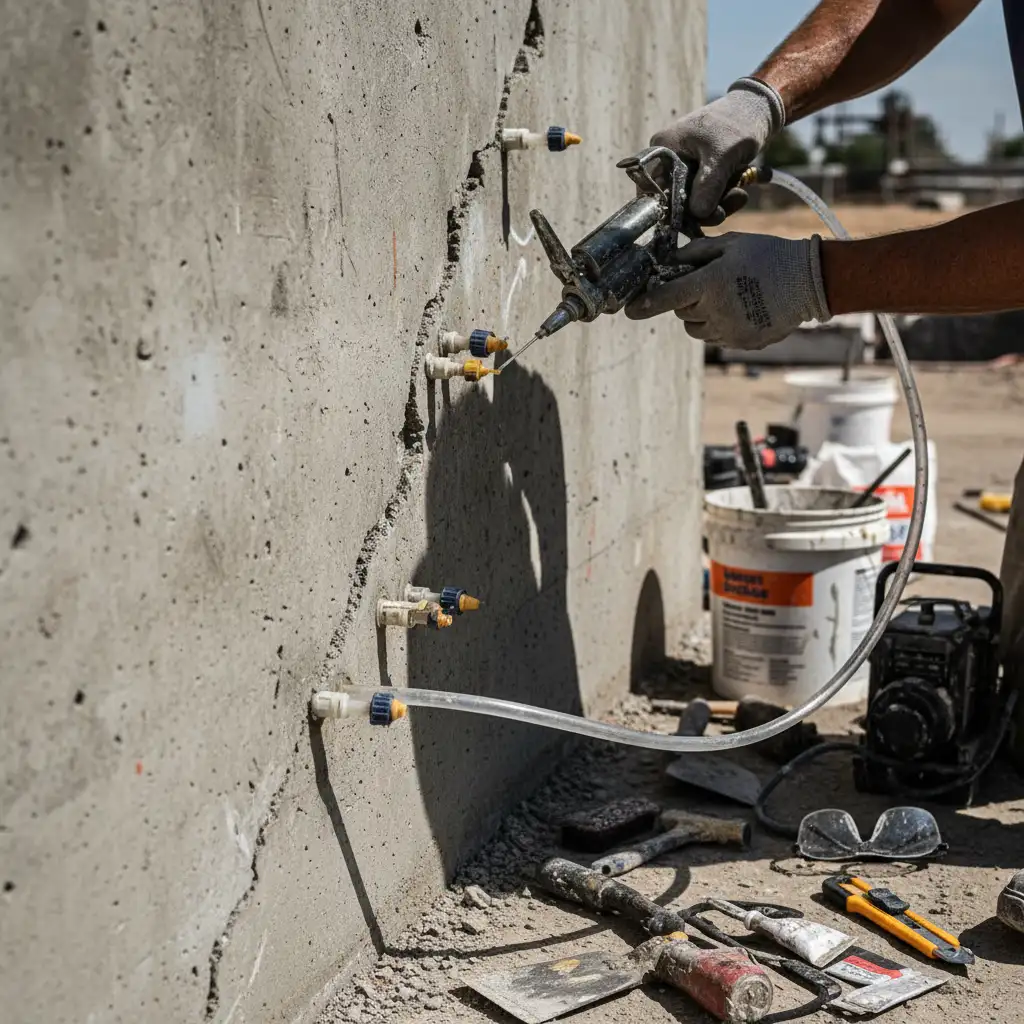
Our team in action — foundation-repair professionals serving Cedar Park
Foundation Repair Methods We Use in Round Rock and Cedar Park
Steel Push Pier Systems
Steel push piers are hydraulically driven through the existing foundation into deep, load-bearing strata. In Cedar Park and Round Rock, this typically means reaching 18–28 feet to penetrate through the expansive Taylor Clay into the Austin Chalk or Edwards Limestone bedrock below. This method is ideal for significant settlement in heavier structures and provides a permanent, engineered solution. Learn About Structural Foundation Repair
Helical Pier Installation
Helical piers feature screw-like steel blades that are rotated into the soil, providing both compression and tension resistance. They are well-suited for lighter residential structures, new construction underpinning, and locations near the creek drainage corridors in Cat Hollow and Behrens Ranch where helical anchors can resist hydrostatic uplift forces. Home Foundation Repair Options
Slab Foam Lifting (PolyUrethane Lifting)
For interior slab voids and minor settlement of 1 inch or less, high-density polyurethane foam is injected beneath the slab through small drilled holes. The foam expands to fill voids, stabilize loose soil, and gently lift settled sections. This method is minimally invasive and cures within 15 minutes, making it popular for commercial properties in the La Frontera and Tech Ridge corridors where business downtime is costly. Concrete Foundation Repair
Pressed Concrete Pilings
Pre-cast concrete cylinders hydraulically pressed into the soil offer a cost-effective option for lighter residential structures. While less favored in the deepest clay profiles of central Williamson County, they remain a practical method for specific soil profiles found in parts of Jollyville and Wells Branch.
Crawl Space Repair and Pier Shimming
For older pier-and-beam homes in Anderson Mill, Great Hills, and pre-1970 sections of Round Rock, we repair or replace deteriorated wood beams, install new concrete piers, and add moisture barriers and ventilation improvements to prevent future damage. Crawl Space Repair Services
Ready for Foundation Repair Methods? Get Your Free Estimate Today.
Round Rock Foundation Repair Group serves Cedar Park and the surrounding area — we’ll be on-site within 24 hours.
📞 Call (512) 220-3502Foundation Repair Methods Cost in Cedar Park and Round Rock, TX
Understanding the cost of foundation repair in Cedar Park requires recognizing that no two jobs are identical. Below are general ranges based on our regional experience:
- Foundation Inspection: $200–$500 for a comprehensive evaluation with written report and elevation survey
- Foam Slab Lifting: $800–$3,500 depending on the number of injection points and volume of foam required
- Pressed Concrete Pilings (per pier): $350–$500 per pier; average residential jobs require 8–20 piers, totaling $3,500–$12,000
- Steel Push Pier Installation (per pier): $1,200–$1,800 per pier; typical Cedar Park homes require 10–20 piers, ranging from $12,000–$36,000 for full perimeter repair
- Helical Pier Installation (per pier): $1,400–$2,000 per pier depending on depth and load requirements
- Crawl Space Pier-and-Beam Repair: $3,000–$15,000 depending on the number of piers, beam replacement scope, and moisture barrier installation
- Commercial Foundation Repair: $15,000–$100,000+ depending on building size, load conditions, and method required
Cedar Park-specific cost factors include the depth required to reach stable bearing strata (deeper than many other Texas metro areas due to thick Taylor Clay profiles), permit fees through the City of Cedar Park or Williamson County, and potential access challenges in densely landscaped properties in Avery Ranch or Mayfield Ranch. Many homeowners ask about Foundation Repair Methods in Round Rock cost — we provide detailed written estimates at no obligation after inspection.
Cedar Park and Round Rock Neighborhoods We Serve
Avery Ranch (Austin/Cedar Park, TX 78717)
Built primarily between 2000 and 2015, Avery Ranch homes sit on post-tension slabs over some of the deepest expansive clay profiles in Williamson County. The golf-course-adjacent properties face additional irrigation-related moisture variability that contributes to differential settlement. Find Foundation Repair Near Me in Avery Ranch
Teravista (Round Rock, TX)
This master-planned community developed in the early 2000s experienced concentrated foundation claims following the 2011 drought. Homes in the lower elevation sections near the Teravista golf course drainage areas are particularly prone to seasonal movement.
Forest Creek (Round Rock, TX 78664)
Forest Creek homes built in the 1990s are now entering the 25–30-year window when deferred maintenance and accumulated soil movement frequently manifest as significant foundation problems, particularly stair-step brick cracking and interior door misalignment.
Cat Hollow / Brushy Creek (TX 78681)
Properties near the Brushy Creek greenbelt face both drought-related shrinkage and episodic creek flooding events that saturate soils and create hydrostatic pressure, requiring repair methods that address both settlement and uplift resistance.
Anderson Mill (Austin, TX 78750)
One of the older subdivisions bordering Cedar Park, Anderson Mill contains many pier-and-beam homes from the 1970s and early 1980s where crawl space moisture issues and aging wood infrastructure are the primary repair drivers. Crawl Space Repair for Anderson Mill Homes
Foundation Maintenance Tips for Cedar Park Homeowners
- Maintain consistent soil moisture year-round. During Cedar Park’s summer drought periods (June–September), run a soaker hose 18–24 inches from your foundation perimeter 2–3 times per week to prevent extreme clay shrinkage.
- Grade your yard away from the foundation. Maintain a minimum 6-inch drop over the first 10 feet from the foundation to direct rainfall away from the perimeter beam — especially important during Central Texas’s intense spring storm season.
- Clean and extend gutters and downspouts. Discharge downspouts at least 5 feet from the foundation; consider underground drainage pipes in neighborhoods with tight lot spacing like Sendero Springs or Paloma Lake.
- Monitor and manage tree root zones. Keep large Live Oaks and Cedar Elms at least 15–20 feet from the foundation; consider root barriers for existing trees closer than 10 feet.
- Inspect your foundation twice annually. Walk the full perimeter in spring and fall, photographing any new cracks or soil gaps. The fall inspection is especially important after Cedar Park’s dry summer season.
- Adjust irrigation zones seasonally. Avoid running sprinklers directly against the foundation or allowing ponding near the perimeter — over-watering is as damaging as drought in Taylor Clay soils.
- Address plumbing leaks immediately. A leaking water or sewer line beneath the slab can cause localized soil saturation and dramatic differential settlement within weeks in Cedar Park’s reactive soils.
Why Choose Round Rock Foundation Repair Group in Cedar Park, TX
Round Rock Foundation Repair Group is a locally rooted company built specifically to serve the foundation repair needs of the Round Rock, Cedar Park, Georgetown, and greater Williamson County communities. We are not a national franchise — we are specialists who work exclusively in Central Texas and understand the specific interplay between Williamson County’s Taylor Clay soils, the regional drought-flood climate cycle, and the construction methods used in every decade of the area’s development.
Our inspectors have evaluated foundations across every major subdivision in Cedar Park and Round Rock, from Avery Ranch post-tension slabs to Anderson Mill pier-and-beam homes. We use precision digital elevation instruments — not simple water levels — to produce accurate, reproducible measurements that allow us to track movement over time and verify repair effectiveness. Every repair recommendation is made based on engineering analysis, not a sales quota.
We serve all Cedar Park neighborhoods and maintain rapid response capacity throughout our full service area, including Pflugerville, Georgetown, Austin, Brushy Creek, Wells Branch, and Jollyville. Call (512) 220-3502 or use our online form to request your inspection today.
Cedar Park Foundation Repair Methods in Round RockFrequently Asked Questions About Foundation Repair Methods in Cedar Park, TX
How much does foundation repair cost in Cedar Park, TX?
Foundation repair costs in Cedar Park typically range from $3,500 for minor foam lifting or a small number of pressed piers to $35,000 or more for full-perimeter steel pier installation on a larger home. The primary cost driver in Cedar Park is the depth required to reach stable bearing strata — our deep Taylor Clay profiles often require piers at 20–28 feet, which is deeper than many other Texas regions and affects per-pier cost. A detailed written estimate is provided after your inspection with no obligation.
How long does foundation repair take in Cedar Park?
Most residential foundation repair projects in Cedar Park are completed in 1 to 3 days once work begins. Larger perimeter pier jobs or commercial projects may take 3–5 days. Permit processing through the City of Cedar Park or Williamson County typically adds 2–5 business days before work can begin. We provide a realistic timeline with your written estimate.
Will my foundation repair fix the cracks in my walls?
Foundation repair stabilizes and, where possible, lifts the structure back toward its original elevation. This can reduce or close cosmetic cracks in drywall, brick mortar, and tile. However, it does not automatically repair existing cracks — those require separate cosmetic repairs after the foundation has been stabilized and confirmed stable, typically 30–90 days post-repair.
Is Cedar Park’s soil really that different from other Texas cities?
Yes, significantly. The Taylor Clay formation that underlies much of Cedar Park and Round Rock has one of the highest plasticity index values of any soil in the state — meaning it swells and shrinks more dramatically with moisture changes than soils in, for example, Houston’s Beaumont Clay or Dallas’s less reactive northern profiles. The 2011 drought demonstrated this viscerally: properties that had been stable for 20 years experienced sudden 2-inch drops in a single summer.
Do I need a permit for foundation repair in Cedar Park?
In most cases, yes — pier installation and structural foundation work require a permit from the City of Cedar Park or Williamson County depending on jurisdiction. Minor cosmetic crack repair and foam lifting of non-structural interior slabs may not require a permit. Round Rock Foundation Repair Group handles all permitting as part of our project process.
Can I sell my home after foundation repair in Cedar Park?
Yes. Texas law requires disclosure of known foundation issues, but a properly documented and repaired foundation — with a written completion report and pier location diagram — is routinely accepted by buyers, lenders, and title companies throughout Williamson County. Many buyers and their agents view a professionally repaired and documented foundation more favorably than one with signs of movement and no repair history.
How do I know if my foundation problem is active or stable?
Active movement is characterized by cracks that are visibly growing, doors or windows that have recently changed behavior, or floor elevations that are measurably different from month to month. Our inspection process includes a baseline elevation survey that, when compared to a follow-up reading 30–60 days later, can definitively determine whether movement is ongoing. This two-visit diagnostic is particularly valuable for Cedar Park properties where seasonal soil moisture changes can mimic active structural failure.
What is the difference between slab foundation repair and pier-and-beam repair in Cedar Park?
Slab foundations — which dominate Cedar Park homes built after 1975 — are repaired primarily through underpinning (push piers, helical piers, or pressed pilings) or foam lifting for minor void filling. Pier-and-beam foundations — more common in older Anderson Mill and pre-1970 Round Rock homes — are repaired by replacing or reinforcing the wood beams, shimming or replacing the concrete block or wood piers, and addressing moisture and ventilation in the crawl space. Learn More About Crawl Space and Pier-and-Beam Repair
Get Expert Foundation Repair in Cedar Park, TX Today
If your home or commercial property is showing signs of foundation movement — whether you are in Avery Ranch, Forest Creek, Sendero Springs, or anywhere across the Cedar Park and Round Rock area — don’t wait. Foundation problems in Central Texas’s reactive clay soils rarely resolve on their own and typically worsen with each drought and rain cycle. Round Rock Foundation Repair Group provides honest, engineering-based assessments and proven repair solutions tailored to Williamson County’s unique soil conditions.
Call us now at (512) 220-3502 to speak with a foundation specialist or to schedule your comprehensive inspection. You can also Contact Us Online to request a callback at your convenience. We serve Cedar Park, Round Rock, Georgetown, Austin, Pflugerville, Brushy Creek, and all surrounding communities — with the local knowledge your foundation deserves.