Slab Foundation Repair in Cedar Park, TX
Fast, Reliable Slab Foundation Repair in Cedar Park, TX — Licensed & Insured
Need slab foundation repair in Cedar Park, TX? Round Rock Foundation Repair Group fixes settled slabs on clay soils. Call (512) 220-3502 today.
- Licensed & Insured
- Locally Owned & Operated
- Free Inspection & Estimate
Request Your
Free EstimateSlab foundation repair is the process of stabilizing, lifting, and restoring concrete slab foundations that have shifted, cracked, or settled due to soil movement, water intrusion, or structural stress. In Cedar Park, TX, this service is especially critical given the region’s expansive clay soils and dramatic seasonal moisture swings that put constant pressure on residential and commercial foundations throughout the year.
At Round Rock Foundation Repair Group, we specialize in diagnosing and correcting slab foundation problems across Cedar Park and the greater Austin metro area. Our team understands the unique geotechnical conditions of Williamson County — from the shrink-swell behavior of Taylor Black Clay to the limestone shelf transitions found in newer developments along US-183A. Whether you own a 1990s tract home near Twin Creeks or a newer build in Brushy Creek Ranch, we deliver lasting foundation solutions tailored to Cedar Park’s specific soil and climate profile.
Call us today at (512) 220-3502 for a professional foundation inspection.
Understanding Slab Foundation Repair
A concrete slab foundation is a single, continuous layer of reinforced concrete poured directly onto prepared ground to serve as both the floor and structural base of a building. First popularized in post-World War II American residential construction, slab foundations became the dominant building method across Texas throughout the 1960s and accelerated dramatically during the suburban boom of the 1980s and 1990s. Today, the overwhelming majority of homes built in Cedar Park — which incorporated as a city in 1973 and experienced its most explosive growth between 1995 and 2015 — rest on post-tensioned or conventionally reinforced concrete slabs.
Slab foundations are cost-effective and well-suited to flat terrain, but they are highly vulnerable to differential settlement — the uneven sinking or heaving of one portion of the slab relative to another. When the soil beneath a slab expands unevenly, contracts after drought, or erodes due to plumbing leaks, sections of the concrete can crack, tilt, or separate. Left unaddressed, differential settlement leads to sticking doors, cracked drywall, misaligned windows, and ultimately structural compromise.
Slab foundation repair corrects these problems by inserting support piers beneath the settled portions of the foundation, hydraulically lifting the slab back toward its original elevation, and stabilizing it against future movement. Depending on the severity of the damage and the underlying cause, repair may also include mudjacking, polyurethane foam injection, or drainage correction to eliminate the source of soil instability.
In the Cedar Park area, slab foundation issues affect single-family homes, townhomes, retail strip centers, office buildings, and multi-family complexes alike. Communities platted during the rapid growth era of the late 1990s and early 2000s — such as those in the Forest Oaks, Buttercup Creek, and Avery Ranch neighborhoods — frequently present foundation repair needs as their slabs age through their first two to three decades and encounter cumulative soil movement. Understanding how and why slabs fail in this specific geography is the first step toward protecting your investment.
Signs You Need Slab Foundation Repair in Cedar Park
Structural Warning Signs
- Diagonal cracks running from the corners of door frames or window openings at 45-degree angles
- Horizontal or stair-step cracks in brick veneer, particularly on the exterior walls facing north or east
- Visible gaps between the top of interior walls and the ceiling plane exceeding ¼ inch
- Separation between the chimney or garage addition and the main structure of the home
Interior Observable Symptoms
- Doors or windows that stick, drag, or no longer latch properly — especially after seasonal rainfall changes
- Floors that feel noticeably unlevel underfoot or show visible slope when a marble is placed on them
- Cracks in ceramic tile floors, especially running diagonally across grout lines
- Drywall cracks that reappear after being patched and painted
Exterior Warning Signs
- Gaps appearing between the slab edge and soil or landscaping mulch beds
- Visible slab cracking on the garage floor or exposed perimeter beam
- Porch or front stoop pulling away from the main foundation by more than ½ inch
Urgency Indicators
If you observe multiple signs simultaneously, if cracks are widening over a period of weeks, or if you hear popping or cracking sounds from your walls or floors, contact Round Rock Foundation Repair Group immediately at (512) 220-3502. Rapid progression indicates active soil movement and requires prompt professional evaluation.
Our Slab Foundation Repair Process in Cedar Park
Initial Consultation and Site Review (Day 1)
Our process begins with a phone consultation to understand your concerns, followed by scheduling an on-site visit. We gather basic information about your home’s construction year, any known plumbing history, and visible symptoms you’ve observed. For Cedar Park properties, we also note proximity to drainage easements, tree canopy coverage, and whether the home is in an area with known expansive clay soil concentrations.
Comprehensive Foundation Inspection (Day 1–2)
Our inspector performs a full elevation survey of your slab using a Zip Level Pro-2000 precision altimeter, recording measurements at a minimum of every 8 feet around the perimeter and across interior load-bearing points. This produces a topographic map of your slab’s current elevation profile, identifying high and low zones. We also examine all visible cracks, assess plumbing penetrations, and evaluate exterior drainage grades. In Cedar Park, we pay special attention to the north and east elevations where clay soil moisture tends to accumulate.
Soil and Cause Analysis (Days 2–3)
We review available USDA Web Soil Survey data for your specific parcel, cross-referencing soil series with local geotechnical knowledge. If a plumbing leak is suspected, we recommend a hydrostatic pressure test of your under-slab plumbing before proceeding — a critical step for Cedar Park homes built before 2005 with copper drain lines.
Custom Repair Plan and Proposal (Days 3–5)
Based on inspection findings, we prepare a written repair plan specifying pier locations, depths, method, and projected lift amounts. We explain the plan clearly and answer all questions before any work is authorized.
Site Preparation and Pier Installation (Days 1–3 of Work)
Our crew prepares access points, excavates pier locations typically 24 inches in diameter and up to 20–22 feet deep to reach stable limestone or dense clay bearing strata common beneath Cedar Park’s soil profile, then installs piers according to the engineered plan.
Hydraulic Lifting and Leveling (Day 2–3 of Work)
Using synchronized hydraulic jacks placed on each installed pier, we carefully and gradually lift the settled slab sections. Lifting is performed incrementally — typically in ¼-inch increments — to avoid over-stressing the existing concrete structure.
Final Inspection and Site Restoration (Day 3–4 of Work)
We conduct a post-repair elevation survey to confirm target grades have been achieved, backfill excavations, restore landscaping and concrete flatwork disturbed during access, and provide a written completion report.
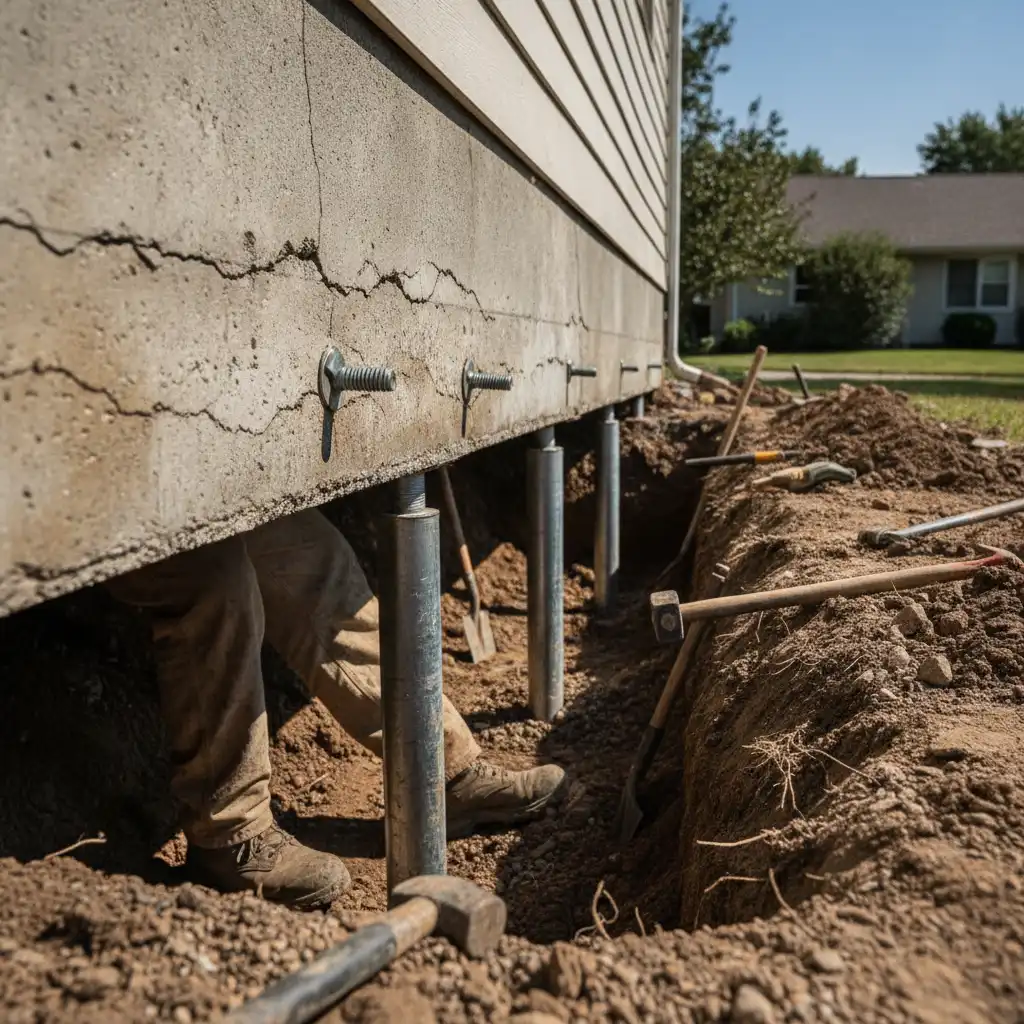
Our team in action — foundation-repair professionals serving Cedar Park
Slab Foundation Repair Methods We Use in Cedar Park
Steel Push Piers
Steel push piers are hydraulically driven sections of galvanized or epoxy-coated steel pipe installed beneath the foundation perimeter until they reach competent bearing strata. In Cedar Park, this typically means reaching the Austin Chalk limestone formation at depths between 16 and 24 feet. Push piers are best suited for settled foundations experiencing downward movement and are our most frequently used method in the Buttercup Creek and Forest Oaks areas.
Helical Piers
Helical piers feature steel shaft sections with welded helical plates that are rotated into the ground using hydraulic torque motors. They are ideal for interior pier installations where access is limited and for lighter structures such as townhomes and single-story homes. Helical piers are also used when soil conditions prevent push pier installation, such as in areas near Cedar Park’s eastern boundaries where fill soils are present.
Polyurethane Foam Injection
For minor slab voids and shallow settlement of 1 inch or less, high-density polyurethane foam is injected through small drilled holes in the slab. The expanding foam fills voids, re-compacts loose soils, and lifts the slab. This minimally invasive method is particularly effective for garage floors, interior slab sections, and driveways in Cedar Park’s newer subdivisions along the US-183A corridor.
Mudjacking (Slabjacking)
Mudjacking pumps a slurry of cement, soil, and water beneath the slab to fill voids and restore support. While less durable than foam injection for long-term applications, mudjacking is a cost-effective option for concrete flatwork, sidewalks, and pool decks in Cedar Park residential communities.
Drainage Correction and Root Barrier Installation
Because many Cedar Park foundation problems originate from poor drainage or live oak root intrusion, we frequently pair structural repairs with site drainage improvements and the installation of root barriers along foundation perimeters to prevent recurrence.
Ready for Slab Foundation Repair? Get Your Free Estimate Today.
Round Rock Foundation Repair Group serves Cedar Park and the surrounding area — we’ll be on-site within 24 hours.
📞 Call (512) 220-3502Slab Foundation Repair Cost in Cedar Park, TX
The cost of slab foundation repair in Cedar Park varies based on the severity of movement, the number of piers required, the chosen repair method, and site accessibility. Below are general ranges based on current Central Texas market conditions:
- Steel push pier installation: $1,400–$1,800 per pier. A typical Cedar Park single-family home requiring perimeter stabilization may need 8 to 16 piers, placing total project costs in the range of $11,200–$28,800.
- Helical pier installation: $1,500–$2,000 per pier, with similar per-home totals depending on scope.
- Polyurethane foam injection: $800–$2,500 for minor void filling and shallow slab lifting on garage floors or flatwork.
- Mudjacking: $500–$1,500 for concrete flatwork and walkways.
- Complete foundation restoration (severe differential settlement): $18,000–$45,000 for larger homes or cases requiring both perimeter and interior pier systems.
Cedar Park-specific pricing factors include soil depth to bearing strata (deeper limestone requires more pier segments and increases cost), tree root removal and root barrier installation ($300–$800 additional), pre-repair plumbing testing ($250–$500), and post-repair drainage grading. Homes in areas like Avery Ranch or Twin Creeks with dense landscaping and limited access around the foundation perimeter may incur additional mobilization costs.
We provide detailed written estimates at no obligation following our inspection. Contact us at (512) 220-3502 to schedule your evaluation. Schedule a Free Foundation Inspection
Cedar Park Neighborhoods We Serve
Buttercup Creek
One of Cedar Park’s most established communities, Buttercup Creek features homes primarily built between 1985 and 2000. These older slabs, constructed before post-tensioning became standard in the market, are particularly vulnerable to differential settlement on the heavy Houston Black Clay soils that dominate this area. Homeowners here frequently encounter perimeter beam cracking and interior floor slopes.
Twin Creeks
Twin Creeks is a master-planned community built largely between 1998 and 2008 along Brushy Creek’s upper watershed. The community’s proximity to creek drainage corridors means seasonal moisture variations are amplified, and mature live oaks throughout the neighborhood contribute to localized soil desiccation near foundations.
Avery Ranch
Straddling the Cedar Park–Austin border along Avery Ranch Boulevard, this large community features homes built from 2001 through 2015. Altered drainage patterns from golf course and commercial development along the community’s southern edge have directed seasonal stormwater toward residential foundations, contributing to heave-related slab damage in lower-elevation sections.
Forest Oaks
Forest Oaks, located near RM 1431 and Lakeline Boulevard, contains 1990s-era homes on post-tensioned slabs. The area’s dense tree canopy — predominantly live oak and cedar elm — creates challenging moisture management conditions. We regularly perform pier installations and root barrier work here. View All Cedar Park Service Areas
Foundation Maintenance Tips for Cedar Park Homeowners
- Maintain consistent soil moisture year-round. Use a soaker hose system placed 12–18 inches from your foundation perimeter during Cedar Park’s dry summers and fall drought periods to prevent the clay soil shrinkage that causes settlement.
- Ensure positive drainage away from your slab. All soil, mulch, and hardscape within 10 feet of your foundation should slope away at a minimum grade of 1 inch per foot to prevent moisture pooling against your perimeter beam.
- Clean gutters and extend downspouts. Downspout discharge should terminate at least 4–6 feet from your foundation. Cedar Park’s intense storm events can deliver 2–3 inches of rain in under an hour, overwhelming undersized diverters.
- Manage tree placement carefully. Plant large trees, especially live oaks, no closer to your foundation than the tree’s expected mature canopy radius — typically 20–30 feet for mature live oaks common in Cedar Park.
- Monitor and repair plumbing promptly. Schedule a hydrostatic plumbing test every 5–7 years for homes built before 2005 with copper under-slab drain lines.
- Avoid overwatering foundation plantings. Irrigation beds directly against the foundation can over-saturate clay soils and cause localized heave — the opposite of settlement but equally damaging.
- Inspect your foundation annually. Walk your perimeter each spring after Cedar Park’s rainy season and note any new cracks, gaps, or soil separation for early intervention.
Why Choose Round Rock Foundation Repair Group for Cedar Park Slab Repairs
Round Rock Foundation Repair Group is a locally rooted foundation repair company serving Cedar Park and the surrounding Central Texas region. Our team has extensive hands-on experience with the specific soil conditions, drainage challenges, and construction eras that define the Cedar Park housing market — from aging 1980s slabs in Buttercup Creek to post-tensioned foundations in Cedar Park’s newest growth corridors near 183A Toll.
We use professional-grade equipment, including precision laser elevation instruments and hydraulic pier driving systems engineered for the deep clay profiles of Williamson County. Every repair plan we produce is based on site-specific data, not one-size-fits-all estimates.
Our service area covers Cedar Park, Round Rock, Georgetown, Austin, Pflugerville, Brushy Creek, and surrounding communities, meaning we understand how regional conditions vary even within a short drive. We are committed to transparent pricing, clear communication, and repair work that addresses root causes — not just visible symptoms.
Call (512) 220-3502 or contact us online to schedule your Cedar Park foundation inspection today.
Frequently Asked Questions: Slab Foundation Repair in Cedar Park, TX
How much does slab foundation repair cost in Cedar Park, TX?
Most Cedar Park slab foundation repair projects range from $8,000 to $30,000 depending on the number of piers needed, the depth to bearing strata, and whether drainage corrections are required. Smaller repairs involving polyurethane foam injection may cost $800–$2,500. We provide free written estimates following a professional inspection.
How long does slab foundation repair take in Cedar Park?
The inspection and proposal phase typically takes 3–5 business days. Active repair work for a standard single-family home in Cedar Park generally requires 1–3 days on-site, depending on the number of piers and site conditions. Larger or more complex projects may take 4–5 days.
What causes slab foundation problems specifically in Cedar Park?
Cedar Park’s primary foundation challenge is the expansive Houston Black Clay and Austin Clay soils that shrink and swell dramatically with moisture changes. The area’s irregular rainfall — including severe drought cycles like 2011 and intense storm seasons — drives this movement. Root intrusion from the area’s abundant live oaks and aging under-slab plumbing are secondary but significant contributors.
Do I need to move out during foundation repair?
In most cases, no. Slab foundation repairs using exterior pier installation allow homeowners to remain in the property during the work. We do ask that homeowners remove fragile items from walls and shelves before lifting begins, as minor vibration from hydraulic jacking can disturb wall hangings and décor.
Will my homeowner’s insurance cover slab foundation repair in Cedar Park?
Standard Texas homeowner’s insurance policies generally exclude foundation repair caused by gradual soil movement or settling — which covers the majority of Cedar Park foundation issues. However, if the damage is caused by a sudden covered event, such as a plumbing leak, a portion of costs may be covered. We can provide detailed repair documentation to assist with any insurance claim you choose to file.
How do I know if my Cedar Park home needs foundation repair or just cosmetic patching?
Cosmetic cracks — hairline cracks less than 1/16 inch wide that do not grow over time — can often be patched without structural intervention. However, cracks wider than ¼ inch, diagonal cracks at door and window corners, sticking doors, or unlevel floors indicate structural movement that requires professional pier repair, not surface patching. A professional elevation survey is the definitive way to determine the extent of movement.
Does Round Rock Foundation Repair Group serve all of Cedar Park, including areas near 183A Toll?
Yes. We serve all of Cedar Park, including properties along the 183A Toll corridor, RM 1431, Whitestone Boulevard, and all residential communities from Buttercup Creek to Avery Ranch and Twin Creeks. We also serve neighboring communities including Round Rock, Georgetown, Austin, Pflugerville, Brushy Creek, Jollyville, Wells Branch, and Anderson Mill. View Our Full Service Area
What is the difference between slab foundation repair and foundation patching?
Foundation patching fills surface cracks in the concrete with epoxy or polymer compounds and addresses only visible cosmetic damage. Slab foundation repair addresses the structural cause of movement — soil instability — by installing deep piers that transfer the load of the structure to stable bearing strata well below the active clay zone. Patching without structural repair allows movement to continue and cracks to reappear. Learn About Foundation Patching
Schedule Your Cedar Park Slab Foundation Inspection Today
Don’t let shifting soils and Cedar Park’s challenging clay conditions put your home or business at risk. Round Rock Foundation Repair Group provides professional slab foundation inspections, honest assessments, and lasting repair solutions tailored specifically to Cedar Park’s soil profile and climate.
Whether you’re noticing your first diagonal crack in the drywall or dealing with severe floor slopes after years of deferred attention, our team is ready to help. We serve all Cedar Park neighborhoods, including Buttercup Creek, Twin Creeks, Avery Ranch, and Forest Oaks, as well as the broader Round Rock and Austin metro area.
Call us now at (512) 220-3502 to speak with a foundation specialist or submit a contact form to request a callback. Protect your foundation — and your investment — with Cedar Park’s trusted slab repair team.