Concrete Foundation Repair in Cedar Park, TX
Fast, Reliable Concrete Foundation Repair in Cedar Park, TX — Licensed & Insured
Need concrete foundation repair in Cedar Park, TX? Round Rock Foundation Repair Group fixes settled slabs, cracks & more. Call (512) 220-3502 for a free estimate.
- Licensed & Insured
- Locally Owned & Operated
- Free Inspection & Estimate
Request Your
Free EstimateConcrete foundation repair is the process of diagnosing, stabilizing, and restoring a home or commercial building’s concrete foundation to its original structural integrity. In Cedar Park, TX, the expansive clay soils of the Texas Hill Country fringe create unique stress conditions that accelerate foundation movement, cracking, and settlement far faster than in many other regions of the country.
Round Rock Foundation Repair Group delivers professional concrete foundation repair services throughout Cedar Park and the greater North Austin corridor. Our crews understand the specific behavior of the dark, shrink-swell Vertisol clay soils that underlie much of Cedar Park’s rapid-growth subdivisions, from Buttercup Creek to Twin Creeks. Whether you are dealing with hairline cracks in a newly built slab or significant settlement in a 1990s pier-and-beam home, we bring the diagnostic tools, engineered repair methods, and local knowledge needed to protect your investment.
Call us today at (512) 220-3502 to schedule a foundation inspection.
Understanding Concrete Foundation Repair in Cedar Park, TX
A concrete foundation is the continuous structural interface between a building and the earth beneath it. In Cedar Park and the broader Central Texas region, the overwhelming majority of residential construction built after the 1970s uses a post-tensioned or conventionally reinforced concrete slab-on-grade. Older homes — particularly those constructed before Cedar Park’s incorporation as a city in 1973 — sometimes feature pier-and-beam systems that combine a crawl space frame with concrete piers driven or poured into the underlying soil.
Concrete foundation repair encompasses a wide spectrum of interventions. At the minor end, foundation patching fills surface cracks and restores the concrete’s weathering resistance. At the major end, structural foundation repair involves installing steel push piers, helical piers, or concrete pressed pilings beneath a settled slab to re-level the structure and transfer load to competent bearing strata deeper in the earth — often 15 to 25 feet below grade in the Cedar Park area.
Historically, Central Texas homeowners began experiencing dramatic increases in foundation claims during the severe drought cycles of the 1950s and again in the 1980s. As Cedar Park’s population exploded from roughly 5,000 residents in 1990 to more than 80,000 today, tens of thousands of new slabs were poured on minimally conditioned clay lots across master-planned communities like Walsh Ranch, Anderson Mill West, and Cypress Canyon. Many of those slabs are now entering their first or second major maintenance window, making foundation repair one of the most commonly needed home services in the 78613 and 78641 zip codes.
Foundation repair is not a cosmetic service — it is a structural intervention governed by engineering principles. Repairs are typically designed to meet or exceed the International Residential Code (IRC) and Texas-specific guidelines published by the Texas Section of the American Society of Civil Engineers (ASCE). Round Rock Foundation Repair Group coordinates with licensed structural engineers when projects require stamped repair plans, ensuring every job meets the standards required for resale, refinancing, or commercial permitting in Williamson County.
Learn more about our Foundation Inspection services
Why Concrete Foundation Repair Is Needed in Cedar Park, TX
Expansive Clay Soils
The single most significant driver of foundation damage in Cedar Park is the presence of Austin Chalk–overlying Vertisol clay, particularly the Houston Black and Heiden series soils that dominate the flatlands west of US-183 and north of Brushy Creek. These soils have a Plasticity Index (PI) that routinely measures between 35 and 55 — extremely high by engineering standards. A PI above 25 is generally considered problematic for foundations. When these clays absorb moisture, they can swell volumetrically by as much as 10 to 15 percent, exerting upward pressures measured in thousands of pounds per square foot. When they dry out, they shrink by the same margin, creating voids beneath slab edges that lead to differential settlement.
Cedar Park’s Boom-Era Construction
Cedar Park experienced its most dramatic residential growth between 1998 and 2008 and again from 2012 to 2022. During both periods, competitive construction timelines sometimes meant lots were not allowed adequate moisture conditioning before slabs were poured. Subdivisions such as Buttercup Creek, Whitestone, and Riviera Springs — developed heavily in the early 2000s — now show elevated rates of edge lift and interior slab settlement, as the original soil moisture equilibrium established at time of construction has shifted due to landscaping, irrigation, and prolonged drought.
Drought and Weather Extremes
Cedar Park averages only about 32 to 35 inches of rainfall per year, but that rainfall arrives unevenly. The historic drought of 2011 — when Cedar Park recorded less than 14 inches of precipitation for the full year and temperatures exceeded 100°F for more than 90 consecutive days — caused widespread and sudden foundation movement across Williamson County. Many homeowners who had no prior foundation issues discovered sticking doors, diagonal wall cracks, and visible slab gaps within a single summer season. The February 2021 Winter Storm Uri then introduced the opposite extreme: frozen and burst pipes saturated soils unevenly beneath hundreds of Cedar Park slabs, triggering a new wave of heave-related damage in neighborhoods like Twin Creeks and Anderson Mill West.
Tree Root Moisture Competition
Cedar Park’s mature live oak and cedar elm populations — particularly in older sections of the city along Lakeline Boulevard and within the Brushy Creek greenbelt corridor — draw significant subsurface moisture from the soil, accelerating differential drying beneath slabs on the tree-side of a home. Root systems from live oaks can extend two to three times the canopy diameter, often reaching well under adjacent foundations.
Plumbing Leaks
The same aggressive soil chemistry that attacks concrete can corrode copper and galvanized steel plumbing. Slab leaks are a contributing factor in a significant percentage of Cedar Park foundation repair cases, as escaping water selectively saturates one zone of the subbase while adjacent areas remain dry, creating the differential moisture conditions that drive uneven heave.
Signs You Need Concrete Foundation Repair in Cedar Park
Interior Warning Signs
- Diagonal cracks running from the corners of door frames or window openings at a 45-degree angle
- Doors and windows that stick, bind, or no longer latch properly — especially after a dry summer season
- Visible gaps between interior walls and the ceiling or floor
- Uneven or sloping floors detectable by a marble or level, with deviations greater than 1 inch over 20 feet
- Cracks in ceramic tile floors, particularly running in straight lines across grout joints
Exterior Warning Signs
- Stair-step cracking in brick veneer mortar joints along exterior walls
- Visible gaps between the brick veneer and window or door trim
- Cracks in the concrete slab visible at the garage floor, especially near the perimeter beam
- Separation between the foundation and attached structures such as porches, patios, or driveways
Urgent Red Flags
- Cracks wider than 1/4 inch in the foundation itself
- Any crack that is actively widening — mark the ends with a pencil and date them to monitor growth
- Water intrusion through the slab or foundation wall following heavy rain events
- Visible bowing of basement or retaining walls (common in split-level homes near Brushy Creek)
Schedule a professional foundation inspection in Cedar Park
Our Concrete Foundation Repair Process in Cedar Park
Initial Consultation and Scheduling (Day 1)
Contact Round Rock Foundation Repair Group at (512) 220-3502. We gather basic information about your property, including construction year, zip code, and the symptoms you have observed. For Cedar Park homes in flood-prone zones near Brushy Creek, we also note proximity to drainage channels that can influence soil saturation patterns.
On-Site Foundation Inspection (Day 2–5)
A trained inspector visits the property and performs a comprehensive evaluation using optical leveling equipment, crack mapping documentation, moisture probe readings at multiple perimeter locations, and a review of the original slab thickness documentation if available. For Cedar Park homes built between 1995 and 2010, we specifically evaluate post-tension cable locations before recommending any pier placement to avoid cutting stressed tendons.
Engineering Review and Repair Proposal (Days 5–10)
Our findings are compiled into a written repair proposal with a site plan showing recommended pier locations, estimated lift amounts, and method justification. When Williamson County permits are required, we coordinate with a licensed structural engineer for stamped drawings.
Site Preparation and Access (Repair Day 1)
Our crew protects landscaping, removes slab access panels where necessary, and locates all underground utilities through Texas 811 dial-before-you-dig notification — critical in Cedar Park’s densely plumbed new construction zones.
Pier Installation or Slab Repair (Repair Days 1–3)
Depending on the method selected, steel push piers are hydraulically driven to refusal depth (typically 18–25 feet in Cedar Park’s geology), helical piers are torqued to target capacity, or mudjacking/polyurethane foam is injected beneath lifted slab sections. Most residential projects in Cedar Park are completed within one to three days.
Lifting, Leveling, and Verification (Repair Day 2–3)
Once piers are at bearing depth, hydraulic jacks simultaneously lift the foundation to the target elevation. Interior floor levels are verified with digital levels before the lift is locked off.
Site Restoration and Final Walkthrough
Excavations are backfilled and compacted, concrete access caps are patched, and a final walkthrough documents pre- and post-repair elevations. We also provide a written maintenance plan specific to your Cedar Park home’s soil zone and irrigation setup.
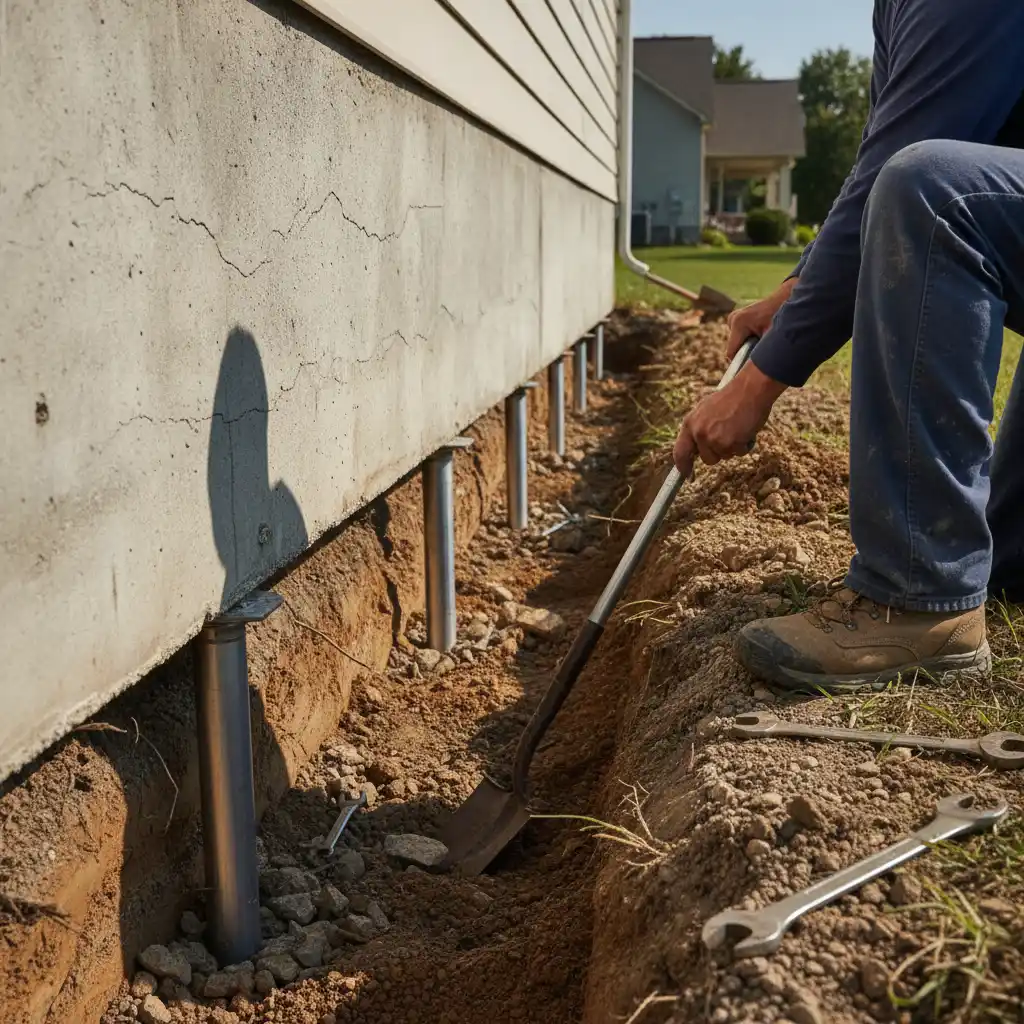
Our team in action — foundation-repair professionals serving Cedar Park
Foundation Repair Methods We Use in Cedar Park
Steel Push Piers
The most common method for deeply settled Cedar Park slabs. Galvanized or epoxy-coated steel pipe sections are hydraulically driven through the expansive clay layers to competent bedrock or dense gravel at depths of 18–25 feet. Ideal for homes experiencing significant edge settlement, particularly in Buttercup Creek and Forest Oaks neighborhoods where the clay profile is deepest.
Helical Piers
Steel shafts with helical plates are torqued into the ground using hydraulic drive heads. Helical piers are preferred for lighter structures, new construction corrections, and areas where driven pier vibration is a concern — such as near the aging masonry homes along Lakeline Drive. They are also used for crawl space foundation repair on older Cedar Park pier-and-beam structures.
Polyurethane Foam Lifting (Slab Lifting)
High-density, two-component polyurethane foam is injected through small (5/8-inch) drilled holes beneath settled concrete sections. The foam expands to fill voids, compacts loose subbase material, and can lift slabs by 1–3 inches. This method is particularly effective for garage floors, interior slab sections, and sidewalks in Cedar Park where full pier installation is not warranted.
Mudjacking (Slabjacking)
A cement-soil slurry is pumped beneath sunken concrete to restore grade. A lower-cost alternative to foam for larger surface areas such as driveways and pool decks — commonly requested in Cedar Park’s master-planned communities where extensive flatwork surrounds the home.
Foundation Patching and Crack Injection
Epoxy or polyurethane crack injections seal active water intrusion cracks and restore tensile continuity across structural cracks in the slab or foundation wall. Used as a standalone repair for minor damage or as a finishing step after pier-based leveling. Learn more about our Foundation Patching services
Ready for Concrete Foundation Repair? Get Your Free Estimate Today.
Round Rock Foundation Repair Group serves Cedar Park and the surrounding area — we’ll be on-site within 24 hours.
📞 Call (512) 220-3502Concrete Foundation Repair Cost in Cedar Park, TX
Foundation repair costs in Cedar Park vary significantly based on the severity of damage, the repair method required, the number of piers needed, and accessibility factors specific to the property. Below are realistic price ranges based on current Central Texas market conditions.
Typical Cost Ranges
- Foundation Inspection: $200–$500 for a standalone professional evaluation with written report
- Foundation Crack Patching: $500–$2,500 depending on crack length, depth, and whether injection materials are required
- Polyurethane Slab Lifting: $800–$3,500 for garage floors, interior sections, or sidewalks
- Steel Push Pier Installation: $1,200–$1,800 per pier installed; most Cedar Park residential projects require 8–18 piers, placing total project costs between $9,600 and $32,400
- Helical Pier Installation: $1,400–$2,000 per pier for residential applications
- Full Structural Foundation Repair (large slab): $15,000–$50,000+ for severe settlement requiring comprehensive pier systems and interior access work
Cedar Park–Specific Cost Factors
Post-tensioned slabs — extremely common in Cedar Park homes built after 1995 — require additional engineering review and careful pier placement to avoid cable conflicts, which can add $500–$1,500 to project costs. Homes in Williamson County flood zones near Brushy Creek tributaries may require additional permits. High-volume demand following severe drought summers (as experienced in 2011, 2018, and 2022) can extend scheduling windows and influence seasonal pricing.
We provide free, no-obligation estimates for all Cedar Park foundation repair projects. Call (512) 220-3502 to request yours. More information on Foundation Repair costs in Cedar Park
Cedar Park Neighborhoods We Serve
Buttercup Creek
One of Cedar Park’s oldest established subdivisions, with homes dating from the mid-1980s to early 2000s. Many Buttercup Creek properties sit on thick Houston Black clay profiles and feature conventional reinforced slabs without post-tensioning — making them candidates for both pier-based leveling and crack repair work as they enter their 25–40 year maintenance window.
Twin Creeks
A large master-planned community in northwest Cedar Park (78613) developed primarily between 2000 and 2012. Twin Creeks homes frequently feature post-tensioned slabs. The community’s extensive tree canopy — including large live oaks preserved along greenbelts — creates localized soil drying patterns that contribute to edge lift and differential settlement. Post-Uri pipe-burst damage in 2021 led to elevated slab heave reports throughout this community.
Anderson Mill West / Cypress Canyon
Located along the Cedar Park–Austin boundary near FM 2769, these neighborhoods include homes built from the 1990s through the 2010s on moderately deep clay profiles. Proximity to Anderson Mill Road’s commercial corridor means some properties experience vibration loading from heavy traffic, which can aggravate existing crack networks over time.
Lakeline / Whitestone Area
High-density mixed-use development near Lakeline Mall includes both residential and light commercial properties. Commercial foundation repair needs — including retail strip centers and medical office buildings — are common in this zone. Learn about our Commercial Foundation Repair services
Foundation Maintenance Tips for Cedar Park Homeowners
- Maintain consistent soil moisture year-round. Install a soaker hose or drip system along the perimeter of your foundation and run it 2–3 times per week during Cedar Park’s dry summer months (typically May through October) to prevent the shrink-swell cycling that causes differential settlement.
- Grade your yard away from the foundation. Maintain a minimum slope of 6 inches over the first 10 horizontal feet around the perimeter to direct heavy Hill Country rain events away from the slab edge rather than toward it.
- Keep large trees at a safe distance. Plant new trees at least 15–20 feet from your foundation. If existing live oaks or cedar elms are closer, consider deep-root irrigation to reduce competitive soil drying.
- Inspect and clean gutters seasonally. Clogged gutters deposit concentrated water against one side of the foundation, creating the localized saturation that drives differential heave.
- Monitor your plumbing annually. Schedule a hydrostatic plumbing test every 3–5 years, especially if your Cedar Park home was built before 2005. Undetected slab leaks are a leading secondary cause of foundation movement in the 78613 zip code.
- Caulk and seal expansion joints. Keep concrete expansion joints between your slab, driveway, and patio sections properly sealed to prevent water infiltration and weed root intrusion.
- Document any cracks with photos and dates. A crack that is not growing is very different from one that widens seasonally. Annual photo documentation helps you and your foundation professional make informed decisions about timing and urgency of repairs.
Why Choose Round Rock Foundation Repair Group in Cedar Park
Round Rock Foundation Repair Group is a locally operated foundation repair company serving Cedar Park, Round Rock, and the greater North Austin region. Unlike national franchise operators, our team lives and works in the same communities we serve — we understand the specific soil profiles of the 78613 and 78641 zip codes, the construction timelines of Cedar Park’s major subdivisions, and the permit requirements of Williamson County.
We specialize in the full range of concrete foundation repair services, from minor crack patching and polyurethane slab lifting to full structural pier systems for severely settled homes and commercial buildings. Every project begins with a thorough, honest inspection — we will tell you if your foundation needs immediate intervention or simply monitoring.
Our service area covers all of Cedar Park and extends throughout Round Rock, Georgetown, Austin, Pflugerville, Brushy Creek, and surrounding communities. We work with licensed structural engineers when stamped plans are required and communicate transparently about costs, timelines, and realistic outcomes before any work begins.
Call (512) 220-3502 today to speak directly with a Cedar Park foundation repair specialist. Learn more about Round Rock Foundation Repair Group
Frequently Asked Questions — Concrete Foundation Repair in Cedar Park, TX
How much does concrete foundation repair cost in Cedar Park, TX?
Costs range from as little as $500 for simple crack patching to $30,000 or more for large-scale pier systems on a significantly settled slab. The most common residential repair projects in Cedar Park — involving 10–14 push piers on a 1,800–2,500 square foot slab — typically fall in the $12,000–$22,000 range. Post-tensioned slabs and homes near Brushy Creek flood zones may require additional engineering review that adds to total project cost.
How do I know if my Cedar Park home needs foundation repair or just cosmetic patching?
Surface cracks in drywall or minor hairline cracks in the slab itself are often cosmetic and can be monitored. Warning signs that indicate structural repair is needed include cracks wider than 1/4 inch, doors and windows that stick or no longer close properly, floor slopes detectable with a level, and stair-step cracking in exterior brick — all of which indicate active differential movement rather than normal concrete curing shrinkage.
How long does foundation repair take in Cedar Park?
Most residential pier installations in Cedar Park are completed in one to three days depending on the number of piers, site access, and weather. Polyurethane foam lifting projects are often completed in a single day. The pre-repair inspection and engineering review period typically adds five to ten business days before work begins.
Does my home’s post-tensioned slab make foundation repair more complicated?
Yes — post-tensioned slabs, which are very common in Cedar Park homes built after 1995 in neighborhoods like Twin Creeks, Cypress Canyon, and Walsh Ranch, require pier placement to be coordinated around the cable grid. We use available engineering records and on-site cable locators to avoid compromising stressed tendons. This adds planning time but does not prevent successful foundation repair.
Will foundation repair disrupt my landscaping in Cedar Park?
Exterior pier installation requires excavating access holes approximately 24–30 inches in diameter to a depth of 2–3 feet at each pier location. We take care to protect existing landscaping and irrigation lines during excavation and restore all exterior areas after pier installation is complete. Interior pier access through the slab requires cutting small sections of flooring, which we patch with matching concrete.
Should I fix a plumbing leak before or after foundation repair?
Ideally, active slab leaks should be repaired before foundation work begins. An unresolved plumbing leak will continue to introduce moisture differentials beneath the slab, potentially undermining a freshly leveled foundation. We recommend a hydrostatic plumbing test as part of the pre-repair evaluation for any Cedar Park home showing signs of both foundation movement and unexplained water bill increases.
Do you serve commercial properties in Cedar Park?
Yes. Round Rock Foundation Repair Group provides commercial foundation repair for retail, office, and light industrial properties throughout Cedar Park, including the Lakeline commercial corridor and business parks near US-183A. Commercial projects typically require engineered repair plans and Williamson County permits, which we coordinate on your behalf. Learn more about Commercial Foundation Repair
Is foundation repair covered by homeowners insurance in Texas?
Standard Texas homeowners insurance policies typically do not cover foundation damage caused by soil movement or drought — the most common causes in Cedar Park. Coverage may apply if the damage is directly caused by a sudden and accidental plumbing leak (slab leak), so it is worth reviewing your policy and consulting your insurance agent before ruling out a claim. We can provide detailed documentation of observed damage to support insurance inquiries.
Contact Round Rock Foundation Repair Group Today
If you have noticed cracking walls, sticking doors, uneven floors, or any other warning signs of foundation movement in your Cedar Park home or commercial building, do not wait. Foundation problems in the expansive clay soils of Williamson County rarely resolve on their own — and early intervention almost always costs significantly less than addressing advanced structural damage.
Round Rock Foundation Repair Group is ready to help homeowners and property managers throughout Cedar Park, Twin Creeks, Buttercup Creek, Anderson Mill West, and all surrounding communities with honest inspections and proven repair solutions.
Call us now at (512) 220-3502 to schedule your foundation inspection in Cedar Park. You can also reach us online to request a free estimate. Request a Free Foundation Repair Estimate in Cedar Park