Home Foundation Repair in Cedar Park, TX
Fast, Reliable Home Foundation Repair in Cedar Park, TX — Licensed & Insured
Need home foundation repair in Cedar Park, TX? Round Rock Foundation Repair Group fixes slab & pier foundations. Call (512) 220-3502 for a free estimate today.
- Licensed & Insured
- Locally Owned & Operated
- Free Inspection & Estimate
Request Your
Free EstimateHome foundation repair is the process of diagnosing, stabilizing, and restoring the structural base of a residential property to ensure long-term safety and integrity. In Cedar Park, TX, the expansive clay soils of the Blackland Prairie and the region’s dramatic seasonal moisture swings create some of the most demanding foundation conditions in Central Texas. Homes in Cedar Park experience unique stress cycles that can cause slabs to heave, settle, or crack far more aggressively than in other parts of the country.
At Round Rock Foundation Repair Group, we specialize in delivering professional home foundation repair solutions tailored specifically to the geology, climate, and construction styles found throughout Cedar Park and the greater Austin metro. Whether you are dealing with a freshly noticed crack or a long-standing settlement issue, our team has the local knowledge and technical expertise to restore your home’s foundation properly. Call us today at (512) 220-3502 to schedule your inspection.
Understanding Home Foundation Repair in Cedar Park, TX
Home foundation repair encompasses a broad range of corrective and preventative measures designed to address the failure or deterioration of a home’s structural base. Foundations in Cedar Park fall primarily into two categories: post-tension concrete slab-on-grade foundations, which became the dominant construction method in Central Texas after the 1980s, and older pier-and-beam foundations common in homes built before 1970. Each system has distinct failure modes and requires specific repair strategies.
Slab foundations in Cedar Park are typically poured at a thickness of four to six inches and are reinforced with either steel rebar or post-tensioned cables. Over time, differential movement — where one part of the slab moves more than another — causes the concrete to crack, doors to bind, and floors to become unlevel. Pier-and-beam foundations, while more forgiving in some respects, are vulnerable to wood rot, beam deterioration, and shifting concrete piers, especially in Cedar Park’s humid summer conditions.
The history of foundation problems in the Cedar Park area is closely tied to the region’s rapid residential growth. From the early 2000s through the 2020s, Cedar Park expanded from a small bedroom community into one of the fastest-growing cities in the United States. Subdivisions such as Buttercup Creek, Riviera Springs, and Twin Creeks were built atop soil profiles that were not always fully mitigated for expansive clay behavior, leaving thousands of homes exposed to long-term settlement risk.
Foundation repair as a formal industry in Central Texas developed significantly during the 1990s and 2000s as the connection between expansive soils and structural damage became better understood by engineers and contractors alike. Today, methods such as hydraulic pier installation, polyurethane foam injection, and carbon fiber reinforcement represent the state of the art in residential foundation restoration, and Round Rock Foundation Repair Group employs all of these techniques in Cedar Park homes.
Why Home Foundation Repair Is Needed in Cedar Park, TX
Cedar Park sits at the transition zone between the Texas Hill Country to the west and the Blackland Prairie to the east, a geographic position that creates exceptionally challenging foundation conditions. The dominant soil type beneath most Cedar Park neighborhoods is Houston Black clay, classified by the USDA as a vertisol. This soil type has a plasticity index (PI) that frequently exceeds 40, meaning it expands dramatically when wet and contracts and cracks when dry — sometimes shrinking enough to create gaps of two to four inches along the perimeter of a home’s foundation during severe drought.
The Texas drought of 2011 serves as a defining moment for Cedar Park homeowners. During that event, Central Texas recorded its driest one-year period since record-keeping began, with Austin-Bergstrom International Airport logging only 9.93 inches of rainfall for the calendar year against a normal of 31.5 inches. In Cedar Park specifically, neighborhoods built on unmitigated clay — including portions of Buttercup Creek and Lakeline Ranch — saw a measurable spike in foundation repair inquiries, as the extreme moisture deficit caused slabs to drop two to four inches in the most affected areas.
Seasonal swings remain a persistent problem even in non-drought years. Cedar Park typically receives heavy rainfall in May and October, when monthly totals can reach six to eight inches, followed by hot, dry summers where July and August routinely see highs above 100°F and minimal precipitation. This wet-dry-wet cycle repeats every year and gradually fatigues even well-built foundations. Homes in the Twin Creeks and Crossings at Carriage Hills subdivisions, which were developed in the mid-2000s on cuts and fills associated with the rolling terrain near US-183A, are particularly susceptible to this cyclical movement.
Cedar Park’s proximity to Brushy Creek and its tributary drainage systems introduces an additional variable: localized flooding and soil saturation events. Homes near the Brushy Creek Regional Trail corridor and those in lower-lying sections of Avery Ranch (which straddles the Cedar Park and Austin city limits) can experience hydrostatic pressure from saturated soils after major rain events like those associated with Hurricane Harvey in August 2017, which dropped over ten inches in parts of Williamson County within 48 hours. Saturated clay loses its bearing capacity, allowing slab edges to drop while interior sections remain relatively elevated — a classic edge-settlement failure pattern.
Finally, Cedar Park’s aggressive tree population contributes meaningfully to foundation damage. Live oaks and cedar elms — abundant throughout the city’s older neighborhoods and manicured subdivisions alike — have root systems that can extend 50 to 100 feet from the trunk. During dry periods, these roots extract moisture from beneath slabs, accelerating soil shrinkage directly under the foundation. Homes in older sections of Cedar Park near Buttercup Creek Boulevard where mature tree canopy is well-established see this mechanism drive measurable differential settlement year after year.
Signs You Need Home Foundation Repair in Cedar Park
Interior Warning Signs
- Diagonal cracks running from the corners of door frames or window frames at 45-degree angles
- Doors and windows that stick, refuse to latch, or have developed visible gaps along their frames
- Floors that feel noticeably sloped or that register more than one inch of elevation change over a 10-foot span
- Cracks in drywall, particularly in stair-step patterns along interior walls
- Separation between interior walls and the ceiling or floor
Exterior Warning Signs
- Horizontal or stair-step cracks in brick veneer, which are especially common on Cedar Park homes built between 1995 and 2010
- Gaps between the brick and the mortar wider than 1/4 inch
- Visible separation between the chimney and the main structure
- Cracks in the concrete slab itself along the garage floor or exterior perimeter
Urgency Indicators
Contact a foundation professional immediately if you observe cracks wider than 1/4 inch, cracks that are actively growing, or any structural element that has shifted out of plumb. These conditions can escalate rapidly, especially following Cedar Park’s spring rain season or after extended dry stretches during summer.
Our Home Foundation Repair Process in Cedar Park
Initial Consultation and Scheduling (Day 1)
Contact Round Rock Foundation Repair Group at (512) 220-3502. Our team gathers preliminary information about your home’s age, construction type, and visible symptoms. We typically schedule inspections within two to five business days for Cedar Park addresses.
Comprehensive Foundation Inspection (Day 2–5)
Our inspector visits your Cedar Park home and performs a full interior and exterior evaluation. This includes floor elevation surveys using a Zip-Level Pro 2000 digital manometer to measure differential movement to within 1/100th of an inch, crack documentation, and soil moisture assessment around the perimeter. We also review the drainage profile of your lot relative to Cedar Park’s typical grade patterns and proximity to drainage corridors.
Engineering Analysis and Repair Plan (Days 5–10)
Inspection data is reviewed and a customized repair plan is developed. For complex cases or those requiring a stamped engineering report — sometimes required by lenders or buyers in Cedar Park real estate transactions — we coordinate with licensed structural engineers familiar with Williamson County soil conditions.
Site Preparation (Repair Day 1)
Our crew prepares the work area, protecting landscaping and hardscape. In Cedar Park neighborhoods with established mature trees, we take extra precautions to avoid damaging root zones during pier installation.
Foundation Repair Execution (Days 1–3 Depending on Scope)
Repairs are completed using the method specified in your plan — whether hydraulic pier installation, foam injection, or patching. Most residential jobs in Cedar Park are completed within one to three days.
Site Restoration and Cleanup (Final Repair Day)
All excavation areas are backfilled and compacted. Concrete flatwork is patched where necessary, and the property is restored as close to its pre-repair condition as possible.
Post-Repair Documentation and Follow-Up
We provide a written completion report with before-and-after elevation readings, a description of work performed, and maintenance recommendations specific to your home’s soil and drainage conditions in Cedar Park.
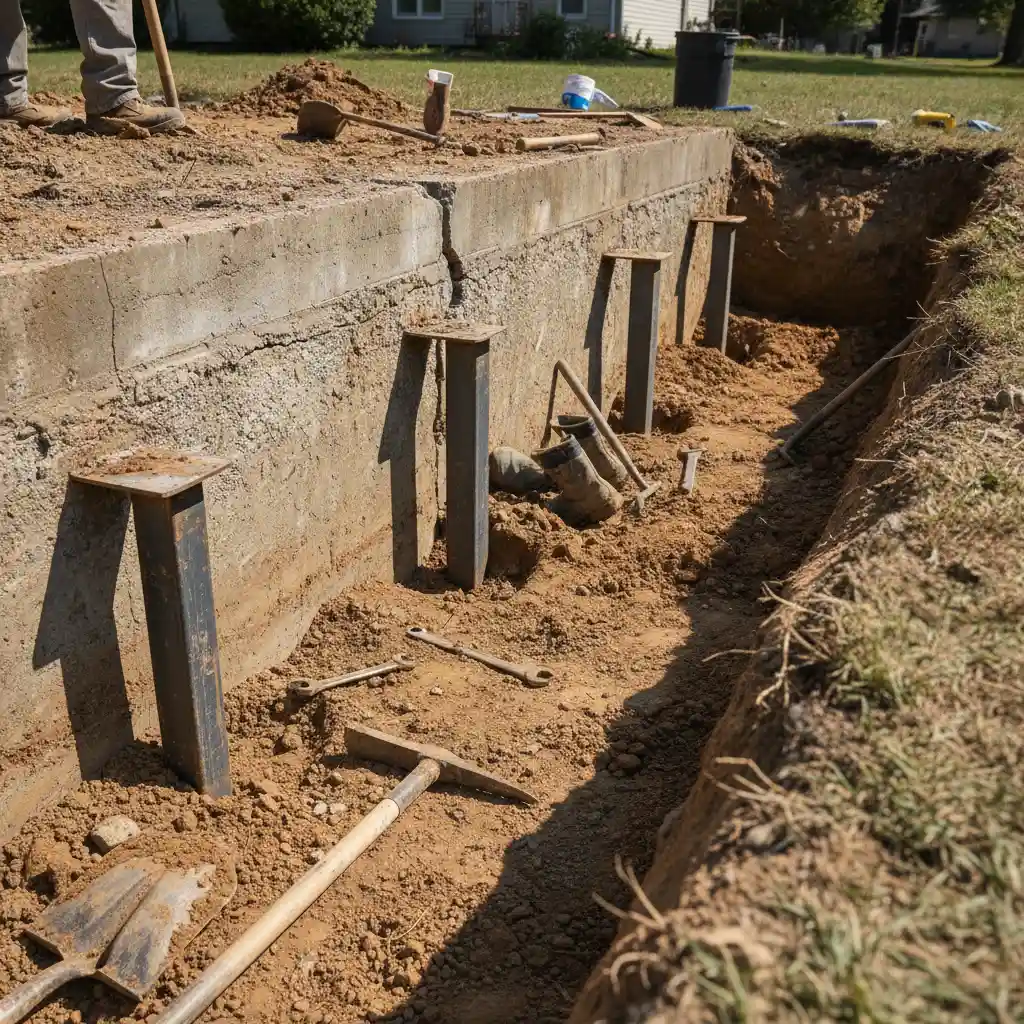
Our team in action — foundation-repair professionals serving Cedar Park
Foundation Repair Methods We Use in Cedar Park
Hydraulic Steel Pier Installation
Steel push piers or helical piers are driven through unstable surface soils to reach load-bearing strata — typically the dense Austin Chalk or Taylor Marl formations found at depths of 15 to 30 feet beneath much of Cedar Park. This method is the gold standard for permanent slab lifting and stabilization and is most appropriate for homes experiencing significant edge settlement of one inch or more.
Polyurethane Foam Injection (Slab Lifting)
High-density polyurethane foam is injected through small 5/8-inch holes drilled in the slab. The expanding foam fills voids, compacts loose subsoil, and lifts settled sections. This minimally invasive method works well in Cedar Park homes where interior voids have formed due to soil shrinkage during drought cycles and where settlement is less than one inch.
Pressed Concrete Pilings
Cylindrical concrete pilings are hydraulically pressed into the ground beneath the slab’s edge. This is a cost-effective option frequently used in Cedar Park’s mid-range residential market and is well-suited to homes on lots with limited side-yard access where heavy equipment cannot reach.
Carbon Fiber Wall Straps and Crack Stitching
For foundations experiencing lateral cracking or bowing — less common in Cedar Park’s slab-dominant housing stock but found in older pier-and-beam homes with concrete stem walls — carbon fiber reinforcement straps prevent further movement without requiring excavation.
Foundation Patching and Crack Sealing
For cosmetic or non-structural cracks, epoxy injection and polyurethane caulk sealing prevent moisture infiltration — a critical concern given Cedar Park’s intense spring rainfall events. Learn more about our Foundation Patching services
Ready for Home Foundation Repair? Get Your Free Estimate Today.
Round Rock Foundation Repair Group serves Cedar Park and the surrounding area — we’ll be on-site within 24 hours.
📞 Call (512) 220-3502Home Foundation Repair Cost in Cedar Park, TX
The cost of home foundation repair in Cedar Park varies widely depending on the severity of the damage, the repair method required, and the size and construction type of your home. Below are general price ranges based on current market conditions in Williamson County:
- Foundation Inspection: $300–$600 for a comprehensive evaluation with elevation survey. Some contractors offer free inspections; a paid independent inspection provides unbiased results.
- Polyurethane Foam Injection: $1,500–$5,000 for minor to moderate void-filling and lifting work on a standard Cedar Park slab home.
- Pressed Concrete Pilings: $1,200–$3,500 per pier installed, with most Cedar Park homes requiring between 8 and 20 piers depending on the home’s footprint, totaling $10,000–$25,000 for a complete perimeter repair.
- Steel Push Piers or Helical Piers: $1,500–$3,000 per pier, with deeper installations required in some Cedar Park areas where Austin Chalk is deeper; total project costs typically range from $15,000–$40,000.
- Crack Patching and Sealing: $500–$2,500 depending on the number and severity of cracks.
Cedar Park-specific pricing factors include the depth required to reach stable bearing material (which varies across the city’s diverse geology), lot access constraints in older subdivisions, and the presence of mature trees requiring careful excavation. Many homeowners in Cedar Park finance foundation repairs through home equity lines of credit or contractor financing programs. Call us at (512) 220-3502 for a detailed estimate.
Learn more about Foundation Repair costs in the Cedar Park area
Cedar Park Neighborhoods We Serve
Buttercup Creek
One of Cedar Park’s oldest established subdivisions, with homes dating from the late 1970s through the 1990s. Many properties here feature original post-tension slabs that have experienced decades of clay-driven movement. Mature live oaks throughout the neighborhood are a primary driver of seasonal differential settlement.
Twin Creeks
Developed primarily between 2000 and 2010, Twin Creeks sits on rolling terrain with significant cut-and-fill grading. Homes on filled sections are particularly susceptible to long-term consolidation settlement. We frequently service homes here with steel pier systems reaching the Austin Chalk layer.
Lakeline Ranch
A 1990s-era subdivision near Lakeline Boulevard with heavy clay soil profiles. The neighborhood’s relatively flat topography results in poor surface drainage, leading to chronic perimeter moisture imbalance and edge-heave conditions in wet years.
Avery Ranch
Straddling the Cedar Park and Austin city limits, Avery Ranch features homes built from 2002 to 2015. Lower-lying lots near the community’s golf course are prone to saturation after heavy rainfall events, and we regularly address both edge settlement and interior void formation here.
We also serve all surrounding communities including Round Rock, Georgetown, Austin, Brushy Creek, Pflugerville, and additional neighborhoods. View our full service area
Foundation Maintenance Tips for Cedar Park Homeowners
- Maintain consistent soil moisture year-round. Install a soaker hose system around your foundation perimeter and run it during Cedar Park’s dry summer months — typically June through September — to prevent clay from shrinking away from the slab edge.
- Ensure positive drainage away from the foundation. The ground should slope at least six inches downward over the first ten horizontal feet away from your home. Cedar Park’s clay soils shed water poorly, so grading maintenance is essential after settling occurs.
- Clean gutters and extend downspouts. Downspouts should discharge at least five to six feet from the foundation. During Cedar Park’s peak May rainfall, clogged gutters can deposit hundreds of gallons of water directly against the slab edge.
- Monitor and manage tree root zones. Keep large trees — particularly live oaks and cedar elms — planted at least 15 to 20 feet from the foundation. Consider root barriers for existing trees closer than this distance.
- Inspect plumbing for leaks annually. A leaking under-slab pipe is among the leading causes of localized soil erosion and slab settlement in Cedar Park. A hydrostatic pressure test can detect leaks before they cause significant damage.
- Check and repack expansion joints. Cedar Park’s temperature swings — from lows near 25°F in January to highs above 105°F in July — cause concrete to contract and expand. Keep expansion joints between the slab and adjoining flatwork sealed.
- Document cracks annually. Photograph and date any cracks each spring and fall. This helps distinguish stable historic cracking from new active movement requiring professional evaluation.
Why Choose Round Rock Foundation Repair Group for Cedar Park Foundation Repair
Round Rock Foundation Repair Group is a locally operated foundation repair company serving Cedar Park and the broader Central Texas region. Our team has deep familiarity with the specific soil profiles, construction eras, and drainage characteristics that define Cedar Park’s residential landscape — knowledge that out-of-state or generalist contractors simply cannot replicate.
We serve Cedar Park homeowners in every corner of the city, from the established neighborhoods near Buttercup Creek to the newer developments along the US-183A toll corridor. Our service area extends throughout Williamson County and into Travis County, covering Round Rock, Georgetown, Austin, Brushy Creek, Pflugerville, and surrounding communities.
Every project begins with a thorough, honest inspection. We explain your repair options in plain language, provide itemized written estimates, and never recommend more work than your home actually needs. Our repair crews are experienced in Cedar Park-specific challenges including working around mature trees, navigating tight side-yard access in established subdivisions, and reaching the deeper bearing strata that some lots require.
Call Round Rock Foundation Repair Group at (512) 220-3502 to schedule your Cedar Park foundation inspection today.
Learn more about Round Rock Foundation Repair Group
Frequently Asked Questions: Home Foundation Repair in Cedar Park, TX
How much does home foundation repair cost in Cedar Park, TX?
Costs range from as little as $1,500 for minor foam injection work to $40,000 or more for a full-perimeter steel pier installation on a large home. The average Cedar Park residential foundation repair project — typically involving 10 to 16 pressed concrete or steel piers — falls between $10,000 and $22,000. Cedar Park-specific factors like pier depth requirements and site access affect the final price. Call (512) 220-3502 for a free estimate.
How long does foundation repair take in Cedar Park?
Most residential foundation repair projects in Cedar Park are completed in one to three days. Larger homes or those requiring engineered pier systems driven to Austin Chalk depths of 20 to 30 feet may take three to five days. The inspection and planning phase typically adds five to ten business days before work begins.
Does Cedar Park’s soil really cause that much foundation damage?
Yes. Cedar Park’s Houston Black clay soils have one of the highest swell-shrink potentials of any soil type in the United States. The Texas A&M AgriLife Extension estimates that expansive soils cause more property damage nationally each year than floods, tornadoes, hurricanes, and earthquakes combined — and Cedar Park’s Blackland Prairie clays are among the most active in the state.
Will my homeowner’s insurance cover foundation repair in Cedar Park?
Standard homeowner’s insurance policies in Texas typically do not cover foundation damage caused by expansive soil movement, which is the most common cause in Cedar Park. Coverage may apply if the damage results from a sudden covered event such as a plumbing leak or, in some cases, flood damage. We recommend reviewing your policy with your insurance agent before beginning repairs.
How do I know if my Cedar Park home needs foundation repair or just cosmetic patching?
Cosmetic cracking — hairline cracks under 1/8 inch that have not changed in size — typically does not require structural intervention. However, cracks wider than 1/4 inch, cracks accompanied by door or window binding, or any crack that has measurably grown over time warrants a professional evaluation. An elevation survey using precision instruments is the most reliable way to distinguish cosmetic from structural movement.
Can foundation repairs increase my Cedar Park home’s value?
Yes. Foundation issues are among the most significant disclosure items in Texas real estate transactions and can reduce a home’s market value or prevent a sale entirely. Completed repairs, supported by documentation and a transferable warranty where available, typically have a positive effect on appraisal value and buyer confidence in the Cedar Park market.
How soon after a drought should I have my Cedar Park foundation inspected?
We recommend scheduling a foundation inspection after any summer in which Cedar Park records two or more consecutive months below 50% of normal rainfall. The soil shrinkage that occurs during these periods often causes the most significant movement, and catching damage early — before the following wet season allows soil to re-expand and mask symptoms — leads to the most cost-effective repairs.
Do you offer foundation inspection services for home buyers in Cedar Park?
Yes. We provide pre-purchase foundation inspections for Cedar Park home buyers. Given the city’s expansive soil conditions and the prevalence of homes built during the high-growth 2000s, we strongly recommend a dedicated foundation evaluation as part of any home purchase due diligence process. Learn more about our Foundation Inspection service
Schedule Your Cedar Park Foundation Repair Consultation Today
If your Cedar Park home is showing signs of foundation movement — from sticky doors and cracked drywall to visible slab cracks and uneven floors — do not wait for the problem to worsen. Cedar Park’s expansive clay soils and seasonal moisture extremes mean foundation issues rarely resolve on their own. The sooner you act, the more cost-effective the solution is likely to be.
Round Rock Foundation Repair Group is ready to help. Our team serves all Cedar Park neighborhoods, including Buttercup Creek, Twin Creeks, Lakeline Ranch, Avery Ranch, and every community in between. We also serve Round Rock, Georgetown, Austin, Brushy Creek, Pflugerville, and the surrounding region.
Call us today at (512) 220-3502 to schedule your comprehensive foundation inspection. You can also contact us online to request an appointment at your convenience. Let Round Rock Foundation Repair Group protect your most important investment.