Crawl Space Repair in Cedar Park, TX
Fast, Reliable Crawl Space Repair in Cedar Park, TX — Licensed & Insured
Need crawl space repair in Cedar Park, TX? Round Rock Foundation Repair Group fixes moisture, structural damage & more. Call (512) 220-3502 for a free estimate.
- Licensed & Insured
- Locally Owned & Operated
- Free Inspection & Estimate
Request Your
Free EstimateCrawl space repair is the process of identifying, diagnosing, and correcting structural and moisture-related problems within the shallow, accessible space beneath your home’s floor system. In Cedar Park, TX, where expansive clay soils, high humidity, and rapid residential growth create a perfect storm for crawl space deterioration, proactive repair is not optional — it is essential to protecting your home’s long-term value and structural integrity.
At Round Rock Foundation Repair Group, we specialize in comprehensive crawl space repair solutions tailored specifically to the environmental and geological conditions found throughout Cedar Park and the greater Austin metropolitan area. From moisture encapsulation and vapor barrier installation to structural beam and pier replacement, our experienced team brings technical precision and local knowledge to every project. If you are noticing sagging floors, musty odors, or rising energy bills in your Cedar Park home, our experts are ready to help. Call us today at (512) 220-3502 for a thorough evaluation.
Understanding Crawl Space Repair
A crawl space is a narrow, unfinished area underneath a home — typically 18 inches to 4 feet in height — that provides access to plumbing, electrical systems, and structural supports. Unlike slab-on-grade foundations that are common in newer Cedar Park subdivisions, crawl space foundations were a popular construction method in older Central Texas homes built between the 1950s and early 1990s, offering builders an economical alternative to full basements while accommodating sloped terrain and expansive soils.
Crawl space repair encompasses a wide range of corrective measures. At its most basic level, it involves clearing debris, improving drainage, and installing vapor barriers to control moisture. At a more advanced level, it may require sistering or replacing damaged floor joists, installing crawl space support posts, encapsulating the entire space with heavy-gauge polyethylene liner, and integrating dehumidification systems to maintain safe relative humidity levels — ideally below 60 percent relative humidity to prevent mold growth and wood rot.
In Central Texas, the geology is dominated by expansive Vertisol clay soils — locally called “black gumbo” — that shrink dramatically during drought and swell during wet seasons. This cyclical movement exerts enormous pressure on crawl space piers and floor framing systems, causing differential settlement, cracked beams, and deteriorating wood members. Cedar Park’s position within the Balcones Fault Zone also introduces localized soil variability, meaning that two homes on the same street may experience vastly different crawl space conditions depending on their precise footprint and drainage patterns.
Historically, crawl spaces were left open or vented to outside air — a practice that the building science community has recognized as problematic in humid climates like Central Texas. Modern repair strategies favor fully encapsulated crawl spaces that are sealed and conditioned, dramatically reducing moisture infiltration, pest activity, and structural degradation. Whether your Cedar Park home was built in the 1970s in an older established neighborhood or in the 1990s during the area’s first major growth boom, understanding the fundamentals of crawl space repair is the first step toward a safer, more durable home.
Signs You Need Crawl Space Repair in Cedar Park
Structural Warning Signs
- Floors that visibly sag, bounce, or feel “spongy” when walking — particularly in hallways and kitchens
- Gaps appearing between your hardwood or tile flooring and baseboards
- Interior doors and windows that stick, jam, or no longer close flush within their frames
- Visible cracks in drywall along wall-ceiling junctions, typically diagonal and wider than 1/8 inch
- Cracked, split, or visibly deflected floor joists or beams observed from below
Moisture and Air Quality Warning Signs
- Persistent musty or earthy odors rising through floor vents or from beneath the home
- Visible mold growth — black, green, or white — on wood members, insulation, or the vapor barrier
- Unexplained increases in monthly energy bills suggesting conditioned air is escaping through floor leaks
- Condensation forming on first-floor pipes, subflooring, or HVAC ductwork in the crawl space
- Pest activity including termites, rodents, or wood-boring beetles entering through the crawl space
Urgency Indicators
If you notice structural symptoms combined with moisture indicators simultaneously, treat this as an urgent situation. Advanced wood rot can compromise a floor joist’s load-bearing capacity within 6 to 18 months of initial moisture exposure. Contact Round Rock Foundation Repair Group immediately at (512) 220-3502 if multiple symptoms are present.
Our Crawl Space Repair Process in Cedar Park
Round Rock Foundation Repair Group follows a disciplined, multi-phase process designed specifically for Cedar Park’s geological and climatic conditions. Here is what to expect from your first call to project completion.
Initial Phone Consultation (Day 1)
When you call (512) 220-3502, our Cedar Park service coordinator gathers key information about your home — including construction era, neighborhood location, and observed symptoms — to dispatch the most qualified technician for your specific situation.
On-Site Crawl Space Inspection (Day 2–5)
Our inspector physically enters and surveys your entire crawl space, measuring moisture levels with a calibrated digital hygrometer, documenting joist and beam conditions with photography, assessing pier integrity, and mapping any standing water or drainage pathways. In Cedar Park neighborhoods near Brushy Creek, we pay particular attention to sub-surface moisture infiltration patterns that differ from homes on higher ground in areas like Forest Creek.
Engineering Assessment and Repair Plan (Days 5–10)
Our team develops a detailed written repair proposal specifying materials, methods, timelines, and costs. For structurally compromised crawl spaces, we coordinate with a licensed structural engineer when beam or pier replacement is required, ensuring all work meets Williamson County and City of Cedar Park building codes.
Preparation and Drainage Correction (Day 1 of Repair)
Before any structural or encapsulation work begins, we address active water intrusion by installing interior French drains, sump pumps, or re-grading perimeter drainage to direct water away from the foundation — critical in Cedar Park’s clay-heavy soils that pool water rather than absorb it.
Structural Repairs (Days 1–3 of Repair)
Damaged floor joists are sistered or replaced using #2 or better pressure-treated lumber. Settlement-affected crawl space piers are shimmed, reinforced, or replaced with steel adjustable support posts capable of bearing loads up to 60,000 pounds. Timeline: 1 to 3 days depending on scope.
Encapsulation and Moisture Control (Days 2–4 of Repair)
We install a minimum 20-mil reinforced polyethylene vapor barrier across all ground surfaces and up all crawl space walls, sealed at seams with waterproof tape and mechanically fastened at the perimeter. Vents are sealed, and a commercial-grade dehumidifier is installed and set to maintain relative humidity below 55 percent — the optimal threshold for Cedar Park’s climate.
Final Inspection and Documentation (Final Day)
We perform a complete post-repair moisture reading and structural verification, provide you with before-and-after photographic documentation, and walk you through the maintenance requirements for your newly repaired crawl space.
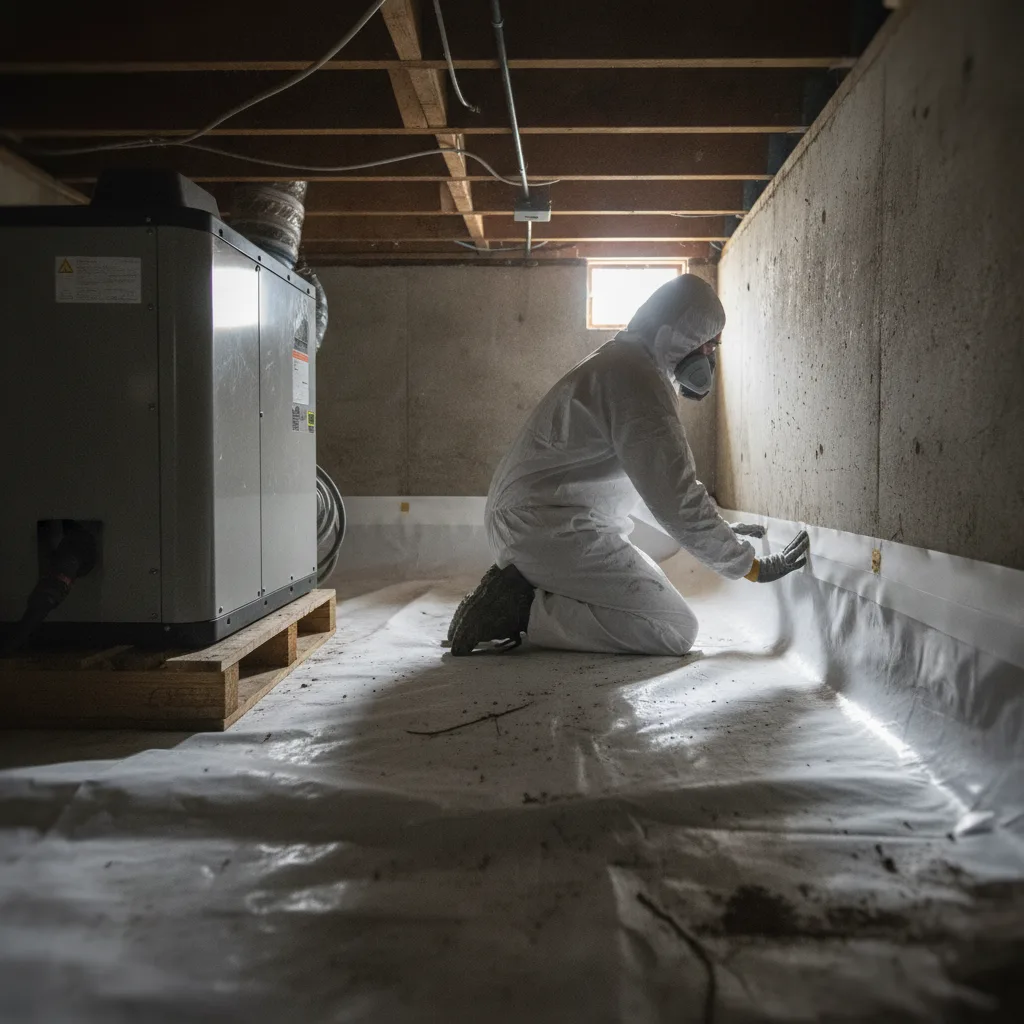
Our team in action — foundation-repair professionals serving Cedar Park
Crawl Space Repair Methods and Approaches
1. Crawl Space Encapsulation
Full encapsulation seals the crawl space from ground moisture using a heavy-gauge vapor barrier, closed-cell spray foam at penetrations, and sealed vents. This is the most comprehensive moisture control solution and is strongly recommended for Cedar Park homes within 500 feet of Brushy Creek or in low-lying areas of neighborhoods like Cat Hollow. Encapsulation reduces indoor humidity, lowers HVAC energy consumption by 15 to 25 percent, and dramatically extends the lifespan of wood floor systems. Learn more about our foundation inspection services
2. Structural Sistering and Joist Replacement
When floor joists show rot, insect damage, or deflection exceeding L/360 (the standard allowable deflection for residential floor systems), we sister new lumber alongside damaged members or perform full replacement. This method is most common in Cedar Park homes built between 1965 and 1985 using untreated dimensional lumber.
3. Crawl Space Pier Installation and Reinforcement
Differential settlement caused by Cedar Park’s shrink-swell soils often leaves crawl space support piers out of level. We install new helical or concrete piers driven to stable bearing strata below the active soil layer — typically 10 to 15 feet deep in this region — to restore level floor support permanently. Explore our structural foundation repair solutions
4. Interior Drainage and Sump Pump Systems
For crawl spaces with recurring water intrusion — particularly relevant after heavy rain events along Cedar Park’s Brushy Creek drainage basin — we install perimeter drainage channels and sump pump systems that actively remove water before it contacts wood framing members.
5. Crawl Space Dehumidification
Standalone crawl space dehumidifiers rated for spaces up to 3,000 square feet are installed and hardwired to drain continuously, maintaining safe humidity levels year-round without homeowner intervention. Essential for Cedar Park’s humid subtropical climate zone.
Ready for Crawl Space Repair? Get Your Free Estimate Today.
Round Rock Foundation Repair Group serves Cedar Park and the surrounding area — we’ll be on-site within 24 hours.
📞 Call (512) 220-3502Crawl Space Repair Cost in Cedar Park, TX
One of the most common questions homeowners ask is: what does crawl space repair cost in Cedar Park? The answer depends heavily on the scope of damage, the size of your crawl space, and the specific methods required. Below are typical price ranges based on our experience serving the Cedar Park area.
- Basic Vapor Barrier Installation: $1,500 – $4,000 for an average 1,000–1,500 sq. ft. crawl space with a 6-mil to 10-mil liner.
- Full Crawl Space Encapsulation (20-mil liner + sealed vents + dehumidifier): $5,000 – $12,000 depending on square footage and access conditions.
- Structural Joist Sistering or Replacement: $2,500 – $8,000 depending on the number of affected members and lumber species required.
- Crawl Space Pier Installation (per pier): $500 – $1,500 per pier, with most projects requiring 4 to 12 piers.
- Interior Drainage and Sump Pump System: $3,000 – $7,500 including excavation, drainage channel, and pump installation.
- Comprehensive Full Repair (structural + encapsulation + drainage): $10,000 – $25,000+ for severely damaged crawl spaces in older Cedar Park homes.
Cedar Park-Specific Pricing Factors
Cedar Park homeowners should be aware that labor costs in the Austin-Round Rock metropolitan statistical area have increased approximately 18 percent since 2020 due to construction workforce demand. Homes in areas with restricted crawl space access — particularly 1970s-era homes in neighborhoods like Anderson Mill with low clearance heights under 24 inches — may incur access surcharges of $300 to $800. Material costs for pressure-treated lumber and reinforced vapor barrier products have stabilized following 2021–2022 supply chain disruptions but remain approximately 12 percent above pre-pandemic pricing.
We recommend scheduling a professional inspection before budgeting, as costs can vary significantly. Call (512) 220-3502 for a detailed, no-obligation estimate. View all crawl space repair services
Cedar Park Neighborhoods We Serve
Avery Ranch
Located along Brushy Creek in northwest Cedar Park, Avery Ranch features homes built primarily between 2000 and 2015. While many are slab-on-grade, a subset of homes along lower creek elevations utilize crawl space foundations with elevated floor systems susceptible to seasonal moisture. The proximity to Brushy Creek Regional Trail creates recurring ground saturation challenges unique to this area.
Buttercup Creek
One of Cedar Park’s older established neighborhoods, Buttercup Creek contains a significant number of homes built in the 1980s and early 1990s with vented crawl space foundations. Many of these homes have original vapor barriers that are now over 30 years old, degraded, and in urgent need of replacement. The 2011 Texas drought caused notable pier settlement throughout this neighborhood.
Anderson Mill
Straddling the Williamson-Travis County line, Anderson Mill’s 1970s-era homes represent some of the oldest residential crawl space construction in the Cedar Park service area. Low crawl space clearances — some as shallow as 16 inches — combined with aging untreated lumber make structural deterioration common. Learn about our home foundation repair services
Forest Oaks
A mid-1990s neighborhood featuring mixed foundation types, Forest Oaks homeowners frequently contact us following intense storm seasons. The neighborhood’s topography channels runoff toward lower-lying lots, creating persistent moisture accumulation beneath crawl space homes that lack adequate perimeter grading.
Crawl Space Maintenance Tips for Cedar Park Homeowners
- Inspect your vapor barrier twice per year — ideally in April after spring rains and in October after summer heat — checking for tears, displacement, or standing water.
- Maintain exterior grading at a minimum 6-inch drop over the first 10 feet from your foundation perimeter to direct Cedar Park’s clay-heavy runoff away from the crawl space.
- Clean gutters and extend downspouts at least 6 feet from the foundation — critical during Cedar Park’s intense spring thunderstorm season (March through May).
- Monitor your crawl space dehumidifier monthly, emptying the reservoir if not hard-piped to a drain, and verify it is maintaining humidity below 60 percent.
- Trim trees within 10 feet of the foundation, particularly the aggressive live oaks and cedar elms common throughout Cedar Park, to limit root intrusion and moisture competition near the foundation.
- Check for plumbing leaks inside the crawl space each year, as slow leaks from aging supply lines are a leading cause of localized wood rot in Cedar Park homes built before 1995.
- Install door sweeps and seal vents to prevent pest entry — Cedar Park’s climate supports year-round termite activity, and crawl spaces are the primary entry point for subterranean termites in this region.
- Schedule a professional inspection every 3 to 5 years, particularly following extreme weather events like the 2021 Winter Storm Uri or significant drought periods. Schedule your foundation inspection today
Why Choose Round Rock Foundation Repair Group for Crawl Space Repair in Cedar Park
Round Rock Foundation Repair Group has built its reputation by focusing exclusively on the foundation and crawl space repair needs of homeowners throughout the Cedar Park, Round Rock, and greater Austin area. We understand the Blackland Prairie clay soils, the Brushy Creek floodplain dynamics, and the specific construction eras of Cedar Park’s housing stock in a way that out-of-town contractors simply cannot replicate.
Our technicians are trained in both moisture management science and structural repair techniques, allowing us to address the root causes of crawl space failure rather than applying temporary cosmetic fixes. We use commercial-grade materials — including 20-mil reinforced vapor barriers, steel adjustable support columns, and commercial dehumidifiers — that are engineered to withstand Cedar Park’s climate extremes for decades.
We serve homeowners throughout Cedar Park, Avery Ranch, Buttercup Creek, Anderson Mill, Round Rock, Georgetown, Austin, Pflugerville, and all surrounding communities. Our team responds promptly, communicates transparently throughout every project, and stands behind our work. Call (512) 220-3502 today to speak with a Cedar Park crawl space repair specialist. See our commercial foundation repair services
Frequently Asked Questions About Crawl Space Repair in Cedar Park, TX
How much does crawl space repair cost in Cedar Park, TX?
Crawl space repair costs in Cedar Park typically range from $1,500 for basic vapor barrier replacement to $25,000 or more for comprehensive structural repair with full encapsulation and drainage systems. The most common mid-range project — encapsulation with minor joist repair — runs between $6,000 and $12,000 for an average Cedar Park home. Costs vary based on crawl space square footage, severity of damage, and access conditions.
How long does crawl space repair take in Cedar Park?
Most residential crawl space repair projects in Cedar Park are completed within 2 to 5 business days. Simple vapor barrier replacements may be completed in a single day, while comprehensive projects involving structural repairs, pier installation, and full encapsulation typically require 3 to 5 days. We provide a specific timeline in your written estimate.
Is crawl space encapsulation worth it in Cedar Park’s climate?
Yes — Cedar Park’s humid subtropical climate with high summer dew points makes crawl space encapsulation one of the highest-return investments available to homeowners. Studies by the Advanced Energy Corporation found that encapsulated crawl spaces reduce HVAC energy consumption by 15 to 25 percent and significantly extend the lifespan of wood floor systems by eliminating the moisture cycling that causes rot and structural movement.
What caused my crawl space to fail if my home is only 20 years old?
Cedar Park experienced explosive residential growth in the late 1990s and early 2000s, and many homes from that era were built with vented crawl space designs that are now understood to be ineffective in humid climates. Additionally, the 2011 drought, the 2015 Memorial Day floods, and the 2021 Winter Storm Uri all caused accelerated deterioration in crawl spaces that lacked encapsulation protection. Age alone is not the only predictor of crawl space condition in this area.
Do I need a permit for crawl space repair in Cedar Park?
Permit requirements depend on the scope of work. Vapor barrier replacement and dehumidifier installation generally do not require permits in the City of Cedar Park. However, structural repairs involving floor joist replacement or new pier installation typically require a building permit through the City of Cedar Park Development Services Department or Williamson County, depending on your specific address. Our team handles permit coordination as part of every structural repair project.
How do I know if I have a crawl space or a slab foundation?
Homes with crawl space foundations typically have a visible exterior access hatch or vents along the foundation perimeter, and floors that are noticeably higher off the ground (18 inches or more). Slab homes sit directly on the ground with no accessible space beneath. If you are unsure, our team can identify your foundation type during a free consultation call.
Can mold in my crawl space affect my family’s health?
Yes. Research indicates that up to 40 percent of the air in a home’s living space originates from the crawl space through the “stack effect” — the natural upward movement of air. Mold spores, volatile organic compounds from wood rot, and pest allergens generated in an unhealthy crawl space circulate into your living areas. Cedar Park homeowners with unexplained respiratory symptoms, allergy flare-ups, or persistent musty odors should prioritize a crawl space inspection. Schedule an inspection with our team
Do you serve areas outside of Cedar Park?
Yes. Round Rock Foundation Repair Group serves Cedar Park, Round Rock, Georgetown, Austin, Pflugerville, Brushy Creek, Tech Ridge, Wells Branch, Jollyville, Avery Ranch, Great Hills, Anderson Mill, Forest Creek, Behrens Ranch, Sendero Springs, Teravista, La Frontera, Paloma Lake, Mayfield Ranch, and Cat Hollow. Call (512) 220-3502 to confirm service availability in your specific neighborhood.
Get Expert Crawl Space Repair in Cedar Park, TX — Call Today
Your Cedar Park home deserves a crawl space that is dry, structurally sound, and built to withstand the region’s demanding climate and soil conditions. Whether you are dealing with sagging floors, mold odors, rising energy bills, or visible structural damage, Round Rock Foundation Repair Group has the local expertise and technical resources to restore your crawl space to peak condition.
Do not wait for small problems to become costly structural failures. Cedar Park’s expansive clay soils and seasonal moisture extremes mean that crawl space deterioration progresses faster here than in many other regions of the country. Early intervention saves thousands of dollars and protects your family’s health and safety.
Call us now at (512) 220-3502 to schedule your comprehensive crawl space inspection in Cedar Park, TX. Our team is ready to assess your home, provide a transparent written estimate, and begin restoring your crawl space with solutions built to last. Contact Round Rock Foundation Repair Group today