Foundation Patching in Cedar Park, TX
Structural Foundation Patching Specialists Serving Cedar Park, TX
Need foundation patching in Cedar Park, TX? Round Rock Foundation Repair Group fixes cracks caused by clay soils & drought. Call (512) 220-3502 today.
- Licensed & Insured
- Locally Owned & Operated
- Free Inspection & Estimate
Request Your
Free EstimateFoundation patching is a targeted repair method designed to seal cracks, fill voids, and restore structural integrity to damaged concrete foundations. Rather than a full foundation replacement, patching addresses localized deterioration — hairline cracks, spalling concrete, surface erosion, and minor settlement gaps — before they escalate into major structural failures.
In Cedar Park, TX, the combination of expansive clay soils, dramatic seasonal moisture swings, and rapid residential growth makes foundation patching one of the most frequently needed home maintenance services in the area. Homes built during Cedar Park’s explosive growth period between 2000 and 2015 are now reaching the age where early foundation wear becomes visible and requires professional attention.
At Round Rock Foundation Repair Group, we bring deep local knowledge of Cedar Park’s geological and climatic conditions to every patching project. Our team diagnoses the root cause of foundation damage, applies the correct repair method for your specific soil and structure type, and ensures lasting results that stand up to Central Texas conditions. Call us today at (512) 220-3502 to schedule your inspection.
Understanding Foundation Patching
Foundation patching refers to the professional repair of localized damage to a home or building’s concrete foundation. Unlike full foundation replacement or deep pier installation, patching targets specific areas of deterioration — filling cracks, reinforcing weakened zones, and restoring the surface and structural continuity of the concrete slab or stem wall.
Concrete foundations, by their very nature, are subject to cracking over time. When concrete cures, it naturally shrinks slightly. As decades pass, thermal expansion and contraction cycles, soil movement, and moisture infiltration all stress the concrete matrix. The result is a spectrum of damage ranging from cosmetic surface cracks to structurally significant fractures that allow water intrusion and compromise load-bearing capacity.
Historically, foundation patching relied on simple mortar fills or hydraulic cement — solutions that were quick but often temporary. Modern foundation patching uses polymer-modified repair mortars, epoxy injection systems, polyurethane foam expansion, and carbon fiber reinforcement. These materials bond at the molecular level to existing concrete, flex with minor soil movement, and resist moisture far more effectively than older methods.
In Cedar Park specifically, patching is not just a cosmetic fix. The region’s geology — primarily the Taylor and Austin Chalk formations overlain by Vertisol clay soils — creates conditions where even small foundation cracks can rapidly widen during dry periods as soils shrink away from the foundation edge. A crack that measures 1/8 inch in March can expand to 3/8 inch by August without intervention. Early patching interrupts this cycle.
Residential construction in Cedar Park spans several eras. Older homes in established neighborhoods like Anderson Mill (built largely in the late 1970s and 1980s) feature pier-and-beam foundations common to that period, while the massive suburban expansion of the 2000s brought predominantly post-tension slab construction. Each foundation type has distinct patching needs, vulnerabilities, and repair approaches that our team is specifically trained to address.
Foundation patching is also a prerequisite for other repair methods. Before installing piers, installing drainage systems, or encapsulating crawl spaces, contractors must first stabilize and patch existing cracks to ensure subsequent repairs are effective and long-lasting. Learn about our Foundation Inspection process
Why Foundation Patching Is Needed in Cedar Park, TX
Expansive Clay Soils
The dominant soil type throughout Cedar Park is Houston Black Clay and related Vertisol clays — soils rated with a Plasticity Index (PI) above 40, indicating extreme shrink-swell behavior. The Texas A&M AgriLife Extension classifies these soils among the most problematic for residential foundations in the entire state. When these clays absorb moisture, they expand with pressures exceeding 2,000 pounds per square foot. When they dry, they contract and pull away from foundation edges, leaving unsupported spans that crack under the home’s weight.
Seasonal Moisture Extremes
Cedar Park averages approximately 32 inches of annual rainfall, but this precipitation is highly uneven. Wet springs — like the record-setting rains of May 2015 when Williamson County received over 11 inches in a single month — are followed by scorching, dry summers where Cedar Park routinely records 60 or more days above 100°F. The summer of 2022 was particularly damaging, with an extended drought that caused widespread foundation movement across Cedar Park neighborhoods including Avery Ranch, Twin Creeks, and the Brushy Creek corridor. This boom-and-bust moisture cycle stresses foundations relentlessly year after year.
Rapid Growth and Soil Disturbance
Cedar Park’s population grew from approximately 26,000 in 2000 to over 82,000 by 2020 — a more than 200% increase. This rapid development required extensive grading, fill placement, and soil disturbance across large areas of the city. Homes built on fill soils or improperly compacted lots in newer sections of Cedar Park — particularly along Ronald Reagan Boulevard and in the Lakeline area — are especially prone to differential settlement that creates the cracks patching addresses.
Aging Infrastructure
Homes built in Cedar Park during the early 2000s are now 20 to 25 years old — an age at which deferred foundation maintenance becomes acute. Post-tension slabs in neighborhoods like Buttercup Creek and Carriage Hills are showing stress fractures, particularly at re-entrant corners and plumbing penetrations. These are exactly the locations where professional patching is most critically needed to prevent water infiltration into the slab system.
Plumbing Leaks Beneath Slabs
Cedar Park’s water quality — moderately hard at approximately 150–200 mg/L calcium carbonate — accelerates corrosion in older copper supply lines. Slab leaks are common in Cedar Park homes built before 2005. When leaks go undetected, they saturate soils beneath the foundation unevenly, causing heaving in wet areas and settlement in dry areas simultaneously. Patching the resulting cracks is an essential step in post-leak repair. Explore our Concrete Foundation Repair services
Signs You Need Foundation Patching in Cedar Park
Interior Warning Signs
- Diagonal cracks running from the corners of door frames or windows at a 45-degree angle
- Doors that stick, fail to latch, or have gaps along the top or bottom edge exceeding 1/4 inch
- Cracks in drywall, especially in stair-step patterns along mortar joints
- Gaps between baseboards and the floor, or between crown molding and the ceiling
- Sloping or uneven floors detectable when rolling a marble across the surface
Exterior Warning Signs
- Visible cracks in the exterior foundation wall or exposed slab edge wider than 1/8 inch
- Stair-step cracking in brick veneer, which indicates differential settlement
- Gaps opening between the foundation and the soil line during dry Cedar Park summers
- Spalling or flaking concrete on the foundation surface, especially on the north-facing sides
- Efflorescence — white mineral deposits — indicating water is moving through foundation cracks
Urgency Indicators
Seek immediate professional evaluation if you observe cracks wider than 1/2 inch, cracks with horizontal displacement (one side higher than the other), or any crack accompanied by water seepage during rain events. These symptoms suggest active structural movement that requires prompt intervention beyond simple patching.
Our Foundation Patching Process in Cedar Park
Comprehensive Foundation Inspection (Day 1 — 2 to 3 Hours)
Every project begins with a thorough inspection of your foundation, including measurements of floor elevation changes using a Zip Level Pro altimeter accurate to 1/100 of an inch. We map all visible cracks, assess their width, depth, and direction, and identify plumbing leak indicators. We also evaluate soil conditions around the perimeter — particularly important in Cedar Park where soil shrinkage gaps often reveal the source of stress.
Root Cause Identification (Day 1 — Included with Inspection)
Patching a crack without addressing its cause leads to recurring damage. We determine whether movement is active or historical, whether plumbing leaks are contributing, and whether drainage issues are directing water toward or away from the foundation. Cedar Park’s clay soils require this diagnostic step — what works in sandy soil areas does not apply here.
Surface Preparation (Day 2 — 2 to 4 Hours)
We clean all crack surfaces using wire brushing, compressed air, and where needed, grinding to remove loose concrete, spalling material, and contaminants. Proper surface preparation is critical for patching materials to bond effectively to existing concrete.
Material Selection and Mixing (Day 2 — 1 Hour)
We select the appropriate patching compound based on crack type, location, width, and moisture conditions. Active water infiltration requires hydraulic cement or polyurethane foam; dry structural cracks receive epoxy injection; surface spalling is addressed with polymer-modified mortar.
Patching Application (Day 2 — 2 to 6 Hours Depending on Scope)
Materials are applied per manufacturer specifications and our field-tested protocols for Cedar Park’s climate. Epoxy injections are port-drilled at intervals calculated for the crack depth. Polyurethane foam is injected under controlled pressure. Mortar patches are applied in lifts for cracks deeper than 1/2 inch.
Curing and Quality Check (Day 2–3 — 24 to 72 Hours)
Materials are allowed to cure fully. During Central Texas summers, we schedule work to avoid peak afternoon heat above 95°F, which can affect cure rates. A quality inspection verifies bond integrity and surface finish.
Drainage and Soil Recommendations (Day 3 — 1 Hour)
We provide a written report of recommended grading, drainage, and soil moisture maintenance steps specific to your Cedar Park property — the essential layer of protection that keeps patches lasting for years. Schedule your foundation inspection today
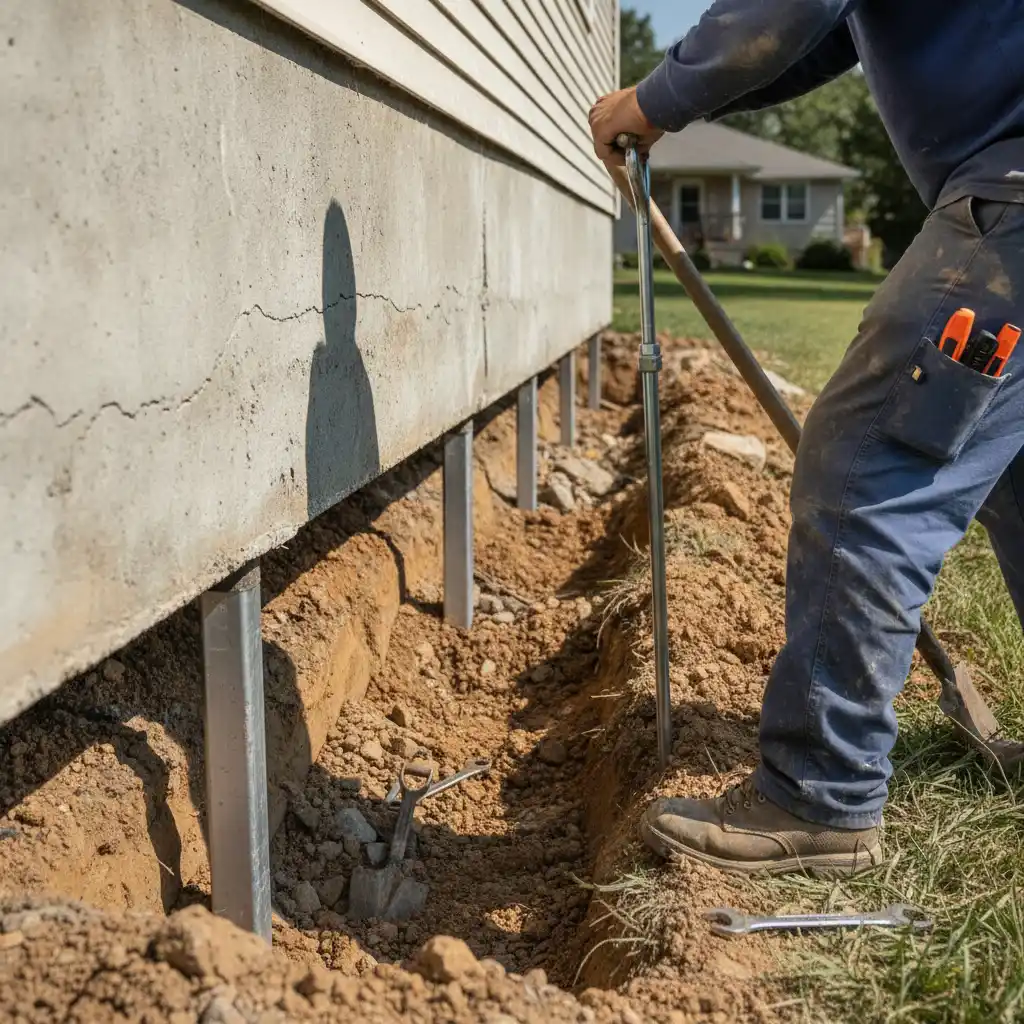
Our team in action — foundation-repair professionals serving Cedar Park
Foundation Patching Methods We Use in Cedar Park
Epoxy Crack Injection
Best for: Structural cracks in dry conditions, cracks 0.002 inches to 1/2 inch wide. Epoxy injection restores structural integrity by bonding crack faces together with a material stronger than the original concrete (compressive strength exceeding 12,000 PSI). We use this method extensively in Cedar Park slab foundations where cracks have stabilized but require long-term sealing against moisture intrusion.
Polyurethane Foam Injection
Best for: Active water-infiltrating cracks, cracks with slight ongoing movement. Polyurethane foam expands to fill voids, is flexible once cured, and creates a watertight seal. Particularly effective for Cedar Park homes during or shortly after the spring rain season when cracks may still have residual moisture.
Hydraulic Cement Patching
Best for: Active water flow through cracks or penetrations. Sets in 3 to 5 minutes even under water pressure. Used for urgent repairs during wet conditions common in Cedar Park’s late spring storm season.
Polymer-Modified Mortar Repair
Best for: Surface spalling, large surface voids, and exposed aggregate areas. Our mortar formulations include acrylic and latex polymers that improve adhesion and flexibility — essential for Cedar Park’s temperature range, which swings from below 20°F during winter storms to 110°F in summer.
Carbon Fiber Staples and Stitching
Best for: Wide cracks with risk of continued movement or cracks in load-bearing stem walls. Carbon fiber staples are embedded across the crack to prevent further widening. Used in older Cedar Park pier-and-beam homes where stem wall cracking is more common. Learn about our Structural Foundation Repair services
Ready for Foundation Patching? Get Your Free Estimate Today.
Round Rock Foundation Repair Group serves Cedar Park and the surrounding area — we’ll be on-site within 24 hours.
📞 Call (512) 220-3502Foundation Patching Cost in Cedar Park, TX
Understanding the cost of foundation patching helps Cedar Park homeowners plan appropriately and avoid being caught off guard. Costs vary significantly based on crack severity, access difficulty, method required, and the number of locations needing repair.
Typical Price Ranges
- Minor hairline crack patching (1–3 cracks): $250 – $600
- Moderate crack repair with epoxy injection (3–8 locations): $600 – $1,800
- Extensive patching including polyurethane injection and surface restoration: $1,800 – $4,500
- Full perimeter stem wall patching with carbon fiber stitching: $4,500 – $8,000+
- Commercial foundation patching (warehouses, retail, office buildings): $5,000 – $25,000+ depending on square footage
Factors That Affect Cost in Cedar Park
- Crack width and depth: Wider, deeper cracks require more material and labor
- Active vs. dormant movement: Active cracks require more flexible (and more expensive) materials
- Access difficulty: Pier-and-beam crawl spaces in older Cedar Park homes add labor time
- Seasonal timing: Emergency repairs during peak summer season may carry premium rates
- Companion work needed: Drainage corrections or soil treatment alongside patching increases total project cost
Cedar Park homeowners should be cautious of quotes significantly below these ranges — inadequate surface preparation or low-quality patching compounds fail within one to two Texas summers. Call us at (512) 220-3502 for a transparent, detailed estimate. View all Foundation Patching services
Cedar Park Neighborhoods We Serve
Avery Ranch
One of Cedar Park’s largest master-planned communities, Avery Ranch features homes built primarily between 2002 and 2012 on post-tension slabs. Homes here back up to Brushy Creek greenbelt areas where soil moisture levels vary significantly between wooded and open sections. We frequently address re-entrant corner cracks and plumbing penetration failures in this neighborhood.
Buttercup Creek
An established Cedar Park community with homes from the early 1990s to mid-2000s, Buttercup Creek sits on some of the heaviest clay profiles in the city. Foundation movement during the 2011 and 2022 droughts affected a high percentage of properties here. Patching combined with root barrier installation (due to mature oak trees) is a common service package in this area.
Twin Creeks
Located along the western edge of Cedar Park near Anderson Mill Road, Twin Creeks features golf course-adjacent homes built in the early 2000s. Irrigation runoff from the golf course can create localized soil saturation adjacent to home foundations, leading to differential movement patterns we see regularly in this community.
Carriage Hills
This mid-2000s development in north Cedar Park near FM 1431 includes many homes that experienced foundation stress during the rapid population surge. We serve numerous homeowners in Carriage Hills with both patching and Home Foundation Repair services. Crawl Space Repair is also available for applicable structures.
Foundation Maintenance Tips for Cedar Park Homeowners
- Maintain consistent soil moisture year-round: Use a soaker hose system set 12–18 inches from the foundation perimeter during Cedar Park’s dry summers (typically June through September) to prevent clay soil from shrinking away from the slab.
- Ensure positive drainage: Grade soil so that the ground slopes away from your foundation at a minimum of 6 inches over the first 10 feet — critical given Cedar Park’s heavy spring rain events.
- Clean gutters twice yearly: Cedar Park’s live oak and cedar trees drop debris in spring and fall. Clogged gutters dump concentrated water directly at the foundation, a primary driver of localized heaving.
- Inspect and repair downspout extensions: Extend downspouts at least 5 feet from the foundation, discharging away from the home. Many Cedar Park lots with small setbacks require flexible extension pipes.
- Monitor and repair plumbing promptly: Schedule a plumbing pressure test every 3–5 years, especially for homes built before 2005 with copper supply lines under the slab.
- Control large tree roots: Cedar Park’s native cedar elms and live oaks develop aggressive root systems. Install root barriers within 10 feet of the foundation for any tree with a trunk diameter exceeding 4 inches.
- Inspect your foundation annually: Walk the perimeter each October after summer stress and each April after winter and spring moisture cycles. Document any new cracks with photographs and measurements.
Why Choose Round Rock Foundation Repair Group for Cedar Park Foundation Patching
Round Rock Foundation Repair Group is a locally rooted company serving Cedar Park and the broader Central Texas region. We are not a national franchise applying generic solutions — our team has worked in Cedar Park neighborhoods through multiple drought cycles, spring flood events, and the specific structural challenges that Williamson County clay soils create. We understand that the same crack means something different in Avery Ranch than it does in Anderson Mill, and we apply that local knowledge to every repair.
Our technicians are trained in the full spectrum of patching methods and material systems, ensuring your repair is matched to your foundation type, soil conditions, and crack characteristics — not to whatever material happens to be in the truck. We use only professional-grade, manufacturer-approved repair compounds rated for Central Texas temperature extremes.
We serve all Cedar Park neighborhoods as well as Round Rock, Georgetown, Austin, Brushy Creek, Pflugerville, and surrounding communities. Every project begins with an honest inspection and a transparent estimate. Call (512) 220-3502 to speak with a Cedar Park foundation specialist today. Explore our Foundation Restoration services
Frequently Asked Questions About Foundation Patching in Cedar Park, TX
How much does foundation patching cost in Cedar Park, TX?
Foundation patching in Cedar Park typically ranges from $250 for a single minor crack repair to $8,000 or more for extensive stem wall restoration with carbon fiber reinforcement. The most common residential patching projects — addressing 3 to 10 crack locations with epoxy or polyurethane injection — generally fall between $800 and $3,000. Contact us at (512) 220-3502 for a free estimate specific to your home.
How long does foundation patching take?
Most residential foundation patching projects in Cedar Park are completed within one to two days. Minor crack repairs may be finished in a single half-day visit. Larger projects involving multiple methods — such as combining epoxy injection with surface mortar restoration — typically require two full days plus a curing period of 24 to 72 hours before the area is returned to full use.
Will foundation patching permanently fix my foundation cracks?
Patching permanently seals and stabilizes cracks that have stopped moving. If the underlying cause — soil moisture imbalance, poor drainage, or active plumbing leaks — is not corrected, new cracks can develop. This is why our Cedar Park projects always include a written drainage and moisture management recommendation alongside the physical repair. Addressing both the symptom and the cause yields the most durable results.
Is Cedar Park’s soil really that hard on foundations?
Yes. Williamson County’s Vertisol clay soils have some of the highest plasticity indices in Texas, meaning they experience extreme volume changes with moisture fluctuation. Cedar Park’s pattern of wet springs followed by very dry summers — as seen dramatically in 2011 and again in 2022 — amplifies this effect. Homes in Cedar Park experience soil volume swings that can exert thousands of pounds of pressure per square foot on foundation edges seasonally.
Can I patch my foundation myself using products from a hardware store?
Consumer-grade concrete patching products are appropriate for very minor cosmetic surface repairs but are not suitable for structural crack sealing. They lack the adhesion strength, flexibility, and moisture resistance of professional-grade polymer-modified or epoxy systems. In Cedar Park’s climate, an improperly patched crack often reopens within one season. Professional repairs are a better long-term investment.
How do I know if my Cedar Park home needs patching or more extensive foundation repair?
Cracks narrower than 1/4 inch with no displacement and no water infiltration are generally candidates for patching. Cracks wider than 1/2 inch, cracks where one side is higher than the other, or cracking accompanied by significantly sloping floors typically indicate the need for pier installation or more comprehensive structural repair. Our inspection process distinguishes between these categories clearly. Schedule a Foundation Inspection
Do you offer foundation patching for commercial properties in Cedar Park?
Yes. Round Rock Foundation Repair Group provides Commercial Foundation Repair and patching services for retail centers, office buildings, warehouses, and multi-family properties throughout Cedar Park, including along the US-183A corridor and the 1890 Ranch commercial district. Commercial projects are assessed individually with detailed scope-of-work proposals.
What neighborhoods near Cedar Park do you serve?
We serve the full Cedar Park area including Avery Ranch, Buttercup Creek, Twin Creeks, Carriage Hills, and more. We also serve Round Rock, Georgetown, Austin, Brushy Creek, Pflugerville, Anderson Mill, Great Hills, Mayfield Ranch, Forest Creek, Behrens Ranch, Sendero Springs, Teravista, and all surrounding communities throughout the greater Austin metro. View all service areas
Get Expert Foundation Patching in Cedar Park, TX Today
Don’t let a small crack become a costly structural problem. Cedar Park’s expansive clay soils and extreme seasonal conditions mean that foundation issues left unaddressed will almost always worsen — especially heading into summer drought conditions or heavy spring rain cycles.
Round Rock Foundation Repair Group is ready to evaluate your foundation, identify the right patching solution, and deliver lasting results built for Central Texas conditions. Serving Cedar Park and all surrounding communities, we combine local expertise with professional-grade materials and proven repair methods.
Call us now at (512) 220-3502 to schedule your foundation inspection and get a transparent, no-obligation estimate. You can also reach us online to request an appointment at a time that works for your schedule. Protect your most important investment — act today before the next Texas summer takes its toll on your foundation.