Foundation Inspection in Cedar Park, TX
Thorough Foundation Inspection in Cedar Park, TX — Honest Assessments
Need a foundation inspection in Cedar Park, TX? Round Rock Foundation Repair Group provides expert inspections for clay soil conditions. Call (512) 220-3502 today.
- Licensed & Insured
- Locally Owned & Operated
- Free Inspection & Estimate
Request Your
Free EstimateA professional foundation inspection is the first and most critical step in protecting your home or commercial property from structural damage. At Round Rock Foundation Repair Group, we provide thorough, expert foundation inspections throughout Cedar Park, TX — evaluating every aspect of your structure’s base to identify current damage, developing risks, and long-term vulnerabilities before they become costly emergencies.
Cedar Park’s unique combination of expansive Blackland Prairie clay soils, dramatic seasonal rainfall swings, and rapid residential growth since the early 2000s creates conditions that challenge even well-built foundations year after year. Our team understands these local dynamics intimately. We have performed hundreds of inspections across Cedar Park’s neighborhoods, from newer subdivisions near US-183 to established homes closer to 1890 Ranch and Twin Creeks. Whether you are buying a new property, noticing warning signs, or simply maintaining your investment, a professional foundation inspection gives you actionable answers.
Call us today at (512) 220-3502 to schedule your inspection.
Understanding Foundation Inspection in Cedar Park, TX
A foundation inspection is a systematic, professional evaluation of a structure’s foundational elements — including the slab, piers, beams, grade beams, and surrounding drainage conditions. Unlike a general home inspection, a dedicated foundation inspection uses specialized diagnostic tools, elevation measurements, and soil analysis to produce a detailed picture of your foundation’s current condition and its trajectory over time.
Foundation inspections became increasingly standardized in Texas during the 1980s and 1990s as the state’s insurance industry and real estate market grappled with widespread foundation claims, particularly in regions underlain by reactive clay soils. The Texas Section of the American Society of Civil Engineers (ASCE) developed guidelines that engineers and foundation specialists still follow today, emphasizing moisture content uniformity beneath slabs, proper drainage grading, and pier load calculations.
In Cedar Park specifically, the overwhelming majority of residential structures built after the city’s incorporation in 1973 — and especially those constructed during the explosive growth boom from 2000 through 2023 — are post-tension or conventionally reinforced concrete slab-on-grade foundations. These slab systems are efficient and cost-effective, but they are acutely sensitive to the soil movement that Cedar Park’s geology promotes. Older homes near the historic downtown core along Bell Boulevard may feature pier-and-beam construction, which presents its own distinct inspection requirements, including crawl space evaluation and wood beam condition assessment.
Commercial properties in Cedar Park, such as those along Whitestone Boulevard, US-183A, and the 1890 Ranch commercial corridor, often feature deeper reinforced foundations or drilled pier systems that require specialized load testing and documentation during an inspection.
A complete foundation inspection from Round Rock Foundation Repair Group includes interior and exterior visual assessment, precise digital elevation surveys using Zip-Level instrumentation, drainage and grading evaluation, soil condition review, crack mapping and documentation, and a written report with repair recommendations if needed. Learn more about our full foundation inspection process
Why Foundation Inspection Is Needed in Cedar Park, TX
Cedar Park’s Expansive Clay Soils
The single greatest driver of foundation movement in Cedar Park is the prevalence of Blackland Prairie clay soils — specifically the Austin Clay and Houston Black Clay series — that underlie much of the city’s eastern and central areas. These soils are classified as “highly expansive,” with a Plasticity Index (PI) commonly ranging from 40 to 60 and shrink-swell potential that can produce vertical movement of 3 to 6 inches or more in drought-to-wet cycles. The Texas Shrink-Swell Map published by the Bureau of Economic Geology at UT Austin identifies Cedar Park’s eastern zones as among the most active in Williamson County.
Extreme Drought and Rainfall Cycles
Cedar Park experiences a continental subtropical climate with pronounced wet and dry seasons that directly fuel soil movement. The Central Texas drought of 2011 — the worst single-year drought in Texas recorded history, with Cedar Park receiving just 12.4 inches of rainfall versus a normal 32 inches — caused catastrophic soil shrinkage across the region. Countless Cedar Park foundations that had been stable for years developed new cracks, differential settlement, and door-frame distortion during and immediately following that event. Similarly, the historic rainfall brought by storms in May 2015, when parts of Williamson County received over 11 inches in 48 hours, caused rapid soil expansion and heave in areas that had dried out.
Rapid Development and Younger Foundations
Cedar Park’s population grew from approximately 26,000 in 2000 to over 82,000 by 2023, making it one of the fastest-growing cities in the United States. This explosive growth means tens of thousands of homes built during various market conditions, some with thinner slab designs or inadequate post-tension cable spacing. Subdivisions such as Buttercup Creek, Twin Creeks, and Forest Oaks — many developed between 2003 and 2012 — are now reaching the 10-to-20-year mark where deferred foundation maintenance often becomes visible and urgent.
Topographic Variation and Drainage Challenges
Cedar Park’s terrain transitions between the limestone-underlain Texas Hill Country to the west and the clay-dominant Blackland Prairie to the east. Neighborhoods near Brushy Creek Regional Trail and the Brushy Creek corridor experience periodic flooding and prolonged soil saturation, while hilltop developments in the western parts of the city near Lakeline Boulevard face different challenges including limestone bedrock that limits drainage and concentrates surface water near foundations.
Root Systems from Native Trees
Cedar Park’s namesake Eastern Red Cedar trees, along with native live oaks, post oaks, and the many mature trees in older neighborhoods near Bell Boulevard and New Hope Drive, extend aggressive root systems that draw moisture from the soil immediately adjacent to foundations. During dry seasons, this concentrated moisture extraction accelerates differential settlement beneath and around slabs. Regular foundation inspections allow homeowners to monitor these effects before they become structural.
Signs You Need a Foundation Inspection in Cedar Park
Interior Warning Signs
- Diagonal cracks running from the corners of door frames or window frames — a hallmark of differential foundation settlement
- Doors and windows that stick, refuse to latch, or no longer sit square in their frames
- Cracks in drywall, especially stair-step patterns along wall seams
- Gaps appearing between walls and ceilings or walls and floors
- Floors that feel noticeably uneven, bouncy, or sloped when walking
- Cracked or buckled floor tiles, particularly in kitchens and bathrooms
Exterior Warning Signs
- Horizontal or stair-step cracks in brick veneer or mortar joints wider than 1/4 inch
- Visible gaps between the brick and window or door frames
- Cracks in the concrete slab edge visible along the perimeter
- Soil pulling away from the foundation creating a visible gap, common in Cedar Park during summer drought
- Poor drainage with water pooling within 6 feet of the foundation after rain
Urgency Indicators
Any crack wider than 1/4 inch, any door that has suddenly become inoperable, or any visible separation between structural elements warrants an immediate inspection. Cedar Park homeowners who notice these changes following a prolonged dry spell or immediately after heavy rains should schedule an inspection within days, not weeks.
Our Foundation Inspection Process in Cedar Park
Initial Consultation and History Review (15–20 Minutes)
Before arriving on-site, our team reviews any available information about your property, including construction year, prior repair history, and any known drainage or soil issues in your specific Cedar Park neighborhood. During this call or at arrival, we ask targeted questions about when you first noticed symptoms and what seasonal conditions preceded them.
Exterior Visual Assessment (20–30 Minutes)
Our inspector walks the complete perimeter of your structure, documenting crack locations, widths, and orientations; grading and drainage conditions relative to the foundation; vegetation proximity; and the condition of any visible slab edge, piers, or crawl space vents. In Cedar Park, we pay particular attention to soil-gap formation along the perimeter and signs of moisture intrusion from the Brushy Creek drainage basin in applicable neighborhoods.
Interior Visual Assessment (20–30 Minutes)
We systematically evaluate every room, noting crack patterns in walls, ceilings, and flooring. Door and window operability is tested throughout the structure. In pier-and-beam homes near Cedar Park’s older Bell Boulevard corridor, we also inspect the crawl space for beam condition, pier alignment, and moisture damage.
Precision Elevation Survey (30–45 Minutes)
Using Zip-Level Pro-2000 digital manometer instrumentation accurate to ±1/16 inch, we map elevation readings at a grid of points across the entire floor plan. This creates a topographic picture of the slab, identifying high and low spots, the direction of movement, and the magnitude of differential settlement. Cedar Park homes on expansive clay typically show meaningful elevation variance; our survey quantifies exactly how much.
Drainage and Grading Analysis (15–20 Minutes)
We evaluate surface drainage slopes, downspout discharge points, and any hardscape features that may be directing water toward the foundation. In Cedar Park’s clay-dominated soils, positive drainage of at least 6 inches drop over the first 10 feet from the structure is critical.
Documentation and Written Report (Delivered Within 24–48 Hours)
We compile all findings — photographs, elevation maps, crack diagrams, and drainage notes — into a comprehensive written inspection report. This report includes a clear assessment of foundation condition, any repair recommendations, estimated repair scope, and preventative maintenance guidance tailored to your Cedar Park property.
Consultation and Next Steps
We walk you through our findings in plain language, answer all questions, and help you understand your options — whether that means immediate structural foundation repair, a monitoring plan, or simply a maintenance schedule.
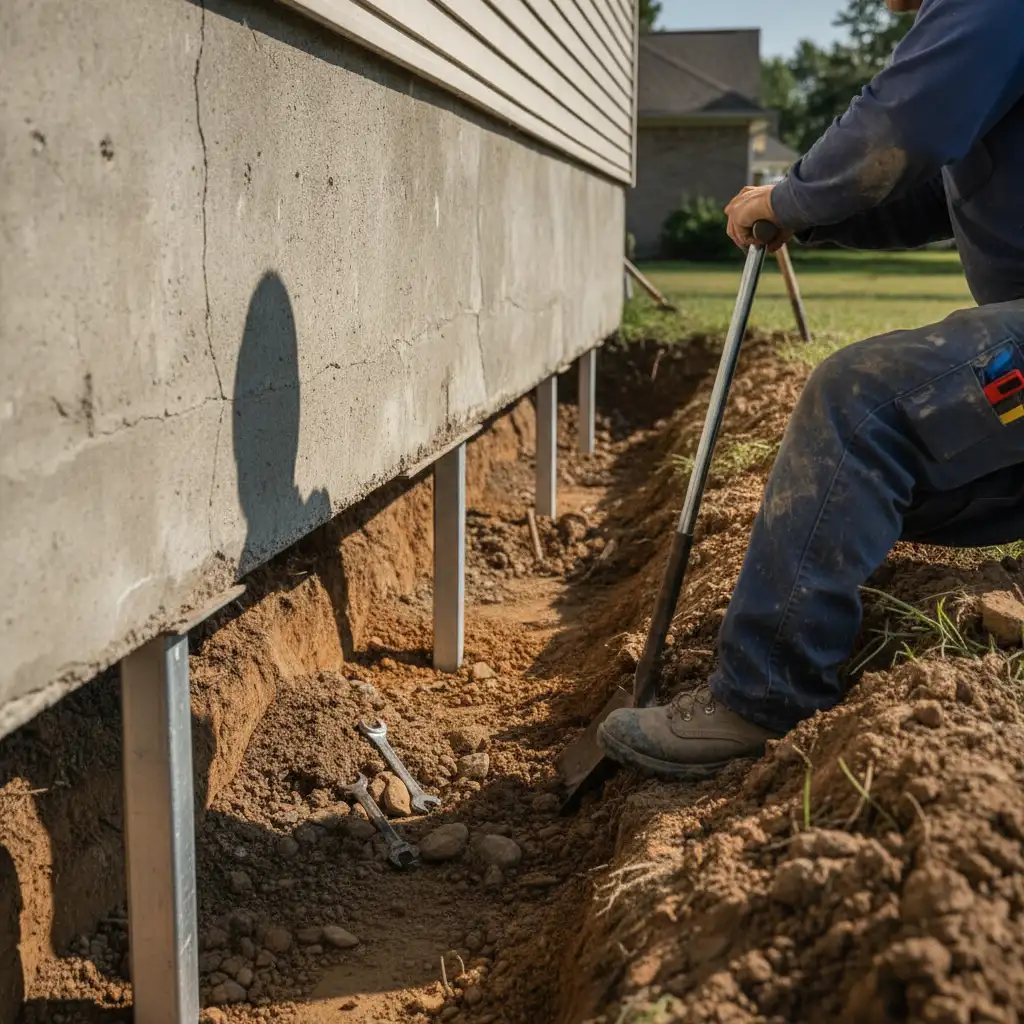
Our team in action — foundation-repair professionals serving Cedar Park
Foundation Inspection Methods and Approaches
Digital Elevation Mapping
The most objective diagnostic tool in our inspection is the Zip-Level digital elevation survey. By recording precise elevation data at dozens of points across your floor plan, we create a quantitative baseline that distinguishes cosmetic settling from actionable differential movement. In Cedar Park’s expansive clay environments, readings showing differential elevation of 1.5 inches or more over a 20-foot span typically indicate repair-level movement. This data also serves as a benchmark for future monitoring inspections.
Crack Classification and Mapping
Not all foundation cracks are equal. Our inspectors classify cracks by type (structural versus shrinkage), orientation (horizontal, vertical, diagonal, stair-step), width (hairline under 1/16 inch versus active at 1/4 inch or wider), and location relative to load-bearing elements. In Cedar Park brick veneer homes, stair-step cracking in the mortar bed joints is a particularly reliable indicator of differential slab settlement below.
Crawl Space and Pier-and-Beam Assessment
For Cedar Park’s older pier-and-beam homes, we conduct a hands-on crawl space inspection assessing wood beam integrity, pier plumb and condition, vapor barrier effectiveness, and signs of prolonged moisture. Crawl space repair is often the primary remediation need in these older structures.
Drainage and Moisture Pattern Analysis
We assess both surface drainage and evidence of subsurface moisture variation — including efflorescence on concrete, staining patterns, and vegetation health indicators. Cedar Park’s clay soils retain and channel moisture in predictable ways, and experienced inspectors can read these patterns to anticipate where foundation movement will occur next.
Plumbing Leak Correlation
Slab plumbing leaks beneath a foundation are a leading cause of localized heave and settlement in Cedar Park. Where our elevation survey or crack patterns suggest concentrated moisture movement, we advise homeowners to perform a static plumbing pressure test as a complementary diagnostic step.
Ready for Foundation Inspection? Get Your Free Estimate Today.
Round Rock Foundation Repair Group serves Cedar Park and the surrounding area — we’ll be on-site within 24 hours.
📞 Call (512) 220-3502Foundation Inspection Cost in Cedar Park, TX
Understanding the cost of a foundation inspection in Cedar Park helps homeowners budget appropriately and avoid being surprised by wide price ranges. Here is what you can expect:
Typical Price Ranges
- Standard Residential Inspection (slab-on-grade, under 2,500 sq ft): $300–$600
- Larger Residential Inspection (2,500–4,500 sq ft): $500–$850
- Pier-and-Beam Inspection with Crawl Space: $400–$750
- Commercial Property Inspection: $750–$2,500+ depending on building size and complexity
- Engineer-Stamped Inspection Report (PE Seal): Add $300–$600 to base inspection cost
What Affects Foundation Inspection Cost in Cedar Park
Property Size and Age: Larger and older homes require more inspection time and more elevation measurement points. Cedar Park homes built before 1990 near the Bell Boulevard corridor often require additional time for crawl space or aging slab assessment.
Report Type: A basic observational report costs less than a full engineering report with PE stamp, which is required by most Cedar Park lenders for real estate transactions involving documented foundation issues.
Re-Inspection Monitoring: Follow-up monitoring inspections to track foundation movement over time typically range from $150–$300 and are highly advisable for Cedar Park properties showing early-stage movement.
Cedar Park-Specific Pricing Notes
The high volume of foundation-related real estate transactions in Cedar Park’s active housing market means inspections tied to home purchases often have a faster turnaround requirement, which may affect scheduling priority fees. Costs for foundation inspections in Cedar Park are generally consistent with the greater Austin metro area market, though some contractors serving only Austin proper may charge travel surcharges for Cedar Park addresses — we do not.
Cedar Park Neighborhoods We Serve
Twin Creeks
Developed primarily between 2000 and 2010, Twin Creeks features a mix of single-family homes on post-tension slabs in the 1,800 to 3,200 square foot range. The neighborhood’s position near Brushy Creek and its tributary drainage corridors exposes many lots to cyclical moisture fluctuation. We regularly perform inspections and home foundation repair consultations in Twin Creeks, where early-stage settlement is common in homes approaching the 15-to-20-year mark.
Buttercup Creek
One of Cedar Park’s older planned communities, Buttercup Creek includes homes built from the late 1980s through the early 2000s. The variety of construction vintages means foundation systems range from older conventionally reinforced slabs to more modern post-tension designs, requiring inspection approaches tailored to each era.
Forest Oaks
Situated in Cedar Park’s eastern quadrant on heavily expansive clay soils, Forest Oaks homes built between 2004 and 2012 have experienced above-average foundation movement rates. The 2011 drought had a particularly pronounced impact on properties here, and many homeowners have had repairs performed once but benefit from annual monitoring inspections.
1890 Ranch
This large master-planned community along US-183A includes both residential and commercial properties. The newer construction phases, some completed as recently as 2020, include thicker slab designs, but lot grading variations across the development make drainage-related inspection findings common. Commercial foundation repair needs also arise frequently in 1890 Ranch’s retail and office corridor.
Foundation Maintenance Tips for Cedar Park Homeowners
- Maintain Consistent Soil Moisture Year-Round: In Cedar Park’s climate, use a soaker hose system placed 18–24 inches from the foundation perimeter and run it during dry spells — especially July through September — to prevent the dramatic soil shrinkage that triggers settlement.
- Ensure Positive Drainage Away from the Foundation: Maintain at least a 6-inch drop in grade over the first 10 feet surrounding your home. Re-grade low spots annually, particularly after Cedar Park’s heavy spring rains displace mulch and soil.
- Direct Downspouts at Least 5 Feet from the Foundation: Extend all gutter downspouts with splash blocks or flexible extensions to move roof water well away from your slab edge.
- Control Tree Root Encroachment: Maintain a minimum 10-foot clearance between large trees — particularly the Eastern Red Cedars and live oaks common throughout Cedar Park — and your foundation. Install root barriers where necessary.
- Check and Repair Plumbing Leaks Promptly: Have your slab plumbing pressure-tested every 5–7 years, especially if your Cedar Park home was built before 2005 and uses copper or cast-iron supply lines.
- Keep Flower Beds Properly Sloped: Raised flower beds against the foundation are a common cause of concentrated moisture in Cedar Park. Ensure bed soil slopes away and that bed borders do not trap water against brick or siding.
- Schedule Annual or Biennial Monitoring Inspections: For Cedar Park properties that have shown any historical movement, a brief annual elevation check is the most cost-effective way to catch new movement before it requires major repair.
Why Choose Round Rock Foundation Repair Group for Your Cedar Park Inspection
Round Rock Foundation Repair Group is locally based and exclusively serves the Cedar Park, Round Rock, Georgetown, and greater Austin area — meaning our inspectors understand Cedar Park’s specific soil maps, drainage patterns, neighborhood construction vintages, and seasonal weather cycles at a level that out-of-market companies simply cannot match. When we inspect a home in Buttercup Creek or Forest Oaks, we bring direct, cumulative knowledge of how those specific neighborhoods behave over time.
Our inspection team uses professional-grade Zip-Level digital elevation instrumentation, delivers written reports with photographic documentation, and provides honest, pressure-free recommendations. We perform structural foundation repair, foundation restoration, concrete foundation repair, crawl space repair, and foundation patching — so when an inspection reveals a need for repair, you have a single, trusted provider who already knows your property.
We serve homeowners, commercial property owners, real estate agents, and buyers throughout Cedar Park and surrounding communities. Call us at (512) 220-3502 for an honest assessment from a team that knows Cedar Park foundations.
Frequently Asked Questions: Foundation Inspection in Cedar Park, TX
How much does a foundation inspection cost in Cedar Park, TX?
Most residential foundation inspections in Cedar Park range from $300 to $750 depending on home size, foundation type, and whether a PE-stamped engineering report is required. Homes in larger Cedar Park subdivisions like 1890 Ranch or Twin Creeks that exceed 3,000 square feet typically fall in the $500–$750 range. Commercial inspections start at approximately $750. We provide transparent pricing before scheduling. See our full foundation inspection cost guide
How long does a foundation inspection take in Cedar Park?
A standard residential inspection takes approximately 1.5 to 2.5 hours on-site, depending on home size and the complexity of findings. The written report is typically delivered within 24 to 48 hours after the on-site visit. If your Cedar Park real estate transaction requires a rushed report, we offer expedited delivery when scheduling allows.
Do I need a foundation inspection when buying a home in Cedar Park?
Strongly yes. Cedar Park’s expansive clay soils and rapid development history mean that foundation issues are among the most common material defects in local real estate transactions. A general home inspector is not equipped to perform the elevation measurements and crack analysis that a dedicated foundation inspection provides. We strongly recommend a standalone foundation inspection for any Cedar Park home purchase, particularly for properties built before 2005 or in neighborhoods with known soil reactivity like Forest Oaks or Buttercup Creek.
What is the difference between a foundation inspection and a general home inspection in Cedar Park?
A general home inspector performs a broad visual review of all major home systems and is not trained or equipped to quantify foundation movement with precision instruments. A dedicated foundation inspection uses digital elevation mapping, crack classification protocols, and soil/drainage analysis to produce a structurally specific assessment. In Cedar Park’s clay soil environment, the precision of a dedicated foundation inspection is essential for meaningful diagnosis.
How often should Cedar Park homeowners have their foundations inspected?
For homes with no known history of movement, a professional inspection every 3 to 5 years is a reasonable baseline. For Cedar Park homes in high-clay-soil areas (eastern neighborhoods near Parmer Lane and US-183), homes near Brushy Creek drainage corridors, or any home that has undergone prior foundation repair, annual monitoring inspections are advisable. After extreme weather events — such as the prolonged droughts that Cedar Park experienced in 2011 and again in 2022 — a post-event inspection is a wise precaution regardless of inspection history.
Can a foundation inspection tell me if I have a slab plumbing leak in my Cedar Park home?
A foundation inspection can identify the signatures of a plumbing leak — including localized upward heave, staining patterns, and concentrated crack activity — but it does not replace a plumbing pressure test. When our elevation survey or crack mapping in a Cedar Park home suggests a potential plumbing leak beneath the slab, we document our findings and recommend a plumber perform a static pressure test as the next diagnostic step.
What happens if the inspection finds foundation damage in my Cedar Park home?
We walk you through every finding, explain the severity and urgency, and provide a written repair recommendation. Depending on findings, solutions may range from drainage correction and a soaker hose installation — which can stabilize a Cedar Park slab before significant repair is needed — to structural foundation repair using pressed pilings, drilled piers, or foundation patching for isolated surface damage. We provide all applicable repair services in Cedar Park and the surrounding area.
Does Round Rock Foundation Repair Group serve all of Cedar Park, TX?
Yes. We serve all Cedar Park neighborhoods including Twin Creeks, Buttercup Creek, Forest Oaks, 1890 Ranch, Ranch at Brushy Creek, Crossings at Carriage Hills, Anderson Mill West, and all surrounding areas. We also serve Round Rock, Georgetown, Austin, Pflugerville, Brushy Creek, and the broader Central Texas region. View our full service area
Schedule Your Foundation Inspection in Cedar Park, TX Today
Your Cedar Park home is likely your most valuable asset — and its foundation is what everything else depends on. Whether you have noticed cracking walls, sticking doors, or simply want the peace of mind that comes from knowing your foundation is stable, Round Rock Foundation Repair Group is ready to help.
Our team serves all of Cedar Park and the greater Austin area. We deliver honest, thorough inspections with no-pressure recommendations, written reports, and the local expertise that Cedar Park’s expansive clay soils demand.
Call us now at (512) 220-3502 to schedule your foundation inspection. We offer flexible scheduling for Cedar Park homeowners, real estate agents, and commercial property managers. Do not wait until a small problem becomes a major repair — contact Round Rock Foundation Repair Group today.