Home Foundation Repair in Georgetown, TX
Fast, Reliable Home Foundation Repair in Georgetown, TX — Licensed & Insured
Need home foundation repair in Georgetown, TX? Round Rock Foundation Repair Group fixes slab, pier & beam, and crawl space issues. Call (512) 220-3502 today.
Georgetown, Texas is one of the fastest-growing cities in the United States, and with that rapid growth comes a critical challenge that many homeowners face: foundation problems. The expansive clay soils beneath Georgetown’s neighborhoods, combined with the region’s dramatic wet and dry cycles, create some of the most demanding foundation conditions in Central Texas. Home Foundation Repair in Georgetown, TX is not a one-size-fits-all service — it requires deep local knowledge, proven techniques, and equipment suited to the unique geology of Williamson County.
At Round Rock Foundation Repair Group, we specialize in diagnosing and repairing residential foundations throughout Georgetown and the surrounding communities. Whether you’re dealing with hairline cracks in your brick veneer, sticking doors along your hallway, or visibly sloping floors in a home built during Georgetown’s 1990s housing boom, our team brings the expertise to restore your home’s structural integrity safely and permanently. Call us today at (512) 220-3502 to schedule your inspection.
Understanding Home Foundation Repair in Georgetown, TX
A home’s foundation is its most critical structural component. It transfers the weight of the entire structure — walls, roof, floors, and contents — into the ground below. When the soil beneath a foundation shifts, swells, shrinks, or becomes saturated, that transfer of load is disrupted, and the foundation begins to move. This movement, even measured in fractions of an inch, can produce significant damage throughout a home over time.
Home foundation repair encompasses a wide range of corrective measures designed to stabilize, lift, or restore a foundation that has been compromised by soil movement, water intrusion, poor initial construction, or natural settling. The discipline has evolved significantly since the mid-twentieth century, when simple concrete piers were the primary solution. Today, engineers and contractors use hydraulic steel piers, helical piers, polyurethane foam injection, carbon fiber reinforcement, and a host of other technologies to address foundation issues with greater precision and longevity.
Read moreShow less
In Georgetown specifically, the residential building stock spans several distinct eras. The historic downtown area features homes built as early as the 1870s and 1880s, constructed on shallow slab or pier-and-beam systems that were engineered for the soil conditions of that era — but not necessarily for today’s drought-and-flood extremes. The post–World War II subdivisions that filled in along Williams Drive and Austin Avenue through the 1960s and 1970s predominantly used slab-on-grade construction with minimal post-tension reinforcement. The explosive suburban development of the 1990s and 2000s brought thousands of new homes to areas like Teravista and Georgetown Village, many of which were built quickly on expansive soils that were not adequately prepared. Each of these eras presents its own set of foundation challenges, and understanding the history of a home’s construction is an important first step in diagnosing what has gone wrong and how to fix it.
Foundation repair in Georgetown is also closely tied to the local water table, drainage patterns, and the presence of Blackland Prairie soils — a topic we explore in depth in the following section. Proper repair requires not only fixing the existing damage but also addressing the root causes so that the problem does not recur.
Why Home Foundation Repair Is Needed in Georgetown, TX
Georgetown’s Expansive Clay Soils: The Root Cause
The single greatest contributor to foundation problems in Georgetown is the soil. Williamson County sits at the eastern edge of the Edwards Plateau, where the underlying geology transitions from limestone bedrock in the west to deep deposits of Blackland Prairie clay in the east. Georgetown’s residential neighborhoods — particularly those east of Interstate 35, including Teravista, Georgetown Village, and Sun City Texas — are built directly on Taylor Clay and Austin Chalk formations. Taylor Clay is among the most expansive soils in North America, capable of swelling up to 10 to 15 percent in volume when saturated and shrinking dramatically during dry periods.
This swell-shrink cycle exerts tremendous upward and lateral pressure on concrete slabs. During a wet spring, a Georgetown home’s foundation may be pushed upward by as much as 2 to 4 inches in isolated areas where water pools. During the brutal summers — such as the record-breaking drought of 2011, when Georgetown recorded 90 consecutive days above 100°F and Williamson County was declared a federal disaster area — that same clay can pull away from the foundation perimeter, leaving voids that cause slab edges to drop by 1 to 3 inches.
Named Weather Events That Have Damaged Georgetown Foundations
Several specific weather events have accelerated foundation damage across Georgetown neighborhoods. The 2011 Texas drought is widely considered the most damaging single-year event for residential foundations in Central Texas history, affecting thousands of homes in Georgetown alone. The 2015 Memorial Day floods, which dropped more than 11 inches of rain in parts of Williamson County over a 48-hour period, caused rapid soil saturation that created heaving conditions in many neighborhoods. More recently, Winter Storm Uri in February 2021 froze soil at unprecedented depths, causing frost heave and subsequent settling in areas that rarely experience sustained below-freezing temperatures, including neighborhoods in the Sun City and Wolf Ranch communities.
Neighborhood-Specific Challenges
In the historic Courthouse Square district, homes built on pier-and-beam systems face wood rot and moisture intrusion in crawl spaces that are inadequately ventilated for Georgetown’s humidity levels, which average 65 to 75 percent relative humidity from May through September. In Teravista, the rolling topography creates natural drainage patterns that direct water toward certain home sites, concentrating soil movement pressure on downhill foundations. Sun City Texas, Georgetown’s large active-adult community established in 1995, contains thousands of homes on slab foundations that are now 25 to nearly 30 years old — old enough to show the cumulative effects of decades of clay movement.
The combination of expansive soils, extreme weather cycles, rapid construction, and an aging housing stock makes Georgetown one of the most foundation-repair-active markets in Central Texas. Addressing these issues promptly protects both home value and structural safety.
Free, no-obligation estimates
Talk to Round Rock Foundation Repair Group
Tell us what you need and we’ll take it from there.
Signs You Need Home Foundation Repair in Georgetown, TX
Interior Warning Signs
- Diagonal cracks at door corners or window corners, typically running at 45-degree angles
- Doors that stick, bind, or no longer latch properly, especially interior doors along a hallway
- Windows that are difficult to open or have visibly out-of-square frames
- Gaps appearing between walls and ceilings, or between walls and baseboards
- Floors that slope more than 1 inch per 10 feet of run, detectable with a level
- Cracks in drywall that return after being patched and repainted
Exterior Warning Signs
- Stair-step cracks in brick veneer, particularly at corners or near garage openings
- Visible separation between the chimney and the main roofline
- Concrete porch or garage floor pulling away from the main slab
- Cracks in the foundation stem wall or visible at the base of exterior walls
Urgency Indicators
If you observe cracks wider than one-quarter inch, doors that will not close at all, or floors with a slope exceeding 2 inches across a room, these are urgent warning signs requiring immediate professional inspection. Georgetown homeowners should also be vigilant after any significant weather event — particularly following extended drought periods or heavy rainfall — as soil movement is most active during these transitions.
Our process
Our Home Foundation Repair Process in Georgetown, TX
- 01
Comprehensive Foundation Inspection (Day 1)
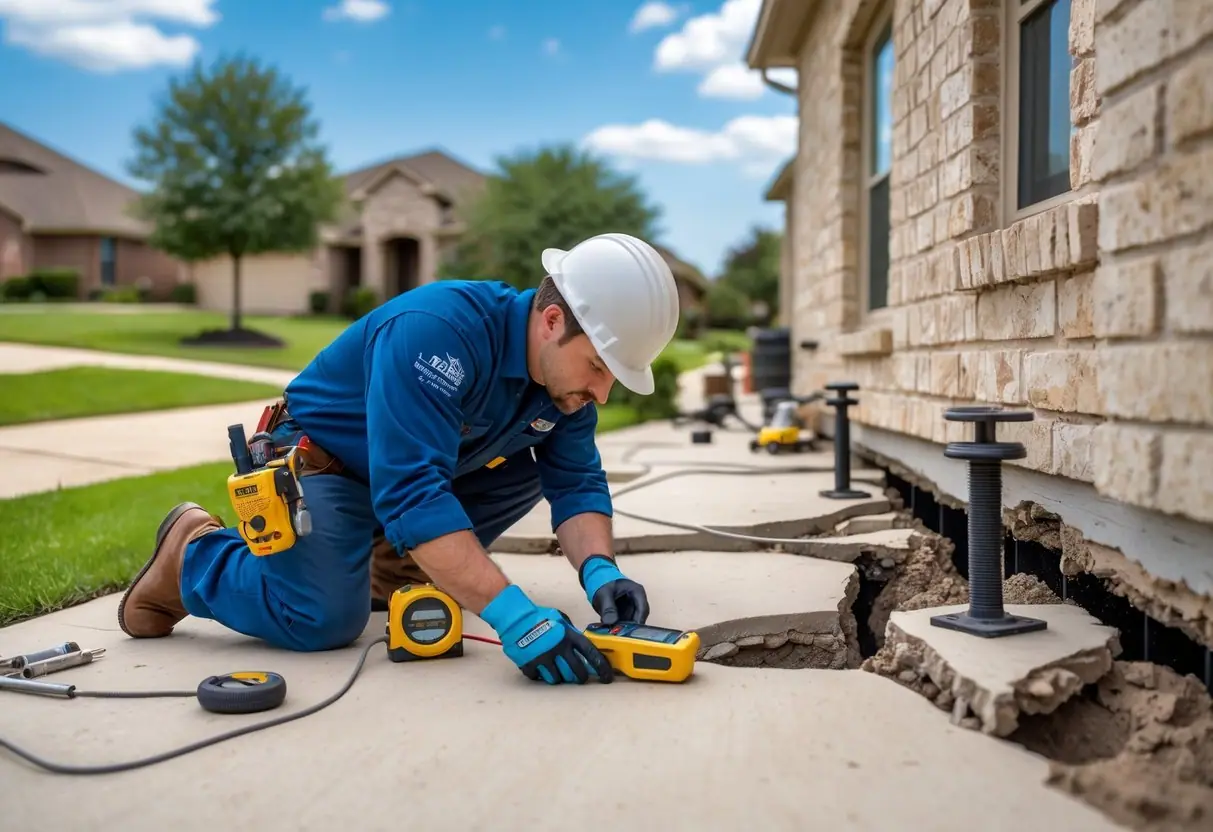
Our licensed inspector visits your Georgetown property and performs a full interior and exterior evaluation. We use a Zip Level Pro-2000 altimeter to measure differential elevation across your slab to within one-hundredth of an inch. We document all visible cr
- 02
Soil and Site Assessment (Day 1–2)
Because Georgetown’s soils vary significantly even within a single neighborhood, we assess soil conditions at your specific site. We note proximity to trees — particularly live oaks and cedar elms common in Georgetown landscaping — which can draw moisture from
- 03
Engineering Review and Repair Plan (Days 3–5)
Our team prepares a detailed repair plan, which for complex jobs may involve coordination with a licensed structural engineer. We determine the appropriate repair method, number of piers required, and any drainage corrections needed. We provide a written estim
- 04
Site Preparation and Permitting (Days 5–10)
We handle all required permitting with the City of Georgetown Development Services Department. We protect your landscaping and prepare access points for pier installation equipment, with minimal disruption to your property.
- 05
Foundation Repair Execution (Days 10–14 Typically)
Pier installation, crack repair, or other structural corrections are completed by our certified crew. Most Georgetown residential repairs are completed in one to three days on-site, depending on scope.
- 06
Drainage and Moisture Corrections
Where needed, we install root barriers, French drains, or downspout extensions to redirect water away from the foundation — a critical step given Georgetown’s clay soil reactivity.
- 07
Final Inspection and Documentation
We perform a post-repair elevation survey, document all work completed, and walk you through maintenance recommendations specific to your Georgetown home’s soil conditions and drainage environment.
Foundation Repair Methods and Approaches We Use in Georgetown
Hydraulic Steel Push Piers
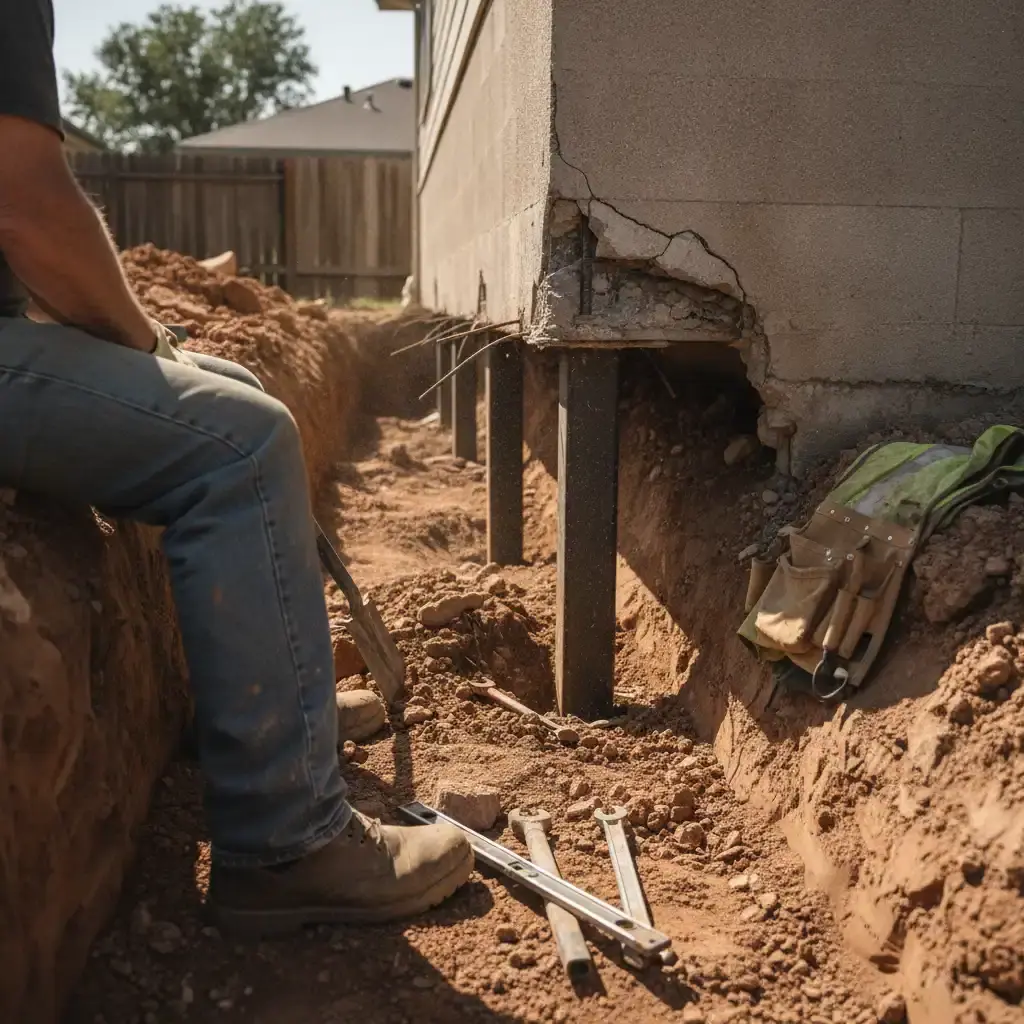
Push piers are driven deep into the earth until they reach load-bearing strata — in Georgetown’s eastern neighborhoods, this typically means driving through Taylor Clay until reaching stable Austin Chalk limestone at depths of 15 to 25 feet. Push piers are ideal for sinking foundations in Sun City Texas, Teravista, and Georgetown Village. Learn more about steel push pier installation
Helical Piers
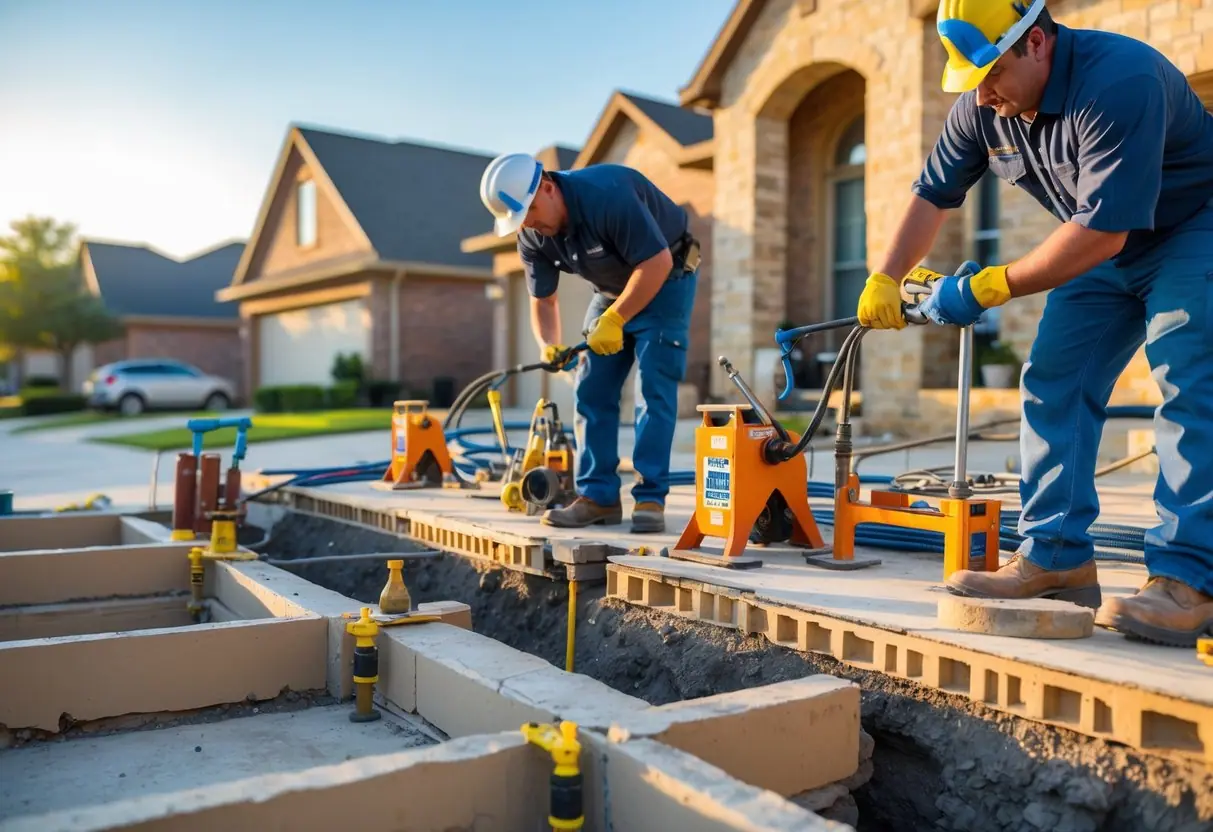
Helical piers are screwed into the ground using a hydraulic torque motor and are particularly effective where soil conditions are variable or where access is limited — such as in the tight crawl spaces of Georgetown’s historic downtown homes. They can be installed in areas with high moisture content without risk of pier drift.
Concrete Pressed Piling
Cylindrical concrete pilings pressed into the soil are a cost-effective option commonly used in Georgetown’s mid-range residential market. They perform well in consistent clay soil profiles found in many Wolf Ranch and Georgetown Village neighborhoods.
Polyurethane Foam Injection
For minor slab voids, settlement of interior floors, and sidewalk or driveway lifting, high-density polyurethane foam is injected through small drilled holes to fill voids and gently re-level concrete. This method is minimally invasive and is often completed in a single day.
Carbon Fiber Wall Reinforcement
For bowing or cracking foundation walls in Georgetown’s pier-and-beam homes, carbon fiber straps bonded to the wall surface provide tensile strength without the need for excavation. Explore carbon fiber foundation reinforcement
Home Foundation Repair Cost in Georgetown, TX
One of the most common questions Georgetown homeowners ask is: how much does home foundation repair cost? The answer depends on several variables, but we can provide realistic ranges based on our experience in the Georgetown and greater Williamson County market.
Typical Cost Ranges
- Foundation Inspection: $200–$500 for a professional inspection with elevation mapping; some companies offer free inspections on qualifying properties
- Minor Crack Repair and Patching: $500–$1,500 for cosmetic and surface-level concrete crack repair
- Pier Installation (per pier): $400–$800 per steel push pier or helical pier, fully installed
- Average Georgetown Residential Repair: $4,500–$12,000 for a typical slab foundation repair requiring 8 to 18 piers
- Extensive Structural Repair: $15,000–$30,000+ for severe cases involving multiple elevation issues, drainage correction, and engineering oversight
- Crawl Space Repair: $3,000–$8,000 depending on scope of pier replacement and moisture barrier installation
Read moreShow less
Georgetown-Specific Cost Factors
Several factors can affect your specific cost in Georgetown. The depth required to reach stable Austin Chalk bedrock — which varies across the city — directly affects pier cost. Homes in the historic district with limited equipment access may require hand-excavation, increasing labor costs. Properties with significant drainage problems may require additional investments in French drains or grading, typically ranging from $1,500 to $5,000. Most major foundation repairs in Georgetown qualify for homeowner financing, and we work with several lenders offering 0-percent interest promotional periods. Explore foundation repair financing options

Georgetown Neighborhoods We Serve
Sun City Texas
Established in 1995 and now home to more than 10,000 residents, Sun City Texas features thousands of slab-on-grade homes built across multiple phases through the mid-2010s. The earlier-phase homes (1995–2005) in Sun City are now showing the cumulative effects of 20-plus years of clay movement and are among the most common repair candidates in our Georgetown service area.
Teravista
This master-planned community straddles the Round Rock–Georgetown border and features rolling topography that creates drainage challenges for downhill home sites. Homes built in the early 2000s are increasingly showing pier-area settlement as initial soil compaction relaxes.
Georgetown Village
Located along Williams Drive near the SW Bypass, Georgetown Village was developed primarily in the 1990s and 2000s. The flat terrain here means water drains slowly, contributing to soil saturation during Georgetown’s wet seasons and accelerating heaving and settlement cycles.
Historic Downtown Georgetown
The Courthouse Square area and surrounding residential blocks feature some of the city’s oldest homes, many on original pier-and-beam construction. These properties require specialized crawl space repair, wood pier replacement, and moisture barrier installation adapted to their age and construction style. Learn about our crawl space repair services
Foundation Maintenance Tips for Georgetown Homeowners
Preventing foundation damage — or preventing repaired foundations from requiring future work — requires year-round attention to moisture management around your Georgetown home.
- Maintain consistent soil moisture: During Georgetown’s dry summers, run soaker hoses 18 to 24 inches from your foundation perimeter 2 to 3 times per week to prevent clay shrinkage.
- Clean gutters seasonally: Georgetown’s live oak and cedar trees drop heavy debris; clogged gutters cause water to cascade against the foundation rather than being directed away.
- Ensure positive drainage: The soil around your home should slope away at a minimum of 6 inches of drop over the first 10 feet from the foundation.
- Extend downspouts: All downspout extensions should discharge at least 5 feet from the foundation edge — 10 feet is ideal for Georgetown’s clay soils.
- Monitor large trees: Keep mature trees pruned and consider root barriers for trees within 20 feet of your foundation.
- Fix plumbing leaks immediately: A slow drip under a slab can saturate clay soil beneath your foundation within weeks, causing localized heaving.
- Schedule annual inspections: Annual professional elevation checks allow early detection of movement before it becomes costly structural damage.
Why Choose Round Rock Foundation Repair Group for Georgetown Home Foundation Repair
Round Rock Foundation Repair Group has built its reputation serving homeowners throughout Georgetown, Round Rock, Cedar Park, and the greater Austin metro area. We understand the specific soil conditions, weather patterns, and construction eras that define Georgetown’s residential foundation challenges — and we bring that local knowledge to every project we take on.
Our team is experienced across the full spectrum of foundation repair services: from structural foundation repair and concrete foundation repair to crawl space repair, foundation patching, and commercial foundation repair. We do not subcontract our core repair work — the crew that shows up at your Georgetown home is our crew, trained in the methods and standards we stand behind.
Read moreShow less
We serve Georgetown homeowners with the same dedication we bring to every community in our service area, including Round Rock, Cedar Park, Pflugerville, Austin, and neighborhoods throughout Williamson and Travis counties. When you call (512) 220-3502, you reach a local team that knows your neighborhood, your soil type, and the most effective repair strategy for your specific situation. Learn more about our team and approach
FAQ
Frequently Asked Questions About Home Foundation Repair in Georgetown, TX
How much does home foundation repair cost in Georgetown, TX?
Most Georgetown residential foundation repairs fall between $4,500 and $12,000 for a standard slab repair requiring 8 to 18 piers. Minor crack patching can be as low as $500 to $1,500, while extensive structural repairs involving drainage corrections and engineering oversight can reach $20,000 to $30,000 or more. We provide free, written estimates before any work begins.
How long does foundation repair take for a Georgetown home?
Most residential foundation repairs in Georgetown are completed in one to three days of on-site work, following the inspection, planning, and permitting phase, which typically takes 7 to 14 days. Larger or more complex projects — particularly older homes in the historic district or large Sun City properties — may require additional time.
Does my Georgetown home need a permit for foundation repair?
Yes. The City of Georgetown requires permits for structural foundation repairs. Round Rock Foundation Repair Group handles all permitting with the City of Georgetown Development Services Department on your behalf, including scheduling any required inspections.
Will my homeowner’s insurance cover foundation repair in Georgetown?
Standard homeowner’s insurance policies in Texas typically exclude foundation damage caused by soil movement, settling, or shrinkage — which are the primary causes of foundation problems in Georgetown. However, if foundation damage is caused by a covered peril such as a plumbing leak, a portion of repair costs may be covered. We recommend reviewing your policy and consulting with your insurance provider. We can provide documentation to support your claim where applicable.
What causes foundation problems specifically in Georgetown neighborhoods?
Georgetown’s foundations are primarily challenged by Taylor Clay and Blackland Prairie soils, which expand and contract dramatically with moisture changes. Georgetown’s climate — wet springs, intensely hot and dry summers, and periodic freeze events — creates repeated cycles of soil heaving and shrinkage. Named events like the 2011 drought, the 2015 Memorial Day floods, and Winter Storm Uri in 2021 have each caused measurable foundation damage across Georgetown neighborhoods.
Are pier-and-beam foundations in Georgetown’s older homes repairable?
Yes. Pier-and-beam foundations, common in Georgetown’s historic downtown and older residential areas, are often more accessible for repair than slab foundations. We can replace deteriorated wood piers with concrete or steel alternatives, install moisture barriers, improve crawl space ventilation, and address drainage issues — all without major disruption to the home above. Learn more about pier-and-beam foundation repair
How do I know if my Georgetown home’s foundation is settling or heaving?
Settling causes the foundation to drop, typically at the perimeter, and is most common during Georgetown’s dry summer months when clay soils shrink. Heaving causes the foundation to rise, most often at the interior or where water pools, and is more common during wet periods. Both produce similar symptoms — cracking, sticking doors, sloping floors — but require different repair approaches. A professional elevation survey using precision measurement equipment is the most reliable way to distinguish between the two.
How soon after heavy rain or drought should I have my Georgetown foundation inspected?
We recommend scheduling an inspection within 30 to 60 days following any significant weather event — either a prolonged drought or heavy rainfall event like those Georgetown commonly experiences. This timing allows soil conditions to partially stabilize while still capturing evidence of movement before it is masked by seasonal moisture rebound.
Schedule Your Georgetown Foundation Inspection Today
If you’ve noticed cracks, sticking doors, sloping floors, or any other signs of foundation movement in your Georgetown home, don’t wait. Foundation problems in Georgetown’s expansive clay soils typically worsen over time — and the cost of early repair is almost always significantly lower than the cost of delayed intervention.
Round Rock Foundation Repair Group serves Georgetown, Sun City Texas, Teravista, Georgetown Village, the historic downtown district, and communities throughout Williamson and Travis counties. Our team is ready to provide an honest, thorough assessment of your home’s foundation and a clear path to lasting repair.
Call us now at (512) 220-3502 to schedule your inspection. Request a free estimate online and one of our Georgetown-area specialists will follow up within one business day. Protect your home. Protect your investment. Call Round Rock Foundation Repair Group today.
Get in touch
Find foundation repair help near you
Request a free estimate online or give us a call — our team will follow up quickly.
- Call us(512) 220-3502
- Visit1 Chisholm Trail Rd suite 450 room j, Round Rock, TX 78681
- HoursMon-Sat: 7:00 am – 7:00 pm