Foundation Restoration in Georgetown, TX
Structural Foundation Restoration Specialists Serving Georgetown, TX
Need foundation restoration in Georgetown, TX? Round Rock Foundation Repair Group fixes slab, crawl space & commercial foundations. Call (512) 220-3502 today.
- Licensed & Insured
- Locally Owned & Operated
- Free Inspection & Estimate
Request Your
Free EstimateFoundation restoration is the comprehensive process of diagnosing, stabilizing, and rebuilding a compromised home or commercial foundation to its original structural integrity — or better. Unlike simple patching, full restoration addresses the underlying causes of damage, ensuring long-term safety for your property and everyone inside it.
Georgetown, TX presents a uniquely challenging environment for foundations. The city’s expansive Blackland Prairie clay soils, dramatic seasonal moisture swings, and rapid residential growth in areas like Wolf Ranch and Georgetown Village create conditions that accelerate foundation movement far faster than in many other Central Texas communities. Homes built during the development booms of the 1990s through the 2010s are now reaching the age where deferred maintenance becomes structural risk.
At Round Rock Foundation Repair Group, we bring deep regional expertise to every foundation restoration project in Georgetown. Our crews understand local soil behavior, drainage patterns, and building construction norms — translating that knowledge into lasting repairs. Call us today at (512) 220-3502 for a professional assessment.
Understanding Foundation Restoration in Georgetown, TX
Foundation restoration is a multi-phase structural intervention that goes well beyond filling cracks or shimming a pier. It encompasses a full evaluation of load-bearing elements, drainage conditions, soil composition, and structural movement history — followed by engineered repairs designed to halt further movement and restore the home or building to code-compliant, safe condition.
The discipline evolved significantly in Texas throughout the mid-20th century as post-war suburban expansion pushed construction onto reactive clay soils that engineers in earlier eras had largely avoided. By the 1970s and 1980s, Texas homeowners and contractors were grappling with epidemic levels of foundation distress, particularly in communities built on the Blackland Prairie formation that stretches from Waco through Austin and directly through Williamson County — Georgetown’s home county.
Georgetown itself incorporated in 1848 and has experienced several distinct growth periods: the early downtown brick commercial buildings of the late 1800s, the post-WWII residential expansion, and the modern master-planned community boom beginning in the late 1990s. Each era produced buildings with different foundation types — from rubble stone foundations beneath historic structures on Austin Avenue, to conventional concrete slabs in Sun City Georgetown, to post-tension slabs in newer Wolf Ranch subdivisions. Foundation restoration must be tailored to the specific construction era and foundation type of each building.
Modern foundation restoration combines geotechnical science, structural engineering, and proven installation methods including pressed concrete piering, helical pier systems, and interior drainage management. The goal is not just cosmetic correction of visible damage, but permanent structural stabilization that accounts for Georgetown’s soil dynamics and climate variability. When performed correctly by licensed professionals familiar with Williamson County’s geology, foundation restoration can extend a structure’s safe service life by decades.
For Georgetown property owners, understanding what full restoration entails — versus superficial repair — is essential before investing in any foundation work. Schedule a Foundation Inspection to get an honest assessment of what your property actually needs.
Why Foundation Restoration Is Needed in Georgetown, TX
Georgetown’s Expansive Clay Soils
The dominant soil type beneath Georgetown’s residential and commercial districts is Houston Black clay — a member of the Blackland Prairie soil series classified by the USDA as having a Plasticity Index (PI) exceeding 40 in many areas. This means the soil expands dramatically when wet and contracts severely when dry, with volumetric changes of up to 30% recorded in Williamson County test borings. Neighborhoods like Georgetown Village, Teravista (which straddles the Round Rock/Georgetown boundary), and Berry Creek sit directly atop these highly reactive formations.
Drought and Rainfall Extremes
Georgetown averages approximately 34 inches of annual rainfall, but that average masks violent seasonal swings. The historic 2011 drought — the worst single-year drought in Texas recorded history — caused soil moisture deficits of 12 to 18 inches below normal across Williamson County. Thousands of Georgetown-area foundations dropped 1 to 3 inches during that period as clay soils desiccated and shrank beneath slabs. The subsequent wet winters of 2015–2016, which brought over 50 inches of annual rainfall to the region, caused rapid re-expansion. This cycle of extreme contraction and heave is the primary engine of foundation damage in Georgetown.
Rapid Development on Marginal Soils
Georgetown’s population grew from roughly 28,000 in 2000 to over 75,000 by 2020 — nearly tripling in two decades. Development pressure pushed new subdivisions like Wolf Ranch, Morningstar, and Parkside at Mayfield Ranch onto terrain that would have been passed over in slower-growth periods. Some of these developments required significant cut-and-fill grading, which can create differential soil density beneath slabs — one of the leading predictors of foundation movement within the first 10 years of construction.
Aging Infrastructure and Tree Root Intrusion
Georgetown’s older neighborhoods — particularly those within the Georgetown Historic District and along University Avenue — feature mature Live Oaks and Texas Pecans with root systems that extend 2 to 3 times the canopy diameter. These roots extract substantial soil moisture during dry periods, creating localized soil shrinkage directly beneath and around foundations. Plumbing systems in homes built before 1990 are also reaching end-of-life, and slab leaks from aging cast-iron or galvanized supply lines contribute significantly to localized soil erosion and foundation undermining.
Caliche Layers and Drainage Complications
Beneath Georgetown’s clay topsoil, caliche (calcium carbonate hardpan) layers are common at depths of 3 to 8 feet. These impermeable layers trap perched water during heavy rainfall events, preventing proper drainage and keeping soils saturated for extended periods — the exact opposite of drought conditions yet equally destructive to foundation stability. Neighborhoods built on the western limestone-transition zones, including portions of Serenada and Cimarron Hills, face this layered drainage challenge acutely.
Signs You Need Foundation Restoration in Georgetown, TX
Structural Warning Signs
- Diagonal cracks at door and window corners exceeding 1/4 inch in width
- Doors and windows that stick, fail to latch, or have visible gaps at frame corners
- Visible separation between walls and ceilings or walls and floors
- Bowing or leaning exterior brick veneer with stair-step mortar cracking
- Floors that slope more than 1 inch per 10 feet when measured with a level
Interior Warning Signs
- Sheetrock cracks that reappear after patching, particularly above doorways
- Gaps between baseboards and the floor, or crown molding pulling from the ceiling
- Tile floors with cracked grout lines in diagonal or grid patterns
- Cabinets separating from walls in kitchens or bathrooms
Exterior and Environmental Warning Signs
- Visible foundation cracks on exterior slab edges or pier-and-beam perimeter beams
- Pooling water within 6 feet of the foundation after rainfall
- Chimney leaning away from the roofline
- Garage floor separating from the main slab
Urgency Indicator: If you observe multiple signs simultaneously, or if cracks have grown measurably over a 30-day period, treat this as an emergency situation requiring immediate professional evaluation. Active movement is far more dangerous and expensive to address than stabilized historic damage. Book an Emergency Foundation Inspection Today
Our Foundation Restoration Process in Georgetown, TX
Initial Site Assessment (Day 1 — 1 to 2 Hours)
Our certified inspector visits your Georgetown property and conducts a systematic exterior and interior evaluation. We photograph all visible damage, measure floor elevations at 6-foot grid intervals using a Ziplevel Pro-2000 altimeter, and note drainage conditions around the perimeter. We review your home’s age, construction type, and any known plumbing history.
Soil and Drainage Analysis (Days 1–3)
Based on your Georgetown neighborhood and lot characteristics, we assess likely soil PI values using Williamson County geotechnical data and, when necessary, recommend a soil boring report. We identify drainage deficiencies, moisture intrusion sources, and any irrigation or tree-related soil moisture contributors specific to your site.
Engineered Repair Plan (Days 3–7)
We develop a written scope of work identifying pier locations, pier type, depth targets, and any supplemental drainage or plumbing corrections required. For Georgetown homes on Blackland Prairie clay, pier designs typically target depths of 16 to 30 feet to reach stable bearing strata below the active soil zone. You receive a clear proposal with itemized pricing before any work begins.
Site Preparation and Access (Day of Work, Morning)
Our crew protects landscaping, marks utility lines through 811 Texas One-Call, and positions equipment. Interior furniture is moved away from work zones. For slab foundations, concrete cutting is performed with diamond-blade equipment to minimize vibration and debris.
Pier Installation and Structural Lifting (1–3 Days Depending on Scope)
Piers are installed to engineered depth and load specifications. Hydraulic jacks are used to raise settled foundation sections incrementally — typically no more than 1/4 inch per lift cycle — to minimize stress on the structure. Final elevations are verified against our Day 1 baseline measurements.
Drainage and Supplemental Corrections (1–2 Days if Required)
French drains, surface grading corrections, or root barriers are installed as specified in the repair plan. Plumbing pressure tests may be conducted after lifting to confirm no new leak points exist.
Site Restoration and Final Walkthrough (Final Day)
Concrete patches are finished, landscaping is restored, and all work areas are cleaned. We conduct a final walkthrough with the homeowner, review maintenance recommendations specific to Georgetown’s climate, and deliver all documentation.
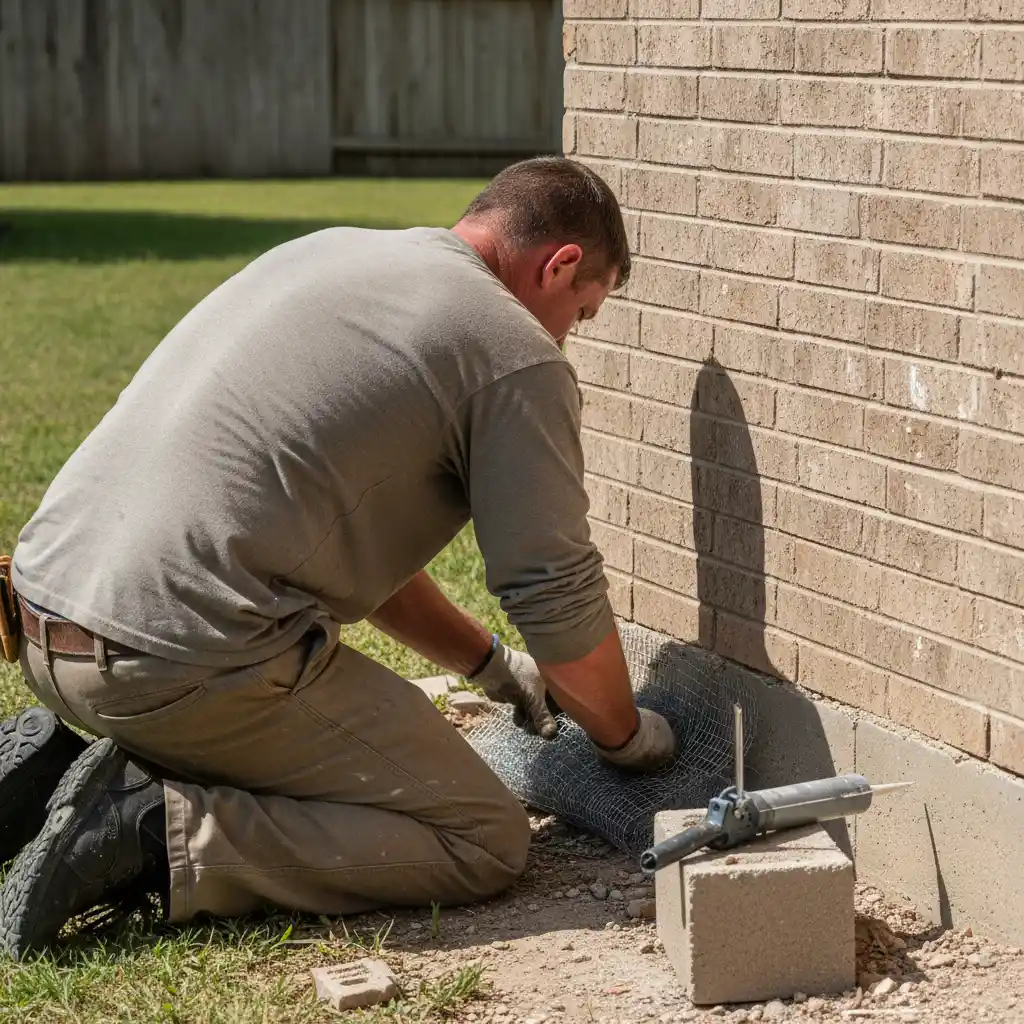
Our team in action — foundation-repair professionals serving Georgetown
Foundation Restoration Methods We Use in Georgetown, TX
Pressed Concrete Piering (Push Piers)
The most widely used method for Georgetown slab foundation restoration. Cylindrical concrete cylinders (typically 6 inches in diameter) are hydraulically pressed into the ground using the structure’s own weight as resistance, then locked in place beneath a pier bracket. Ideal for Georgetown’s deep clay soils where bearing strata may exist at 16 to 25 feet. Cost-effective for residential applications and suitable for most neighborhoods including Sun City Georgetown and Georgetown Village.
Helical Pier Systems
Steel shafts with helical bearing plates that are torque-driven into the soil. Helical piers are preferred when the structure’s dead load is insufficient to drive push piers — common in lighter commercial buildings, additions, or porches. They are also the method of choice for new construction underpinning on Georgetown’s western limestone-transition soils where variable bearing resistance exists.
Steel Push Piers (Resistance Piers)
Galvanized or epoxy-coated steel pipe sections driven to refusal depth — often 25 to 40 feet in Georgetown’s deeper clay profiles. Preferred for heavier structures or where load capacity requirements exceed what concrete cylinders can provide. Commonly used for commercial foundation repair in Georgetown’s downtown and IH-35 corridor commercial zones.
Slab Void Filling and Mud Jacking
For foundations that have not settled but have developed voids beneath the slab due to soil erosion, polyurethane foam injection or traditional mud jacking restores sub-slab support. Particularly applicable in Georgetown neighborhoods with aging plumbing where water intrusion has eroded fine soils from beneath interior slab sections.
Crawl Space Repair and Pier Shimming
Older Georgetown properties — particularly those in the historic downtown area and along Williams Drive — may feature pier-and-beam construction. These foundations are restored through replacement or addition of wood, concrete, or steel piers, combined with beam sistering and moisture barrier installation in the crawl space. Learn More About Our Crawl Space Repair Services
Ready for Foundation Restoration? Get Your Free Estimate Today.
Round Rock Foundation Repair Group serves Georgetown and the surrounding area — we’ll be on-site within 24 hours.
📞 Call (512) 220-3502Foundation Restoration Cost in Georgetown, TX
Foundation restoration costs in Georgetown, TX vary significantly based on the extent of damage, foundation type, soil conditions, and the number of piers or interventions required. Below are general ranges based on current regional market data for Williamson County:
- Foundation Inspection: $200–$500 (credited toward repair work with most contractors)
- Minor Foundation Repair (1–5 piers, limited cracking): $2,500–$6,000
- Moderate Foundation Restoration (6–15 piers, multiple elevation corrections): $7,000–$18,000
- Major Foundation Restoration (16+ piers, drainage corrections, plumbing repairs): $18,000–$40,000+
- Commercial Foundation Repair: $15,000–$100,000+ depending on building size and load requirements
Georgetown-Specific Cost Factors
Georgetown’s deep Blackland Prairie clay soils frequently require piers driven to 20–28 feet to reach stable bearing, increasing material and labor costs compared to markets with shallower bearing strata. Homes in newer developments like Wolf Ranch or Morningstar built on cut-and-fill lots may require additional geotechnical investigation, adding $800–$2,500 to project costs.
Homes in Georgetown’s Historic District may require coordination with the Georgetown Historic and Architectural Review Commission (HARC) before exterior foundation work, which can extend project timelines and require architect involvement. Budget an additional $1,000–$3,000 for design and review compliance on historic properties.
Many homeowners wonder about insurance coverage — standard homeowners insurance policies in Texas generally exclude foundation damage caused by soil movement, though sudden water-related foundation damage may be partially covered. We recommend reviewing your policy before the inspection. Request a Free Foundation Restoration Estimate
Georgetown Neighborhoods We Serve
Sun City Georgetown
This massive age-restricted community north of Ronald Reagan Boulevard features thousands of homes built primarily from 1995 through the 2010s on Houston Black clay soils. The uniform slab construction and relatively flat terrain create consistent soil moisture conditions, but the sheer density of irrigation systems means individual lot drainage management varies widely. Sun City homes frequently experience center-lift heave due to perimeter moisture barriers combined with interior dryness.
Georgetown Village
Located in southeast Georgetown near IH-35, Georgetown Village was developed primarily in the late 1990s and early 2000s. Many homes in this community are showing foundation movement consistent with the 2011 drought impact followed by incomplete recovery. Diagonal brick cracking on two-story elevations is a common presenting symptom here.
Wolf Ranch and Parkside at Mayfield Ranch
These newer master-planned communities feature post-tension slabs on terrain that was significantly regraded during development. Post-tension foundations require specialized expertise — cutting or drilling these slabs incorrectly can sever tensioned cables and create catastrophic structural compromise. Our crew is specifically trained for post-tension restoration protocols.
Georgetown Historic District (Downtown Core)
Properties along Austin Avenue, Main Street, and the surrounding blocks include structures from the 1880s through 1930s with rubble stone, brick pier, and early concrete foundations. These require careful hand-excavation techniques, historical material matching, and HARC compliance — specialized work that demands experienced local contractors. Explore Our Home Foundation Repair Services
Foundation Maintenance Tips for Georgetown Homeowners
- Maintain Consistent Soil Moisture Year-Round: During Georgetown’s hot summers (average highs above 95°F from June through August), run a soaker hose 18–24 inches from the foundation perimeter 2–3 times per week to prevent the extreme soil shrinkage that causes settlement.
- Ensure Positive Drainage Away From the Foundation: All soil, mulch, and hardscaping should slope away from the slab at a minimum grade of 6 inches per 10 feet. Georgetown’s clay soils shed water slowly — standing water for more than 24 hours after rainfall is a red flag.
- Clean Gutters and Extend Downspouts: Downspouts should discharge at least 5 feet from the foundation. Williamson County averages 3–5 significant storm events per spring season, and uncontrolled roof runoff is one of the leading causes of localized foundation over-saturation.
- Manage Tree Proximity: Maintain mature Live Oaks and Cedar Elms at least 15 feet from the foundation. If existing large trees are closer, install a root barrier to a depth of 24–36 inches between the root zone and the slab perimeter.
- Test Plumbing Annually: Request a hydrostatic pressure test on your plumbing system every 3–5 years, especially in Georgetown homes built before 1995. Slab leaks are a leading cause of accelerated foundation damage.
- Inspect Foundation Perimeter After Each Drought Period: Walk the exterior of your home after any prolonged dry spell and note new cracking or separation. Early detection dramatically reduces restoration costs.
- Avoid Overwatering Near the Foundation: While moisture maintenance is important, excess irrigation within 12 inches of the foundation can cause heave in Georgetown’s expansive clay soils. Balance is key.
Why Choose Round Rock Foundation Repair Group for Foundation Restoration in Georgetown, TX
Round Rock Foundation Repair Group has built its reputation across Williamson County by combining technical rigor with honest, transparent communication. We are not a national franchise applying generic solutions to unique local conditions. Our team works specifically in the Round Rock–Georgetown–Cedar Park corridor and understands the nuanced soil behavior, drainage patterns, and construction styles that define this region.
We serve Georgetown and surrounding communities including Cedar Park, Pflugerville, Brushy Creek, Austin, Wells Branch, Jollyville, Avery Ranch, Great Hills, Anderson Mill, Forest Creek, Behrens Ranch, Sendero Springs, and La Frontera — giving us unmatched regional experience with the specific geologic formations and neighborhood construction histories that affect foundation performance across Central Texas.
Every restoration project begins with an honest assessment. We will tell you if your situation requires full restoration, targeted repairs, or simply preventative maintenance — without upselling work you don’t need. Our written proposals are detailed, itemized, and fixed-price so there are no surprises at project completion. We stand behind our work with clear documentation and are available for follow-up consultations as your foundation’s performance evolves with Georgetown’s seasonal soil cycles.
Call us at (512) 220-3502 to speak directly with a foundation specialist who knows Georgetown’s specific challenges. Schedule Your Georgetown Foundation Inspection
Frequently Asked Questions About Foundation Restoration in Georgetown, TX
How much does foundation restoration cost in Georgetown, TX?
Most Georgetown residential foundation restoration projects fall between $7,000 and $25,000, depending on the number of piers required, drainage corrections needed, and the complexity of the structure. Homes on Georgetown’s deep Blackland Prairie clay soils often require piers driven to 20–28 feet, which increases material costs compared to areas with shallower stable soil. We provide detailed, fixed-price proposals after a thorough site inspection.
How long does foundation restoration take in Georgetown?
Most residential foundation restoration projects in Georgetown require 2 to 5 days of active work, depending on scope. Initial inspection and proposal development take 3 to 7 days. For historic downtown properties that require HARC review, add 4 to 8 weeks for permitting and approval before work can begin.
Is foundation restoration in Georgetown covered by homeowners insurance?
Standard Texas homeowners insurance policies typically exclude foundation damage caused by soil movement, drought, or gradual settlement — the most common causes in Georgetown. However, sudden water-related damage (such as a plumbing failure beneath the slab) may have some coverage. Review your policy carefully and consult with your insurer before your inspection appointment.
What makes Georgetown foundations fail faster than in other cities?
Georgetown sits squarely on the Blackland Prairie formation, home to some of the most expansive clay soils in the United States. Combined with Georgetown’s severe drought-to-flood seasonal swings — exemplified by the record 2011 drought and the following wet cycles — soil volumetric changes here are more extreme than in many other Texas communities. Rapid population growth also pushed development onto marginal soils that are now showing accelerated movement.
Can I stay in my home during foundation restoration?
In most cases, yes. Foundation restoration work is performed from the exterior of the home for slab foundations, and daily habitability is generally not impaired. For interior access points required in some crawl space or void-filling situations, specific rooms may need to be cleared temporarily, but overnight displacement is rarely necessary for standard residential projects.
What is the difference between foundation repair and foundation restoration?
Foundation repair typically refers to targeted fixes — patching a specific crack, replacing a single failed pier, or correcting a localized drainage issue. Foundation restoration is a comprehensive intervention that addresses the full scope of structural compromise, underlying causes, and preventative systems to ensure the problem does not recur. For Georgetown homes that have experienced multiple seasons of drought-expansion cycling, restoration is usually the more appropriate and cost-effective long-term solution.
Do you work on commercial properties in Georgetown?
Yes. We provide Commercial Foundation Repair services for retail, office, warehouse, and light industrial properties in Georgetown and throughout Williamson County. Commercial projects involve engineered load calculations, Williamson County permitting, and often third-party structural engineer oversight. We have experience working on properties along IH-35, Williams Drive, and in Georgetown’s growing commercial districts.
How do I know if my Georgetown home needs restoration vs. just maintenance?
If your home has measurable floor elevation differential greater than 1 inch per 10 feet, structural cracks wider than 1/4 inch, or doors and windows that have become non-functional, professional restoration is likely warranted. If cracking is hairline, recent, and isolated, enhanced moisture management and monitoring may be sufficient. The only reliable way to know is through a professional inspection with floor elevation measurements — not a visual walkthrough alone. Book a Professional Foundation Inspection in Georgetown
Get Expert Foundation Restoration in Georgetown, TX — Contact Us Today
If your Georgetown home or commercial property is showing signs of foundation distress, every week of delay allows further movement and increases restoration complexity. Round Rock Foundation Repair Group provides honest, expert foundation restoration across Georgetown and the surrounding communities of Cedar Park, Round Rock, Pflugerville, Brushy Creek, Avery Ranch, Forest Creek, Sendero Springs, and beyond.
Our Georgetown-experienced team is ready to assess your foundation, explain your options in plain language, and deliver a written fixed-price proposal — no pressure, no vague estimates, no surprises.
Call us now at (512) 220-3502 to speak with a foundation specialist, or use the link below to schedule your inspection online.
Schedule Your Georgetown Foundation Restoration Inspection Online