Foundation Problems in Georgetown, TX: Expert Diagnosis & Repair
Structural Foundation Problems in Georgetown Specialists Serving Georgetown, TX
Dealing with foundation problems in Georgetown, TX? Round Rock Foundation Repair Group offers expert diagnosis & repair for Georgetown’s expansive clay soils. Call (512) 220-3502.
- Licensed & Insured
- Locally Owned & Operated
- Free Inspection & Estimate
Request Your
Free EstimateFoundation problems in Georgetown, TX are among the most serious structural challenges homeowners and business owners face in Williamson County. From hairline cracks in concrete slabs to visibly bowing basement walls and sinking perimeter beams, foundation issues left unaddressed can compromise the entire integrity of a structure. Georgetown’s unique combination of expansive clay-rich soils, dramatic seasonal moisture swings, and a rapidly growing housing stock makes foundation deterioration more common here than in many other Texas communities.
Round Rock Foundation Repair Group brings specialized, locally informed expertise to every foundation problem we encounter in Georgetown. Our team understands the geological realities of the Blackland Prairie soil corridor that runs through central Williamson County, and we tailor every repair strategy to the specific conditions found beneath Georgetown properties. Whether you own a historic Victorian-era home near the downtown Square or a newer construction in Wolf Ranch or Teravista, we have the tools, techniques, and local knowledge to solve your foundation problems correctly the first time. Call us today at (512) 220-3502.
Understanding Foundation Problems in Georgetown, TX
Foundation problems encompass a wide spectrum of structural failures and deterioration patterns that affect the load-bearing base of a building. At the most fundamental level, a foundation is designed to transfer the weight of an entire structure safely into the ground below. When the soil beneath that foundation shifts, erodes, swells, or compresses unevenly, the foundation itself begins to move — and the damage that follows can range from cosmetic cracking to catastrophic structural failure.
In Georgetown, foundation problems have been a documented concern for well over a century. The city’s earliest masonry and brick structures, many built in the late 1800s around the Williamson County Courthouse Square, were constructed directly on or near the expansive Blackland Prairie soils that dominate this part of Central Texas. Early builders were aware of seasonal heaving but lacked modern mitigation techniques. Today, those same soil dynamics affect everything from 1920s bungalows in the Inner Loop neighborhoods to post-tension slab homes built during Georgetown’s explosive growth period from the 1990s onward.
Foundation problems are not a niche concern in Georgetown — they are a mainstream reality. Williamson County consistently ranks among the highest counties in Texas for foundation-related insurance claims, driven largely by the shrink-swell behavior of the Houston Black clay and Austin Black clay soils that underlie much of the city. Post-tension slabs, pier-and-beam systems, conventional slab-on-grade foundations, and crawl space structures are all vulnerable to these conditions.
The building types most commonly affected in Georgetown include single-family residential homes on post-tension or conventional slabs, older pier-and-beam cottages in the historic East Side and San Gabriel Heights neighborhoods, light commercial structures along Williams Drive and Austin Avenue, and newer large-format homes in master-planned communities such as Wolf Ranch, Morningstar, and Berry Creek. Understanding which foundation type your property has — and how Georgetown’s specific soil and climate interact with it — is the essential first step toward effective repair.
Foundation problems are also directly linked to water management. Georgetown’s topography features gently rolling terrain that drains toward the South Fork of the San Gabriel River and its tributaries. Improper grading, inadequate guttering, and encroaching tree root systems all accelerate moisture-driven foundation movement throughout the city.
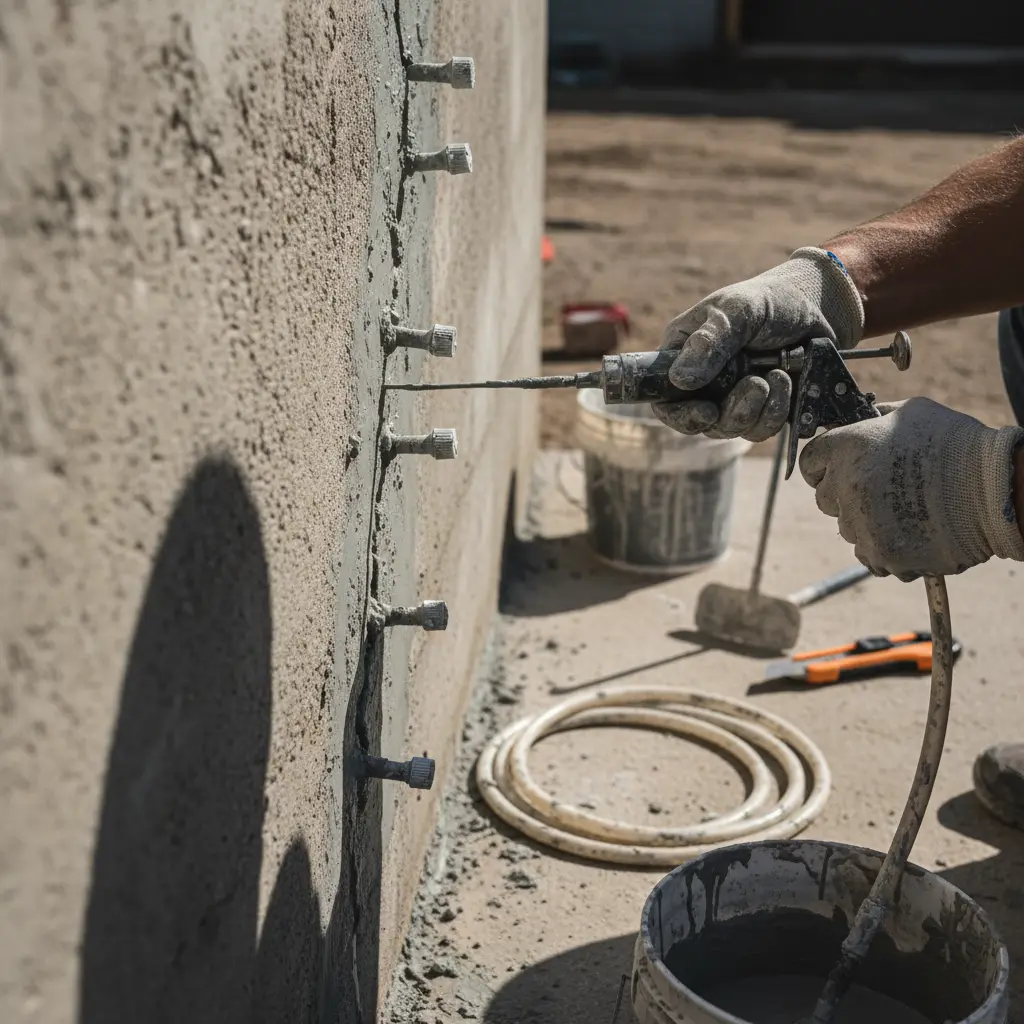
Our team in action — foundation-repair professionals serving Georgetown
Why Foundation Problems Are So Prevalent in Georgetown, TX
Expansive Blackland Prairie Soils
The dominant soil type beneath the majority of Georgetown’s developed residential and commercial areas is Austin Black clay and Houston Black clay, both classified as high-shrink-swell Vertisols. These soils can expand volumetrically by as much as 30 to 40 percent when saturated and contract by a similar margin during drought conditions. In practical terms, this means the ground beneath a Georgetown home can rise or fall by 3 to 5 inches or more over the course of a single seasonal cycle. No standard concrete slab or pier-and-beam system is designed to accommodate that magnitude of differential movement without cracking, tilting, or settling.
Georgetown’s Drought-Flood Cycle
Central Texas and Georgetown in particular are subject to a pronounced drought-flood cycle that is among the most extreme in the continental United States. The 2011 Texas drought, which was formally declared the worst single-year drought in Texas recorded history, caused catastrophic soil desiccation across Williamson County. Soils beneath Georgetown foundations shrank by record amounts, pulling support away from slabs and pier systems simultaneously across entire neighborhoods. The recovery rains of 2012 and 2013 then caused rapid re-expansion, creating a second wave of foundation movement. More recently, the February 2021 Winter Storm Uri created freeze-thaw cycles that damaged drainage infrastructure and introduced new moisture patterns under thousands of Georgetown foundations. Neighborhoods in the northern sections of the city, including those near Ronald Reagan Boulevard and SH-195, experienced particularly severe differential settling events during these periods.
Georgetown’s Rapid Growth and Fill Soils
Georgetown has been one of the fastest-growing cities in the United States for several consecutive years, with population growth frequently exceeding 5 to 7 percent annually. This explosive development has pushed construction into areas with marginal soil conditions, steep slopes near the San Gabriel River corridor, and cut-and-fill building pads that introduce artificial soil stratification. Newer subdivisions including Wolf Ranch, Morningstar, Parkside on the River, and Somerset Hills have all been built partially on engineered fill, which compacts unevenly and creates differential settlement risks not present in undisturbed native soil areas.
Tree Root Intrusion and Moisture Competition
Georgetown’s mature urban tree canopy, particularly the large live oaks and cedar elms prevalent in neighborhoods like Georgetown Village, Berry Creek, and the historical sections near the Square, creates significant moisture competition in the upper soil layers. Tree roots actively extract moisture from the clay soils adjacent to foundations, creating localized dry pockets that cause asymmetrical settling. This is a leading cause of the diagonal stair-step cracking patterns seen on brick veneers throughout Georgetown’s older established neighborhoods.
Aging Infrastructure and Original Construction Standards
Homes built in Georgetown prior to 1980, including those in the Inner Loop area, Cimarron Hills, and the historic East Side, were often constructed under building codes that did not require the deeper pier depths or post-tensioned slab designs now standard in Williamson County. These structures are inherently more vulnerable to soil movement and represent a disproportionate share of severe foundation failure cases in the city.
Signs You Need Foundation Problem Services in Georgetown
Interior Warning Signs
- Doors and windows that stick, drag, or no longer latch properly — especially in spring and fall as soils shift seasonally
- Diagonal cracks running from the corners of door frames or window openings toward the ceiling
- Visible gaps between interior walls and the ceiling or floor
- Uneven, sloping, or bouncy floors, particularly in pier-and-beam homes common in Georgetown’s older neighborhoods
- Cracks in drywall that recur even after patching
- Separation between cabinetry and walls in kitchens or bathrooms
Exterior Warning Signs
- Stair-step cracking in brick mortar joints along exterior walls
- Horizontal or vertical cracks in the visible foundation stem wall
- Gaps between the siding or brick veneer and the foundation
- Chimneys leaning or pulling away from the main structure
- Visible settlement or heaving of the concrete slab at the perimeter
Urgent Indicators Requiring Immediate Attention
- Cracks wider than 1/4 inch anywhere in the foundation or load-bearing walls
- Sudden appearance of multiple new cracks after a major rain event or dry spell
- Visible tilting or differential elevation change across the floor plan
Foundation Repair Methods We Use in Georgetown
Steel Push Piers
Steel push piers are driven hydraulically through the unstable upper soil layers to load-bearing strata or bedrock, which in much of Georgetown is the Austin Chalk or Edwards limestone formation at depths typically ranging from 18 to 35 feet. This method is highly effective for the slab-on-grade and post-tension foundations common in Georgetown subdivisions built after 1985, and is particularly well-suited for moderate to severe settlement cases.
Helical Piers
Helical piers use a screw-like design to anchor into stable soils and are ideal for lighter structures, interior applications, or locations with limited access such as narrow side yards common in Georgetown’s older Inner Loop neighborhoods. They can be installed with minimal vibration, making them appropriate for historically sensitive properties near the Georgetown Square.
Concrete Pressed Pilings
Pressed concrete cylinder pilings are a cost-effective solution widely used across Central Texas, including Georgetown. They work best in areas where consistent clay soil depth provides adequate friction capacity. This method is commonly applied to residential slab foundations in established Georgetown neighborhoods like Georgetown Village and Berry Creek Estates.
Pier-and-Beam Restoration
Georgetown’s older pier-and-beam homes — many concentrated in the East Side, San Gabriel Heights, and near the historic downtown — require a different approach involving replacement or reinforcement of wood or concrete block piers, sister beams, and subfloor leveling. Crawl space moisture control is integrated into these repairs given Georgetown’s humidity levels and soil moisture variability.
Slab Patching and Crack Injection
For minor foundation cracking without significant differential movement, epoxy and polyurethane crack injection methods can stabilize and seal foundation cracks, preventing water infiltration and further deterioration. This is typically appropriate for Georgetown homes showing early-stage distress indicators.
Ready for Foundation Problems? Get Your Free Estimate Today.
Round Rock Foundation Repair Group serves Georgetown and the surrounding area — we’ll be on-site within 24 hours.
📞 Call (512) 220-3502Foundation Problem Repair Costs in Georgetown, TX
Understanding the cost of foundation repair in Georgetown helps homeowners plan responsibly and avoid being misled by unusually low estimates. Costs vary significantly based on the repair method, severity of damage, foundation type, and site-specific conditions.
Typical Georgetown Foundation Repair Cost Ranges
- Minor crack patching and injection: $500 to $2,500 per repair area
- Concrete pressed pilings (per pier): $300 to $500, with most Georgetown slab homes requiring 8 to 20 piers ($2,400 to $10,000 total)
- Steel push pier installation (per pier): $1,200 to $1,800, with full-perimeter systems on larger Georgetown homes ranging from $8,000 to $20,000+
- Helical pier installation (per pier): $1,500 to $2,200 per pier
- Full pier-and-beam restoration: $4,000 to $15,000 depending on square footage and extent of beam and joist damage
- Commercial foundation repair: $15,000 to $80,000+ depending on structure size and load requirements
Georgetown-Specific Cost Factors
Several local factors influence repair costs in Georgetown specifically. Properties in western Georgetown near the limestone shelf may require drilling equipment rather than driven piers, increasing costs by 15 to 25 percent. Homes in newer master-planned communities on engineered fill may require deeper pier installations to reach adequate bearing capacity. Historic properties near the Georgetown Square may require additional care during installation to avoid damaging original masonry, adding to labor costs.
We strongly recommend obtaining at least two to three written estimates for any Georgetown foundation repair project. Be cautious of estimates that do not specify pier depth, method, or include a post-repair elevation verification process. Call us at (512) 220-3502 for a transparent, detailed estimate. Schedule a Free Foundation Inspection
Georgetown Neighborhoods We Serve
Georgetown Village
Developed primarily in the 1990s and early 2000s, Georgetown Village features large numbers of conventional slab-on-grade homes that were built before post-tension slabs became the area standard. These homes frequently show differential settlement related to the high-shrink-swell Houston Black clay soils that dominate the eastern portions of the city. Corner cracks and sticking doors are common first complaints here.
Berry Creek
Berry Creek is a master-planned golf community where larger custom and semi-custom homes on premium lots have experienced foundation issues related to mature tree root intrusion and variable soil conditions near Berry Creek itself. The combination of higher property values and complex foundation designs makes professional, precise repair critical in this neighborhood.
Wolf Ranch and Sun City
These large-scale planned communities in northern and western Georgetown include significant areas of engineered fill and cut-and-fill building pads. Sun City Georgetown, with its large population of senior homeowners, generates consistent demand for foundation inspection and preventative repair services. Post-tension slabs dominate in both communities.
Historic Downtown and Inner Loop
Georgetown’s beautiful historic district, centered on the Williamson County Courthouse Square, contains structures dating from the 1870s through the 1930s, many built on unreinforced brick or stone foundations. These properties require specialized restoration approaches that preserve historic fabric while correcting structural deficiencies. Learn About Historic Foundation Restoration
Foundation Maintenance Tips for Georgetown Homeowners
Preventing foundation problems in Georgetown is significantly less expensive than repairing them. The following maintenance practices are specifically important given Georgetown’s climate and soil conditions.
- Maintain consistent soil moisture year-round. Use a soaker hose system placed 18 to 24 inches from the foundation perimeter during extended dry periods, particularly during Georgetown’s summer drought season from June through September. Aim to keep soil moisture consistent rather than allowing extreme wet-dry cycles.
- Ensure positive drainage away from the foundation. Georgetown’s clay soils shed water slowly. Grade soil so it slopes at least 6 inches over the first 10 feet away from your foundation perimeter.
- Clean and maintain gutters and downspouts. Direct downspout discharge at least 5 to 6 feet from the foundation using splash blocks or underground drains.
- Manage tree placement. Avoid planting large trees, especially live oaks and cedar elms, within 15 to 20 feet of your foundation. If mature trees are already present, consider root barriers.
- Inspect for plumbing leaks annually. Underground plumbing leaks beneath Georgetown slabs are a significant and underdiagnosed contributor to localized foundation settlement.
- Monitor and document crack progression. Mark the ends of visible cracks with a pencil and date, checking quarterly to determine if they are active or dormant.
- Schedule a professional foundation inspection every 3 to 5 years, more frequently for homes in Georgetown’s highest-risk soil zones near the Blackland Prairie corridor.
Why Choose Round Rock Foundation Repair Group for Georgetown Foundation Problems
Round Rock Foundation Repair Group is a locally operated, Central Texas-focused foundation repair company with deep experience serving Georgetown and the surrounding Williamson County communities. We are not a national franchise — we are your neighbors, and we work exclusively in the soil and climate conditions of the greater Georgetown and Round Rock region.
Our technicians understand the specific challenges posed by Georgetown’s Blackland Prairie clay soils, the limestone transition zones in western Georgetown, and the engineered fill conditions in the city’s newest developments. We do not apply generic repair formulas — every repair plan is site-specific and based on actual measured data from your property.
We serve Georgetown homeowners as well as clients throughout our broader service area including Round Rock, Cedar Park, Austin, Pflugerville, Brushy Creek, Teravista, Avery Ranch, Anderson Mill, Great Hills, Forest Creek, Behrens Ranch, Sendero Springs, and surrounding communities. Our commitment is to provide honest assessments, transparent pricing, and durable repairs that stand up to Georgetown’s demanding soil and climate conditions. Learn More About Our Team Call us today at (512) 220-3502.
Frequently Asked Questions About Foundation Problems in Georgetown, TX
How much does foundation repair typically cost in Georgetown, TX?
Foundation repair costs in Georgetown range from approximately $500 for minor crack injection to $20,000 or more for full-perimeter steel pier systems on larger homes. The most common repair scenario — a mid-sized Georgetown slab home with moderate settlement requiring 10 to 14 pressed concrete or steel piers — typically falls in the $3,500 to $12,000 range. Site-specific factors such as soil type, pier depth required to reach stable bearing, and access constraints all influence final pricing. We provide detailed written estimates before any work begins.
Why are foundation problems so common in Georgetown specifically?
Georgetown sits directly on some of Texas’s most expansive and reactive Blackland Prairie clay soils. The Austin Black and Houston Black clay types that underlie most of the city’s developed areas expand and contract dramatically with seasonal moisture changes. Georgetown’s pattern of intense summer droughts followed by heavy fall and spring rains creates a particularly aggressive shrink-swell cycle that stresses foundations continuously. This is compounded by the city’s rapid growth on marginal soils and engineered fill sites.
How long does foundation repair take in Georgetown?
Most residential foundation repairs in Georgetown are completed within 1 to 3 days for standard pier installations. More complex projects involving extensive pier-and-beam reconstruction, interior pier systems, or commercial structures may require 5 to 10 working days. Permit processing through the City of Georgetown Building Department typically adds 3 to 7 business days prior to work commencement for projects requiring a permit.
Will foundation repair fix my sticking doors and cracks in Georgetown?
Foundation repair addresses the root cause of sticking doors and cracking — the structural movement of the foundation itself. After repair, most door and window alignment issues resolve as the structure stabilizes. Cosmetic repairs to drywall cracks and brick mortar joints are typically performed after the foundation has been stabilized and any remaining movement has ceased, which generally means waiting 30 to 90 days after repair completion in Georgetown’s climate.
Do I need a permit for foundation repair in Georgetown, TX?
The City of Georgetown requires building permits for structural foundation repairs, including pier installation projects. Round Rock Foundation Repair Group handles permit applications on behalf of our clients for all permitted projects within Georgetown city limits and Williamson County jurisdiction. Permit fees are included in our project estimates.
Is my Georgetown home’s foundation problem covered by homeowner’s insurance?
Standard Texas homeowner’s insurance policies generally exclude foundation damage caused by soil movement, shrinkage, or settlement — which are the most common causes of foundation problems in Georgetown. Coverage may exist if a sudden, accidental event such as a burst pipe directly caused the foundation damage. We recommend reviewing your policy carefully and consulting with your insurance agent. We can provide documentation of damage findings to support any legitimate insurance claim.
How do I know if my Georgetown home needs foundation repair or just monitoring?
Cracks smaller than 1/8 inch that have been stable for more than two seasons may warrant monitoring rather than immediate repair. Active cracks that are widening, cracks wider than 1/4 inch, doors or windows that have recently become significantly harder to operate, or visible floor slope greater than 1 inch over 20 feet are all indicators that professional repair is warranted rather than continued observation. A professional inspection is the only reliable way to make this determination.
Can foundation problems in Georgetown get worse if I wait?
Yes, and in Georgetown’s soil conditions they frequently do. Each annual drought-flood cycle subjects an already-compromised foundation to additional movement stress. What begins as minor differential settlement costing $4,000 to $6,000 to repair can progress to major structural failure requiring $15,000 to $25,000 or more in corrections if ignored for two to three additional seasonal cycles. Early intervention is almost always significantly more cost-effective. Request Your Georgetown Foundation Inspection Today
Contact Round Rock Foundation Repair Group for Georgetown Foundation Problems
If your Georgetown home or business is showing signs of foundation problems — sticking doors, wall cracks, uneven floors, or visible foundation cracking — do not wait for conditions to worsen. Round Rock Foundation Repair Group is ready to provide a comprehensive, honest foundation inspection and a transparent repair estimate based on your property’s specific conditions.
We serve Georgetown, Round Rock, Cedar Park, Austin, Pflugerville, Brushy Creek, and all surrounding communities throughout Williamson and Travis Counties. Our team is available to answer your questions and schedule your inspection promptly.
Call us now at (512) 220-3502 to speak with a Georgetown foundation repair specialist. You can also submit a contact form online to request a callback or schedule an inspection at your convenience. Protect your Georgetown property — reach out to Round Rock Foundation Repair Group today.