Structural Foundation Repair in Georgetown, TX
Fast, Reliable Structural Foundation Repair in Georgetown, TX — Licensed & Insured
Expert structural foundation repair in Georgetown, TX. Round Rock Foundation Repair Group fixes slab settlement, cracks & crawl spaces. Call (512) 220-3502 today.
- Licensed & Insured
- Locally Owned & Operated
- Free Inspection & Estimate
Request Your
Free EstimateStructural foundation repair is the process of diagnosing and correcting damage to the load-bearing base of a residential or commercial building — restoring structural integrity, preventing further settlement, and protecting the long-term value of your property. In Georgetown, TX, the combination of expansive clay soils, dramatic seasonal moisture swings, and rapid population growth has made foundation problems one of the most common and costly challenges homeowners face in Williamson County.
At Round Rock Foundation Repair Group, we specialize in delivering precise, lasting structural foundation repair solutions tailored to Georgetown’s unique geology and climate. Whether your home sits on the blackland prairie soils of the Wolf Ranch area or in the limestone-underlain neighborhoods near the San Gabriel River, our team has the local knowledge and technical expertise to diagnose the root cause of your foundation issues and implement the right fix — the first time. Call us today at (512) 220-3502 for a professional assessment.
Understanding Structural Foundation Repair in Georgetown, TX
Structural foundation repair encompasses a broad range of engineering-based interventions designed to stabilize, lift, and restore a building’s foundation to its original or as-close-to-original position and load capacity. Unlike cosmetic patching — which simply fills visible cracks — true structural repair addresses the underlying movement, soil failure, or water intrusion that caused the damage in the first place.
The history of foundation problems in Central Texas is deeply tied to the region’s geology. Georgetown sits at the intersection of two major soil types: the expansive Blackland Clay that dominates eastern Williamson County and the thinner, rocky soils overlying Austin Chalk and Edwards Limestone in the western and central parts of the city. This geological boundary — sometimes called the “Balcones Escarpment transition zone” — runs roughly along Interstate 35, meaning neighborhoods on opposite sides of the highway can experience dramatically different types of foundation movement.
Georgetown’s growth has been explosive. Between 2010 and 2023, the city’s population more than doubled, from approximately 47,000 to over 100,000 residents, making it one of the fastest-growing cities in the United States for multiple consecutive years. This rapid development has brought thousands of new slab-on-grade homes built quickly on soils that weren’t always adequately prepared or compacted, contributing to a higher-than-average prevalence of early foundation settlement in newer subdivisions like Teravista, Wolf Ranch, and Morningstar.
Foundation issues affect all building types in Georgetown — from the late 1800s and early 1900s pier-and-beam Victorian and craftsman homes in the historic downtown square district, to the post-WWII concrete slab homes in established mid-century neighborhoods, to the sprawling modern construction in master-planned communities developed after 2005. Each era and construction type presents unique repair challenges that demand locally experienced contractors who understand the full spectrum of Georgetown’s built environment.
Structural foundation repair services we provide include full foundation restoration, concrete foundation repair, crawl space stabilization, commercial foundation repair, foundation patching, and comprehensive foundation inspections. Learn more about our foundation inspection services
Why Structural Foundation Repair Is Needed in Georgetown, TX
Expansive Blackland Clay Soils
The dominant soil type across much of eastern Georgetown and neighborhoods like Teravista, Forest Creek (Round Rock/Georgetown border area), and Behrens Ranch is the Houston Black clay series — a Vertisol-class soil that can expand up to 30–40% in volume when wet and shrink dramatically when dry. The Williamson County Soil Survey (USDA-NRCS) classifies much of this soil with a shrink-swell potential rated “very high,” meaning a single weather cycle from wet spring to dry summer can shift the ground beneath a slab foundation by 1 to 3 inches vertically. Over several years, this repeated movement causes slabs to crack, bow, and separate from the structure above.
Extreme Drought Cycles and the 2011 Texas Drought
Central Texas is no stranger to drought, but the summer of 2011 stands as a defining catastrophe for Georgetown-area foundations. The 2011 Texas drought — the worst single-year drought in the state’s recorded history — resulted in Georgetown receiving less than 12 inches of rainfall between October 2010 and September 2011, compared to the annual average of approximately 34 inches. Soil moisture levels dropped so severely that clay soils contracted to depths of 5 to 8 feet beneath slabs, causing rapid, widespread foundation settlement across entire subdivisions. Insurance claims and foundation repair calls surged across Williamson County throughout 2012 and 2013 as homeowners discovered the aftermath of that extreme drying. Similar, though less severe, drought conditions in 2022 produced a second wave of foundation movement reports across Georgetown neighborhoods.
The San Gabriel River Floodplain and Moisture Variability
Georgetown is bisected by the North and South forks of the San Gabriel River, and properties within or near FEMA-mapped floodplain zones — particularly in older sections near the Georgetown square and along River Ridge — experience the opposite problem: periodic soil saturation that softens bearing capacity and causes upheaval or differential settlement. When floodplain-adjacent soils cycle between saturation (during events like the October 2018 flash floods that struck Williamson County) and extreme drying, the cumulative foundation movement can exceed what soils in drier locations experience.
Rapid Development and Inadequate Site Preparation
Georgetown’s master-planned communities — including Wolf Ranch, Morningstar, Parkside at Mayfield Ranch, and Sun City — were developed at speed, and in some cases, earthwork and soil compaction did not fully account for the deep shrink-swell potential of native clays. Post-tensioned slab systems used in most post-2000 construction provide some resistance to movement, but even these systems can fail when soil movement is severe enough or when drainage around the foundation is inadequate — a common issue in newer developments where landscaping hasn’t yet matured to manage stormwater effectively.
Aging Infrastructure in Historic Georgetown
In the historic downtown district and surrounding streets — many of which feature homes built between 1880 and 1950 on pier-and-beam foundations — aging wood piers, deteriorating crawl space conditions, and outdated drainage infrastructure contribute to chronic moisture imbalance. These older structures require specialized foundation restoration approaches that preserve historic character while delivering modern structural performance.
Signs You Need Structural Foundation Repair in Georgetown
Interior Warning Signs
- Diagonal cracks emanating from the corners of door frames or window openings (typically at 45-degree angles)
- Doors or windows that stick, won’t latch, or have developed visible gaps along their frames
- Cracks in drywall, especially where walls meet ceilings or in stairwells
- Uneven or sloping floors detectable when a marble rolls consistently in one direction
- Separation between walls and ceilings or between walls themselves
Exterior Warning Signs
- Stair-step cracking in brick veneer along mortar joints — one of the most common and diagnostic signs in Georgetown slab homes
- Visible gaps between the brick and the roofline, soffit, or window frames
- Cracks in the concrete slab visible in the garage floor or along the perimeter of the structure
- Chimney leaning or separating from the main structure
Crawl Space & Basement Indicators
- Sagging or soft floors above a crawl space
- Visible moisture, standing water, or mold in the crawl space
- Rotting or displaced wood piers (common in Georgetown’s pre-1960 homes)
Urgency Indicators
Seek immediate professional evaluation if you notice cracks wider than ¼ inch, any crack that is actively growing, or doors that have suddenly become impossible to open or close — these may indicate rapid, ongoing movement.
Our Structural Foundation Repair Process in Georgetown, TX
At Round Rock Foundation Repair Group, we follow a disciplined, transparent process designed to deliver lasting results while keeping Georgetown homeowners informed at every stage.
Comprehensive Foundation Inspection (Day 1 — 2–3 Hours)
Our inspection begins with a detailed elevation survey using a Zip-level Pro 2000 digital manometer, which measures floor elevations at multiple grid points across your home to quantify differential settlement — often down to 1/10 of an inch. We also examine exterior brick patterns, interior crack patterns, drainage conditions, and soil conditions around the perimeter. In Georgetown, we pay particular attention to whether your property sits on Blackland Clay or Austin Chalk-influenced soils, as this directly determines the repair method we recommend. Schedule your Georgetown foundation inspection today
Root Cause Analysis and Engineering Consultation (Days 2–5)
We analyze inspection findings and, when warranted, coordinate with licensed geotechnical engineers familiar with Williamson County soil profiles. This step ensures we’re treating the cause of movement, not just its symptoms.
Written Repair Proposal and Method Selection (Days 3–7)
We present a detailed written proposal specifying the repair method, number and placement of piers or supports, expected lift results, timeline, and total cost — with no hidden fees. We explain all options clearly so you can make an informed decision.
Site Preparation and Permitting (Days 5–10)
We handle all required permitting with the City of Georgetown’s Development Services department. Site prep includes protecting landscaping, marking utility lines through 811 Texas, and setting up equipment access.
Foundation Repair Installation (1–5 Days Depending on Scope)
Our crews install the selected pier or repair system with precision, driving piers to bedrock or load-bearing strata — which in Georgetown’s western areas can mean reaching Austin Chalk at depths of 10 to 20 feet, while in eastern clay-dominated zones we drive steel piers to 25–35 feet to reach stable bearing.
Lift and Leveling (Same Day as Installation)
Once piers are set, we carefully hydraulically lift the foundation back toward its original position, monitoring with elevation instruments to avoid over-lifting, which can cause additional interior cracking.
Site Restoration and Final Inspection (Day of Completion)
We backfill excavations, restore landscaping where possible, and conduct a final elevation survey to document post-repair measurements. We review all findings with you and provide documentation for your records and future resale.
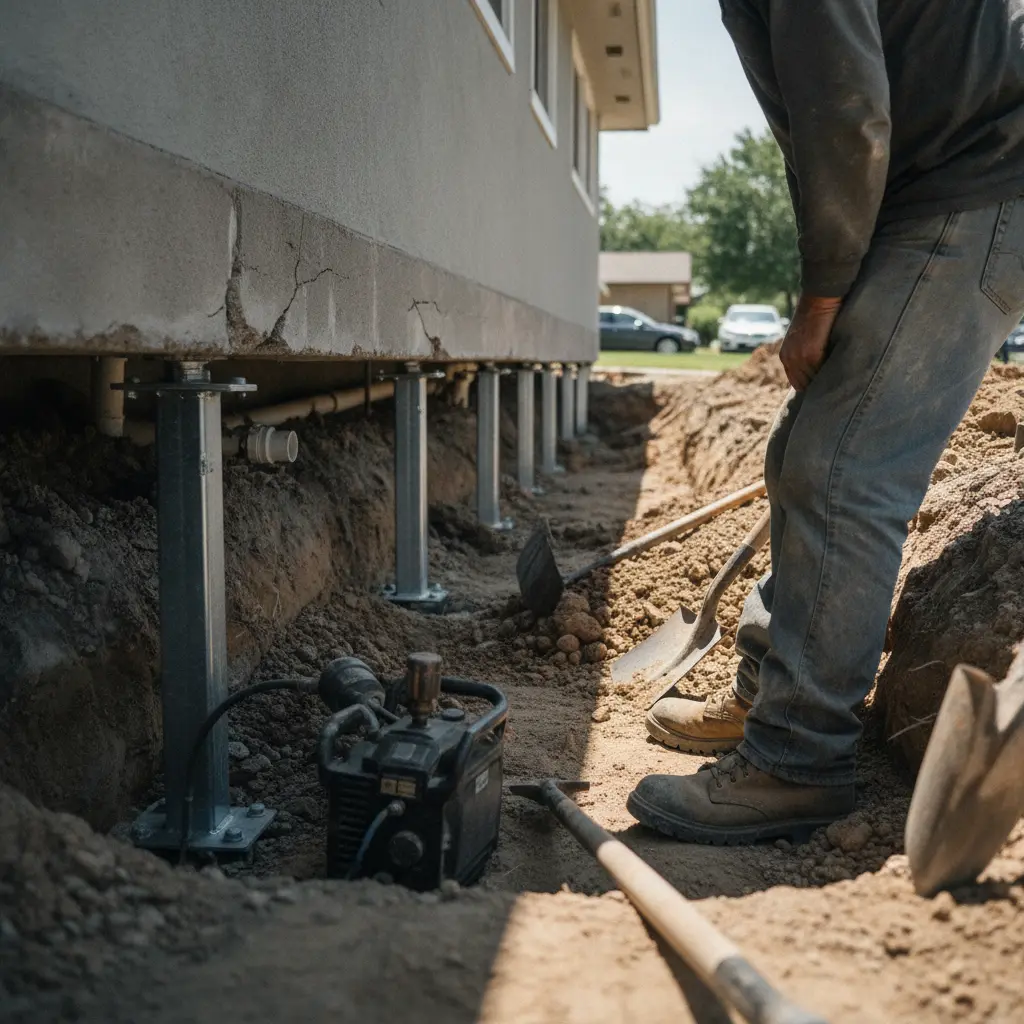
Our team in action — foundation-repair professionals serving Georgetown
Foundation Repair Methods We Use in Georgetown, TX
Steel Push Piers (Resistance Piers)
The most common solution for slab foundations experiencing settlement in Georgetown’s Blackland Clay zones. Galvanized steel pipe sections are hydraulically driven through unstable soil until they reach bedrock or a firm load-bearing stratum. In Georgetown’s eastern areas, this typically means penetrating to depths of 25–40 feet. Steel push piers are ideal for heavier structures and provide a permanent, verifiable solution. Learn more about steel pier foundation repair
Helical Piers
Best suited for lighter structures, additions, porches, and interior applications where access is restricted. Helical piers are screwed into the ground rather than driven, making them ideal for Georgetown’s historic downtown properties where vibration must be minimized near older masonry structures.
Slab Pier Systems for Post-Tensioned Slabs
Many Georgetown homes built after 1990 feature post-tensioned concrete slabs. Repairing these requires specialized piers installed through the slab without cutting post-tension cables — a critical distinction that our team is trained and equipped to handle safely.
Crawl Space Repair and Pier Replacement
For Georgetown’s pre-1960 pier-and-beam homes — particularly in the historic district — we replace deteriorated wood piers with adjustable steel supports, install moisture barriers, and improve ventilation to address the root causes of crawl space settlement. Explore our crawl space repair solutions
Foundation Patching and Crack Injection
For non-structural cracks or as a finishing step after pier installation, we use polyurethane or epoxy injection systems to seal cracks against water intrusion and restore surface integrity of concrete slabs and foundation walls. Learn about our foundation patching services
Ready for Structural Foundation Repair? Get Your Free Estimate Today.
Round Rock Foundation Repair Group serves Georgetown and the surrounding area — we’ll be on-site within 24 hours.
📞 Call (512) 220-3502Structural Foundation Repair Cost in Georgetown, TX
Understanding the cost of structural foundation repair in Georgetown helps homeowners plan and avoid surprises. Costs vary significantly based on the type, severity, and extent of foundation damage, as well as the specific soil and access conditions at your property.
Typical Price Ranges
- Foundation Inspection: $200–$500 (often credited toward repair if work is performed)
- Minor Foundation Patching / Crack Repair: $500–$2,500
- Crawl Space Pier Replacement (Pier-and-Beam Homes): $3,000–$8,000
- Slab Foundation Repair with Steel Piers (partial — 4 to 8 piers): $4,000–$9,000
- Full Perimeter Slab Foundation Repair (10–20+ piers): $10,000–$25,000+
- Commercial Foundation Repair: $15,000–$80,000+ depending on structure size and scope
Georgetown-Specific Cost Factors
Pier depth requirements significantly affect cost in Georgetown. Properties in western Georgetown on shallow Austin Chalk may require shorter piers (10–18 feet) at lower per-pier cost, while properties in eastern Georgetown on deep Blackland Clay typically require piers driven 30–40 feet, increasing per-pier pricing. Post-tensioned slab homes — common in Wolf Ranch and Sun City — require specialized pier installation that costs 10–20% more than standard slab pier work due to the additional care required.
Georgetown’s strong growth has maintained healthy contractor competition, which helps keep pricing reasonable compared to Austin proper, where labor costs run 10–15% higher. We provide fully itemized, written estimates so you can compare accurately.
Many homeowners ask about insurance coverage: standard homeowners insurance policies typically exclude foundation repair caused by soil movement, though some policies cover damage caused by plumbing leaks. We can help you document findings for any applicable insurance claim.
Georgetown Neighborhoods We Serve
Wolf Ranch
This large master-planned community in western Georgetown features predominantly post-2010 construction on post-tensioned slabs. The newer homes here are built on soils transitioning between Blackland Clay and thinner upland soils, and some have shown early settlement within 5–8 years of construction. Our team regularly works in Wolf Ranch and is familiar with the specific soil preparation practices used by the major builders active in this area.
Historic Downtown Georgetown District
Georgetown’s historic square and surrounding residential streets contain some of Williamson County’s oldest homes — many built between 1880 and 1930 on traditional pier-and-beam systems. These structures require sensitive, experienced repair approaches that respect historic materials while achieving modern structural performance. Our crawl space repair and helical pier expertise is particularly well-suited here.
Sun City Texas
This massive 55+ active adult community in northwestern Georgetown features thousands of homes built on expansive soils between 1995 and the present. The community’s age diversity means some original homes are now experiencing their first major soil movement cycle. We have extensive experience with Sun City’s specific slab designs and HOA documentation requirements.
Teravista
Straddling the Georgetown-Round Rock border, Teravista’s homes sit on classic Williamson County Blackland Clay. Homes here built between 2003 and 2012 are now entering the age range when cumulative soil movement commonly becomes apparent. See our Round Rock foundation repair services
Foundation Maintenance Tips for Georgetown Homeowners
Preventative maintenance is the most cost-effective foundation strategy for Georgetown property owners. Follow these location-specific tips to minimize soil movement and extend the life of your foundation:
- Maintain consistent soil moisture year-round. During Georgetown’s dry summers — typically June through September — use a soaker hose system placed 12–18 inches from the foundation perimeter to prevent the deep soil shrinkage that causes slab settlement in Blackland Clay.
- Ensure positive drainage away from the foundation. Grade soil so that surface water flows away from the structure at a minimum slope of 6 inches over the first 10 feet — especially important given Georgetown’s intense summer thunderstorm patterns.
- Clean gutters and extend downspouts. Downspouts should discharge at least 5–6 feet away from the foundation. Clogged gutters allow water to pool against the foundation edge during Georgetown’s spring rain season.
- Avoid large trees planted close to the foundation. Live oaks and cedar elms — both common in Georgetown landscaping — have aggressive root systems that extract enormous amounts of moisture from clay soils within a 20-foot radius.
- Monitor plumbing for leaks under the slab. Have your plumbing pressure-tested every 5–7 years, as undetected slab leaks are a leading cause of localized soil saturation and foundation upheaval in Georgetown’s slab homes.
- Schedule annual foundation elevation checks. An annual or bi-annual professional elevation survey — especially critical after severe drought years like 2011 and 2022 — allows early detection of movement before damage becomes costly.
- Manage irrigation carefully near the foundation. Overwatering landscaping adjacent to the home contributes to differential moisture levels that cause heaving on one side while the other settles.
Why Choose Round Rock Foundation Repair Group for Georgetown Structural Foundation Repair
When it comes to structural foundation repair in Georgetown, TX, local knowledge isn’t a bonus — it’s essential. Round Rock Foundation Repair Group is based in the greater Round Rock/Georgetown area, which means our teams drive Georgetown’s streets daily, work in its neighborhoods continuously, and understand the precise soil and drainage conditions that distinguish a Wolf Ranch slab problem from a historic district pier-and-beam issue.
We specialize in the full range of foundation services Georgetown homeowners need: structural foundation repair, foundation restoration, commercial foundation repair, foundation inspection, crawl space repair, foundation patching, home foundation repair, and concrete foundation repair. Every repair recommendation we make is backed by on-site elevation data, not guesswork.
We believe in transparent, detailed written proposals — no vague estimates, no pressure tactics. Our crews are trained, background-checked, and equipped with professional-grade tools including digital elevation instruments and hydraulic pier-driving systems. We handle all permitting with the City of Georgetown’s Development Services office, so you never have to navigate that process alone.
Ready to protect your Georgetown home? Call us at (512) 220-3502 or request a free foundation evaluation online. We also serve Round Rock, Cedar Park, Austin, Pflugerville, and surrounding communities. View all service areas
Frequently Asked Questions About Structural Foundation Repair in Georgetown, TX
How much does structural foundation repair cost in Georgetown, TX?
Costs in Georgetown typically range from $4,000 to $25,000 for residential slab foundation repairs, depending on the number of piers required, their depth, and your home’s size and access conditions. Minor repairs and patching can start as low as $500–$2,500. Georgetown-area pricing is generally 10–15% lower than Austin proper due to lower local labor overhead. We provide free, detailed written estimates after a thorough on-site inspection.
How long does foundation repair take in Georgetown?
Most residential foundation repair projects in Georgetown are completed in 1 to 3 days once work begins. The pre-repair process — including inspection, proposal review, and permitting with the City of Georgetown — typically takes 1 to 2 weeks. Larger commercial projects or full-perimeter repairs may require 3 to 5 days of active work.
Is structural foundation repair covered by homeowners insurance in Texas?
Standard homeowners insurance policies in Texas typically exclude damage caused by soil movement, settlement, or shrinkage — which are the most common causes of foundation problems in Georgetown. However, if a covered peril such as a plumbing leak caused or contributed to your foundation damage, that portion may be covered. We can provide detailed documentation to support your insurance claim if applicable.
How deep do foundation piers need to go in Georgetown, TX?
Pier depth varies significantly by location within Georgetown. In western Georgetown, where Austin Chalk limestone is closer to the surface, piers may reach stable bearing at 10 to 18 feet. In eastern Georgetown and areas with deep Blackland Clay profiles — such as Teravista and neighborhoods near the Georgetown-Round Rock border — piers typically need to reach 25 to 40 feet to penetrate through unstable clay into competent bearing material. This difference directly affects repair cost and is one reason an accurate soil assessment is essential.
What’s the difference between foundation settlement and foundation heave?
Settlement occurs when soil beneath a foundation loses moisture, contracts, and sinks — causing the foundation to drop. Heave occurs when soil gains excess moisture, expands, and pushes the foundation upward. Both are common in Georgetown due to its expansive Blackland Clay soils. Interestingly, heave is sometimes more damaging and more costly to repair than settlement, and it requires different repair strategies. This distinction is one reason professional diagnosis matters so much.
Do I need a permit for foundation repair in Georgetown, TX?
Yes. The City of Georgetown requires permits for structural foundation repair work. We handle the permit application process with Georgetown’s Development Services department as part of every job, ensuring all work is code-compliant and properly documented — which is important for future home sales.
How soon after the 2022 drought should I have my Georgetown foundation inspected?
If you haven’t had your foundation professionally inspected since the severe drought conditions of summer 2022, we recommend scheduling an evaluation now. Soil moisture loss during that period was significant across Williamson County, and foundation movement caused by the 2022 drought may still be actively progressing or may have created vulnerabilities that the next wet season could worsen. Early detection is always less expensive than delayed repair.
Can you repair foundations in Georgetown’s historic district without damaging the historic structure?
Yes. Our team has specific experience working with Georgetown’s pre-1940 pier-and-beam homes near the historic square. We use helical piers and adjustable steel supports that can be installed with minimal vibration and disruption, protecting delicate masonry, original wood framing, and historic finishes. We also coordinate with the appropriate parties when preservation considerations are involved.
Get Expert Structural Foundation Repair in Georgetown, TX Today
Don’t wait until small cracks become a major structural crisis. Foundation problems in Georgetown’s expansive clay soils almost always worsen over time — and the cost of early intervention is a fraction of the cost of delayed repair. Round Rock Foundation Repair Group is ready to help you protect your most valuable asset.
Contact us today to schedule your professional foundation inspection and receive a detailed, no-obligation written estimate. Our team serves Georgetown, Round Rock, Cedar Park, Austin, Pflugerville, and all surrounding Williamson and Travis County communities.
- Call or Text: (512) 220-3502
- Request Online: Schedule Your Free Georgetown Foundation Evaluation
We answer calls seven days a week and offer emergency response for urgent structural situations. Trust the local experts — Round Rock Foundation Repair Group.