Foundation Crack Repair in Georgetown, TX
Fast, Reliable Foundation Crack Repair in Georgetown, TX — Licensed & Insured
Need foundation crack repair in Georgetown, TX? Round Rock Foundation Repair Group fixes slab, pier & structural cracks. Call (512) 220-3502 for a free estimate.
- Licensed & Insured
- Locally Owned & Operated
- Free Inspection & Estimate
Request Your
Free EstimateFoundation crack repair is the process of identifying, sealing, and structurally reinforcing cracks that form in a home’s or building’s foundation — whether slab, pier-and-beam, or concrete block — to prevent water intrusion, structural shifting, and long-term settlement damage. In Georgetown, TX, the combination of expansive Blackland Prairie clay soils, fluctuating seasonal moisture, and rapid residential growth across neighborhoods like Wolf Ranch, Berry Creek, and Sun City makes foundation cracking one of the most common — and most urgent — property concerns in Williamson County.
At Round Rock Foundation Repair Group, we specialize in diagnosing and repairing foundation cracks across the Georgetown area and surrounding Central Texas communities. From hairline surface cracks to deep structural fractures, our team delivers lasting solutions tailored to the specific soil and climate conditions unique to this region. Call us today at (512) 220-3502 for a professional assessment.
Understanding Foundation Crack Repair
Foundation cracks are not a single phenomenon — they exist on a spectrum from cosmetic surface blemishes to structural emergencies that threaten the integrity of an entire building. Understanding the difference is the first step toward effective, lasting repair.
Concrete and masonry foundations develop cracks through several mechanisms. Shrinkage cracks occur naturally as concrete cures and loses moisture — typically appearing within the first few years of a structure’s life. These are usually vertical, narrow (under 1/8 inch), and largely cosmetic. Settlement cracks, by contrast, result from soil movement beneath the foundation. When the ground shifts unevenly, one section of the foundation sinks or rotates relative to another, producing diagonal or stair-step cracks that often widen over time. Horizontal cracks in basement or retaining walls indicate lateral soil pressure and are among the most serious types, frequently requiring immediate structural intervention.
Historically, Georgetown’s building stock reflects decades of growth tied to Central Texas’s economic expansion. Older homes in the Downtown Georgetown Historic District — many built between the 1890s and 1950s — often sit on pier-and-beam foundations that have undergone decades of soil-driven movement. Meanwhile, the explosive growth of master-planned communities throughout the 1990s through today brought tens of thousands of post-tension slab foundations to neighborhoods north and west of IH-35. These slabs, while engineered for Texas soil conditions, remain vulnerable to the region’s notorious clay shrink-swell cycles.
Foundation crack repair techniques have advanced significantly over the past two decades. Modern epoxy injection systems, polyurethane foam fills, carbon fiber strap reinforcements, and helical pier underpinning have replaced older stop-gap methods that often failed within a few seasons. Today’s repairs are engineered to address not just the visible crack but the underlying soil movement causing it — a distinction that separates a permanent fix from a temporary patch.
In Georgetown specifically, the prevalence of post-tension slab construction means repair professionals must be especially careful — cutting or drilling near post-tension cables without proper cable-location procedures can cause catastrophic slab failure. Round Rock Foundation Repair Group’s technicians are trained and equipped to work safely on all foundation types common to Williamson County.
Why Foundation Crack Repair Is Needed in Georgetown, TX
Expansive Blackland Prairie Clay Soils
Much of Georgetown sits atop Blackland Prairie soils — specifically the Houston Black and Austin clay series — known for extreme shrink-swell behavior. These soils can expand volumetrically by as much as 30–40% when saturated and shrink dramatically during drought, creating vertical soil movement of 2–4 inches or more beneath a foundation. The Williamson County Soil Survey identifies these clay-heavy deposits as among the most challenging for residential construction in Central Texas. Neighborhoods like Teravista on the eastern side of Georgetown and the areas around Westinghouse Road corridor sit heavily on these soils, making them particularly high-risk zones for differential settlement cracking.
Georgetown’s Drought-Flood-Drought Cycle
Central Texas is climatologically defined by extreme precipitation variability. Georgetown recorded back-to-back 100-year drought conditions during the 2011 Texas drought — one of the most severe in recorded state history — followed by the devastating Memorial Day floods of May 2015, when Williamson County received over 10 inches of rain in 24 hours. This rapid cycling between bone-dry and saturated soil conditions is exactly what drives the worst foundation cracking. The soil contracts, the slab loses support, cracks form — then the rains return, water infiltrates the cracks, and freeze-thaw micro-expansion widens them further.
Georgetown’s Rapid Development and New Construction Volume
Georgetown has ranked as one of the fastest-growing cities in the United States multiple times throughout the 2010s and into the 2020s. Communities like Wolf Ranch (developed from the mid-2000s onward), Sun City Georgetown (established 1995, still expanding), and Morningstar represent enormous volumes of relatively new construction built on minimally seasoned lots. When builders grade and compact fill soils quickly to meet demand, those soils continue to settle for years post-construction — often producing noticeable foundation cracks within 3–7 years of a home’s completion.
The San Gabriel River Corridor and Floodplain Soil Variability
Homes near the North Fork San Gabriel River and Lake Georgetown reservoir — particularly in the Berry Creek and Cimarron Hills areas — face additional foundation challenges from variable alluvial soils deposited by historic river activity. These zones can feature dramatically different soil layers within feet of each other, increasing the risk of differential settlement where one part of a foundation moves independently of another, producing diagonal stair-step cracks in brick veneer and drywall.
Aging Infrastructure in Historic Georgetown
The Downtown Georgetown Historic District and surrounding Courthouse Square neighborhoods include homes and commercial structures over 100 years old. Many of these buildings rest on unreinforced limestone rubble foundations or early concrete piers that were never designed to accommodate modern soil science. As surrounding trees — many large Live Oaks and Pecan trees common throughout Georgetown — mature, their root systems further destabilize the soil moisture balance around older foundations.
Signs You Need Foundation Crack Repair in Georgetown
Interior Warning Signs
- Diagonal cracks at the corners of doors and windows, often appearing after a dry summer season
- Doors and windows that stick, jam, or no longer close flush with their frames
- Cracks in drywall — particularly diagonal cracks running from door/window corners toward the ceiling
- Gaps between interior trim (crown molding, baseboards) and walls or ceilings
- Uneven or sloping floors, detectable by a rolling marble or level measurement
Exterior Warning Signs
- Stair-step cracks in brick veneer — a classic indicator of differential foundation settlement
- Visible cracks in the foundation itself, especially horizontal cracks wider than 1/4 inch
- Gaps forming between the foundation and the siding, brick, or exterior wall material
- Separation of chimney from the main structure
- Bowing or bulging in retaining walls or crawl space walls
Urgency Indicators — Call Immediately If You Notice
- Any horizontal crack in a foundation wall, regardless of width
- A crack that has visibly widened over a period of days or weeks
- Water actively entering through a foundation crack after rain
- A crack accompanied by a noticeable step — meaning one side of the crack is higher than the other
- Structural doors (exterior) that will not close or latch
Our Foundation Crack Repair Process in Georgetown, TX
Round Rock Foundation Repair Group follows a structured, transparent repair process designed to identify the true source of cracking and deliver a solution engineered for Georgetown’s specific soil and climate conditions.
Initial Consultation and Visual Assessment (Day 1 — 1–2 Hours)
Our process begins with a thorough on-site evaluation. A technician visits your Georgetown property, documents all visible cracks, measures their width and displacement, photographs interior and exterior indicators, and discusses your home’s history — including any known drainage issues, tree proximity, or recent soil disturbance.
Structural and Soil Evaluation (Day 1–3 — 2–4 Hours)
Beyond the visual inspection, we use elevation surveys with precision instruments to map any differential settlement across your slab or foundation system. For Georgetown properties, we cross-reference USDA soil survey data for Williamson County to confirm the specific clay series beneath your home — critical for selecting the right repair method.
Repair Plan and Written Estimate (Day 2–5)
We provide a written repair plan specifying the recommended methods, materials, timeline, and cost range. For post-tension slab homes common in Georgetown’s newer neighborhoods, we include cable-location procedures in the plan before any drilling or cutting begins.
Site Preparation (Repair Day — 1–2 Hours)
We protect your landscaping, flooring, and interior finishes. Utilities are flagged per Texas 811 requirements, and any furniture or fixtures near the work area are relocated. For interior crack injection, this includes surface preparation and cleaning of the crack channel.
Crack Repair Execution (Repair Day — 4–8 Hours Depending on Scope)
The repair itself is performed using the method selected in the plan — epoxy injection, polyurethane foam, carbon fiber reinforcement, or pier installation. Our technicians work methodically from the deepest point of the crack outward, ensuring full penetration and adhesion.
Drainage and Grade Corrections (As Needed — Same Day or Following Day)
Many Georgetown foundation cracks are exacerbated by poor drainage against the foundation. Where applicable, we recommend and can coordinate French drain installation, downspout extensions, or re-grading to direct water away from your foundation — addressing the moisture source driving clay soil movement.
Final Inspection and Documentation (End of Project)
We conduct a final walkthrough with you, review all completed work, and provide documentation of the repairs performed — useful for future real estate disclosures and insurance records. We also provide guidance on seasonal maintenance specific to Georgetown’s dry-summer and wet-spring cycle.
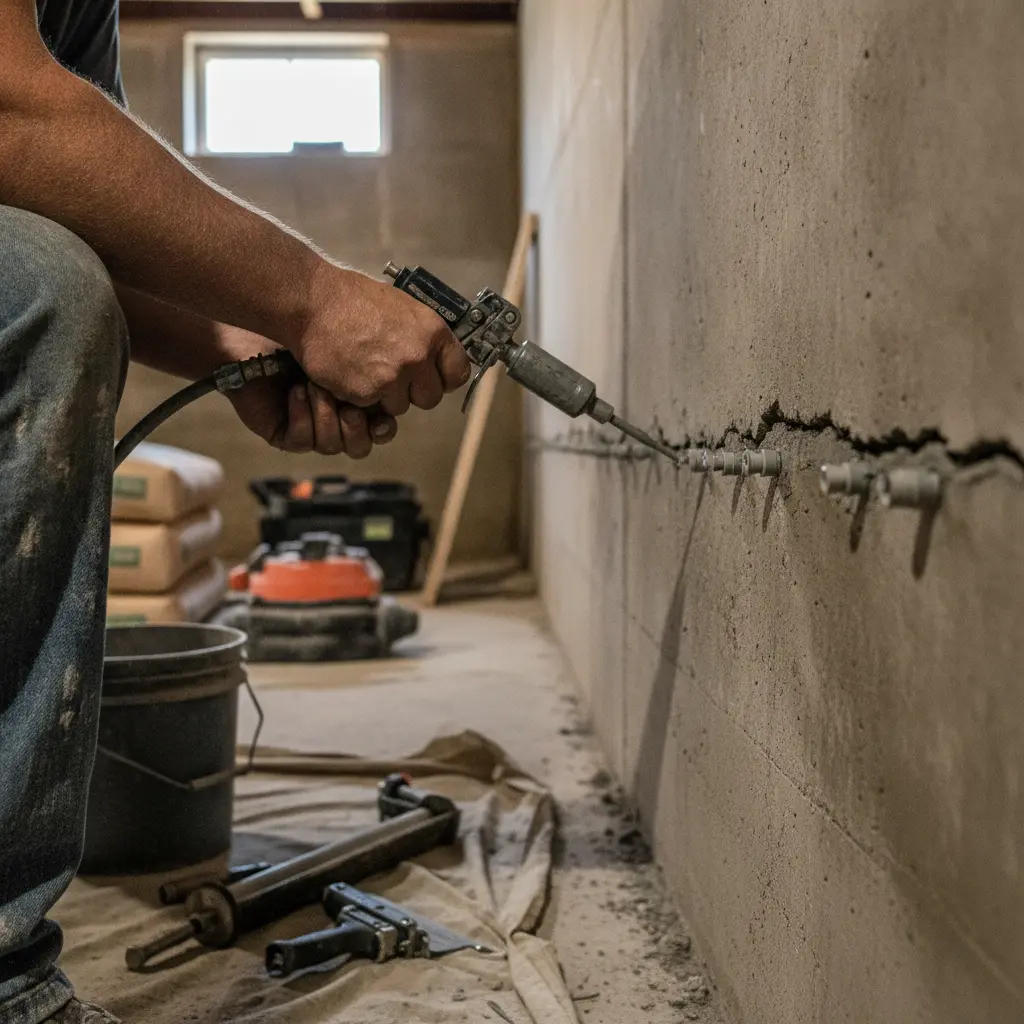
Our team in action — foundation-repair professionals serving Georgetown
Foundation Crack Repair Methods We Use in Georgetown
Epoxy Injection
Epoxy injection is ideal for structural concrete cracks that are dry or only intermittently wet. A two-part epoxy resin is injected under low pressure into the crack, bonding the concrete back to near its original tensile strength. This method is commonly used on Georgetown garage slabs, foundation walls, and older concrete pier-and-beam foundations in the historic district where structural integrity must be restored.
Polyurethane Foam Injection
For cracks actively admitting water — common after Georgetown’s spring rain events — polyurethane foam injection is preferred. The foam expands on contact with moisture, filling voids and creating a flexible, waterproof seal. It accommodates ongoing minor soil movement, making it well-suited for Georgetown’s shrink-swell clay environment where the ground continues to move seasonally.
Carbon Fiber Strap Reinforcement
Horizontal or bowing foundation wall cracks require reinforcement beyond simple filling. High-tensile carbon fiber straps are bonded vertically across the cracked wall, providing resistance to continued lateral soil pressure. This method is particularly applicable in Georgetown crawl space foundations and older basement structures near the San Gabriel River corridor.
Helical and Push Pier Underpinning
When cracking is caused by active settlement — the foundation is still moving — surface crack repair alone is insufficient. Helical piers are drilled through unstable surface soils down to competent bearing strata (in Georgetown, typically the Austin Chalk or Taylor Marl layers at depths of 15–25 feet). Push piers hydraulically lift and stabilize settled sections. This addresses the root cause, not just the symptom. Learn more about pier underpinning services
Foundation Patching and Resurfacing
For minor shrinkage cracks and cosmetic surface damage, high-strength hydraulic cement or polymer-modified mortar patching restores the foundation’s surface integrity and prevents moisture infiltration. Explore our foundation patching services
Ready for Foundation Crack Repair? Get Your Free Estimate Today.
Round Rock Foundation Repair Group serves Georgetown and the surrounding area — we’ll be on-site within 24 hours.
📞 Call (512) 220-3502Foundation Crack Repair Cost in Georgetown, TX
One of the most common questions Georgetown homeowners ask is: “How much does foundation crack repair cost?” The honest answer is that cost varies significantly based on crack type, severity, repair method, and underlying soil conditions. Below are realistic ranges based on current Central Texas market pricing.
Typical Cost Ranges
- Minor crack patching (surface shrinkage cracks): $300–$800 per crack
- Epoxy or polyurethane injection (structural or leaking cracks): $500–$1,500 per crack, depending on length and depth
- Carbon fiber strap installation: $400–$800 per strap; most projects require 3–8 straps
- Helical or push pier installation: $1,200–$1,800 per pier; most Georgetown slab stabilization projects require 8–15 piers, placing total costs between $12,000–$25,000 for full perimeter stabilization
- Crawl space foundation repair: $3,000–$15,000 depending on scope and number of failing piers or beams
Factors That Affect Your Georgetown Repair Cost
- Soil depth to bearing stratum: Georgetown’s Austin Chalk depth varies; deeper piers cost more to install
- Post-tension slab presence: Cable-location and avoidance adds time and cost
- Foundation access: Landscaping, decks, or additions covering the foundation perimeter increase labor costs
- Number and distribution of cracks: Multiple isolated cracks cost more than a single linear crack requiring one injection run
- Drainage corrections needed: Add $500–$4,000 for French drains or re-grading
Contact Round Rock Foundation Repair Group at (512) 220-3502 for a site-specific estimate. We offer free consultations for Georgetown homeowners and provide written estimates before any work begins. Schedule a foundation inspection today
Georgetown Neighborhoods We Serve
Sun City Georgetown
This massive Del Webb active-adult community, established in 1995 and still expanding, encompasses thousands of homes built across multiple decades on Georgetown’s northwest side. Homes here frequently exhibit differential settlement issues related to the transition between Blackland clay and the underlying Edwards Plateau limestone near the community’s western edges. Older sections built in the late 1990s now routinely require pier underpinning as their slabs approach the 25–30-year mark.
Wolf Ranch
One of Georgetown’s most prominent newer master-planned communities, Wolf Ranch features predominantly post-tension slabs built from the mid-2000s through the present day. Rapidly developed on heavy clay soils, many Wolf Ranch homes are beginning to exhibit the classic 7–10-year settlement crack pattern seen throughout Central Texas new construction.
Berry Creek and Cimarron Hills
These golf-course communities in northern Georgetown sit near the San Gabriel River corridor where alluvial soil variability creates unique differential settlement risks. Larger, custom-built homes in this area often have more complex foundation geometries that require specialized repair planning.
Downtown Georgetown Historic District
The 19th and early 20th-century structures surrounding Courthouse Square represent Georgetown’s oldest building stock. These properties often require masonry crack repair, historic mortar matching, and pier-and-beam restoration rather than modern slab techniques. Sensitivity to historic preservation standards is essential here. Historic foundation repair services
Foundation Crack Prevention: Maintenance Tips for Georgetown Homeowners
Proactive maintenance dramatically reduces both the frequency and severity of foundation cracking in Georgetown’s challenging soil environment. Follow these location-specific practices year-round:
- Maintain consistent soil moisture year-round. During Georgetown’s hot, dry summers (June–September), use a soaker hose system placed 12–18 inches from your foundation perimeter to prevent clay soil from shrinking away from the slab.
- Clean gutters every fall and spring. Clogged gutters dump concentrated water volumes directly against your foundation — a leading cause of crack-inducing saturation events after Georgetown’s spring storms.
- Ensure proper positive grade. The ground around your foundation should slope away at a minimum of 1 inch per foot for the first 6 feet. Georgetown’s clay soils settle and flatten over time, requiring periodic re-grading.
- Manage tree and shrub proximity. Live Oaks and other large trees common in Georgetown should be planted at least 15–20 feet from your foundation. Root systems aggressively extract soil moisture, worsening clay shrinkage beneath the slab.
- Inspect your foundation after major weather events. After a significant drought period or a heavy rain event like Georgetown’s spring thunderstorms, do a visual walkaround of your foundation looking for new cracks or crack widening.
- Address plumbing leaks immediately. Under-slab plumbing leaks are a leading cause of localized soil saturation and foundation heave in Georgetown slab homes.
- Schedule annual professional inspections. Many Georgetown foundation problems that cost $20,000+ to repair could have been addressed for under $3,000 if caught 2–3 years earlier.
Why Choose Round Rock Foundation Repair Group for Georgetown Foundation Crack Repair
Round Rock Foundation Repair Group is a locally rooted foundation repair company serving Georgetown and the broader Williamson County and Central Texas region. Unlike national franchise operations that apply generic repair templates, our team has hands-on experience with Georgetown’s specific soil profiles, building types, and climate patterns that drive local foundation cracking.
We work across the full spectrum of Georgetown foundation types — from post-tension slabs in Wolf Ranch and Sun City to pier-and-beam structures in the historic downtown district. Every repair plan is site-specific and explained transparently before work begins.
Our service area covers Georgetown and all surrounding communities including Round Rock, Cedar Park, Austin, Pflugerville, and Brushy Creek. We offer free on-site consultations, detailed written estimates, and a commitment to repairs that address root causes rather than cosmetic symptoms.
Call (512) 220-3502 today to schedule your Georgetown foundation crack assessment. Request a free consultation online
Frequently Asked Questions: Foundation Crack Repair in Georgetown, TX
How much does foundation crack repair cost in Georgetown, TX?
Costs range from as little as $300–$800 for minor surface crack patching to $15,000–$25,000 or more for full slab stabilization with pier underpinning. Most Georgetown homeowners dealing with moderate settlement cracking can expect repair costs in the $3,000–$10,000 range. The best way to get an accurate number is through an on-site evaluation — call us at (512) 220-3502.
Are my foundation cracks serious, or just cosmetic?
Hairline vertical cracks under 1/16 inch wide are usually cosmetic concrete shrinkage cracks. Cracks wider than 1/4 inch, horizontal cracks, cracks with vertical displacement (one side higher than the other), and cracks that are actively growing all indicate structural concern requiring professional evaluation.
How long does foundation crack repair take in Georgetown?
Simple crack injection repairs can often be completed in 4–8 hours on a single day. Pier underpinning projects for Georgetown slabs typically take 2–4 days depending on the number of piers and site access. Full crawl space foundation restorations may take 3–5 days.
Does Georgetown’s clay soil cause more foundation problems than other areas?
Yes. The Blackland Prairie clay soils covering much of eastern Georgetown — including the Teravista corridor — are among the most expansive soil types in North America. The combination of Georgetown’s drought-intense summers and heavy spring rainfall creates repeated shrink-swell cycles that are significantly more damaging to foundations than soil conditions in less climatically variable regions.
My home is in Sun City Georgetown. What foundation issues should I watch for?
Sun City Georgetown homes, particularly those built in the late 1990s and early 2000s, are now at the age where post-tension slab settlement becomes common. Watch for diagonal drywall cracks at door corners, sticking doors, and floor gaps near exterior walls. These homes often benefit from perimeter pier stabilization to stop ongoing settlement.
Can I repair foundation cracks myself?
DIY hydraulic cement patches can temporarily fill small surface cracks but will not address structural cracking or active settlement. In Georgetown’s clay soil environment, self-repairs that miss the underlying cause typically fail within one or two seasonal cycles. Additionally, drilling or cutting a post-tension slab without proper cable location is extremely dangerous and can cause the slab to fail catastrophically.
Will foundation crack repair affect my Georgetown home’s resale value?
Professionally repaired foundations with documentation generally have minimal negative impact on resale value in the Georgetown market. In fact, documented repairs often reassure buyers more than an aging, uninspected foundation. Unrepaired, visible foundation cracks, however, can reduce offers significantly and trigger renegotiation after inspection.
Do you serve areas outside Georgetown?
Yes — Round Rock Foundation Repair Group serves Georgetown and the surrounding region including Round Rock, Cedar Park, Austin, Pflugerville, Brushy Creek, Tech Ridge, Wells Branch, Jollyville, Paloma Lake, Teravista, La Frontera, Avery Ranch, Great Hills, Mayfield Ranch, Anderson Mill, Cat Hollow, Forest Creek, Behrens Ranch, and Sendero Springs. View our full service area
Get Expert Foundation Crack Repair in Georgetown, TX Today
Georgetown’s expansive clay soils, volatile rainfall patterns, and rapid residential growth make foundation cracking a predictable challenge — but it is one that can be solved with the right expertise and the right repair method. Whether you’ve noticed a single diagonal crack above your bedroom door or multiple cracks spreading across your slab, Round Rock Foundation Repair Group has the local knowledge and technical capability to diagnose and repair it correctly.
Don’t let a small crack become a structural emergency. Contact us today for a free on-site consultation and written estimate.
- Call or text: (512) 220-3502
- Online: Request a Free Foundation Inspection in Georgetown
- Serving: Georgetown, Round Rock, Cedar Park, Austin, and all of Central Texas