
Concrete Foundation Repair in Georgetown, TX
Fast, Reliable Concrete Foundation Repair in Georgetown, TX — Licensed & Insured
Need concrete foundation repair in Georgetown, TX? Round Rock Foundation Repair Group fixes slab, structural & crawl space issues. Call (512) 220-3502 today.
Concrete foundation repair is the process of diagnosing, stabilizing, and restoring the structural integrity of a home or commercial building’s concrete foundation system. In Georgetown, TX, where expansive clay soils, dramatic seasonal moisture swings, and rapid residential growth create persistent stress on concrete slabs and pier-and-beam foundations, professional intervention is often essential to protect your property’s long-term value.
Round Rock Foundation Repair Group serves Georgetown homeowners and business owners with comprehensive concrete foundation repair solutions tailored to the specific geological and climatic conditions of Williamson County. From historic downtown Georgetown properties to new construction in master-planned communities like Teravista and Serenada, our team applies proven methods to stop foundation movement, close cracks, and restore structural stability. Whether you’ve noticed a hairline crack in your slab or doors that refuse to close properly, we have the expertise to address the problem at its root.
Understanding Concrete Foundation Repair
Concrete foundations form the backbone of virtually every residential and commercial structure built in Central Texas over the past several decades. In Georgetown specifically, the dominant foundation type is the post-tensioned concrete slab, a system engineered to handle the expansive soils common throughout Williamson County. Older properties—particularly those built before the 1970s along the historic Georgetown square and along University Avenue—often feature conventional reinforced slab-on-grade or pier-and-beam systems that present their own unique repair challenges.
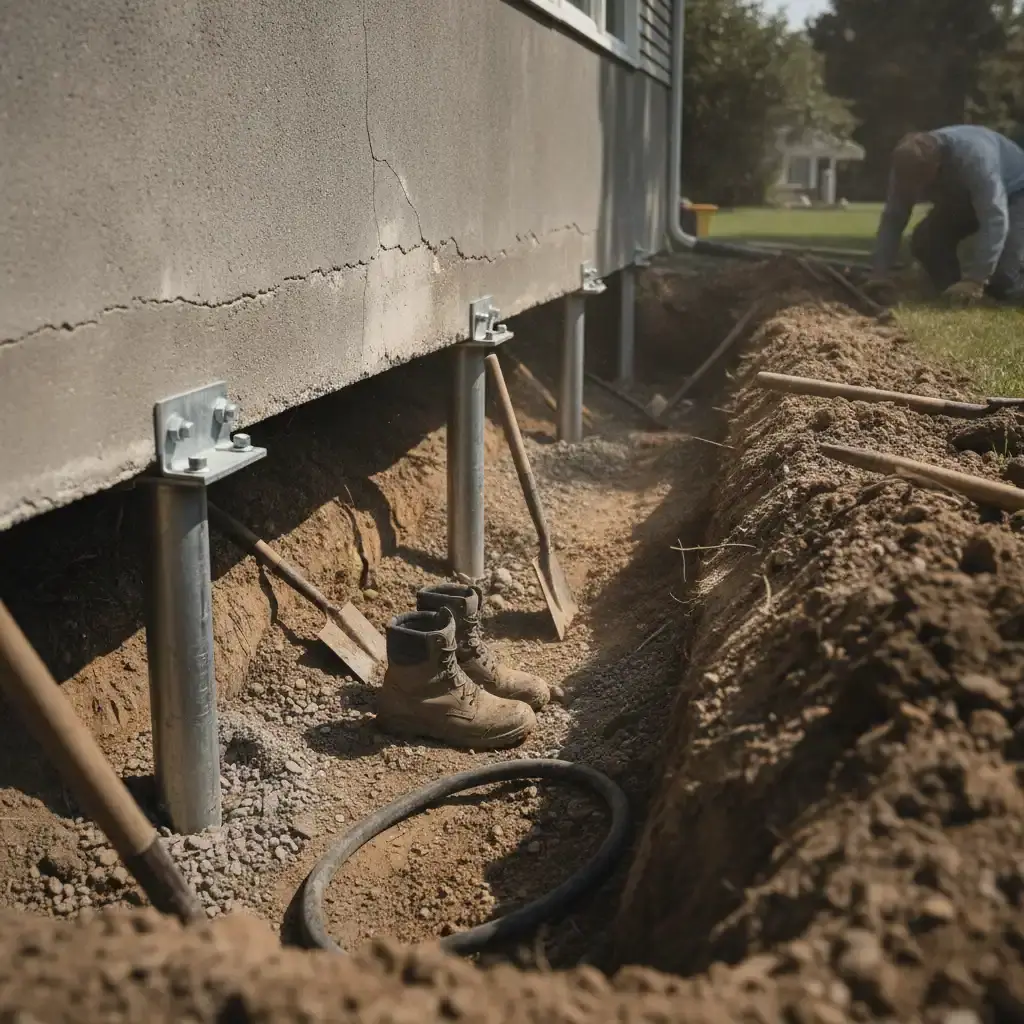
Concrete foundation repair encompasses a wide spectrum of services. At the less invasive end, foundation patching addresses surface-level spalling, minor cracking, and cosmetic deterioration that can allow moisture infiltration if left untreated. Moving up the complexity scale, foundation restoration involves re-leveling settled sections of a slab and reinforcing weakened zones using grouting or epoxy injection techniques. Structural foundation repair—the most comprehensive category—addresses significant differential settlement, major crack propagation, and loss of bearing capacity, often requiring underpinning with steel push piers or helical piers driven deep into stable load-bearing strata.
Read moreShow less
Georgetown’s rapid population growth, which saw the city ranked as one of the fastest-growing cities in the United States for several consecutive years through the early 2020s, has translated into an enormous and diverse housing stock. Subdivisions platted and built quickly during growth surges sometimes feature foundations that were poured during periods of drought-induced soil shrinkage, setting them up for future movement once rain cycles return. Understanding the construction era and soil conditions beneath a specific Georgetown property is therefore a critical first step in any accurate repair diagnosis.
Beyond residential homes, Georgetown’s commercial corridors along Williams Drive, Shell Road, and the rapidly developing FM 1460 corridor include retail centers, office parks, and light industrial facilities whose concrete foundations face similar—and sometimes amplified—movement pressures due to greater structural loads. Learn more about our Commercial Foundation Repair services to understand how we address these higher-stakes scenarios.
Why Concrete Foundation Repair Is Needed in Georgetown, TX
Expansive Clay Soils: Georgetown’s Hidden Challenge
The single greatest contributor to foundation distress in Georgetown is the Blackland Prairie clay soil that underlies much of Williamson County. Geologically classified as Houston Black clay and Austin clay series, these soils are characterized by their extraordinarily high plasticity index—often exceeding 40—meaning they can absorb enormous quantities of water and swell by as much as 6 to 10 inches vertically during wet seasons, then shrink dramatically during dry periods. This cyclical heave-and-shrink dynamic exerts pressures on concrete slabs measured in thousands of pounds per square foot, causing differential settlement as different sections of a foundation rise and fall unevenly.
Drought Cycles and the 2022–2023 Drought Event
Central Texas experiences persistent multi-year drought cycles that are particularly damaging to Georgetown foundations. The 2022–2023 drought, one of the most severe on record for Williamson County, saw Georgetown record rainfall deficits exceeding 12 inches below average for consecutive months. The resulting soil desiccation caused widespread foundation movement throughout subdivisions including Serenada, Georgetown Village, and the Berry Creek corridor. Homeowners in these neighborhoods reported sudden increases in interior door misalignment, drywall cracking above window headers, and visible slab edge gaps of up to 1.5 inches—all classic indicators of drought-induced differential settlement.
The San Gabriel River Corridor and Moisture Variability
Properties situated near the North and South San Gabriel River corridors face an additional layer of complexity: proximity to riparian zones means soils alternate between flood-saturated and drought-desiccated conditions more dramatically than in upland areas of Georgetown. Neighborhoods like River Ridge, parts of Sun City Georgetown, and residential areas adjacent to Lake Georgetown experience this amplified moisture variability. In saturated conditions, hydrostatic pressure beneath slabs can cause upward heaving of up to 3 inches, while subsequent dry periods produce rapid settlement.
Sun City Georgetown: An Age-Related Factor
Sun City Georgetown, the large active-adult community developed beginning in the late 1990s, represents a particularly active segment of Georgetown’s foundation repair market. Homes in the earliest Sun City phases, built between 1995 and 2002, are now 20 to 30 years old—a typical threshold at which original post-tensioned slab designs begin showing cumulative fatigue from decades of soil movement. The community’s internal geography also places many homes on gently sloping terrain that accelerates moisture runoff toward foundation perimeters.
Infrastructure and Tree Root Encroachment
Georgetown’s mature tree canopy, particularly the large live oaks and cedar elms common throughout established neighborhoods like Georgetown Heights and the downtown historic district, contributes to foundation issues through aggressive root systems that extract moisture from soils within 20 to 50 feet of a tree’s trunk. Root-related soil desiccation creates localized settlement zones that produce asymmetric slab distortion even when the broader site appears stable.
Free, no-obligation estimates
Talk to Round Rock Foundation Repair Group
Tell us what you need and we’ll take it from there.
Signs You Need Concrete Foundation Repair
Interior Warning Signs
- Diagonal cracks running from the corners of door frames or window openings, typically at 45-degree angles
- Doors or windows that stick, bind, or no longer latch properly—especially after a dry summer season
- Horizontal or stair-step cracks in interior drywall, particularly along bedroom and hallway walls
- Visible gaps between interior walls and ceiling or floor planes exceeding 1/4 inch
- Sloping or uneven floors detectable by rolling a marble or measured with a level
Exterior Warning Signs
- Visible cracks in the brick veneer, particularly stair-step cracks following mortar joints
- Gaps between the slab edge and the soil or landscaping that weren’t present previously
- Cracks in the concrete slab visible in the garage floor or along exterior walkways
- Chimney separation or leaning away from the main structure
Urgency Indicators
Contact a professional immediately if you observe cracks wider than 1/4 inch, any crack exhibiting vertical displacement between the two sides, structural walls that appear to be bowing, or sudden worsening of symptoms following a heavy rainfall event or extended drought period. These signals suggest active and potentially accelerating foundation movement. Schedule a professional Foundation Inspection today.
Foundation Repair Methods and Approaches
Steel Push Piers
Steel push piers are hydraulically driven through the foundation footing into stable load-bearing soil or bedrock below. In Georgetown, competent limestone is typically encountered between 10 and 20 feet below grade depending on location. Push piers are best suited for settled foundations where the structure’s weight can be transferred to deep stable strata, making them ideal for heavier Georgetown homes with significant differential settlement exceeding 2 inches.
Helical Piers
Helical piers use a screw-like helix plate that rotates into the soil, making them well-suited for lighter structures, additions, porches, and commercial applications with lower dead loads. They are also preferred in Georgetown’s riparian zones near the San Gabriel River where soil layering is inconsistent and push pier refusal depth is unpredictable.
Slab Pier Systems (Interior Piers)
For interior slab settlement, concrete is saw-cut in sections and piers are installed through the slab to reach bearing strata. This method is commonly required in Georgetown homes where the interior of the slab has dropped while the perimeter remains relatively stable—a pattern frequently seen in drought-affected properties in Georgetown Village and Serenada.
Polyurethane Foam Injection (Slab Lifting)
High-density polyurethane foam injected beneath a settled slab expands to fill voids and lift concrete back toward its original elevation. This minimally invasive method is ideal for driveways, garage slabs, sidewalks, and pool decks throughout Georgetown and is completed in a matter of hours.
Foundation Patching and Crack Injection
Epoxy and polyurethane crack injection seals active and dormant cracks to prevent moisture infiltration and restore tensile strength to the concrete. Learn more about our Foundation Patching services for details on this cost-effective approach to minor foundation maintenance.
Concrete Foundation Repair Cost in Georgetown, TX
Understanding the cost of concrete foundation repair in Georgetown requires recognizing that pricing varies significantly based on the severity of damage, the repair method required, the number of piers or injection points needed, and site-specific access conditions. The following ranges reflect typical project costs in the Georgetown and greater Williamson County market.
- Foundation Inspection: $200–$400 for a standalone professional inspection with written report
- Foundation Patching and Crack Injection: $500–$3,000 depending on the number and size of cracks treated
- Polyurethane Foam Slab Lifting: $1,500–$5,000 for residential driveways, garage slabs, and walkways
- Steel Push Pier or Helical Pier Installation: $1,200–$1,800 per pier installed, with most Georgetown residential projects requiring 8 to 20 piers, putting typical full-perimeter projects in the $12,000–$30,000 range
- Crawl Space Repair: $3,000–$15,000 depending on the extent of beam, post, and moisture barrier work required
- Commercial Foundation Repair: $20,000–$100,000+ for larger structures along Georgetown’s commercial corridors
Read moreShow less
Georgetown-Specific Pricing Factors
Georgetown properties near the San Gabriel River or on sloped terrain may require additional excavation or specialized equipment access, adding 10–20% to base pier installation costs. Homes in Sun City Georgetown with mature landscaping that must be protected and restored also tend to incur slightly higher project costs. Texas homeowners should also note that foundation repair is generally not covered by standard homeowners insurance unless damage resulted from a covered peril such as a plumbing leak—a situation our team can help you document properly.
See our detailed Foundation Repair Cost guide for a comprehensive breakdown of pricing factors across all service types.
Georgetown Neighborhoods We Serve
Sun City Georgetown
Built in phases beginning in 1995, Sun City Georgetown’s oldest sections feature homes now approaching their third decade of service. Early-phase construction coincided with a period of above-average rainfall, meaning foundations were poured into adequately moistened soil. As the region’s drought cycles intensified in subsequent years, differential settlement became common throughout the community’s older sections. We regularly perform pier installation and elevation correction work throughout Sun City’s multiple phases.
Serenada
Serenada is an established Georgetown subdivision developed primarily during the 1970s and 1980s. Its conventional reinforced slab foundations are now 40 to 50 years old and show the accumulated effects of decades of Blackland clay movement. Properties here frequently require interior pier work in addition to perimeter stabilization.
Georgetown Village
Georgetown Village, developed through the 2000s and 2010s, represents a mix of post-tensioned slab construction styles. The neighborhood experienced notable foundation activity following the 2022–2023 drought, with many homeowners reporting first-time symptoms requiring professional assessment.
Historic Downtown Georgetown
Properties within the Georgetown historic district, particularly along the Courthouse Square and on streets such as Rock Street and Church Street, include structures dating to the late 1800s and early 1900s. These older buildings often feature rubble stone or unreinforced masonry foundations that require specialized restoration rather than standard modern pier systems. Learn about our Structural Foundation Repair capabilities for historic structures.
Foundation Maintenance Tips for Georgetown Homeowners
- Maintain consistent soil moisture year-round. During Georgetown’s dry summers, use a soaker hose placed 18 to 24 inches from the foundation perimeter to prevent the dramatic soil shrinkage that causes settlement. Run hoses for 20–30 minutes, three to four times per week during drought conditions.
- Ensure proper drainage away from the foundation. Georgetown’s clay soils drain slowly. Grade soil so that the ground slopes away from the foundation at a minimum of 1 inch per foot for the first 6 feet.
- Keep gutters and downspouts clear and extended. Discharge downspout water at least 4 to 6 feet from the foundation perimeter to prevent saturation near the slab edge.
- Monitor large trees near the foundation. Live oaks and cedar elms within 30 feet of your Georgetown home’s foundation should be inspected annually for root encroachment.
- Check under-slab plumbing periodically. Request a plumbing pressure test every 5 to 7 years. Slab leaks beneath Georgetown’s post-tensioned foundations are a leading cause of localized soil saturation and heave.
- Photograph your home’s cracks annually. Dated photographs allow you to track crack width changes over time and provide documentation if professional repair is eventually required.
- Avoid planting water-intensive vegetation immediately adjacent to the foundation. Large shrubs and irrigated flower beds placed directly against the slab edge create uneven moisture zones that accelerate differential movement.
Why Choose Round Rock Foundation Repair Group
Round Rock Foundation Repair Group has built its reputation by focusing exclusively on the foundation conditions found in Central Texas, where Blackland Prairie clay, caliche layers, and Austin Chalk bedrock create a uniquely challenging environment that generic foundation contractors are often ill-equipped to handle. Our team has direct, hands-on experience with the specific soil profiles, rainfall patterns, and construction eras found across Georgetown, Williamson County, and the greater Austin metro area.
We serve Georgetown homeowners, property managers, and commercial clients with the full spectrum of foundation services: Home Foundation Repair, Commercial Foundation Repair, Crawl Space Repair, Foundation Inspection, and more. Every project begins with an honest, thorough assessment—we will never recommend more work than your property actually needs.
Our crews are trained specifically on the pier systems and soil stabilization methods best suited to Georgetown’s geological profile. We provide detailed written documentation for every project, supporting both your peace of mind and any future real estate transaction disclosures required under Texas law.
Call us at (512) 220-3502
Call us at (512) 220-3502to speak with a Georgetown foundation specialist today.
FAQ
Frequently Asked Questions About Concrete Foundation Repair in Georgetown, TX
How much does concrete foundation repair cost in Georgetown, TX?
Costs range widely depending on severity and method. Minor crack injection or patching may cost $500–$3,000, while full pier installation for a typical Georgetown home requiring 10 to 16 piers generally runs $15,000–$25,000. Commercial projects and historic properties can exceed $50,000. We provide free, itemized written estimates so you understand exactly what you’re paying for before any work begins.
How long does foundation repair take in Georgetown?
Most residential foundation repair projects in Georgetown are completed in 1 to 3 days once work begins. Larger homes, commercial properties, or projects requiring interior pier installation through the slab may take 4 to 5 days. Permitting through the City of Georgetown Building Inspections office typically adds 2 to 5 business days to the overall timeline.
Does Georgetown’s clay soil make foundation repair more complicated?
Yes. The Houston Black and Austin clay series soils common throughout Georgetown are among the most expansive in Texas. These soils require that pier depth calculations account not just for load transfer but for the active zone—typically the upper 10 to 15 feet of soil in Georgetown—where seasonal moisture changes cause soil movement. Our team designs repair plans that account for Georgetown’s specific soil plasticity characteristics.
Will my homeowners insurance cover foundation repair in Georgetown?
Standard homeowners insurance policies in Texas typically exclude foundation damage caused by soil movement, settling, or shrinkage. Coverage may be available if a covered peril—such as a ruptured water line beneath the slab—caused the damage. We can provide documentation of our findings to support your insurance claim process if a plumbing-related cause is identified during our inspection.
Is foundation repair necessary before selling a home in Georgetown?
Texas law requires sellers to disclose known foundation issues on the Seller’s Disclosure Notice. Unrepaired foundation problems can significantly impact your home’s appraised value, complicate buyer financing, and reduce your negotiating position. Many Georgetown sellers find that completing foundation repair prior to listing increases their net sale proceeds relative to the repair cost. We provide documentation packages suitable for real estate transactions.
What is the best time of year to repair a foundation in Georgetown?
Foundation repair can be performed year-round in Georgetown. However, many engineers recommend allowing soil conditions to stabilize following an extended drought before performing final lifting, as soils may continue to swell as moisture returns. Spring months—when Georgetown soils have typically recharged following winter rains—often represent ideal conditions for accurate elevation correction and long-term stability.
How do I know if my Georgetown home needs foundation repair or just cosmetic patching?
The key distinction lies in whether the cracking is structural or cosmetic and whether active movement is occurring. Diagonal cracks wider than 1/8 inch, cracks with vertical displacement, multiple simultaneous symptoms (sticking doors, sloping floors, and wall cracks together), or cracks that continue to grow over time all indicate structural repair is needed rather than cosmetic patching. A professional inspection with elevation measurements is the only reliable way to make this determination accurately.
Do you serve areas outside of Georgetown proper?
Yes. Round Rock Foundation Repair Group serves communities throughout the greater Austin metro area including Round Rock, Cedar Park, Pflugerville, Austin, Brushy Creek, Teravista, Avery Ranch, Great Hills, Forest Creek, Anderson Mill, Sendero Springs, and many other neighborhoods. View our complete service area for details.
Get Your Georgetown Foundation Repaired by Local Experts
If you’ve noticed warning signs of foundation distress—sticking doors, cracked walls, uneven floors, or visible slab cracks—don’t wait for the problem to worsen. Georgetown’s expansive clay soils and seasonal drought cycles mean that foundation issues rarely resolve on their own. Early intervention almost always costs less than delayed repair.
Round Rock Foundation Repair Group is ready to help. We serve Georgetown and surrounding communities with honest assessments, proven repair methods, and clear communication from the first phone call through project completion.
Call us today at (512) 220-3502 to schedule your foundation inspection or to speak directly with a Georgetown area foundation specialist. You can also contact us online to request a callback at your convenience. Protect your home—and your investment—starting today.
Get in touch
Find foundation repair help near you
Request a free estimate online or give us a call — our team will follow up quickly.
- Call us(512) 220-3502
- Visit1 Chisholm Trail Rd suite 450 room j, Round Rock, TX 78681
- HoursMon-Sat: 7:00 am – 7:00 pm