Foundation Patching in Georgetown, TX
Structural Foundation Patching Specialists Serving Georgetown, TX
Need foundation patching in Georgetown, TX? Round Rock Foundation Repair Group fixes cracks caused by expansive clay soils. Free evaluation — call (512) 220-3502.
- Licensed & Insured
- Locally Owned & Operated
- Free Inspection & Estimate
Request Your
Free EstimateFoundation patching is a targeted repair process that seals cracks, fills voids, and restores structural integrity to compromised concrete or masonry foundations. Rather than replacing an entire foundation, patching addresses specific areas of damage — saving homeowners and business owners significant time and money while halting further deterioration.
In Georgetown, TX, the combination of expansive clay soils, dramatic seasonal moisture swings, and a rapidly growing housing stock makes foundation patching one of the most frequently requested services in Williamson County. Whether your home sits in the historic downtown district or in a newer development like Teravista or Wolf Ranch, localized ground movement can open cracks that demand immediate professional attention.
Round Rock Foundation Repair Group brings specialized expertise in diagnosing and patching foundations throughout Georgetown and the surrounding Central Texas region. Our team understands the specific geologic and climatic pressures unique to this area, and we tailor every repair to the conditions beneath your specific property. Call us today at (512) 220-3502 for a comprehensive evaluation.
Understanding Foundation Patching
Foundation patching is the process of repairing discrete areas of a foundation that have cracked, spalled, eroded, or separated — without performing a full foundation replacement. The practice dates to early 20th-century concrete construction, when engineers recognized that localized repairs could extend the service life of a structure by decades if performed correctly and with the right materials.
At its core, foundation patching involves cleaning the damaged area, removing loose or deteriorated material, applying a bonding agent or primer, and filling the void or crack with a compatible patching compound — typically a hydraulic cement, epoxy injection system, polyurethane foam, or polymer-modified mortar. The goal is not just cosmetic improvement but the restoration of load-bearing capacity and moisture resistance.
Georgetown’s built environment spans multiple eras of construction. The city’s historic downtown, platted in the 1840s and anchored by the Williamson County Courthouse square, features older limestone block and brick foundations that require heritage-sensitive patching techniques. Mid-century homes constructed between the 1950s and 1980s along University Avenue and in established neighborhoods near Georgetown Lake often use poured concrete slabs that develop shrinkage cracks over time. More recent construction in master-planned communities like Teravista (developed from the early 2000s onward) and Wolf Ranch relies on post-tensioned slab systems that require specialized patching protocols to avoid damaging tensioning cables.
Foundation patching is classified within the broader discipline of structural foundation repair, which also encompasses underpinning, piering, and drainage correction. Patching is often the first line of defense when cracks are identified early — before differential settlement becomes severe. In Georgetown’s market, where real estate values have appreciated sharply over the past decade, addressing patching needs promptly protects both structural safety and property resale value.
Patching is not a one-size-fits-all solution. The type of crack (horizontal, vertical, diagonal, stair-step), its width and depth, the age of the foundation, and the underlying soil conditions all influence which patching method is appropriate. This is why a thorough professional foundation inspection must precede any patching work.
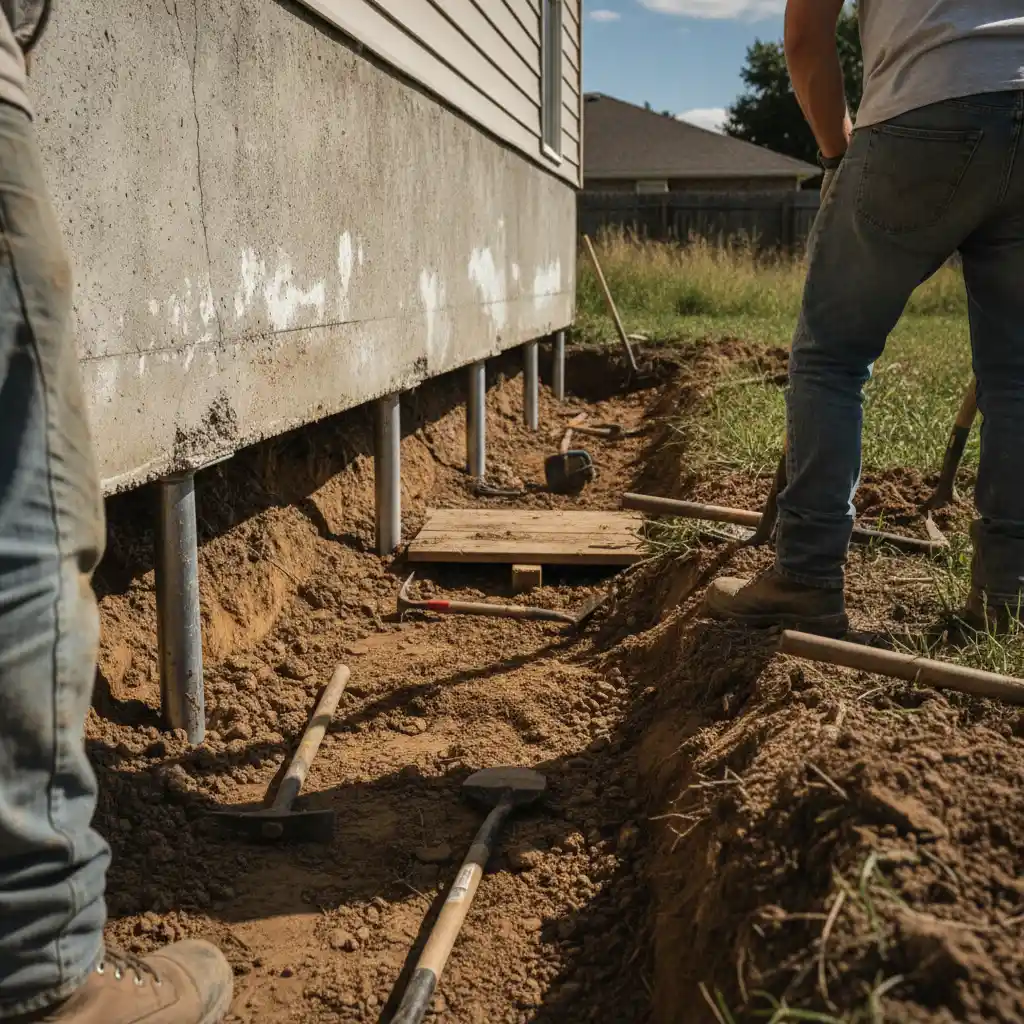
Our team in action — foundation-repair professionals serving Georgetown
Why Foundation Patching Is Needed in Georgetown, TX
Expansive Taylor Clay and Austin Chalk
The bedrock geology beneath Georgetown transitions between the Austin Chalk formation and the Taylor Clay Group — two formations that create dramatically different foundation behaviors depending on moisture content. Taylor Clay, which underlies much of eastern and central Georgetown including neighborhoods like Berry Creek and Georgetown Village, can expand up to 30% in volume when saturated and shrink dramatically during drought. The Texas A&M AgriLife Extension Service has documented plasticity index (PI) values in Williamson County soils ranging from 30 to over 60, with the highest readings concentrated in the Georgetown area. A PI above 20 is generally considered problematic for foundations; Georgetown’s soils frequently double or triple that threshold.
The 2011 and 2022 Texas Droughts
The 2011 Texas drought — the most severe single-year drought in the state’s recorded history — caused catastrophic soil shrinkage across Williamson County. Georgetown received less than 12 inches of rainfall that year, compared to a historical annual average of approximately 34 inches. This rapid moisture loss caused soils to pull away from foundation edges by as much as 2 to 4 inches in some neighborhoods along the Highway 29 corridor and near the San Gabriel River basin. Thousands of Georgetown homes first developed significant foundation cracks that year. A second severe drought in 2022 reactivated dormant crack systems and opened new ones, particularly in established neighborhoods like Serenada and Berry Creek where clay soil profiles are deepest.
Freeze-Thaw Cycles and Winter Storm Uri
Winter Storm Uri in February 2021 exposed a secondary threat to Georgetown foundations: freeze-thaw cycling. When temperatures dropped to -2°F in Georgetown — an all-time record low — water trapped inside existing hairline foundation cracks froze and expanded, widening those cracks significantly. Many homeowners who had monitored stable hairline cracks for years found them dramatically wider following the storm. This mechanical cracking from ice expansion is distinct from soil-movement cracking but equally demands proper patching.
Rapid Development and Grade Changes
Georgetown’s population has grown from approximately 28,000 in 2010 to over 86,000 by 2023, making it one of the fastest-growing cities in the United States. This rapid development has altered natural drainage patterns throughout the city. New subdivisions in the northwest, including Wolf Ranch and Morningstar, have changed surface water flow, sometimes directing runoff toward adjacent older properties. Altered grades around foundations accelerate erosion beneath slabs, creating voids that require prompt crawl space repair and surface patching to prevent progressive settlement.
Plumbing Leaks Beneath Slabs
Georgetown’s older neighborhoods, including homes built before 1990 along Williams Drive and in the Cimarron Hills area, commonly feature cast-iron or galvanized drain lines. As these pipes corrode and leak beneath slabs, the sustained moisture softens surrounding clay, causing localized settlement. A single slow plumbing leak can erode a void 18 to 36 inches wide beneath a slab within two to three years, eventually causing the slab surface to crack and drop.
Signs You Need Foundation Patching in Georgetown
Interior Warning Signs
- Diagonal cracks running from the corners of door frames or window openings at 45-degree angles
- Doors or windows that stick, fail to latch, or have developed visible gaps at their frames
- Floors that feel bouncy, sloped, or uneven when you walk across them
- Cracks in drywall or plaster, especially those wider than 1/4 inch or that have reappeared after previous patching
- Separation between wall surfaces and ceiling or floor trim
Exterior Warning Signs
- Visible cracks in brick veneer, particularly stair-step cracks along mortar joints
- Horizontal cracks in concrete foundation walls, which indicate lateral soil pressure
- Gaps between the foundation and the exterior wall above it
- Concrete spalling — flaking or crumbling surface concrete — along the foundation stem wall
- Standing water pooling against the foundation after rain
Urgency Indicators
Seek immediate professional evaluation if you observe cracks wider than 1/2 inch, any horizontal cracking in a poured concrete wall, foundation displacement visible to the naked eye, or sudden changes in crack width following a rain event or drought. These symptoms may indicate active structural movement beyond the scope of surface patching alone and may require structural foundation repair.
Foundation Patching Methods We Use in Georgetown
Epoxy Crack Injection
Epoxy injection is used for structural cracks in poured concrete foundations where full load transfer across the crack plane must be restored. Two-part epoxy is injected under low pressure through surface ports spaced along the crack. Cured epoxy bonds are stronger than the surrounding concrete, making this ideal for bearing wall foundations in Georgetown’s older downtown commercial structures and mid-century residential homes. This method works best in dry or damp (not actively wet) cracks.
Polyurethane Foam Injection
For cracks that experience active water intrusion — common in Georgetown properties near the San Gabriel River floodplain and in homes with hydrostatic pressure from clay soils — polyurethane foam injection is preferred. The expanding foam reacts with moisture to create a flexible, waterproof seal, accommodating slight future movement without re-cracking.
Hydraulic Cement Patching
Hydraulic cement is applied to actively leaking cracks and surface voids in foundation walls, particularly in crawl space foundations common in Georgetown’s older historic district. It sets rapidly even in wet conditions, making it valuable for emergency moisture intrusion repairs.
Polymer-Modified Mortar Patching
For spalled or deteriorated foundation surfaces, we apply polymer-modified mortar to restore cross-section depth, re-establish protective cover over reinforcing steel, and improve the surface’s resistance to Georgetown’s wet-dry cycles. This method is commonly used on concrete foundation repair projects involving stem walls and exposed perimeter foundations.
Carbon Fiber Stitching
For horizontal or diagonal cracks indicating lateral soil pressure — particularly in Georgetown properties on sloped lots in neighborhoods like Cimarron Hills — carbon fiber staples or stitching bars are embedded across the crack to prevent widening while the patch material fills the void.
Ready for Foundation Patching? Get Your Free Estimate Today.
Round Rock Foundation Repair Group serves Georgetown and the surrounding area — we’ll be on-site within 24 hours.
📞 Call (512) 220-3502Foundation Patching Cost in Georgetown, TX
Foundation patching costs in Georgetown, TX vary significantly based on crack severity, patching method, accessibility, and the total linear footage or surface area requiring treatment. Below are representative ranges based on current Central Texas market pricing:
- Hairline crack sealing (surface sealant, per crack): $150 – $400
- Epoxy injection (per linear foot of crack): $400 – $800
- Polyurethane foam injection (per linear foot): $300 – $600
- Hydraulic cement patching (per square foot of surface area): $8 – $18
- Polymer mortar resurfacing (per square foot): $10 – $25
- Typical whole-project foundation patching scope (1 to 3 cracks, residential): $800 – $4,000
- Extensive patching combined with drainage correction: $4,000 – $12,000+
Georgetown-Specific Cost Factors
Georgetown’s expansive clay soils sometimes require soil stabilization or drainage improvements alongside patching — costs that are site-specific but typically add $1,500 to $5,000 to a project. Historic downtown Georgetown properties with limestone block foundations may require specialty materials and heritage-preservation expertise, adding a 15% to 25% premium over standard concrete patch pricing. Post-tensioned slab patching in newer Georgetown developments like Wolf Ranch requires specialized protocols, increasing per-linear-foot costs by approximately 20% compared to conventional slab work.
We provide free, written estimates for all Georgetown foundation patching projects. Contact us at (512) 220-3502 to schedule your no-obligation evaluation. For a broader repair scope, explore our foundation restoration services.
Georgetown Neighborhoods We Serve
Historic Downtown Georgetown
Georgetown’s downtown square and surrounding residential blocks feature homes and commercial buildings dating from the 1870s through the 1940s. Many structures rest on limestone block or early poured concrete foundations. Mortar joint deterioration, moisture infiltration through porous limestone, and over a century of soil movement create complex patching challenges that require heritage-sensitive materials and techniques.
Berry Creek and Georgetown Village
These established subdivisions east and northeast of downtown sit on deep Taylor Clay profiles with high plasticity indices. Homes built in the 1990s and early 2000s show elevated rates of seasonal crack cycling — opening during summer drought and partially closing after fall rains. Residents here frequently need annual monitoring and periodic re-patching of active cracks.
Teravista
This master-planned community on Georgetown’s eastern edge features predominantly post-tensioned slab construction from the mid-2000s onward. Patching in Teravista requires careful avoidance of post-tensioning cables; our team uses as-built cable layout records when available and ground-penetrating radar when records are unavailable.
Wolf Ranch and Morningstar
Georgetown’s newest large-scale residential communities in the northwest feature modern construction but are already experiencing grade-related drainage issues as landscaping matures. Early-stage crack monitoring and preventative patching are strongly recommended for homeowners here. Learn about our home foundation repair services.
Foundation Maintenance Tips for Georgetown Homeowners
- Implement a seasonal watering program: During Georgetown’s summer drought periods (typically June through September), run soaker hoses 18 to 24 inches from the foundation perimeter for 20 to 30 minutes, three to four times per week. This prevents extreme clay shrinkage, the leading cause of foundation cracking in Williamson County.
- Maintain consistent soil moisture in spring: Don’t over-water during wet springs. Over-saturation can swell Taylor Clay and cause heaving. Aim for consistent, moderate moisture year-round.
- Grade soil away from your foundation: Maintain a minimum slope of 6 inches drop over the first 10 feet away from your foundation on all sides to direct surface water away.
- Clean gutters and extend downspouts: Discharge downspouts at least 5 feet away from the foundation. In Georgetown’s clay-heavy soil environment, concentrated roof runoff is a primary erosion and saturation threat.
- Monitor crack width with a simple marker: Mark the ends of any observed cracks with a pencil line and date. If cracks grow beyond your marks, call for professional evaluation.
- Trim large trees near the foundation: Live oaks and cedar elms common in Georgetown extract enormous amounts of soil moisture. Keep mature trees at least 15 to 20 feet from the foundation where possible.
- Inspect your foundation after extreme weather: Following events like severe droughts, hard freezes, or major storms — particularly events like Winter Storm Uri — inspect your foundation within 30 days for newly opened or widened cracks.
Why Choose Round Rock Foundation Repair Group for Foundation Patching in Georgetown
Round Rock Foundation Repair Group is a locally operated foundation repair company with deep roots in Central Texas. Our technicians work in Georgetown, Williamson County, and the surrounding region daily — giving us firsthand, evolving knowledge of local soil behavior, neighborhood-specific foundation trends, and the seasonal patterns that affect when and how cracks develop and progress.
We specialize in the full spectrum of foundation services, from targeted patching to comprehensive commercial foundation repair, ensuring that every recommendation we make is grounded in the full picture of your structure’s needs — not a one-size-fits-all upsell.
Our process is transparent: we provide written inspection reports, itemized estimates, and clear explanations of every repair we recommend. We use professional-grade materials rated for Central Texas’s demanding thermal and moisture cycling environment. We serve Georgetown and all surrounding communities including Round Rock, Cedar Park, Austin, Pflugerville, and Brushy Creek.
Call us at (512) 220-3502 to schedule your free Georgetown foundation patching consultation today.
Frequently Asked Questions: Foundation Patching in Georgetown, TX
How much does foundation patching cost in Georgetown, TX?
Most residential foundation patching projects in Georgetown range from $800 to $4,000 depending on the number of cracks, the patching method required, and whether drainage corrections are needed. Epoxy injection for structural cracks typically costs $400 to $800 per linear foot, while surface patching with polymer mortar runs $10 to $25 per square foot. Georgetown’s expansive clay conditions sometimes require companion drainage work that adds to the total investment.
How long does foundation patching take?
A typical residential patching project in Georgetown takes one to two days of active work. Epoxy injection requires 24 to 72 hours of curing time before the area is load-bearing. More extensive projects involving multiple locations or drainage improvements may take three to five days total.
Will patching fix my foundation permanently?
Foundation patching addresses existing cracks and seals them against further moisture intrusion. However, if the underlying cause — expansive clay movement, poor drainage, plumbing leaks, or inadequate soil support — is not corrected, new cracks may develop over time. Our diagnostic process identifies root causes so we can recommend comprehensive solutions, not just surface fixes.
What causes foundation cracks in Georgetown specifically?
Georgetown sits on Taylor Clay and Austin Chalk formations that expand and contract dramatically with moisture changes. The region’s average annual rainfall of approximately 34 inches is distributed unevenly, with wet springs and dry summers creating extreme soil movement. The 2011 and 2022 droughts, along with Winter Storm Uri in February 2021, caused particularly widespread foundation cracking across Williamson County.
Is foundation patching covered by homeowners insurance in Georgetown?
Standard Texas homeowners insurance policies typically exclude foundation damage caused by soil movement, which is classified as a gradual cause of loss. However, if a specific covered event — such as a sudden plumbing leak or a named storm — directly caused the foundation crack, a partial claim may be viable. We recommend consulting your insurance agent and can provide documentation of observed damage to support a claim evaluation.
How do I know if I need patching or a more extensive foundation repair?
Surface patching is appropriate for cracks that are stable, narrow (typically under 1/4 inch), and not associated with significant differential settlement. Cracks wider than 1/2 inch, horizontal cracks in foundation walls, or any cracking accompanied by floor elevation differences of more than 1 inch across the structure may require structural solutions such as structural pier installation in addition to patching.
Do you serve neighborhoods outside of Georgetown proper?
Yes. Round Rock Foundation Repair Group serves Georgetown and all surrounding communities including Round Rock, Cedar Park, Austin, Pflugerville, Brushy Creek, Avery Ranch, Great Hills, Teravista, La Frontera, Forest Creek, Behrens Ranch, Sendero Springs, Paloma Lake, Wells Branch, Jollyville, Anderson Mill, Mayfield Ranch, Cat Hollow, and Tech Ridge.
How soon should I patch a foundation crack after I notice it?
We recommend scheduling an evaluation within 30 days of noticing a new crack. In Georgetown’s clay soil environment, cracks that open in late summer drought can allow moisture to penetrate and then cause accelerated erosion when fall rains arrive. Early patching costs dramatically less than repairing the secondary damage caused by water infiltrating an unsealed crack over one or two seasonal cycles.
Get Expert Foundation Patching in Georgetown, TX Today
Don’t let a small crack become a costly structural problem. Round Rock Foundation Repair Group is ready to evaluate your Georgetown property, identify the true cause of your foundation damage, and deliver a targeted, professional patching solution built for Central Texas conditions.
We offer free, no-obligation on-site consultations for Georgetown homeowners and commercial property owners. Our team is familiar with every corner of Georgetown — from the historic downtown square to the newest streets in Wolf Ranch — and we bring that local knowledge to every project we undertake.
Call us now at (512) 220-3502 to schedule your free foundation evaluation. You can also reach us through our website to request an appointment at your convenience. Protect your investment — contact Round Rock Foundation Repair Group today.