Slab Foundation Repair in Georgetown, TX
Fast, Reliable Slab Foundation Repair in Georgetown, TX — Licensed & Insured
Need slab foundation repair in Georgetown, TX? Round Rock Foundation Repair Group fixes settled slabs on Taylor Clay soils. Call (512) 220-3502 today.
- Licensed & Insured
- Locally Owned & Operated
- Free Inspection & Estimate
Request Your
Free EstimateSlab foundation repair is the process of diagnosing, stabilizing, and restoring concrete slab foundations that have shifted, cracked, or settled beneath a home or commercial structure. In Georgetown, TX, the region’s expansive clay soils, dramatic seasonal moisture swings, and rapid population-driven construction make slab foundation issues one of the most common — and most urgent — property concerns homeowners face.
At Round Rock Foundation Repair Group, we bring deep local knowledge to every project. We understand how Georgetown’s unique geology along the Balcones Escarpment influences soil movement, how the city’s older downtown neighborhoods differ from newer master-planned communities like Teravista, and what it takes to deliver lasting repairs in Central Texas conditions. Whether you’re seeing your first hairline crack or dealing with severe structural displacement, our team is equipped to restore your foundation and protect your investment. Call us today at (512) 220-3502 for a professional inspection.
Understanding Slab Foundation Repair
A slab foundation is a single, continuous layer of reinforced concrete — typically 4 to 6 inches thick — poured directly onto prepared ground. It serves as both the structural base and the finished floor system for the building above. The majority of homes built in Central Texas since the 1950s use this construction method because it is cost-effective, relatively fast to install, and well-suited to warm climates where deep frost lines are not a concern.
Slab foundation repair encompasses a range of interventions designed to correct movement that has already occurred and prevent further deterioration. These interventions range from minimally invasive methods such as slabjacking and polyurethane foam injection to more comprehensive structural solutions like deep pier installation. The appropriate repair method depends on the severity of the movement, the soil conditions beneath the slab, the age of the structure, and the intended use of the building.
Historically, Georgetown’s building stock reflects several distinct eras. The original downtown core near the Williamson County Courthouse Square features structures dating to the late 1800s and early 1900s, many of which were retrofitted with slab systems during mid-century renovations. Post-World War II residential expansion brought tract homes throughout the central city, while the development boom of the 1990s through 2000s pushed growth into neighborhoods like Georgetown Village and Sun City. The most recent wave of construction, from 2010 to the present, has produced large master-planned communities on the city’s eastern and southern edges, including Wolf Ranch and Teravista. Each era presents its own foundation challenges.
Georgetown’s rapid growth — the city was ranked among the fastest-growing cities in the United States multiple times between 2015 and 2023 — means a large percentage of its housing stock is relatively new. Even so, new construction is not immune to foundation movement, particularly when built on inadequately prepared expansive soils. Understanding the full spectrum of slab foundation issues, from minor settling to significant structural compromise, is the first step toward protecting your property.
Signs You Need Slab Foundation Repair
Interior Warning Signs
- Diagonal cracks running from the corners of door frames or window frames at 45-degree angles
- Doors and windows that stick, refuse to latch, or have visible gaps at the top or bottom
- Cracks in drywall, especially stair-step patterns following grout lines in tiled areas
- Uneven or sloping floors detectable by rolling a marble across the room
- Gaps forming between walls and ceilings, or between walls and baseboards
- Cabinets pulling away from walls or countertops separating from backsplashes
Exterior Warning Signs
- Visible cracks in the brick veneer, particularly stair-step cracks along mortar joints
- Gaps between the brick and window or door trim exceeding ¼ inch
- Horizontal or diagonal cracks visible in the exposed edge of the foundation slab
- Sections of the slab perimeter that appear sunken or raised relative to adjacent sections
Urgent Red Flags
If you observe cracks wider than ½ inch, sudden new cracking after a major weather event, structural walls visibly out of plumb, or water intrusion through the slab during heavy rain, contact Round Rock Foundation Repair Group at (512) 220-3502 immediately. These signs indicate active structural movement requiring prompt professional evaluation.
Our Slab Foundation Repair Process in Georgetown
Every slab foundation repair project begins with a thorough understanding of your specific property, soil conditions, and structural situation. Here is how we work:
Comprehensive Foundation Inspection (Day 1 — 2 to 3 Hours)
Our certified inspector visits your Georgetown property to conduct a full interior and exterior assessment. We measure floor elevations at multiple points using a digital manometer, document all visible cracking and displacement, review drainage patterns, check for plumbing leaks using a hydrostatic pressure test when warranted, and evaluate soil conditions around the perimeter. We also review the construction era and local soil maps relevant to your specific address.
Detailed Repair Proposal (Days 2–4)
Based on our findings, we prepare a written repair plan specifying the repair method, number and placement of piers or injection points, estimated timeline, and complete cost breakdown. We walk you through every element so you can make a fully informed decision.
Site Preparation (Day of Repair — 1 to 2 Hours)
Our crew prepares the work areas, protects landscaping, marks all utility lines through Texas 811 (required by law in Williamson County), and positions equipment. For interior work, we protect flooring and minimize disruption to your living spaces.
Foundation Repair Execution (1 to 3 Days Depending on Scope)
Pier installation, slabjacking, or foam injection is performed according to the approved plan. For pier-based repairs, each pier is driven to load-bearing strata — typically 20 to 35 feet deep in Georgetown’s eastern clay zones. We monitor and document resistance readings throughout.
Controlled Lifting and Leveling
Once all piers or injection points are in place, we perform a controlled, uniform lift to restore the slab to its optimal elevation. In Georgetown’s clay-heavy soils, we take care to lift conservatively — aggressive over-lifting can cause secondary cracking in structures that have been displaced for an extended period.
Site Restoration and Drainage Review
We backfill all excavations, compact fill material, and restore landscaping to the extent possible. We also provide drainage recommendations — one of the most critical yet frequently overlooked factors in long-term foundation performance in Georgetown.
Final Documentation and Follow-Up
We provide a completed work report with before-and-after elevation measurements, a description of all work performed, and care instructions. We schedule a follow-up check at 90 days to confirm stability.
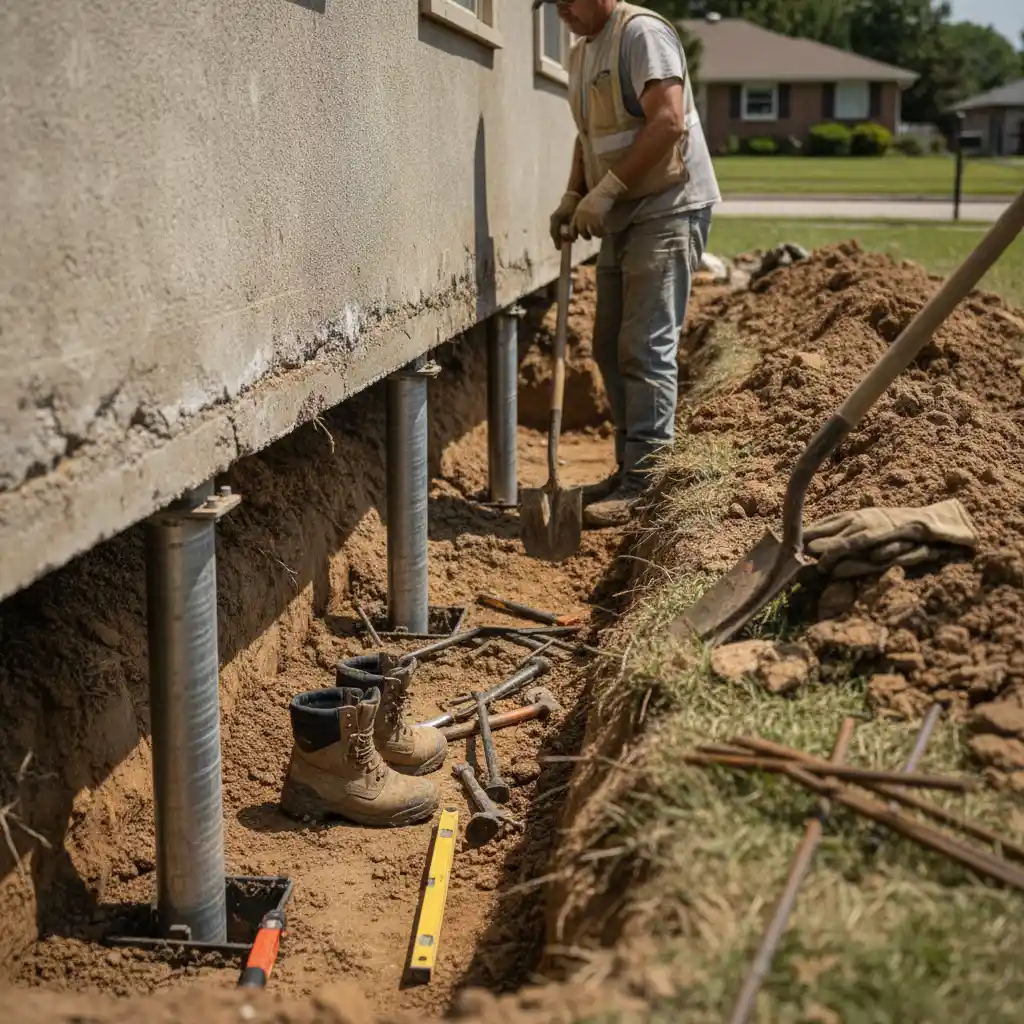
Our team in action — foundation-repair professionals serving Georgetown
Slab Foundation Repair Methods We Use
Steel Push Piers
The most common repair method for Georgetown homes with significant settlement. Galvanized steel pipe sections are hydraulically driven through the slab and unstable upper soil layers until they reach stable load-bearing strata. In Georgetown’s eastern sectors, this typically means penetrating 25 to 35 feet of Taylor Clay. Steel push piers are ideal for structures with measurable differential settlement exceeding 1.5 inches and where long-term stability is the primary concern.
Helical Piers
Helical piers are steel shafts with helical (screw-type) plates that are torqued into the ground rather than driven. They are preferred in areas with limited overhead clearance, for lighter structures such as porches and additions, and in locations near the Balcones transition zone where shallower rock may be encountered. They can be installed with minimal vibration, making them suitable for older Georgetown historic district properties.
Slabjacking (Mudjacking)
A grout mixture is pumped under pressure through small holes drilled in the slab to fill voids and lift settled sections. Best suited for driveways, garage floors, pool decks, and interior slabs with moderate settlement under 2 inches and confirmed soil competency. Common in Georgetown subdivisions built between 1985 and 2005.
Polyurethane Foam Injection
A modern, lightweight alternative to mudjacking, polyurethane foam expands to fill voids and can lift slabs with precision. It cures in minutes rather than days, making it ideal for commercial properties in Georgetown that cannot sustain extended downtime. Also effective for void filling in areas prone to re-saturation.
Foundation Patching and Surface Repair
For minor, non-structural cracks resulting from normal curing or superficial surface damage, epoxy injection and polyurethane caulking provide durable, waterproof repairs. These methods are appropriate only after confirming that no active structural movement is present. Learn more about our Foundation Patching services
Ready for Slab Foundation Repair? Get Your Free Estimate Today.
Round Rock Foundation Repair Group serves Georgetown and the surrounding area — we’ll be on-site within 24 hours.
📞 Call (512) 220-3502Slab Foundation Repair Cost in Georgetown, TX
Understanding the cost of slab foundation repair helps Georgetown homeowners plan appropriately and avoid being caught off guard. Costs vary widely based on the severity of the problem, the repair method required, and property-specific conditions.
Typical Price Ranges
- Foundation Inspection: $200 to $500 for a professional assessment with written report
- Polyurethane Foam Injection: $1,000 to $4,000 for minor void filling and slab lifting
- Mudjacking / Slabjacking: $1,500 to $5,000 depending on the square footage lifted
- Steel Push Pier Installation: $1,200 to $1,800 per pier, with most Georgetown residential projects requiring 8 to 20 piers ($10,000 to $30,000 total)
- Helical Pier Installation: $1,400 to $2,000 per pier
- Complete Structural Foundation Repair (Severe Cases): $25,000 to $50,000+
Georgetown-Specific Cost Factors
Georgetown’s deep Taylor Clay soils typically require piers to be driven deeper than in many other Central Texas markets, which increases per-pier costs by roughly 10 to 15 percent compared to areas with shallower stable strata. Properties in Sun City Georgetown and Teravista, built on particularly deep clay deposits, often fall at the higher end of pier-count estimates. Conversely, properties near the Balcones limestone transition on the city’s west side may require fewer piers driven to shallower depths.
Additional costs to factor in may include plumbing repairs if a leak is contributing to movement, drainage correction work, and interior cosmetic repairs after leveling. We provide transparent, itemized estimates so you know exactly what you’re paying for before any work begins. Schedule your Georgetown Foundation Inspection today
Georgetown Neighborhoods We Serve
Sun City Georgetown
Built in phases beginning in 1995 and home to thousands of residents, Sun City sits on some of Georgetown’s deepest Taylor Clay deposits. Homes here — predominantly single-story retirement residences — frequently experience pier-and-beam as well as slab movement. We have completed numerous projects throughout Sun City and understand the soil profiles specific to this community’s various construction phases.
Teravista
Located along SH 130 in eastern Georgetown, Teravista features homes built primarily between 2005 and the present. The eastern location places these properties squarely on Blackland Prairie clay, and many homeowners report early foundation movement within the first 10 years of construction — a known pattern in this soil type. Foundation Repair in Teravista
Georgetown Village
An established mid-city neighborhood with homes dating from the late 1980s through 2000s. Georgetown Village properties frequently deal with drainage issues and mature tree root systems that create uneven soil moisture conditions beneath slabs.
Serenada
Located in the western part of Georgetown near the San Gabriel River corridor, Serenada features larger lots with significant mature tree cover. Properties here often exhibit localized differential settlement related to moisture competition from established oaks.
Foundation Maintenance Tips for Georgetown Homeowners
Preventing foundation problems is far less expensive than repairing them. Follow these Georgetown-specific maintenance practices to maximize your slab’s longevity:
- Maintain consistent soil moisture year-round. During Georgetown’s frequent drought periods, use a soaker hose system placed 6 to 18 inches from the foundation perimeter to prevent clay shrinkage.
- Ensure positive drainage. The ground around your foundation should slope away at a minimum grade of 1 inch per foot for the first 6 feet. Georgetown’s flat eastern lots are particularly prone to pooling.
- Clean gutters and extend downspouts. Discharge water at least 4 to 6 feet from the foundation. Many Georgetown homes with clogged gutters show accelerated perimeter settlement.
- Monitor and maintain plumbing. Schedule periodic plumbing inspections, especially in homes built before 2000. A slow under-slab leak can saturate soil for months before any interior signs appear.
- Manage large trees carefully. Plant new trees no closer than their mature canopy width from the foundation, and consult an arborist before removing large established trees, as rapid soil re-hydration can cause heaving.
- Inspect your foundation annually. Walk the full perimeter each spring after Georgetown’s wet season and document any new cracking or changes in grade.
- Address cracks promptly. Small cracks sealed early prevent water intrusion and soil destabilization beneath the slab.
Why Choose Round Rock Foundation Repair Group
When it comes to slab foundation repair in Georgetown, TX, local expertise matters more than almost any other factor. Georgetown’s unique combination of Blackland Prairie clays, Balcones Escarpment geology, and dramatic Texas weather cycles creates foundation challenges that require hands-on regional knowledge — not generic solutions.
Round Rock Foundation Repair Group has built our reputation specifically serving the greater Georgetown and Round Rock corridor. We know the soil profiles in Sun City, Teravista, Serenada, and Georgetown Village. We’ve seen what the 2011 drought did to foundations across Williamson County, and we understand how to design repairs that account for future moisture cycles.
Our team offers comprehensive services including Structural Foundation Repair, Foundation Restoration, Commercial Foundation Repair, Foundation Inspection, Crawl Space Repair, Foundation Patching, Home Foundation Repair, and Concrete Foundation Repair — all under one roof. We serve Georgetown and the surrounding communities including Round Rock, Cedar Park, Austin, Pflugerville, and beyond.
We are committed to transparent pricing, honest assessments, and repairs that stand the test of Georgetown’s challenging conditions. Call (512) 220-3502 to speak with a local expert today. Learn more about Round Rock Foundation Repair Group
Frequently Asked Questions About Slab Foundation Repair in Georgetown, TX
How much does slab foundation repair cost in Georgetown, TX?
Costs depend heavily on the repair method and project scope. Minor polyurethane void filling may run $1,000 to $4,000, while a full pier-based structural repair on a Georgetown home with deep Taylor Clay typically ranges from $10,000 to $30,000. We provide free, detailed estimates after a professional inspection so you have a precise number for your specific situation. Call (512) 220-3502 to get started.
How long does slab foundation repair take in Georgetown?
Most residential slab foundation repairs in Georgetown are completed in 1 to 3 days. The inspection and proposal phase takes an additional 2 to 4 days. Larger commercial projects or homes requiring 15 or more piers may take 3 to 5 days of active work. You can typically remain in your home during most repair processes.
Will foundation repair disrupt my landscaping?
Exterior pier installation does require excavation of access holes approximately 24 inches in diameter along the foundation perimeter. We work carefully to protect plants and turf, and we backfill and compact all excavations upon completion. Some landscape restoration may be needed after the work, particularly in established Georgetown gardens with dense planting.
Does Georgetown’s soil type affect how deep piers need to go?
Yes, significantly. Georgetown’s eastern neighborhoods sit on deep Taylor Clay, which can require piers driven 25 to 35 feet to reach stable load-bearing strata. Properties near the Balcones Escarpment on the city’s western edge may encounter limestone at shallower depths of 10 to 20 feet. Our inspectors are familiar with Georgetown’s geological variation and design pier specifications accordingly.
Is foundation repair covered by homeowners insurance in Texas?
Standard Texas homeowners insurance policies typically do not cover foundation repair caused by soil movement, drought, or gradual settling — the most common causes in Georgetown. Coverage may apply if the damage results from a sudden, covered peril such as a burst pipe. We recommend reviewing your specific policy and can provide the documentation insurers typically request.
Can I sell my Georgetown home with a repaired foundation?
Yes. A properly repaired and documented foundation can actually enhance buyer confidence compared to an unrepaired home with visible foundation problems. Texas law requires disclosure of known foundation issues, and a transferable repair warranty provides additional peace of mind for prospective buyers. Our completed work reports and elevation data support a smooth real estate transaction.
How soon after the 2011-style drought conditions should I have my foundation inspected?
We recommend scheduling an inspection within 60 to 90 days after the end of any extended drought in Georgetown. This allows some initial soil re-hydration to occur so our measurements reflect settled conditions rather than peak drought displacement. After major rainfall events following a drought, a second check 30 to 60 days later is also advisable, as heaving can occur as moisture returns to the clay.
Do you serve areas outside Georgetown?
Absolutely. Round Rock Foundation Repair Group serves the entire greater Austin metro including Round Rock, Cedar Park, Pflugerville, Austin, Brushy Creek, Teravista, La Frontera, Avery Ranch, Great Hills, Forest Creek, Behrens Ranch, Sendero Springs, and many other communities throughout Williamson and Travis Counties. View all our service areas
Get Expert Slab Foundation Repair in Georgetown, TX Today
Don’t let Georgetown’s challenging clay soils and unpredictable weather continue damaging your foundation. The sooner a professional assesses your slab, the more repair options you have — and the lower your total cost is likely to be. Round Rock Foundation Repair Group is ready to provide a thorough, honest inspection and a clear repair plan tailored to your Georgetown property.
Call us now at (512) 220-3502 to schedule your foundation inspection. Our team serves Georgetown, Round Rock, Cedar Park, Pflugerville, Austin, and all surrounding communities. You can also reach us online — we respond promptly to all inquiry forms submitted for Georgetown-area properties.
Request Your Free Foundation Inspection in Georgetown
Learn What to Expect During a Foundation Inspection