Foundation Settling in Georgetown, TX
Structural Foundation Settling Specialists Serving Georgetown, TX
Expert foundation settling repair in Georgetown, TX. Round Rock Foundation Repair Group fixes slab, pier & beam issues caused by expansive clay soils. Call (512) 220-3502 today.
- Licensed & Insured
- Locally Owned & Operated
- Free Inspection & Estimate
Request Your
Free EstimateFoundation settling occurs when the soil beneath your home shifts, compresses, or erodes unevenly, causing the structural base of your property to sink or tilt. In Georgetown, TX, this is not a rare concern — it is a widespread reality driven by the region’s expansive clay soils, dramatic seasonal moisture swings, and the rapid residential growth that has placed new structures on challenging terrain throughout Williamson County.
At Round Rock Foundation Repair Group, we specialize in diagnosing and correcting foundation settling for homeowners and commercial property owners across Georgetown and the surrounding Central Texas region. Our team understands the specific geological and environmental conditions that make Georgetown foundations uniquely vulnerable, and we apply proven repair methods tailored to local soil behavior. Whether you own a historic property near the Georgetown Square or a newer build in Wolf Ranch or Berry Creek, our experienced crews are equipped to restore your foundation’s stability and protect your investment for decades to come. Call us today at (512) 220-3502 to schedule a professional inspection.
Understanding Foundation Settling
Foundation settling is the gradual downward or lateral movement of a building’s foundation relative to its original position. A small degree of initial settling — sometimes called normal settling — is expected in virtually every new construction project as the soil beneath the structure adjusts to the added load. This type of settling is typically uniform, minor, and does not compromise structural integrity.
The problem arises when settling becomes differential, meaning different parts of the foundation move at different rates or in different directions. Differential settling creates uneven stress across the slab, pier-and-beam system, or basement walls, leading to cracking, bowing, tilting, and in severe cases, catastrophic structural failure. Historically, settlement-related damage has been one of the most costly categories of property damage in Texas, with the Texas Department of Insurance estimating billions of dollars in annual claims statewide attributable to foundation movement.
Georgetown has experienced rapid population growth since the early 2000s, earning recognition as one of the fastest-growing cities in the United States for multiple consecutive years through the 2010s and into the 2020s. This growth has pushed residential development onto increasingly challenging parcels — hillside lots, creek-adjacent properties, and areas underlain by the Blackland Prairie clay soils that dominate Williamson County’s landscape.
The building stock in Georgetown is diverse. The historic downtown area features structures dating to the late 1800s, many of which were built on shallow rubble-stone or unreinforced concrete foundations that were never designed to accommodate modern load expectations or the volume of soil movement driven by today’s more extreme wet-dry cycles. Meanwhile, neighborhoods developed in the 2000s and 2010s often used post-tension slab foundations that, while engineered for local conditions, still face significant stress from Georgetown’s notoriously reactive soils.
Both residential and commercial structures — from single-family homes to retail centers along Williams Drive and the FM 1460 corridor — are susceptible to settling when soil conditions are not properly managed. Understanding the root causes is the first step toward lasting repair.
Learn more about our Foundation Inspection services
Signs You May Need Foundation Settling Repair
Interior Warning Signs
- Doors and windows that stick, jam, or no longer close flush with their frames
- Diagonal cracks radiating from the corners of door and window openings
- Gaps appearing between interior walls and the ceiling or floor
- Uneven or sloping floors, particularly noticeable when rolling objects drift to one side
- Cracks in drywall, especially those wider than 1/4 inch or that reappear after patching
Exterior Warning Signs
- Visible cracks in brick veneer, especially stair-step cracks in mortar joints
- Gaps between the foundation and exterior brick, siding, or trim boards
- Visible slope or lean in exterior walls when viewed from the street
- Concrete slab sections that have visibly dropped relative to adjacent sections
- Separation between the chimney and the main structure of the house
Urgent Indicators Requiring Immediate Attention
- Cracks wider than 1/2 inch or cracks that are growing measurably
- Doors or windows that can no longer be opened or closed without significant force
- Visible bowing or buckling of foundation walls in crawl space or basement areas
- Water intrusion through foundation cracks after rain events
Schedule a foundation inspection if you notice any of these signs
Our Foundation Settling Repair Process in Georgetown
Comprehensive Site Inspection (Day 1 — 2 to 4 Hours)
Our certified inspector visits your Georgetown property to conduct a thorough assessment. This includes interior and exterior visual inspection, floor elevation measurements using a digital manometer to map differential settlement across the slab, and a review of soil conditions, drainage patterns, and vegetation near the foundation. We document all findings with photographs and measurements.
Soil and Engineering Analysis (Days 2–5)
For properties on Georgetown’s expansive Blackland Prairie soils, we review geotechnical data relevant to your neighborhood and, when necessary, coordinate with licensed engineers to perform additional soil borings. This step is particularly important for properties near the San Gabriel River corridor or on sites with known fill soil histories.
Customized Repair Plan and Proposal (Days 5–7)
We develop a site-specific repair plan that accounts for your foundation type (post-tension slab, conventional slab, or pier-and-beam), the extent of settling, and Georgetown’s local soil conditions. We provide a detailed written proposal with clear cost breakdowns before any work begins. No surprises.
Site Preparation and Excavation (Day 1 of Repair — 4 to 8 Hours)
Our crew carefully excavates access points around the affected foundation sections, taking care to protect landscaping, irrigation systems, and utility lines. We call 811 before every dig — a step that is especially important in Georgetown’s rapidly expanding utility corridors.
Foundation Repair Implementation (Days 1–5 of Repair, Depending on Scope)
Depending on the approved method — pier installation, mudjacking, polyurethane foam lifting, or structural patching — our crew completes the core repair work. Most residential projects in Georgetown are completed within 1 to 3 days; larger commercial projects may require up to 5 days.
Backfill, Grading, and Drainage Improvements (Final Repair Day)
After structural repairs are complete, we backfill excavated areas with compacted select fill, re-grade the soil to direct water away from the foundation at a minimum slope of 6 inches per 10 feet — the standard recommended for Georgetown’s high-rainfall events — and make recommendations for any additional drainage improvements.
Final Inspection and Documentation (1 to 2 Hours)
We conduct a final walkthrough with the property owner, confirm all elevation benchmarks have been achieved, and provide complete documentation of repairs performed — an important record for future home sales or insurance purposes.
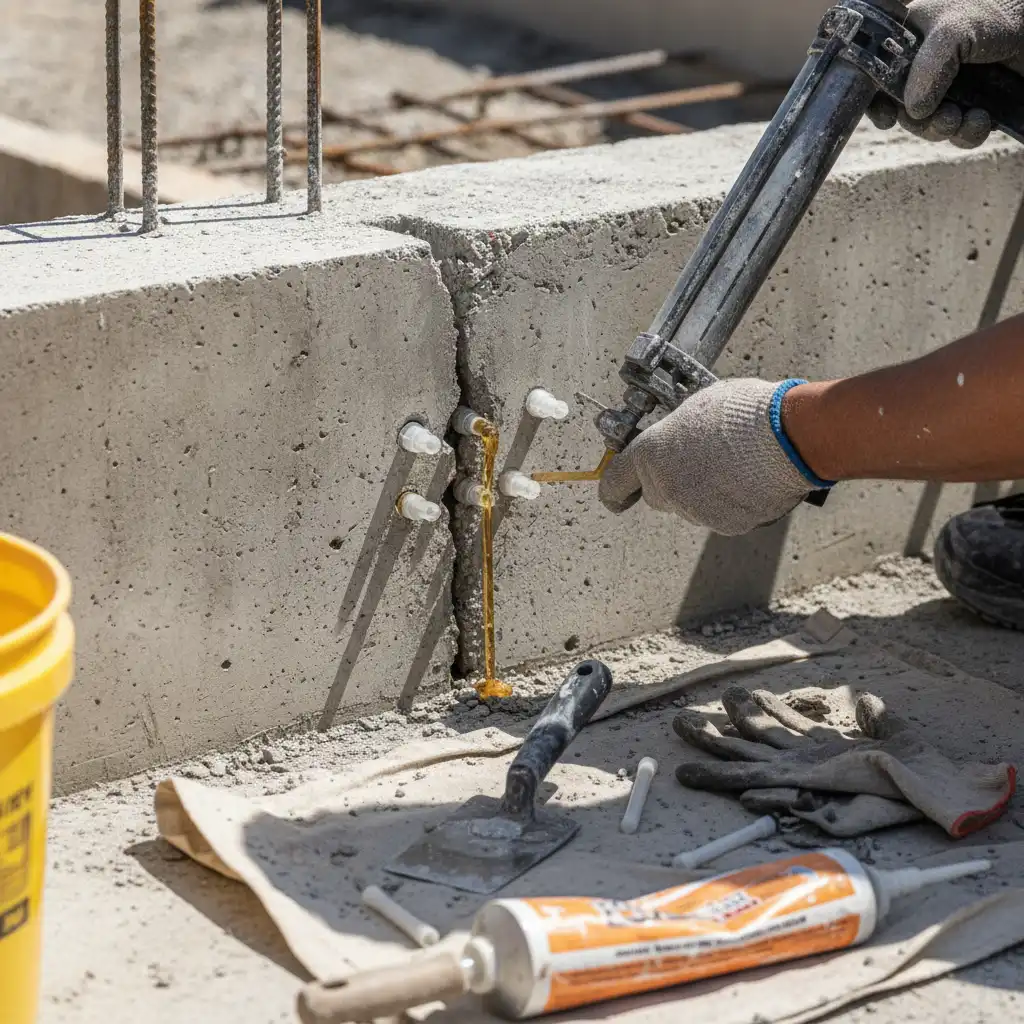
Our team in action — foundation-repair professionals serving Georgetown
Foundation Settling Repair Methods We Use in Georgetown
Steel Push Piers
Steel push piers are driven hydraulically through the unstable soil layer and into competent load-bearing strata below — typically the Georgetown limestone bedrock found at depths of 8 to 20 feet across much of Williamson County. This method is ideal for significant differential settling in both residential and commercial structures. It is our most common recommendation for properties in Sun City Georgetown, Wolf Ranch, and older neighborhoods near downtown where settling exceeds 2 inches.
Learn more about Structural Foundation Repair
Helical Piers
Helical piers are screwed into the soil rather than driven, making them ideal for properties where vibration must be minimized — such as near Georgetown’s historic structures around the Williamson County Courthouse Square. They are also preferred for lighter structures and additions where load requirements are lower.
Polyurethane Foam Lifting (Polyjacking)
For slabs with minor to moderate settling caused by soil voids — common in Georgetown neighborhoods built on fill — expanding polyurethane foam is injected through small ports drilled in the slab. The foam fills voids, expands, and lifts the slab within minutes, with minimal disruption and same-day completion.
Explore our Concrete Foundation Repair options
Mudjacking (Slab Lifting)
A cost-effective alternative for walkways, driveways, garage slabs, and porch sections experiencing minor settling. Cement slurry is pumped beneath the slab to fill voids and restore level. This method is commonly used for exterior flatwork around Georgetown homes experiencing settlement of less than 2 inches.
Crawl Space Pier and Beam Repair
Georgetown’s older homes — particularly those built before 1970 — often feature pier-and-beam foundations. We repair or replace failed interior piers, sister damaged beams, and install new support posts to restore level floors and eliminate structural flex.
Learn about our Crawl Space Repair services
Ready for Foundation Settling? Get Your Free Estimate Today.
Round Rock Foundation Repair Group serves Georgetown and the surrounding area — we’ll be on-site within 24 hours.
📞 Call (512) 220-3502Foundation Settling Repair Cost in Georgetown, TX
Foundation settling repair costs in Georgetown vary considerably depending on the severity of settlement, the repair method required, the size of the structure, and the specific soil conditions on your lot. Below are general cost ranges based on typical projects in the Georgetown and Williamson County area:
- Basic slab patching and crack injection: $500 – $2,500 for minor cosmetic or isolated cracks not associated with significant structural movement.
- Polyurethane foam lifting (polyjacking): $1,500 – $5,000 for residential slabs with moderate void-related settling.
- Mudjacking for exterior flatwork: $800 – $3,000 depending on the area of slab to be lifted.
- Steel push pier installation: $1,200 – $1,800 per pier installed, with most Georgetown residential projects requiring 8 to 16 piers, bringing total project costs to $10,000 – $25,000 for significant differential settling.
- Pier-and-beam restoration: $3,500 – $12,000 for older Georgetown homes requiring interior pier replacement and beam repair.
- Commercial foundation repair: Costs vary widely; contact us for a site-specific commercial assessment.
Georgetown-specific pricing factors include soil access difficulty in hillside neighborhoods, proximity to utilities in densely developed corridors along Williams Drive and Austin Avenue, and the presence of post-tension cables in slabs — which require specialized cutting equipment and engineering review before any slab penetration.
Many homeowners’ insurance policies in Texas do not cover settling caused by soil movement, but we can provide detailed documentation to support any insurance inquiry. We also work with financing partners to make repairs accessible. Call (512) 220-3502 for a free estimate.
Georgetown Neighborhoods We Serve
Sun City Georgetown
This expansive active-adult community in northwest Georgetown features thousands of single-story homes built primarily from the late 1990s through the 2010s on conventional and post-tension slabs. The rolling terrain and proximity to limestone outcrops means some lots have shallow bedrock while adjacent lots sit on deep expansive clay — creating highly variable settling patterns within the same subdivision block.
Wolf Ranch
One of Georgetown’s newest large-scale master-planned communities, Wolf Ranch features homes constructed mostly after 2015 on sites that required significant cut-and-fill grading. Long-term consolidation settling in fill areas is an emerging concern, and we are actively serving homeowners in this community who are beginning to observe early settling indicators.
Berry Creek
Berry Creek is a golf course community in southeast Georgetown with homes built predominantly from the mid-1990s through the mid-2000s. Proximity to Berry Creek drainage and the golf course irrigation system creates localized zones of elevated soil moisture that accelerate differential settling in this neighborhood.
Historic Downtown Georgetown
Properties surrounding the Georgetown Square and along Austin Avenue date to the 1880s through the 1950s and frequently feature unreinforced concrete or rubble-stone foundations. These structures are among the most vulnerable in the city to settling and require specialized, minimally invasive repair approaches. Learn about Foundation Restoration for historic structures
Foundation Settling Prevention Tips for Georgetown Homeowners
- Maintain consistent soil moisture year-round. During Georgetown’s dry summers, run a soaker hose along your foundation perimeter 18 to 24 inches from the foundation to prevent clay soils from desiccating and creating voids beneath your slab.
- Ensure proper grading around your home. The ground should slope away from your foundation at a minimum of 6 inches over 10 feet to prevent water pooling during Georgetown’s intense spring thunderstorm events.
- Clean and extend your gutters and downspouts. Downspouts should discharge water at least 4 to 6 feet from the foundation — a critical step given Georgetown’s average annual rainfall of approximately 34 inches, much of which falls in concentrated storm events.
- Monitor large trees near your foundation. Keep live oaks and pecan trees — common in Georgetown landscaping — trimmed, and consider root barriers if trees are within 15 feet of your foundation.
- Repair plumbing leaks promptly. Even slow leaks from irrigation systems or interior plumbing can saturate soil beneath your slab and trigger heaving or settling.
- Avoid planting large shrubs or raised garden beds directly against the foundation. These trap moisture against the slab and promote uneven soil conditions.
- Schedule a professional foundation inspection every 2 to 3 years. Given Georgetown’s reactive soils, early detection of settling can prevent minor issues from becoming major structural problems. Book a Foundation Inspection today
Why Choose Round Rock Foundation Repair Group for Georgetown Foundation Settling
Round Rock Foundation Repair Group has built its reputation across Central Texas by delivering honest assessments, high-quality repairs, and exceptional customer service to homeowners and business owners throughout Williamson County. Our team has direct, hands-on experience with the specific soil types, drainage challenges, and construction practices that define Georgetown’s foundation landscape — from the Blackland Prairie clays of eastern Georgetown to the cut-fill lots of the city’s newest master-planned communities.
We serve Georgetown as part of our broader Central Texas service territory, which includes Round Rock, Cedar Park, Austin, Pflugerville, and surrounding communities. This regional presence means we have encountered virtually every foundation settling scenario that Central Texas soils can produce, and we apply that cumulative knowledge to every Georgetown project.
Our process is transparent from inspection through completion. We provide detailed written proposals before work begins, explain every repair decision in plain language, and stand behind the quality of our work. When you call (512) 220-3502, you speak with knowledgeable local staff — not a call center — who understand Georgetown’s unique challenges and can guide you through the repair process with confidence.
View our Home Foundation Repair services
Frequently Asked Questions About Foundation Settling in Georgetown, TX
How much does foundation settling repair cost in Georgetown, TX?
Costs range from as little as $500 to $2,500 for minor patching to $10,000 – $25,000 or more for significant differential settling requiring pier installation. Georgetown-specific factors such as post-tension slabs, hillside lot access, and soil depth to bedrock all influence final pricing. We provide free, no-obligation estimates after a site inspection.
How long does foundation settling repair take in Georgetown?
Most residential repairs in Georgetown are completed within 1 to 3 days once work begins. Larger commercial projects or homes requiring extensive pier networks may take up to 5 to 7 days. The initial inspection and engineering analysis phase typically takes 5 to 7 days before repair work starts.
Is foundation settling normal for new homes in Georgetown?
A small amount of uniform initial settling is normal in any new construction. However, differential settling — where parts of the foundation move at different rates — is not acceptable and requires investigation. Georgetown’s active fill sites and expansive clay soils make new homes in communities like Wolf Ranch more susceptible to early differential settling than homes built on undisturbed native soil.
What soil type causes foundation settling in Georgetown?
Georgetown sits primarily on Houston Black clay and Austin clay — two soil series in the Blackland Prairie classification that are among the most expansive in the United States. These soils can shrink and swell by 3 to 6 inches vertically between dry and wet seasons, making them the primary geological driver of foundation settling in the area.
Will my homeowner’s insurance cover foundation settling in Georgetown?
Most standard homeowner’s insurance policies in Texas exclude damage caused by soil movement, settling, or shrinkage. Coverage may apply if settling is caused by a sudden covered event such as a burst pipe. We provide detailed documentation of repairs and causes that can support your insurance inquiry or disclosure requirements during a home sale.
Can foundation settling be stopped permanently?
Properly installed deep foundation piers — driven to competent limestone bedrock below the active soil zone — effectively eliminate further settling at the repaired locations by transferring the structural load past the reactive clay layer. Ongoing maintenance of soil moisture and drainage is still recommended to protect unrepaired areas of the foundation.
Do I need a structural engineer for foundation settling repair in Georgetown?
Not always, but we recommend engineer involvement for significant settling cases, commercial properties, homes with post-tension slabs requiring slab penetration, or properties where a third-party report is needed for real estate transactions. We can coordinate with licensed Texas structural engineers on your behalf when required.
Are Georgetown homes in Sun City more prone to foundation settling?
Sun City Georgetown’s varied terrain — with some lots on shallow bedrock and adjacent lots on deep expansive clay — creates conditions where settling patterns can differ dramatically from one home to the next. Single-story construction in this community places concentrated loads on relatively small foundation footprints, making proper pier design especially important. We have extensive experience with Sun City properties and understand the community’s specific soil variability.
Contact Round Rock Foundation Repair Group Today
If you have noticed cracks, sticking doors, sloping floors, or any other signs of foundation settling at your Georgetown home or commercial property, do not wait. Foundation settling in Central Texas’s reactive clay soils progresses over time, and early intervention is always less costly than deferred repair.
Round Rock Foundation Repair Group is ready to help. Call us at (512) 220-3502 to speak with a knowledgeable team member and schedule your free foundation inspection. We serve Georgetown, Round Rock, Cedar Park, Austin, Pflugerville, and all surrounding communities throughout Williamson and Travis counties.
Schedule Your Free Georgetown Foundation Inspection Now
Commercial Property Owner? Learn About Our Commercial Foundation Repair Services