
Pier and Beam Foundation Repair in Leander, TX
Fast, Reliable Pier and Beam Foundation Repair in Leander, TX — Licensed & Insured
Need pier and beam foundation repair in Leander, TX? Round Rock Foundation Repair Group fixes sagging floors, rotting beams & shifting piers. Call (512) 220-3502.
- Licensed & Insured
- Locally Owned & Operated
- Free Inspection & Estimate
Request Your
Free EstimatePier and beam foundation repair is a specialized structural service designed to restore, stabilize, and reinforce older raised-foundation homes and buildings that rest on a network of wooden beams, joists, and support piers rather than a solid concrete slab. In Leander, TX, this type of foundation system is common in homes built before the 1970s, particularly in the older sections of town near US-183 and the historic downtown corridor.
Leander’s rapid growth, combined with its highly expansive clay-heavy soils and dramatic seasonal rainfall swings, creates unique stress on pier and beam systems that demands local expertise. Round Rock Foundation Repair Group brings deep knowledge of Central Texas geology, Leander’s specific neighborhood construction patterns, and hands-on experience with the moisture management challenges that accelerate pier and beam deterioration in Williamson County. Whether you are dealing with sagging floors, rotting beams, or shifting support piers, our team delivers proven solutions tailored to Leander’s environment.
Call us today at (512) 220-3502 for a professional foundation inspection.
Understanding Pier and Beam Foundation Repair in Leander, TX
A pier and beam foundation — sometimes called a post and beam foundation — elevates a structure above ground level using a grid of vertical supports (piers) connected by horizontal beams and floor joists. This creates a crawl space beneath the home, typically ranging from 18 inches to 36 inches in height, which allows access to plumbing, electrical conduits, and structural members. Unlike slab foundations, pier and beam systems distribute a home’s load through discrete contact points, which makes them both flexible and vulnerable to specific types of failure.
Historically, pier and beam construction dominated residential building in the Austin metropolitan area, including Leander’s early development, from the late 1800s through the mid-20th century. Homes built during Leander’s original township era — many of which still stand in the blocks surrounding Crystal Falls Parkway and the original Leander townsite — were almost exclusively built on this system because poured concrete slab technology was not yet widely available or cost-effective for residential use.
Pier and beam repair encompasses a wide range of corrective work, including:
- Replacing deteriorated wood beams and floor joists weakened by moisture or wood-boring insects
- Resetting or replacing sunken concrete block piers or installing new steel piers
- Sister-framing compromised joists to restore structural load capacity
- Installing vapor barriers and moisture management systems in the crawl space
- Shimming existing piers to re-level floors that have settled unevenly
- Reinforcing the perimeter foundation wall where masonry has cracked or shifted
Because Leander sits within an area of geologically active expansive soils — specifically the Austin Chalk and Taylor Black Clay formations — pier and beam foundations here face a dual threat: seasonal soil movement that shifts piers laterally or vertically, and crawl space humidity that accelerates wood rot and fungal growth. Understanding both factors simultaneously is essential to delivering lasting repairs rather than temporary fixes. Schedule a Foundation Inspection to identify which issues are affecting your specific structure.
Why Pier and Beam Foundation Repair Is Needed in Leander, TX
Expansive Clay Soils: The Taylor Black Clay Problem
Much of Leander, including established neighborhoods like Crystal Falls, Travisso, and Devine Lake District, is underlain by Taylor Black Clay — a high-plasticity soil classified by the USDA as a Vertisol. This soil type expands and contracts dramatically with moisture changes. During wet periods, Taylor Black Clay can expand vertically by 3 to 6 inches per foot of depth, exerting upward pressure exceeding 8,000 pounds per square foot on foundation components. During dry periods, the same soil shrinks and pulls away from piers, leaving voids that allow piers to settle unevenly. The result is cyclical uplift and settlement that cracks beams, shifts piers, and produces the uneven, bouncy floors that Leander homeowners frequently report.
Drought Cycles and Severe Weather Events
Leander and broader Williamson County experienced one of the most severe droughts in recorded Texas history between 2011 and 2013, when rainfall deficits exceeded 20 inches below normal over a sustained two-year period. Foundation repair contractors across the region documented a surge in calls from homeowners in older pier and beam homes as moisture-depleted soils contracted sharply beneath crawl spaces. More recently, Winter Storm Uri in February 2021 caused ground heave events and burst water supply lines in crawl spaces across Leander, depositing standing water under homes in areas like Blockhouse Creek and Highlands at Mayfield Ranch, creating conditions ideal for accelerated wood rot and pier displacement.
Rapid Development Pressure and Aging Infrastructure
Leander’s population grew from approximately 7,600 residents in 2000 to over 75,000 by 2023 — nearly a tenfold increase in two decades. This rapid development has altered groundwater drainage patterns across the city. New impervious cover from roads, parking lots, and rooftops in subdivisions like Bryson, Grand Mesa at Crystal Falls, and Summerlyn has changed how rainwater flows, often channeling concentrated runoff toward older residential areas with pier and beam foundations. Increased subsurface moisture fluctuations in these zones directly accelerate the soil movement that destabilizes pier and beam systems.
Crawl Space Humidity and Biological Deterioration
Leander’s semi-arid climate averages 32 inches of annual rainfall but delivers it unevenly, with wet springs and dry summers creating repeated moisture cycles in crawl spaces. Without adequate vapor barriers and ventilation — which many pre-1970s Leander homes lack — relative humidity in crawl spaces routinely exceeds 80%, providing ideal conditions for wood-destroying fungi, subterranean termites (prevalent throughout Williamson County), and structural wood rot that can reduce beam load capacity by 50% or more before visible exterior symptoms appear. Learn more about our Crawl Space Repair services.
Signs You Need Pier and Beam Foundation Repair in Leander, TX
Interior Warning Signs
- Floors that slope, dip, or feel soft and springy underfoot, particularly in the center of rooms
- Visible gaps between baseboards and the floor, exceeding ¼ inch in width
- Interior doors and windows that stick, drag, or no longer latch properly
- Diagonal cracks at the corners of door and window frames (typically 45-degree stress cracks)
- Creaking or popping sounds from the floor when walking across rooms
Exterior Warning Signs
- Cracks in brick veneer or exterior siding, particularly stair-step cracks in mortar joints
- Visible gaps between the foundation skirting and the soil grade level
- Piers or blocks visible beneath the home that appear tilted, cracked, or displaced
- Separation between the home’s exterior walls and attached structures like porches or garages
Crawl Space Warning Signs — Urgent Action Required
- Standing water or persistent moisture accumulation in the crawl space
- Visible wood rot, fungal growth (white or brown discoloration), or soft, crumbling beam surfaces
- Damaged or missing vapor barrier material
- Evidence of termite mud tubes or insect galleries in wood members
Any crawl space warning sign should be treated as urgent. Structural wood deterioration progresses rapidly in Leander’s humid summer conditions and can compromise a home’s safety within months. Request an emergency foundation inspection today.
Our Pier and Beam Foundation Repair Process in Leander, TX
Round Rock Foundation Repair Group follows a systematic, transparent repair process adapted to the specific conditions found in Leander’s soil profiles, climate patterns, and building stock. Here is what you can expect from start to finish:
Comprehensive Foundation Inspection (Day 1 — 2 to 3 Hours)
Our certified inspector performs a full evaluation of the structure, including interior floor level measurements using a digital laser level, exterior perimeter assessment, and a complete crawl space entry inspection. We document beam conditions, pier positions, moisture readings, and any biological deterioration. In Leander, we pay particular attention to crawl space humidity levels and signs of Taylor Black Clay soil movement beneath piers.
Soil and Drainage Assessment (Day 1 — Included with Inspection)
We assess the grading around your home’s perimeter, identify any drainage patterns directing water toward the crawl space, and note proximity to irrigation systems — a significant factor in Leander neighborhoods with active HOA landscaping requirements, such as Crystal Falls and Travisso.
Custom Repair Plan and Written Estimate (Days 2–3)
We prepare a detailed written scope of work specifying every repair action, material specification, and timeline. We explain all options clearly, including the most conservative and most comprehensive approaches, so you can make an informed decision.
Site Preparation and Crawl Space Access (Repair Day 1 — 2 to 4 Hours)
Our crew prepares the worksite, establishes safe crawl space entry, removes deteriorated vapor barrier material, and temporarily braces any compromised structural members before beginning primary repairs.
Structural Repairs (Repair Days 1–3, Depending on Scope)
Core repair work is completed in sequence: pier replacement or resetting first, beam and joist replacement or sister-framing second, and shimming for final floor leveling third. We use pressure-treated lumber rated for ground contact (UC4B minimum) appropriate for Leander’s soil moisture conditions.
Moisture Management Installation (Repair Day 2–3)
We install heavy-duty 12-mil poly vapor barrier, seal penetrations, and address ventilation to reduce crawl space humidity — a critical step given Leander’s seasonal moisture cycles.
Final Inspection and Documentation (Repair Day 3–4)
We conduct a final level check, photograph all completed work, and provide you with a full written report of repairs performed. Total project timelines typically range from 2 to 5 business days for most Leander pier and beam repair projects.
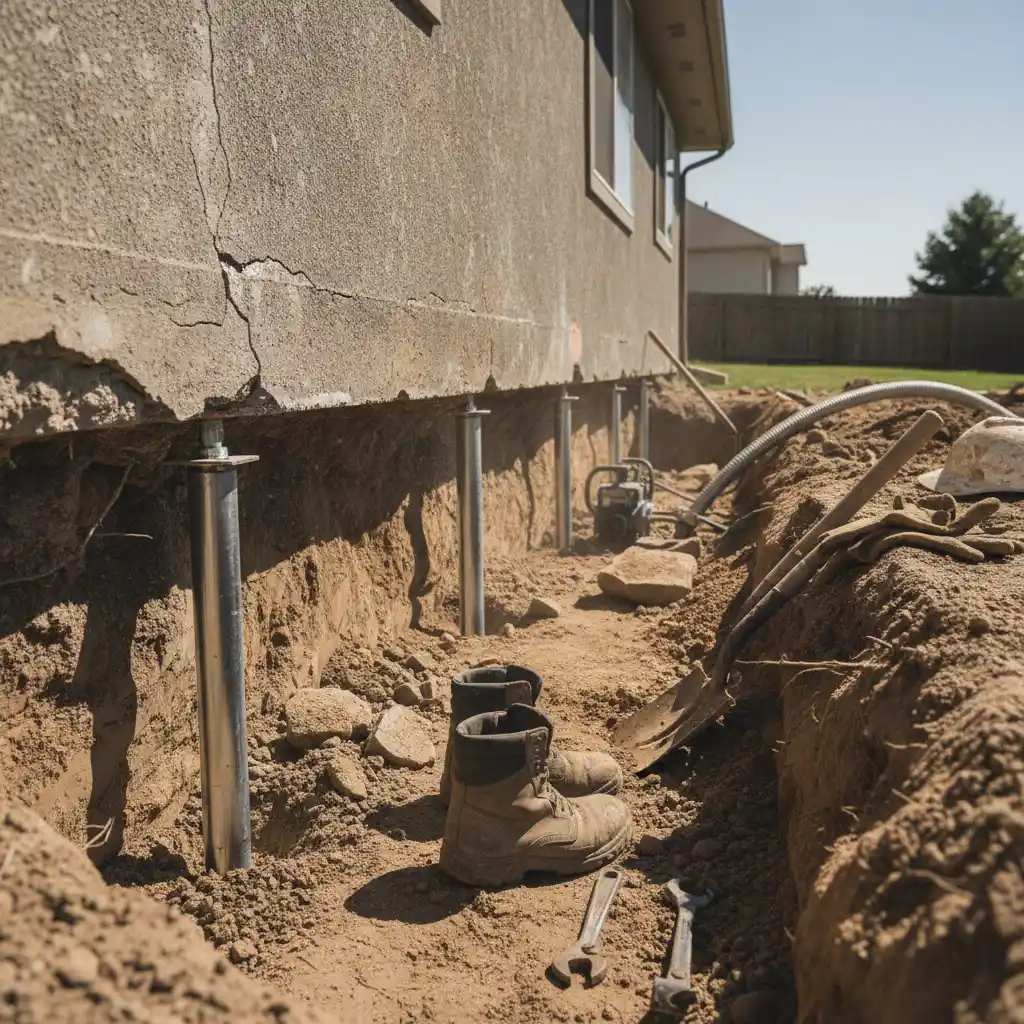
Our team in action — foundation-repair professionals serving Leander
Pier and Beam Repair Methods We Use in Leander, TX
1. Concrete Block Pier Replacement
When existing concrete block or brick piers have cracked, settled, or shifted, we remove and replace them with properly sized concrete block columns set on solid footing. This is the most common repair in Leander’s older homes built between the 1940s and 1960s, where original piers were often undersized for today’s load requirements. Learn about our Structural Foundation Repair services.
2. Steel Pier Installation
For severe settlement cases, particularly in areas of Leander where Taylor Black Clay extends deep into the soil profile, we drive steel piers (also called push piers or helical piers) down to load-bearing strata below the active soil zone — typically 15 to 25 feet in Williamson County. This provides permanent stability independent of surface soil moisture changes.
3. Sister-Framing and Beam Replacement
When floor joists or beams show rot, insect damage, or structural cracking, we install new pressure-treated members alongside or in place of the originals. Sister-framing — attaching a new joist directly to a damaged one — is a cost-effective approach for localized damage, while full beam replacement addresses widespread decay.
4. Shimming and Re-Leveling
For piers that are structurally sound but have experienced minor differential settlement, precision shimming with hardwood or composite shims restores floor level without full pier replacement. This is often applicable in Leander neighborhoods that experienced localized soil shrinkage during the 2011–2013 drought period.
5. Crawl Space Encapsulation
To address the root cause of moisture-driven deterioration, we offer full crawl space encapsulation combining heavy vapor barriers, rim joist insulation, and mechanical dehumidification. This method is particularly valuable in lower-elevation areas of Leander near Brushy Creek tributaries. Explore our Crawl Space Repair options.
Ready for Pier and Beam Foundation Repair? Get Your Free Estimate Today.
Round Rock Foundation Repair Group serves Leander and the surrounding area — we’ll be on-site within 24 hours.
📞 Call (512) 220-3502Pier and Beam Foundation Repair Cost in Leander, TX
Understanding the cost of pier and beam foundation repair in Leander helps homeowners budget appropriately and evaluate contractor proposals with confidence. Costs vary significantly based on damage severity, repair method, and home size, but the following ranges reflect typical Leander market pricing as of 2024.
Typical Cost Ranges
- Basic pier shimming and re-leveling: $1,500 – $4,500 for localized settlement affecting fewer than 10 piers. Common in smaller Leander bungalows of 1,000–1,400 square feet.
- Concrete block pier replacement (partial): $3,500 – $8,000 for replacement of 10–20 piers with new material and shimming to level.
- Full perimeter and interior pier replacement: $8,000 – $18,000 for comprehensive pier replacement on a typical 1,500–2,000 square foot Leander home.
- Beam and joist replacement: $2,000 – $7,500 depending on the number of linear feet requiring replacement and accessibility within the crawl space.
- Steel pier installation: $1,200 – $1,800 per pier installed, with most Leander projects requiring 8 to 20 piers for severe settlement cases.
- Crawl space vapor barrier and encapsulation: $2,500 – $6,000 depending on crawl space square footage and moisture management system complexity.
Leander-Specific Cost Factors
Homes in Leander’s older downtown-adjacent neighborhoods often have lower crawl space clearance — sometimes as little as 14 to 18 inches — which increases labor time and cost compared to standard projects. Homes near Brushy Creek drainage corridors may require additional moisture mitigation work. Additionally, Williamson County permit requirements for structural foundation work may add $200–$600 to project costs depending on scope. Get a free written estimate with no obligation after your inspection.
Leander Neighborhoods We Serve
Historic Leander Townsite Area
Homes built between the 1920s and 1950s near the original Leander railroad townsite — in the blocks closest to the MetroRail station and US-183 — represent the highest concentration of original pier and beam construction in the city. Many of these structures have never had their crawl spaces professionally evaluated and often require beam sister-framing and vapor barrier installation alongside pier work.
Blockhouse Creek
This established community features homes built primarily in the 1980s and 1990s, some of which were constructed with hybrid pier and beam systems. Post-Winter Storm Uri plumbing failures left crawl spaces in this neighborhood with elevated moisture damage, making it a frequent service area for our team.
Crystal Falls
Crystal Falls homes, primarily built from the early 2000s onward, occasionally feature pier and beam construction on sloped lots where terrain required elevated foundations. Taylor Black Clay soil movement is pronounced in this area’s higher-elevation sections, accelerating differential pier settlement.
Devine Lake District and Randy Road Corridor
Mixed-age housing stock in this area includes pre-1970s pier and beam homes alongside newer construction. Older homes here often have undersized original piers and absent vapor barriers, making comprehensive structural and moisture repairs the typical scope of work. Explore Home Foundation Repair options for your neighborhood.
Pier and Beam Foundation Maintenance Tips for Leander Homeowners
Proactive maintenance is the most cost-effective foundation strategy available to Leander homeowners. These location-specific tips address the primary failure drivers in Williamson County:
- Maintain consistent soil moisture around your perimeter. During Leander’s dry summers, use a soaker hose 18 inches from the foundation to prevent Taylor Black Clay from contracting and pulling away from piers. Run for 20–30 minutes every 2–3 days during drought conditions.
- Keep gutters and downspouts clear and extended. Discharge water at least 6 feet from the foundation. Leander’s intense spring storms can deposit 2–4 inches of rain in a single hour — concentrated discharge is a leading cause of crawl space flooding.
- Inspect your crawl space annually. Each spring after the wet season, visually inspect for standing water, new wood rot, pest activity, and vapor barrier damage.
- Check and maintain crawl space ventilation.strong> Ensure all foundation vents are unobstructed. In Leander’s humid summers, inadequate ventilation drives crawl space humidity above 80%.
- Schedule professional termite inspections yearly. Subterranean termites are highly active throughout Williamson County and can compromise structural wood members faster than moisture alone.
- Grade your landscaping away from the foundation. Maintain a minimum 6-inch drop in grade over the first 10 feet from the foundation to direct rainwater away from piers.
- Avoid heavy landscaping against the foundation. Dense plants and mulch beds trap moisture against the perimeter foundation wall and accelerate deterioration in older Leander homes.
Why Choose Round Rock Foundation Repair Group for Pier and Beam Repair in Leander, TX
Round Rock Foundation Repair Group specializes in the specific foundation challenges of the greater Austin and Williamson County market, including Leander’s unique combination of expansive clay soils, aging housing stock, and rapid-growth infrastructure changes. Our team has hands-on experience with the Taylor Black Clay formations and Austin Chalk geology that define foundation behavior throughout this region.
We serve Leander homeowners with the same thoroughness we bring to every community across our service area, including Cedar Park, Georgetown, Round Rock, Pflugerville, and Austin. Every project begins with an honest, transparent inspection and written estimate — no high-pressure sales tactics, no unnecessary upselling.
Our team works exclusively in the Central Texas market, which means we understand what Leander foundations experience year-round: wet springs, dry summers, and the freeze-thaw events that periodically stress crawl space structures. We select materials and methods appropriate for this specific climate rather than applying generic national-brand approaches.
Contact us at (512) 220-3502 to schedule your inspection. We also serve surrounding communities throughout the Austin metro.
Frequently Asked Questions: Pier and Beam Foundation Repair in Leander, TX
How much does pier and beam foundation repair cost in Leander, TX?
Costs in Leander typically range from $1,500 for minor pier shimming to $18,000 or more for comprehensive pier replacement, beam work, and moisture management on a full-size home. The average mid-scope project — replacing 12 to 18 piers and installing a new vapor barrier — runs between $6,000 and $12,000. Every project is unique, and we provide free written estimates after a thorough on-site inspection.
How long does pier and beam repair take in Leander?
Most pier and beam repair projects in Leander are completed within 2 to 5 business days. Simple shimming and re-leveling jobs may be finished in a single day, while projects involving full beam replacement, multiple pier installations, and crawl space encapsulation can extend to a full week. We provide a project timeline in your written estimate before work begins.
Is pier and beam foundation repair covered by homeowner’s insurance in Leander?
Standard homeowner’s insurance policies in Texas generally do not cover foundation repair resulting from soil movement, settling, or gradual deterioration — the most common causes in Leander. However, if foundation damage resulted from a covered event such as a sudden plumbing leak (like those caused by Winter Storm Uri in 2021), a portion of repair costs may be covered. We recommend consulting your insurance provider directly and can provide detailed documentation to support any claim you file.
What makes Leander’s soil particularly hard on pier and beam foundations?
Leander sits on Taylor Black Clay and Austin Chalk formations — among the most expansive soil types in the United States. Taylor Black Clay has a plasticity index commonly above 40, meaning it undergoes extreme volume changes with moisture variation. This cyclical shrink-swell movement is the primary driver of pier displacement and uneven settlement throughout Leander, especially in neighborhoods with mature landscaping and irrigation systems that create uneven soil moisture profiles.
Can I stay in my home during pier and beam repairs?
In most cases, yes. Pier and beam repairs are performed from beneath the home through crawl space access and do not typically require you to vacate the property. There will be some noise and minor vibration during work hours. We schedule work between 7:00 AM and 6:00 PM and communicate daily about progress so you are never caught off guard.
How do I know if my Leander home has a pier and beam or slab foundation?
Pier and beam foundations have a visible crawl space beneath the home — you will typically see a ventilated skirt or lattice around the base of the structure with at least 12 inches of clearance between the ground and the floor structure above. If your home appears to sit slightly elevated above grade and you can hear hollow sounds when walking on the floor, it is almost certainly pier and beam. Slab homes sit directly at grade level with no visible crawl space. Leander homes built before 1970 are predominantly pier and beam.
Do you offer financing for pier and beam foundation repair in Leander?
Yes. We work with third-party financing partners to offer payment plan options for qualified homeowners in Leander and throughout our service area. Financing options are discussed during your estimate appointment. Call us at (512) 220-3502 for details.
How often should I have my pier and beam foundation inspected in Leander?
We recommend a professional crawl space and foundation inspection every 3 to 5 years for Leander homes on pier and beam systems, or immediately following any significant weather event — including extended droughts, major flood events, or hard freezes like Winter Storm Uri. Annual homeowner visual checks of accessible crawl space areas are a valuable complement to professional inspections. Schedule your inspection here.
Get Expert Pier and Beam Foundation Repair in Leander, TX Today
If your Leander home is showing signs of foundation distress — sloping floors, sticking doors, visible cracks, or moisture in the crawl space — do not wait for the problem to worsen. Round Rock Foundation Repair Group provides thorough, honest assessments and lasting structural solutions tailored to Leander’s specific soil, climate, and building conditions.
We serve Leander homeowners from historic downtown properties to newer construction in Crystal Falls, Blockhouse Creek, Bryson, and every neighborhood in between. Our team is ready to help you protect your most important investment.
Call us now at (512) 220-3502 to schedule your free foundation inspection and written estimate. You can also contact us online and a member of our Leander service team will respond within one business day. Do not let foundation problems grow — act today.