Slab Foundation Repair in Leander, TX
Fast, Reliable Slab Foundation Repair in Leander, TX — Licensed & Insured
Need slab foundation repair in Leander, TX? Round Rock Foundation Repair Group fixes Taylor Clay settlement & cracks. Free inspection. Call (512) 220-3502.
- Licensed & Insured
- Locally Owned & Operated
- Free Inspection & Estimate
Request Your
Free EstimateSlab foundation repair is the process of diagnosing, stabilizing, and restoring a concrete slab foundation that has shifted, cracked, or settled unevenly beneath your home or commercial building. In Leander, TX, this is one of the most critical home-maintenance services a property owner can invest in — and one of the most urgent. The explosive growth Leander has experienced over the past decade, combined with the region’s notoriously expansive Blackland Prairie clay soils, creates near-perfect conditions for slab movement and structural damage.
At Round Rock Foundation Repair Group, we bring deep expertise in Central Texas soil behavior, local building codes, and proven repair methodologies to every project we take on in Leander and the surrounding communities. Whether you are seeing your first hairline crack or dealing with doors that will no longer close, our team is ready to provide a thorough assessment and a lasting solution. Call us today at (512) 220-3502 to schedule your foundation inspection.
Understanding Slab Foundation Repair in Leander, TX
A slab foundation — sometimes called a concrete slab or monolithic slab — is a single, continuous layer of poured concrete, typically 4 to 6 inches thick, that rests directly on the ground and serves as both the structural floor and the primary load-bearing base of a building. Unlike pier-and-beam foundations that elevate a structure above the soil, slab foundations are in constant, direct contact with the earth beneath them, making them highly sensitive to any change in soil volume or moisture.
A Brief History of Slab Construction in the Leander Area
Slab foundations became the dominant construction method in Central Texas during the post-World War II suburban boom of the late 1940s and 1950s. Builders favored them because they were faster and cheaper to pour than pier-and-beam systems, and they performed acceptably in dry conditions. Leander itself remained a quiet agricultural community through most of the 20th century, with limited residential construction until the Capital MetroRail Red Line opened its Leander Station in 2008. That transit connection, combined with the rapid expansion of employers along the US-183 and SH-29 corridors, triggered an unprecedented residential building surge. Subdivisions like Crystal Falls, Mason Hills, Bryson, and Lakewood Grove added thousands of new slab-on-grade homes between 2005 and the present day.
Why Slabs Move
Concrete itself is rigid and strong under compression, but it has virtually no flexibility. When the soil beneath a slab expands or contracts — due to moisture changes, drought, or poor compaction — the slab either heaves upward or settles downward. In both cases, the concrete cracks, and those cracks can propagate through walls, ceilings, door frames, and plumbing penetrations. Left unaddressed, even a modest 1-inch differential settlement can cause tens of thousands of dollars in collateral damage to a Leander home.
Building Types Most Affected in Leander
The overwhelming majority of residential structures in Leander are single-family homes built on monolithic slabs, ranging from modest 1,200-square-foot starter homes to sprawling 4,000-square-foot estate properties in gated communities. Strip retail centers along US-183A and commercial buildings near the Leander ISD campuses also rely heavily on slab construction. All of these building types are candidates for slab foundation repair. Schedule a Foundation Inspection
Why Slab Foundation Repair Is Needed in Leander, TX
The Leander Soil Problem: Taylor Clay and Blackland Prairie
The single biggest driver of foundation distress in Leander is the soil itself. A large portion of Leander sits on Taylor Clay, a member of the broader Blackland Prairie soil series that blankets much of Central Texas. Taylor Clay is classified as a highly expansive soil with a plasticity index that frequently exceeds 40 — meaning it absorbs enormous quantities of water and swells dramatically, then shrinks and cracks as it dries. Geotechnical studies conducted in Williamson County have documented vertical soil movement of 3 to 6 inches in a single seasonal cycle in untreated Blackland Prairie soils. That kind of movement, applied unevenly beneath a rigid concrete slab, is a recipe for structural failure.
Leander’s Extreme Drought and Flood Cycles
Central Texas is renowned for its weather extremes, and Leander is no exception. The area experiences what climatologists call a “feast or famine” precipitation pattern. The 2011 Texas drought — one of the most severe single-year droughts in Texas recorded history — caused severe soil desiccation across Williamson County, with rainfall deficits exceeding 18 inches below normal in the Leander area. Thousands of slab foundations that had performed adequately for years suddenly began to show visible cracking and settlement as the clay beneath them contracted. Then, in May 2015 and again during the May 2016 flooding events, the same soils absorbed massive quantities of water in short periods, heaving slabs upward in what engineers call “slab upheaval.” The freeze event of February 2021 added yet another layer of stress, with rapid temperature swings causing additional soil and concrete movement across Leander neighborhoods including Crystal Falls and Lakewood Grove.
Rapid Development and Fill Soil Concerns
Leander’s explosive growth — the city grew from approximately 7,500 residents in 2000 to over 80,000 by 2023 — means that many subdivisions were built quickly on land that was graded with imported fill soil. Fill soil that is not properly compacted to geotechnical specifications can continue to consolidate under load for years after construction, causing gradual settlement. Neighborhoods platted and built between 2012 and 2018, including portions of Bryson, Mason Hills, and the Trails of Shiloh area near US-183A, have seen a higher-than-average incidence of foundation calls as homes in those developments have aged past the five-year mark.
Tree Root Activity Near Leander Slabs
Live oaks and cedar elms — two of the most common trees in Leander residential landscaping — have aggressive, shallow root systems. As these trees mature, their roots extract moisture from the soil within a radius of up to 1.5 times the tree’s height, creating localized drying zones directly beneath slab edges. This differential moisture extraction is one of the leading causes of edge settlement in Leander homes, particularly in established neighborhoods adjacent to the Leander greenbelt corridor along Brushy Creek. Learn More About Home Foundation Repair
Signs You Need Slab Foundation Repair in Leander, TX
Interior Warning Signs
- Diagonal cracks running from the corners of door frames or window openings at 45-degree angles
- Horizontal or stair-step cracks in drywall, particularly along interior load-bearing walls
- Floors that feel noticeably sloped or bouncy when you walk across them
- Interior doors or windows that stick, refuse to latch, or swing open or closed on their own
- Gaps appearing between wall surfaces and ceiling or floor trim
- Visible separation between a fireplace or chimney and the adjacent wall
Exterior Warning Signs
- Stair-step cracking in brick veneer mortar joints, especially near corners
- Visible gaps between the slab edge and the soil or landscaping around the perimeter
- Cracks in the garage floor slab or at the joint between the garage floor and the main slab
- Separation between the slab and attached structures like porches or sunrooms
Plumbing-Related Indicators
- Unexplained increases in your Leander water or sewer utility bill
- Warm spots on tile or concrete floors that may indicate a slab plumbing leak
- Persistent mildew odors at floor level with no visible moisture source
Urgency note: If you observe multiple signs from more than one category simultaneously, or if any crack has widened more than 1/4 inch, treat the situation as urgent and call (512) 220-3502 immediately.
Our Slab Foundation Repair Process in Leander, TX
Initial Consultation and Site Review (Day 1)
The process begins with a phone call or online inquiry. We gather basic information about your Leander property — address, age of construction, visible symptoms — and schedule an on-site visit. We check publicly available Williamson County soil maps and prior permit records for your address before arriving so we can arrive informed.
Comprehensive Foundation Inspection (Day 1–2, 2–4 Hours On-Site)
Our inspector uses a Zip-Level Pro digital elevation system to measure floor elevations at a grid of points throughout your home, producing an accurate topographic map of slab movement. We examine all interior and exterior crack patterns, assess drainage conditions, note proximity of mature trees, and check crawl spaces or utility penetrations if present. Learn About Our Foundation Inspection Services
Engineering Analysis and Repair Plan (Days 3–5)
Elevation data and site observations are compiled into a written report. For Leander properties, we specifically account for Taylor Clay behavior, seasonal moisture depth (the “active zone” in Leander typically extends 5 to 8 feet below grade), and local building code requirements under the City of Leander’s adopted International Residential Code amendments.
Permitting (Days 5–14 as Required)
Depending on the scope of work, permits may be required through the City of Leander Building Inspections Department. We handle all permit applications on your behalf, minimizing delays.
Foundation Repair Execution (1–5 Days Depending on Scope)
Repair crews mobilize with appropriate equipment — hydraulic pier presses, mudjacking rigs, or polyurethane foam injection systems. Work is performed systematically from the most-settled areas outward, with lift measurements monitored in real time to prevent over-correction.
Post-Repair Elevation Verification (Final Day of Work)
Once all piers are set or voids are filled, we conduct a final Zip-Level survey to confirm that elevations have been brought within the engineer’s specified tolerance — typically within 3/4 inch of level across the entire slab footprint.
Site Restoration and Client Walkthrough (Final Day)
All excavated areas are backfilled and tamped. Landscaping is restored to the extent practical. We walk you through all work completed, explain ongoing moisture-management recommendations specific to your Leander property, and provide all warranty documentation.
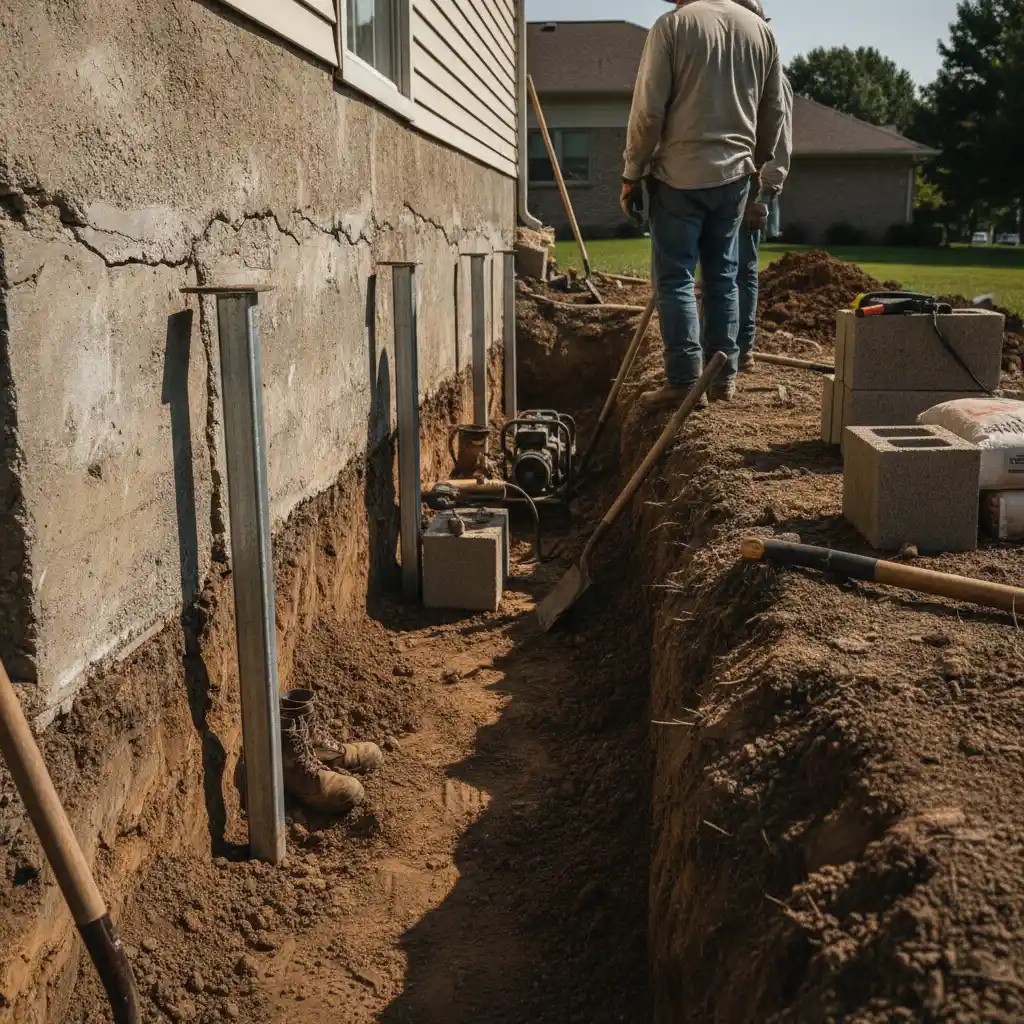
Our team in action — foundation-repair professionals serving Leander
Slab Foundation Repair Methods Used in Leander, TX
1. Steel Push Piers (Deep Underpinning)
Steel push piers are hydraulically driven through unstable near-surface soils until they reach load-bearing strata — typically the Austin Chalk or Georgetown Limestone formations, which underlie much of Williamson County at depths of 15 to 30 feet. This method is the gold standard for significant settlement in Leander’s Taylor Clay zones and is best suited for homes with differential settlement exceeding 1.5 inches. Structural Foundation Repair Services
2. Helical Piers
Helical piers are steel shafts with helical plates that are torque-driven into the ground. They are particularly useful in areas with limited access — such as interior closets or tight side yards common in Leander’s higher-density subdivisions — and in situations where load capacity must be verified by torque readings in real time.
3. Pressed Concrete Pilings
Pressed concrete pilings (also called concrete cylinders) are a cost-effective option for moderate settlement in areas where the active clay zone is well-documented and the depth to stable bearing soil is manageable. They are commonly used in Leander homes built before 2000.
4. Polyurethane Foam Slab Lifting
For slabs that have settled due to void formation or minor soil consolidation — rather than deep clay movement — high-density polyurethane foam can be injected through small 5/8-inch holes in the slab. The foam expands to fill voids, lifts the slab, and cures within minutes. This method is ideal for garage floors, interior slabs, and driveway approaches common in Leander’s newer construction. Concrete Foundation Repair Options
5. Slab Patching and Crack Injection
Minor cracks that do not represent structural movement can be sealed with epoxy or polyurethane crack injection to prevent water intrusion and further deterioration. Foundation Patching Services
Ready for Slab Foundation Repair? Get Your Free Estimate Today.
Round Rock Foundation Repair Group serves Leander and the surrounding area — we’ll be on-site within 24 hours.
📞 Call (512) 220-3502Slab Foundation Repair Cost in Leander, TX
One of the most common questions we receive is: “What does slab foundation repair cost in Leander, TX?” The honest answer is that costs vary widely based on the severity of damage, the repair method required, and the size of the structure. Below are realistic ranges based on current Leander-area market pricing.
Typical Cost Ranges
- Minor crack patching and epoxy injection: $500 – $1,500
- Polyurethane foam slab lifting (per zone): $1,000 – $3,500
- Pressed concrete piling installation (per pier): $350 – $500; typical project 10–25 piers = $3,500 – $12,500
- Steel push pier installation (per pier): $1,200 – $1,800; typical project 8–20 piers = $9,600 – $36,000
- Helical pier installation (per pier): $1,400 – $2,000
- Full perimeter underpinning for a 2,000 sq ft Leander home: $12,000 – $28,000 depending on method and soil conditions
- Commercial foundation repair: $25,000 – $100,000+ depending on building size and load requirements
Leander-Specific Cost Factors
Several factors unique to Leander can influence your total project cost. The depth required to reach stable Austin Chalk or Georgetown Limestone bedrock varies significantly across the city — properties west of US-183A near the Leander–Cedar Park border tend to encounter bedrock at shallower depths, reducing pier costs, while properties in lower-elevation areas near Brushy Creek may require deeper installations. Additionally, the City of Leander’s permit fees and inspection scheduling can add $300 – $800 to project costs compared to unincorporated areas.
Call us at (512) 220-3502 for a free, no-obligation written estimate. More on Foundation Repair Costs in the Leander Area
Leander Neighborhoods We Serve
Crystal Falls
One of Leander’s premier master-planned communities, Crystal Falls features homes built primarily between 2002 and 2018 on the rolling terrain north of Crystal Falls Parkway. The elevation changes in this neighborhood create varied drainage patterns that can cause localized perimeter settlement on the downhill sides of homes.
Bryson
Bryson is a newer development with homes constructed largely between 2014 and the present. Many homes here are built on fill soil brought in during mass-grading operations, and five-to-ten-year settlement cycles are a documented concern. We serve the entire Bryson community along Ronald Reagan Boulevard.
Mason Hills and Trails of Shiloh
Located near the US-183A toll road corridor, these mid-2000s to 2010s subdivisions sit on soils with high clay content. We have completed numerous foundation repair projects in these neighborhoods and understand the specific soil profiles present.
Block House Creek and Lakewood Grove
These established communities, some dating to the 1980s and 1990s, feature older slab construction with thinner concrete sections and less post-tension reinforcement than modern builds. Mature trees in these neighborhoods add tree-root moisture-extraction challenges. Crawl Space Repair for Older Leander Homes
Foundation Maintenance Tips for Leander, TX Homeowners
- Maintain consistent soil moisture year-round. During Leander’s hot, dry summers — when temperatures routinely exceed 100°F for weeks at a time — use a soaker hose or drip irrigation system placed 12 to 18 inches from your foundation perimeter to prevent extreme soil desiccation.
- Ensure positive drainage away from the slab. The City of Leander’s grading standards require a minimum 6-inch drop over the first 10 feet from the foundation. Check your yard grading annually, especially after settling or landscaping changes.
- Keep gutters and downspouts clear and extended. Downspout extensions should discharge water at least 5 feet from the foundation, directing it away from the slab edge.
- Manage tree placement and irrigation. Do not plant large trees — live oaks, cedar elms, or pecans — within 15 feet of your slab. If mature trees are already present, ensure their root zones receive supplemental irrigation during drought.
- Inspect your foundation after major weather events. After Leander’s intense spring storms or prolonged summer droughts, walk your perimeter and interior to check for new cracks or door-sticking issues.
- Address plumbing leaks immediately. A slow slab plumbing leak can saturate the subgrade beneath your Leander home for months before becoming visible, causing localized upheaval or settlement.
- Schedule a professional elevation survey every 3–5 years. Catching differential settlement early — when it is measured in fractions of an inch — can reduce repair costs dramatically compared to addressing a fully failed slab.
Why Choose Round Rock Foundation Repair Group for Slab Foundation Repair in Leander, TX
At Round Rock Foundation Repair Group, we are not a national franchise applying generic repair templates. We are a Central Texas-based company with hands-on experience across Williamson County’s specific soil conditions, local building codes, and the unique challenges posed by Leander’s rapid growth and expansive Taylor Clay soils. We know the difference between a Crystal Falls hillside drainage issue and a Bryson fill-soil settlement problem — and we design our repair plans accordingly.
Our service offerings span the full spectrum of foundation needs: Structural Foundation Repair, Foundation Restoration, Commercial Foundation Repair, Foundation Inspection, Crawl Space Repair, Foundation Patching, Home Foundation Repair, and Concrete Foundation Repair.
We provide written, itemized estimates with no hidden fees, clear project timelines, and transparent communication from your first call through final walkthrough. Our team takes pride in treating every Leander homeowner’s property as if it were our own. Call (512) 220-3502 today.
Frequently Asked Questions: Slab Foundation Repair in Leander, TX
Q: How much does slab foundation repair cost in Leander, TX?
A: Costs in Leander typically range from $3,500 for a minor pressed-concrete-pier job on a small home to $30,000 or more for deep steel pier underpinning on a large property. The average mid-range project involving 12–18 piers on a standard 2,000-square-foot Leander home runs $8,000 – $18,000. We provide free written estimates after a thorough on-site inspection.
Q: How long does slab foundation repair take in Leander?
A: Most residential slab foundation repair projects in Leander are completed in 1 to 3 days. Larger commercial projects or those requiring deep steel piers in challenging soil conditions may take up to 5 business days. Permitting, if required by the City of Leander, can add 5 to 10 business days prior to the repair start date.
Q: Will the city of Leander require a permit for foundation repair?
A: It depends on the scope of work. Cosmetic crack patching typically does not require a permit. However, structural underpinning — including the installation of push piers or helical piers — generally requires a permit from the City of Leander Building Inspections Department. We handle all permitting on your behalf.
Q: Is the expansive clay soil in Leander covered by my homeowner’s insurance?
A: Standard homeowner’s insurance policies in Texas explicitly exclude damage caused by soil movement, settling, shrinkage, or expansion — which means the gradual foundation movement caused by Leander’s Taylor Clay soils is almost never covered. Some policies cover sudden, accidental events like a plumbing leak that causes soil erosion beneath a slab. We can provide detailed documentation of your repair to support any insurance inquiry.
Q: Can you lift my Leander home’s slab back to its original elevation?
A: In most cases, yes — partially or fully. However, on older Leander homes where settlement has been occurring for many years, full restoration to original grade is not always advisable, as sudden large lifts can cause collateral cracking in plaster, tile, or plumbing. Our engineers target a practical, structurally sound elevation that minimizes cosmetic damage while fully stabilizing the structure.
Q: What is the difference between slab settlement and slab upheaval?
A: Settlement occurs when soil loses moisture or load-bearing capacity, causing portions of the slab to drop. Upheaval occurs when expansive soils absorb water and swell, pushing the slab upward — often in the center of the home. Leander homes can experience both, sometimes simultaneously on the same slab. The repair approach differs: settlement is addressed with piers or foam lifting, while upheaval typically requires moisture management and, in some cases, removal and replacement of the affected slab section.
Q: Do you serve areas near Leander, like Cedar Park and Georgetown?
A: Absolutely. Round Rock Foundation Repair Group serves the entire greater Leander area including Cedar Park, Georgetown, Round Rock, Austin, Brushy Creek, Pflugerville, Avery Ranch, Crystal Falls, and all surrounding communities throughout Williamson and Travis counties.
Q: How do I find a reliable slab foundation repair company near me in Leander, TX?
A: Look for a company with demonstrated experience in Williamson County’s specific soil conditions, a verifiable local presence, written itemized estimates, and clear warranty documentation. Round Rock Foundation Repair Group meets all of these criteria and is available at (512) 220-3502 seven days a week.
Get Your Free Slab Foundation Inspection in Leander, TX Today
Your Leander home is likely your largest investment, and the foundation beneath it is what protects everything inside. If you have noticed any of the warning signs described on this page — cracked walls, sticking doors, sloping floors, or gaps at your slab perimeter — do not wait. In Leander’s expansive clay environment, foundation problems do not resolve on their own; they grow.
Round Rock Foundation Repair Group is ready to help with a free, no-pressure, on-site foundation inspection. Our experienced team will give you straight answers, clear options, and a written estimate you can count on.
- Call or text us: (512) 220-3502
- Available: Monday–Saturday, 7 AM – 6 PM; emergency consultations available
- Service area: Leander, TX and all surrounding Williamson and Travis County communities
Request Your Free Foundation Inspection Online or call (512) 220-3502 right now to speak directly with a Leander foundation repair specialist. Protect your home — act today.