Home Foundation Repair in Leander, TX
Fast, Reliable Home Foundation Repair in Leander, TX — Licensed & Insured
Need home foundation repair in Leander, TX? Round Rock Foundation Repair Group fixes settlement, cracks & more. Call (512) 220-3502 for a free inspection.
- Licensed & Insured
- Locally Owned & Operated
- Free Inspection & Estimate
Request Your
Free EstimateHome foundation repair is the process of diagnosing, stabilizing, and restoring the structural base of a residential property to ensure long-term safety and integrity. In Leander, TX, this service is particularly critical due to the region’s expansive clay soils, dramatic seasonal moisture swings, and the rapid residential growth that has brought thousands of new homes to areas like Crystal Falls, Travisso, and Benbrook Ranch over the past decade.
Round Rock Foundation Repair Group serves homeowners throughout Leander with expert assessments and proven repair solutions tailored to Central Texas conditions. Whether you are dealing with stair-step cracks along your brick veneer, doors that no longer latch, or visible settling along your slab perimeter, our team has the local knowledge and technical skills to address the root cause — not just the symptom. Call us today at (512) 220-3502 to schedule your foundation inspection.
Understanding Home Foundation Repair in Leander, TX
A home’s foundation is its most critical structural element. It transfers the weight of the entire structure — walls, roof, floors, and all contents — into the ground below. When the soil beneath that foundation shifts, swells, shrinks, or erodes, the foundation moves with it. Over time, that movement causes cracking, tilting, and separation that can compromise the entire home.
Foundation repair encompasses a broad range of corrective actions. At its most basic, it may involve filling and sealing minor cracks in a concrete slab. At its most involved, it can mean installing a grid of deep-driven steel piers beneath a home to lift and re-level a foundation that has settled several inches below its original position. The appropriate method depends on the soil type, the degree of movement, the foundation type, and the age and construction style of the home.
Leander’s residential building stock is diverse. The city experienced its first major growth wave in the late 1990s and early 2000s when subdivisions like Block House Creek and Devine Lake Estates were developed. Homes from this era typically feature post-tension concrete slab foundations, which are common throughout Central Texas and are designed to flex slightly with soil movement. A second, larger wave of construction began around 2012 and accelerated through 2023, with master-planned communities like Travisso and Grand Mesa at Crystal Falls adding thousands of homes on terrain that ranges from relatively flat limestone plateaus to sloped cedar-covered hillsides.
Older homes built before post-tension slabs became standard may have conventional reinforced concrete slabs or even pier-and-beam foundations — the latter being common in homes built before 1970 in older sections near downtown Leander along US-183 and Bagdad Road. Pier-and-beam foundations have their own vulnerabilities, including wood rot, shifted piers, and sagging floor joists, all of which fall under the umbrella of home foundation repair. Understanding which foundation type your home has is the essential first step in determining the right repair strategy.
Why Home Foundation Repair Is Needed in Leander, TX
Expansive Clay Soils: The Primary Culprit
The dominant soil type throughout Leander and the broader Williamson County area is Houston Black Clay, a member of the Vertisol soil order. This soil is classified as highly expansive, meaning it can absorb significant amounts of water and swell dramatically — expanding by as much as 30 to 40 percent in volume during wet periods — and then shrink and crack when it dries. The Texas A&M AgriLife Extension Service has documented shrink-swell coefficients for Houston Black Clay soils in Williamson County that rank among the highest in the state. When this soil underlies a concrete slab, the seasonal expansion and contraction cycles create upward pressure (heave) during wet seasons and downward voids (settlement) during droughts.
Drought Cycles and Extreme Moisture Events
Central Texas is no stranger to extended drought. The 2011 drought — one of the most severe single-year droughts in Texas recorded history — caused widespread foundation movement across Leander, Cedar Park, and Round Rock. Many homeowners first noticed problems that year: doors sticking in August when soil moisture was at its lowest, then watching cracks appear as fall rains arrived and the soil swelled back. More recently, the February 2021 Winter Storm Uri caused frozen and burst pipes in thousands of Leander homes, releasing water beneath slabs and creating localized soil saturation that led to differential settlement in neighborhoods like Mason Hills and Larkspur.
Topographic Variation and Drainage Challenges
Unlike flatter communities to the east, Leander sits on the eastern edge of the Edwards Plateau, where elevation changes of 50 to 150 feet can occur within a single neighborhood. In communities like Crystal Falls — which straddles elevations ranging from roughly 900 to 1,100 feet above sea level — homes on downslope lots frequently experience water intrusion and lateral soil pressure that homes on flat terrain do not. Travisso, which was developed along dramatic limestone ridge lines near Ronald Reagan Boulevard, presents similar challenges, with retaining walls, cut-and-fill grading, and drainage swales that can redirect surface water toward home foundations rather than away from them.
Rapid Growth and Construction Variability
Leander’s population grew from approximately 26,000 in 2010 to over 75,000 by 2023, making it one of the fastest-growing cities in the United States. That rapid growth brought pressure on builders to complete homes quickly, and in some cases soil preparation — including proper compaction of fill soils — did not receive the attention it required. Homes in newer sections of Benbrook Ranch, Devine Lake, and Block House Creek Road corridors have been among those most frequently presenting foundation concerns in the five to ten years following original construction.
Signs You Need Home Foundation Repair in Leander
Interior Warning Signs
- Diagonal cracks running from the corners of door frames or window openings
- Doors and windows that stick, bind, or no longer close flush
- Gaps between interior walls and the ceiling or floor
- Floors that feel springy, bouncy, or visibly slope more than 1 inch per 8 feet
- Cracks in drywall that reopen after patching
Exterior Warning Signs
- Stair-step cracking in brick mortar joints, especially at corners
- Visible gaps between the brick veneer and the window or door trim
- Separation between the porch or garage slab and the main structure
- Cracks in the exposed edge of the concrete slab perimeter
Urgency Indicators
If you observe cracks wider than ¼ inch, walls that lean or bow visibly, or any structural member that appears to be pulling away from the main frame, treat these as urgent. Contact Round Rock Foundation Repair Group at (512) 220-3502 immediately for an emergency foundation inspection. Schedule a Foundation Inspection
Our Home Foundation Repair Process in Leander, TX
Initial Consultation and Site Visit (Day 1)
We begin with a phone consultation to understand your concerns, followed by an on-site visit. Our inspector reviews the interior and exterior of your home, documents all visible distress indicators, and gathers information about your home’s age, construction type, and drainage situation. For Leander properties, we pay special attention to lot topography and proximity to drainage easements.
Foundation Elevation Survey (Day 1–2)
Using a Zip-Level Pro 2000 hydrostatic leveling instrument, we take elevation readings at points across your slab — typically every 5 to 8 feet — to create a precise elevation map. This tells us exactly where and how much settlement or heave has occurred, which is essential for designing the right repair.
Soil and Drainage Assessment (Day 2–3)
Because Houston Black Clay soils behave so differently depending on moisture content, we assess soil conditions around your perimeter and evaluate your grading, gutter discharge, and irrigation patterns. Many Leander homes have irrigation systems that are inadvertently over-watering the foundation perimeter, contributing to differential heave.
Written Repair Plan and Estimate (Day 3–5)
We provide a detailed written scope of work that includes the repair method recommended, the number and location of piers or other supports, estimated timeline, and itemized pricing. No surprises.
Permitting (If Required)
For significant structural repairs, we coordinate with the City of Leander’s Building Inspection Division to pull any required permits before work begins. This protects you when it comes time to sell.
Repair Execution (2–5 Days Depending on Scope)
Our crew installs pier systems, performs slab repairs, or completes crawl space work according to the approved plan. We work efficiently to minimize disruption to your household.
Final Elevation Check and Cleanup
After repairs are complete, we conduct a post-repair elevation survey to confirm the slab has been restored as close to level as structurally appropriate. We then backfill, compact, and restore landscaping disturbed during pier installation.
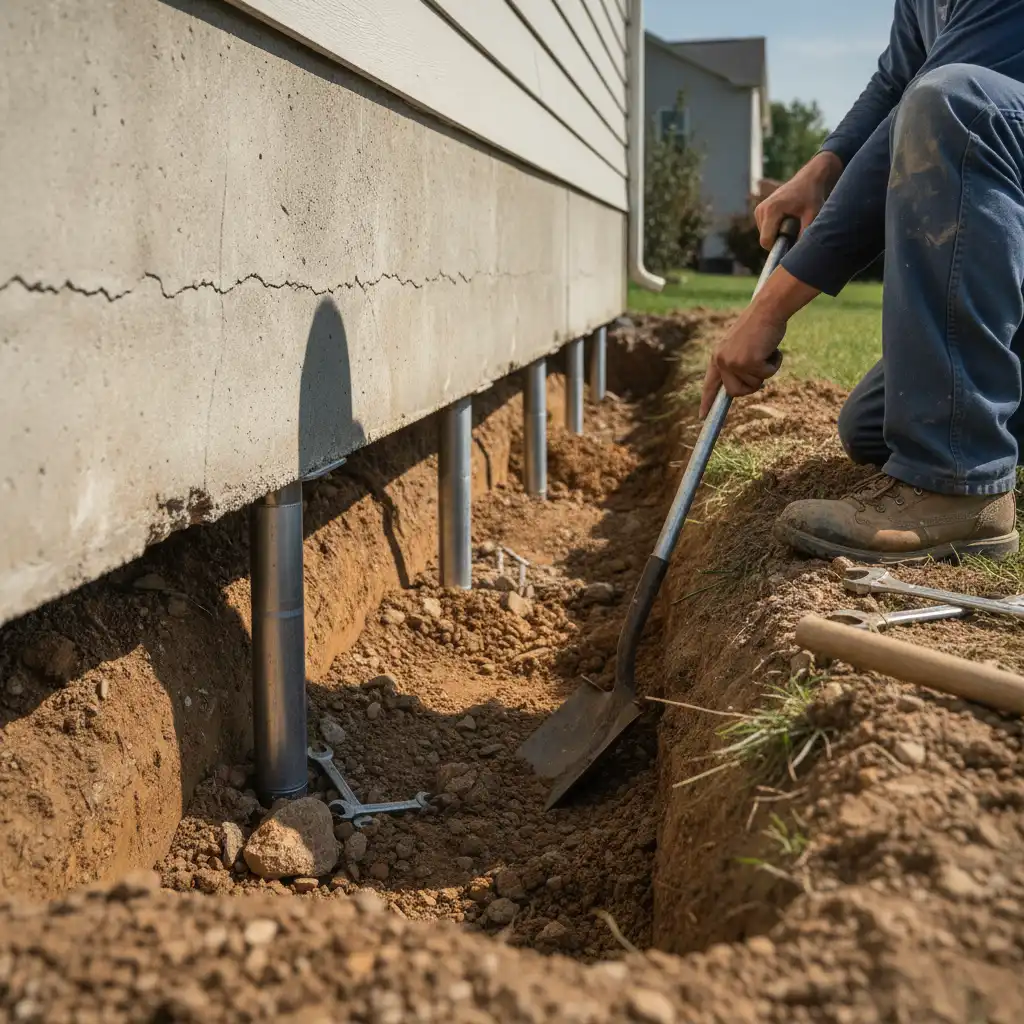
Our team in action — foundation-repair professionals serving Leander
Foundation Repair Methods We Use in Leander
Steel Push Piers
The most common method for addressing settlement in Leander. Hydraulic-driven steel pier sections are pushed through the clay soil layers until they reach load-bearing limestone bedrock or dense soil — typically at depths of 15 to 25 feet beneath homes in the Crystal Falls and Travisso areas. Once at depth, the piers are used to lift and stabilize the foundation. This method is ideal for homes experiencing downward settlement due to soil shrinkage. Learn About Structural Foundation Repair
Helical Piers
Helical piers are screwed into the ground using a torque motor and are well-suited for lighter structures, additions, and porches, or for sites where access limitations prevent heavy equipment. They are also useful in areas with variable soil depth, which occurs in some hillside sections of Leander near the Balcones fault zone.
Slab Piering and Pressed Concrete Cylinders
For interior settlement beneath a post-tension slab, we can access the underside of the slab through small excavated tunnels and install interior piers without removing flooring. This is especially valuable in finished living spaces.
Concrete Crack Repair and Patching
Minor cracks and surface spalling on slab edges or foundation walls are addressed with epoxy injection or polyurethane foam to restore integrity and prevent water infiltration. Learn About Foundation Patching
Crawl Space Repair
Older pier-and-beam homes in the historic core of Leander near downtown and Bagdad Road benefit from crawl space encapsulation, sister joist installation, and pier shimming to address settling and rot. Learn About Crawl Space Repair
Ready for Home Foundation Repair? Get Your Free Estimate Today.
Round Rock Foundation Repair Group serves Leander and the surrounding area — we’ll be on-site within 24 hours.
📞 Call (512) 220-3502Home Foundation Repair Cost in Leander, TX
Understanding the cost of foundation repair helps homeowners plan and make informed decisions. Below are realistic ranges based on repair type and project scope in the Leander, TX market.
- Foundation Inspection: $300–$600 for a professional elevation survey and written report
- Minor Crack Repair and Patching: $500–$2,500 depending on crack length and depth
- Steel Push Pier Installation: $1,200–$1,800 per pier installed; most Leander homes require 8–20 piers, making typical projects range from $10,000–$30,000
- Helical Pier Installation: $1,500–$2,200 per pier for specialty applications
- Crawl Space Repair: $3,000–$12,000 depending on extent of wood damage and number of piers requiring adjustment
- Full Structural Foundation Restoration: $20,000–$50,000+ for homes with extensive multi-directional movement
Leander-Specific Cost Factors
Homes in hillside sections of Crystal Falls or Travisso may incur additional costs due to difficult equipment access on sloped lots. Homes with mature oak or live oak trees near the foundation — common in established Block House Creek neighborhoods — may require root assessment and mitigation as part of the repair scope, adding $500–$2,000 to project cost. Permit fees through the City of Leander typically range from $150 to $400 for structural repair permits.
For a precise estimate tailored to your home, call us at (512) 220-3502 or request a free consultation online.
Leander Neighborhoods We Serve
Crystal Falls
Built primarily between 2003 and 2018 across limestone-rich hillside terrain, Crystal Falls homes frequently encounter both settlement on fill-graded downslope pads and drainage-related heave in low-lying areas adjacent to creek tributaries. We have extensive experience navigating the steep lot access challenges common in this community.
Travisso
Leander’s newest large master-planned community, developed from 2016 onward along dramatic ridge lines near Ronald Reagan Boulevard. Because much of Travisso was built on cut-and-fill pads, homes here are at elevated risk for differential settlement as fill soils consolidate over time.
Block House Creek
One of Leander’s original large subdivisions, with homes dating to the mid-1980s through the early 2000s. Post-tension slabs in this area are aging and more susceptible to cable corrosion and perimeter cracking. Mature tree roots are also a contributing factor.
Benbrook Ranch and Mason Hills
Mid-2000s to early 2010s construction in these communities used standard reinforced slab designs. The Storm Uri pipe-burst events of February 2021 caused localized moisture-related foundation movement here that we have remediated for numerous homeowners in subsequent years.
We also serve all surrounding communities including Cedar Park, Round Rock, Georgetown, and Austin.
Foundation Maintenance Tips for Leander Homeowners
- Maintain consistent soil moisture year-round. Use a soaker hose system placed 12–18 inches from your foundation perimeter during dry months (typically July through October in Leander) to prevent the extreme shrinkage that causes settlement.
- Ensure positive drainage away from your slab. The soil around your foundation perimeter should slope away at a minimum of 6 inches over the first 10 feet. Leander’s clay soils compact over time and can reverse this grade.
- Clean gutters seasonally. Overflow from clogged gutters deposits concentrated water directly at your foundation perimeter — a leading cause of localized heave in Leander’s high-rainfall spring months.
- Extend downspouts 4–6 feet away from the structure. Splash blocks alone are insufficient given Leander’s clay soil absorption rate.
- Monitor irrigation zones near the foundation. Adjust irrigation schedules seasonally and confirm that no zones are saturating the soil within 3 feet of your slab edge.
- Trim large trees and remove dead ones. Live oaks and cedar elms native to the Leander area have aggressive root systems that can extract moisture from soil beneath your slab during drought.
- Inspect your foundation perimeter twice per year. Walk the exterior of your home each spring and fall, photographing any new cracks or changes to note progression over time.
Why Choose Round Rock Foundation Repair Group for Your Leander Home
Round Rock Foundation Repair Group is a locally rooted company that has built its reputation serving homeowners across Williamson County and the greater Austin metro area. Our team understands the specific soil conditions, topographic challenges, and construction patterns that define Leander’s residential landscape — knowledge that a generalist contractor simply cannot replicate.
We work exclusively with proven pier systems and repair methods that are appropriate for Central Texas clay soils. We do not upsell repairs that are not needed, and we provide clear, itemized written estimates before any work begins. Our inspectors use calibrated hydrostatic leveling equipment — not guesswork — to diagnose problems accurately.
We serve all of Leander including Crystal Falls, Travisso, Block House Creek, Benbrook Ranch, Mason Hills, Grand Mesa, and Devine Lake, as well as neighboring communities in Round Rock, Cedar Park, Georgetown, Austin, and Pflugerville.
Call us at (512) 220-3502 to speak with a foundation specialist today. Request Your Free Consultation
Frequently Asked Questions: Home Foundation Repair in Leander, TX
How much does home foundation repair cost in Leander, TX?
Costs vary widely depending on the type and extent of damage. Minor crack repairs may cost $500–$2,500, while pier installation projects for settlement correction typically range from $10,000 to $30,000 for most Leander homes. Severe cases involving widespread movement can exceed $40,000. We provide free, detailed written estimates after our inspection.
How long does foundation repair take in Leander?
Most residential pier installation projects are completed in 2 to 5 business days. Smaller crack repair or patching jobs may be finished in a single day. More complex projects involving interior pier access or crawl space work may take 5 to 10 days. We will give you a specific timeline in your written repair plan.
Is the expansive clay soil in Leander really that different from other areas?
Yes. Williamson County’s Houston Black Clay soils have some of the highest plasticity indexes recorded in Texas, meaning they expand and contract more dramatically with moisture changes than soils in many other regions. This is why foundation issues are so prevalent throughout Leander, Cedar Park, and Round Rock compared to, say, sandy soil areas in East Texas.
My home is in Crystal Falls on a hillside lot. Does that affect the repair approach?
It can. Sloped lots in Crystal Falls and Travisso often have fill soil on the downhill side that is less stable than native soil on the uphill side, which creates differential settlement patterns. Access for pier installation equipment on steep lots may also require modified approach methods or hand-digging in some pier locations, which can affect the project cost and timeline.
Will foundation repair affect my home’s resale value in Leander?
Properly documented and permitted foundation repair typically has a positive effect on resale value compared to leaving known foundation issues unaddressed. Texas law requires disclosure of known foundation problems to buyers. Having a completed repair with documentation and engineering signoff is viewed favorably by buyers and their lenders.
Do I need a permit for foundation repair in Leander, TX?
The City of Leander requires permits for structural foundation repair work. We handle the permitting process on your behalf and ensure all work is inspected and closed out properly. This protects your investment and ensures compliance with local building codes.
My home survived the 2011 drought without problems. Should I still be concerned now?
Possibly. Foundation movement is cumulative. Each drought and wet cycle adds incremental stress. A home that appeared fine after 2011 may have reached a tipping point after the 2022–2023 drought and subsequent heavy rainfall. Additionally, as post-tension cables age past the 20–25 year mark — which applies to many homes built in Block House Creek and Devine Lake in the late 1990s — their effectiveness decreases. A current inspection will tell you where your home stands today.
Can I repair foundation cracks myself?
Surface crack filling with store-bought products can temporarily improve aesthetics but does not address the underlying soil movement causing the crack. In fact, improperly sealed cracks can mask progressive movement that worsens over time. We recommend having any crack wider than ⅛ inch professionally evaluated before attempting any cosmetic repair.
Get Expert Home Foundation Repair in Leander, TX Today
If your Leander home is showing signs of foundation movement — whether you are in Crystal Falls, Travisso, Block House Creek, or anywhere else in our service area — do not wait for small problems to become structural emergencies. The longer foundation issues go unaddressed in Leander’s expansive clay soil environment, the more complex and costly the repair becomes.
Round Rock Foundation Repair Group is ready to help. Call us at (512) 220-3502 to speak directly with a foundation specialist, or use our online form to request your free inspection and estimate. Schedule Your Free Foundation Inspection Now
We also serve homeowners throughout Round Rock, Cedar Park, Georgetown, Austin, Pflugerville, Brushy Creek, Avery Ranch, and surrounding communities. View All Service Areas