
Foundation Waterproofing in Leander, TX
Expert Foundation Waterproofing in Leander, TX — Storm-Tested, Warranty-Backed
Need foundation waterproofing in Leander, TX? Round Rock Foundation Repair Group protects homes from clay soils & flash floods. Call (512) 220-3502 today.
- Licensed & Insured
- Locally Owned & Operated
- Free Inspection & Estimate
Request Your
Free EstimateFoundation waterproofing is the process of applying barriers, drainage systems, and sealants to protect your home’s foundation from water intrusion, moisture damage, and hydrostatic pressure. In Leander, TX — a rapidly growing city in Williamson County situated along Brushy Creek and the Balcones Escarpment — shifting expansive clay soils and unpredictable Central Texas rainfall events make foundation waterproofing not just a luxury but a necessity for long-term structural integrity.
At Round Rock Foundation Repair Group, we specialize in delivering comprehensive foundation waterproofing solutions tailored to the unique geological and climatic conditions found throughout Leander and the surrounding Hill Country transition zone. Our team understands how the local Austin Black Clay soils, seasonal flooding patterns, and the explosive growth of new construction subdivisions like Crystal Falls and Travisso create waterproofing challenges that generic contractors simply aren’t equipped to handle. Whether you own a newer slab-on-grade home or an older pier-and-beam structure, we provide the expertise your foundation demands.
Call us today at (512) 220-3502 to schedule your professional foundation waterproofing assessment.
Understanding Foundation Waterproofing
Foundation waterproofing encompasses a broad range of techniques designed to prevent water from penetrating the structural base of a building. Unlike simple damp-proofing — which only resists minor soil moisture — true waterproofing creates a continuous, impermeable barrier capable of withstanding sustained hydrostatic pressure, the force that groundwater exerts against a foundation wall or slab when the surrounding soil becomes saturated.
Historically, foundation protection in Central Texas was a relatively informal practice. Earlier generations of Leander builders in the mid-20th century relied primarily on grading and surface drainage, assuming the limestone bedrock common throughout Williamson County would naturally channel water away. However, as Leander’s population swelled from roughly 7,500 residents in 2000 to over 75,000 today, mass grading of new subdivisions disrupted natural drainage channels, compacted native soils, and introduced large volumes of impervious cover that redirected stormwater in unpredictable ways.
Modern foundation waterproofing systems are engineered solutions that integrate multiple components: exterior membrane barriers applied to foundation walls, interior drainage mats and French drains, sump pump systems, crack injection materials, and vapor barriers for crawl spaces and pier-and-beam structures. Each component serves a specific role in managing the movement of water at and below grade.
In Leander specifically, the building stock reflects the city’s rapid growth. The majority of residential construction consists of slab-on-grade foundations poured between 2000 and the present, making interior drainage systems and exterior membrane waterproofing the most frequently applied solutions. Older neighborhoods near the historic Leander town center — platted in the late 1800s as a stop along the Austin and Northwestern Railroad — contain pier-and-beam homes that require vapor barrier installation and crawl space encapsulation to combat the moisture accumulation common in the region’s humid subtropical climate.
Commercial properties along US-183 and the Ronald Reagan Boulevard corridor, including retail centers, medical offices, and light industrial facilities, face their own distinct waterproofing demands given their larger footprints and greater susceptibility to hydrostatic loading during heavy rain events. Learn more about our Commercial Foundation Repair services to understand how we address these large-scale challenges.
Why Foundation Waterproofing Is Needed in Leander, TX
Expansive Austin Black Clay Soils
The dominant soil type underlying most of Leander’s developed land is Austin Black Clay, a Vertisol classification known for its extreme shrink-swell behavior. This soil can absorb more than 30% of its own weight in water, expanding dramatically during wet periods and then shrinking and cracking during drought — sometimes forming surface fissures more than 2 inches wide and 12 to 18 inches deep. When water infiltrates through these cracks and reaches the zone beneath a foundation slab, it creates uneven hydrostatic pressure that causes differential settlement, heaving, and ultimately structural cracking. Neighborhoods in western Leander, including Crystal Falls and Travisso, are particularly prone to this cycle because the topsoil cap is shallower and the clay layer sits closer to the surface.
Balcones Fault Zone Influence
Leander straddles the Balcones Escarpment, a geological boundary separating the limestone-dominated Edwards Plateau to the west from the softer sedimentary Blackland Prairie to the east. This transition creates highly variable subsurface conditions — sometimes within the same city block — where pockets of fractured limestone intermix with dense clay lenses. Water moves unpredictably through fractured limestone, emerging as seepage in unexpected locations and undermining foundations that were designed assuming uniform soil conditions.
Intense Rainfall Events and Flash Flooding
Central Texas holds the unfortunate distinction of being part of “Flash Flood Alley,” the region with the highest flash flood frequency in the United States. Leander experiences an average annual rainfall of approximately 33 inches, but precipitation is highly concentrated in spring and fall storm systems. In October 2018, a series of storms dropped more than 10 inches of rain on Williamson County within 48 hours, causing Brushy Creek to overflow its banks and sending stormwater into the lower-lying sections of neighborhoods like Blockhouse Creek and Mason Hills. Events like these overwhelm surface drainage infrastructure and force large volumes of water against foundations with little warning.
Rapid Development and Altered Drainage Patterns
Leander’s construction boom, which has added thousands of new homes in master-planned communities like Bryson, Carneros Ranch, and Grand Mesa at Crystal Falls since 2015, has significantly increased impervious cover across the watershed. When rain falls on rooftops, driveways, and streets instead of being absorbed by native vegetation, it concentrates into drainage swales and retention ponds — many of which sit adjacent to or even within residential lots. Homes backing up to these drainage features in subdivisions like Palmero Vista and Summerlyn experience consistently elevated soil moisture levels that make waterproofing essential rather than optional.
Irrigation and Landscaping Practices
Homeowners attempting to maintain lawns through Leander’s increasingly frequent summer droughts — the region experienced D3 Extreme Drought conditions for more than 14 consecutive weeks during the summer of 2022 according to the U.S. Drought Monitor — often over-irrigate, saturating foundation soils on one side of the home while the opposite side remains desiccated. This differential moisture condition is one of the leading causes of foundation movement in Leander’s established neighborhoods.
Signs You Need Foundation Waterproofing in Leander
Interior Warning Signs
- Standing water or persistent dampness on basement or slab-level floors after rain events
- White chalky deposits (efflorescence) on concrete walls, indicating mineral-laden water has been migrating through the wall
- Musty or mildew odors in lower-level rooms, crawl spaces, or closets adjacent to exterior walls
- Visible mold growth on drywall, insulation, or wood framing near the foundation perimeter
- Doors and windows that stick, jam, or no longer close squarely — a sign of foundation movement driven by uneven soil moisture
Exterior Warning Signs
- Cracks wider than 1/8 inch in brick veneer, stucco, or the foundation itself, particularly stair-step cracks in mortar joints
- Soil pulling away from the foundation creating a visible gap along the perimeter
- Downspout discharge or pooling water within 5 feet of the foundation after rain
- Flower beds or landscaping mulch that directs water toward the house rather than away from it
Urgency Indicators
If you observe horizontal cracks in a foundation wall, water actively seeping through cracks during or immediately after rain, or floors that slope more than 1 inch per 10 feet, these conditions require immediate professional evaluation. Contact us at (512) 220-3502 for an emergency assessment. Schedule a Foundation Inspection today.
Our Foundation Waterproofing Process in Leander
We follow a structured, proven process adapted to Leander’s specific soil and climate conditions to ensure every waterproofing installation performs reliably for decades.
Comprehensive Site Evaluation (Day 1 — 2 to 3 Hours)
Our certified inspector conducts a full assessment of your property, including soil probe tests to determine clay depth, measurement of existing foundation cracks, evaluation of current grading and drainage patterns, and inspection of crawl spaces or accessible under-slab areas. We document all findings with photographs and elevation readings.
Soil Moisture Analysis and Hydrostatic Pressure Mapping (Day 1–2)
Using calibrated moisture meters and in-ground probes, we map the moisture gradient around your foundation perimeter. This step is particularly important in Leander neighborhoods near drainage corridors where subsurface water movement doesn’t always correspond to visible surface conditions.
Custom Waterproofing Plan Design (Day 2–3)
Based on inspection findings, we design a site-specific waterproofing system that may combine exterior membrane application, interior drainage channels, sump pump installation, crack injection, and vapor barrier placement. We present the plan to you with a clear written scope of work and fixed pricing before any work begins.
Site Preparation and Excavation (Day 3–5)
For exterior waterproofing installations, we carefully excavate around the foundation perimeter to expose the full wall height. Our crews are experienced with Leander’s rocky transition soils and use equipment appropriate for both clay-heavy and limestone-adjacent conditions to avoid disrupting existing utilities or landscaping more than necessary.
Waterproofing System Installation (Day 5–10)
We apply the selected waterproofing components in proper sequence — membrane application, drainage board installation, filter fabric placement, and gravel backfill — ensuring continuous coverage with no gaps or bridging failures. Interior drainage systems are installed with minimal disruption to existing flooring where possible.
Drainage Integration and Sump Pump Setup (Day 8–10)
All drainage components are connected to a properly sized sump pit and pump system rated for Leander’s peak storm intensity. We verify discharge locations direct water a minimum of 10 feet from the foundation and comply with Leander municipal stormwater guidelines.
Final Inspection, Backfill, and Grading (Day 10–12)
After system installation, we backfill excavated areas, restore grading to a minimum 6-inch drop over the first 10 feet from the foundation, reseed disturbed lawn areas with drought-tolerant native grass blends appropriate for Williamson County, and conduct a final walkthrough with the homeowner.
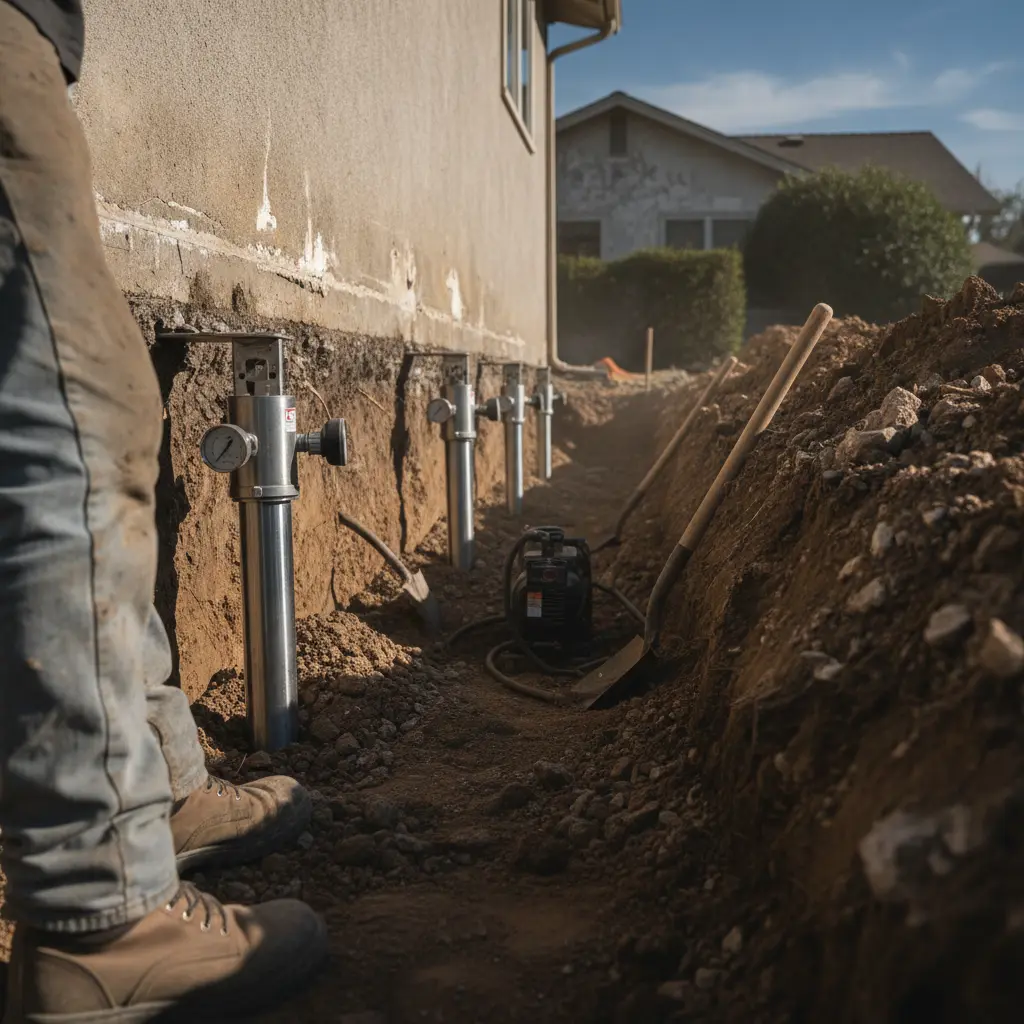
Our team in action — foundation-repair professionals serving Leander
Foundation Waterproofing Methods and Approaches
Exterior Membrane Waterproofing
A continuous polymer-modified bitumen or crystalline waterproofing membrane applied to the exterior face of foundation walls provides the most comprehensive barrier against hydrostatic pressure. This method is ideal for Leander homes where exterior excavation is feasible and where clay soils create sustained water pressure against the foundation wall during wet seasons. It addresses the problem at the source rather than managing water after it enters.
Interior French Drain and Drainage Board Systems
When exterior access is limited — common in Leander’s densely platted newer subdivisions where homes sit close to property lines — interior perimeter drainage systems capture water that migrates through the slab edge or lower wall and channel it to a sump pump. This approach is highly effective for managing water intrusion in homes in established neighborhoods like Block House Creek and Mason Hills. Learn more about our Crawl Space Repair services.
Crack Injection Waterproofing
Polyurethane foam or epoxy injection fills and seals active cracks in concrete foundation walls and slabs, preventing water infiltration at specific failure points. This targeted method is commonly used in Leander’s older downtown-adjacent properties and as a supplement to larger waterproofing systems. Explore our Foundation Patching services.
Crawl Space Encapsulation and Vapor Barriers
Pier-and-beam homes common in older sections of Leander near the historic town center benefit from heavy-gauge polyethylene vapor barriers installed across the crawl space floor, combined with sealed vents and a dedicated dehumidifier to maintain relative humidity below 60% year-round — the threshold above which mold and wood rot accelerate in Central Texas’s humid subtropical climate.
Surface Grading and Drainage Correction
In many Leander cases, improving lot grading and repositioning downspout extensions resolves mild moisture intrusion without requiring invasive waterproofing installation. We evaluate this option at every site assessment as a cost-effective first measure when warranted.
Ready for Foundation Waterproofing? Get Your Free Estimate Today.
Round Rock Foundation Repair Group serves Leander and the surrounding area — we’ll be on-site within 24 hours.
📞 Call (512) 220-3502Foundation Waterproofing Cost in Leander, TX
Understanding the investment required for foundation waterproofing helps homeowners plan appropriately. Costs vary significantly based on the method selected, the size of the foundation, site accessibility, and the severity of existing water intrusion.
Typical Price Ranges
- Crack Injection (per crack): $400 – $800 per linear foot of crack, depending on depth and material
- Interior Drainage System with Sump Pump: $5,000 – $12,000 for a typical 1,800–2,400 sq ft Leander slab home
- Exterior Membrane Waterproofing: $8,000 – $20,000+ depending on linear footage of foundation wall and excavation depth
- Crawl Space Encapsulation: $3,500 – $8,000 for a standard pier-and-beam footprint in older Leander neighborhoods
- Full Perimeter Waterproofing System (combined methods): $15,000 – $35,000 for comprehensive protection on larger homes
Leander-Specific Cost Factors
Several regional factors influence pricing in Leander specifically. Rocky soils in the western portions of the city near Crystal Falls and Travisso increase excavation time and equipment costs compared to purely clay-based sites. Homes in newer subdivisions with underground utilities require additional precautions during excavation. Drought-related foundation movement that occurred during the 2022 drought season left many Leander foundations with pre-existing settlement that must be addressed through Structural Foundation Repair before waterproofing can be effectively applied, adding to total project scope.
Return on Investment
Waterproofing a Leander foundation typically costs significantly less than the average foundation repair bill of $10,000 – $50,000 that results from unaddressed water damage. Most Leander homeowners report that properly waterproofed foundations also contribute to faster home sales and stronger appraisal values in today’s competitive Williamson County real estate market. Call (512) 220-3502 for a free, no-obligation estimate.
Leander Neighborhoods We Serve
Crystal Falls
One of Leander’s premier master-planned communities, Crystal Falls features homes built predominantly between 2003 and the present on sloped terrain with shallow clay-over-limestone soil profiles. Homes here face elevated risk from surface runoff channeled by the community’s extensive network of retention ponds and drainage easements, making exterior membrane waterproofing and proper grading the most common interventions we perform in this neighborhood.
Blockhouse Creek
An established Leander neighborhood developed largely during the 1990s, Blockhouse Creek homes sit adjacent to the creek system that gives the area its name. These properties experience seasonal high water tables that can approach within 18 inches of the surface after significant rain events, requiring interior French drain systems and sump pump installations. Explore our Home Foundation Repair services.
Travisso
Leander’s newest large-scale master-planned community, Travisso features luxury homes on the dramatic limestone escarpment terrain with expansive Hill Country views. The fractured limestone substrate creates unpredictable water migration pathways, and crack injection combined with exterior drainage board systems are frequently required for homes on steeper lots.
Mason Hills and Palmero Vista
These mid-2000s subdivisions in central Leander contain large numbers of two-story homes on standard slab foundations that have experienced the full cycle of Leander’s drought-flood-drought conditions. Differential settlement from uneven soil moisture is the primary concern here, and a combination of waterproofing and Foundation Restoration services is often required.
Foundation Waterproofing Maintenance Tips for Leander Homeowners
Maintaining your waterproofing system and surrounding conditions extends its effective life and reduces the likelihood of costly future repairs. Follow these location-specific recommendations.
- Maintain consistent soil moisture year-round: During Leander’s summer droughts, use a soaker hose on a timer to keep foundation soils from desiccating and cracking. Run hoses approximately 18 inches from the foundation for 20–30 minutes per day during weeks with less than 1 inch of rainfall.
- Inspect and clean gutters every fall and spring: Leander’s cedar and live oak trees drop significant debris that clogs gutters, causing water to overflow directly against the foundation. Clean gutters before the spring and fall storm seasons.
- Extend downspouts at least 6 feet from the foundation: Route extensions away from the house and toward natural drainage swales — never toward neighboring lots or streets, per Leander city code.
- Regrade low spots along the foundation perimeter annually: Leander’s clay soils settle and compact over time, creating depressions that pool water. Add soil to maintain a positive slope away from the house.
- Test your sump pump before storm season: Pour water into the sump pit in March and September to confirm the pump activates and discharges properly before Leander’s peak storm seasons arrive.
- Avoid planting large trees within 20 feet of the foundation: Live oaks and cedar elms common in Leander landscaping draw enormous amounts of soil moisture, accelerating differential settlement.
- Schedule annual professional inspections: Have your waterproofing system and Foundation Inspection performed once per year to catch any emerging issues before they become structural problems.
Why Choose Round Rock Foundation Repair Group for Leander Foundation Waterproofing
Round Rock Foundation Repair Group has built a reputation throughout Williamson County as the team property owners trust when foundation and waterproofing challenges arise. We are locally based, which means we understand the nuances of Leander’s soil variability, the Balcones Escarpment geology, and the drainage behaviors of specific neighborhoods in ways that out-of-market contractors simply cannot replicate.
Our team is experienced across the full spectrum of foundation services — from Foundation Inspections and Foundation Patching to Structural Foundation Repair and Concrete Foundation Repair — meaning we can identify and address all contributing factors to water intrusion, not just apply a surface-level fix that fails within a few seasons.
We serve all of Leander and the broader Central Texas region, including Cedar Park, Georgetown, Pflugerville, Avery Ranch, Great Hills, Anderson Mill, and Brushy Creek. Every project begins with a thorough, no-pressure assessment and ends with a detailed written explanation of the work completed. Our commitment is to your foundation’s long-term performance.
Call us at (512) 220-3502 to speak with a local foundation specialist today.
Frequently Asked Questions About Foundation Waterproofing in Leander, TX
How much does foundation waterproofing cost in Leander, TX?
Costs in Leander typically range from $400–$800 per crack for targeted injection repairs to $5,000–$12,000 for interior drainage systems and $8,000–$20,000 or more for full exterior membrane waterproofing. The rocky terrain in western Leander neighborhoods like Crystal Falls and Travisso can add 10–20% to excavation costs compared to flatter, purely clay-based sites. We provide free, detailed estimates after every site inspection with no obligation to proceed.
How long does foundation waterproofing take in Leander?
Most residential waterproofing projects in Leander are completed within 5 to 12 business days from the start of installation. Exterior membrane systems requiring significant excavation take longer, while interior drainage installations in standard slab homes are often completed in 2 to 4 days. Timeline can be affected by Leander’s weather — we avoid pouring membranes or applying sealants during rain or when temperatures drop below 40°F.
Does Leander’s soil type affect which waterproofing method I need?
Absolutely. The Austin Black Clay soils that dominate Leander’s eastern and central areas respond best to exterior membrane systems that prevent water from contacting the foundation wall at all, combined with interior drainage as a backup. Homes in the western limestone transition zone near Travisso may require different membrane materials that can accommodate minor substrate movement. Our site inspection always includes soil analysis to confirm the right approach for your specific location.
Will foundation waterproofing fix my existing foundation cracks?
Waterproofing prevents water from worsening existing cracks and entering the structure, but it does not restore structural integrity to significantly damaged foundations. If your foundation has experienced settlement or heaving beyond cosmetic cracking, you will likely need Structural Foundation Repair or Foundation Restoration services performed before or alongside waterproofing. Our inspection will clearly identify which services apply to your situation.
How do I know if my Leander home needs waterproofing or just better drainage?
Surface grading and downspout corrections resolve moisture problems in roughly 20–30% of the Leander cases we evaluate. If regrading and drainage improvements eliminate all signs of water intrusion and foundation movement, a full waterproofing installation may not be immediately necessary. However, if moisture continues to reach the foundation despite surface corrections, a formal waterproofing system is the appropriate next step. We always recommend the least invasive effective solution first.
How does Leander’s growth and new construction affect existing home foundations?
Large-scale grading for new subdivisions in Leander — particularly in rapidly developing areas like Bryson and Carneros Ranch — can alter subsurface drainage patterns for nearby existing homes. If a previously dry basement or crawl space began showing moisture after nearby construction commenced, the altered hydrology of the surrounding land may be the cause. We investigate site context as part of every evaluation. Schedule a Foundation Inspection to get answers specific to your property.
Does foundation waterproofing add value to my Leander home?
Yes. In Leander’s competitive real estate market, a documented waterproofing system and transferable service record provides measurable value during inspections and appraisals. Buyers and their inspectors are increasingly aware of Central Texas foundation risks, and homes with professionally waterproofed foundations consistently sell faster and with fewer price reduction negotiations than comparable homes without this protection.
Do you serve areas outside of Leander?
Yes. Round Rock Foundation Repair Group serves a wide area across Central Texas, including Round Rock, Cedar Park, Georgetown, Austin, Pflugerville, Wells Branch, Avery Ranch, Great Hills, Anderson Mill, Brushy Creek, Jollyville, Behrens Ranch, Forest Creek, Sendero Springs, and many other communities throughout the region. View our full service area.
Schedule Your Foundation Waterproofing Assessment in Leander Today
Don’t wait for the next Central Texas storm to reveal what your foundation is already telling you. Water intrusion problems in Leander’s expansive clay soils and unpredictable flash flood environment worsen with every wet season — and the repairs required after significant structural damage far exceed the cost of proactive waterproofing.
Round Rock Foundation Repair Group is ready to evaluate your property, explain your options clearly, and provide a transparent, fixed-price estimate with no pressure and no surprises. We serve Leander and all surrounding communities throughout Williamson and Travis Counties.
Call us now at (512) 220-3502 to speak directly with a local foundation specialist, or visit our office serving the greater Round Rock and Leander area. Same-week appointments are typically available. Protect your foundation — and your investment — starting today.