Structural Foundation Repair in Leander, TX
Fast, Reliable Structural Foundation Repair in Leander, TX — Licensed & Insured
Need structural foundation repair in Leander, TX? Round Rock Foundation Repair Group fixes slab, pier & beam, and commercial foundations. Call (512) 220-3502 today.
- Licensed & Insured
- Locally Owned & Operated
- Free Inspection & Estimate
Request Your
Free EstimateStructural foundation repair is the process of diagnosing, stabilizing, and restoring a building’s foundation to its original load-bearing capacity — preventing further settlement, cracking, or displacement that can compromise the safety of your entire structure. In Leander, TX, where explosive residential growth meets the notoriously challenging Austin Chalk and Taylor Clay geology, foundation issues are not a matter of if but when.
Round Rock Foundation Repair Group brings deep local knowledge of Leander’s expanding neighborhoods, its shrink-swell soils, and the seasonal drought patterns that accelerate foundation movement throughout Williamson County. Whether you own a newer construction home in Travisso or an established property near Crystal Falls, our team provides expert structural foundation repair designed for the specific conditions that Leander homeowners face every day.
Call us today at (512) 220-3502 to schedule your foundation inspection and get started with a customized repair plan.
Understanding Structural Foundation Repair
A home or commercial building’s foundation is its single most critical structural element. It transfers the entire weight of the structure into the ground below, and when that ground moves — due to soil expansion, contraction, erosion, or poor compaction — the foundation moves with it. Structural foundation repair encompasses a broad range of interventions: from installing deep steel piers that reach stable bedrock dozens of feet below grade, to underpinning with concrete pilings, to injecting polyurethane foam beneath a slab to fill voids left by soil washout.
The history of foundation repair in Central Texas is closely tied to the region’s unique geology. Unlike many parts of the United States where sandy or gravelly soils remain relatively stable, the Blackland Prairie soils of Williamson County — including much of Leander — are dominated by expansive montmorillonite clay. Early homebuilders in the greater Austin area, as far back as the post-WWII construction boom of the late 1940s and 1950s, quickly discovered that conventional shallow slab foundations could crack, heave, and shift dramatically with seasonal moisture changes.
By the 1970s and 1980s, engineered post-tension slabs became the regional standard in response to these failures. Today’s Leander, however, is home to an extraordinarily diverse building stock. The city’s population has grown from roughly 7,500 residents in 2000 to well over 75,000 by the early 2020s — making it one of the fastest-growing cities in the United States. That growth means thousands of homes were built across multiple construction eras, each with different foundation engineering standards, and each now subject to Leander’s demanding soil and climate conditions.
Structural foundation repair today is a highly engineered discipline. Modern repair methods are informed by soil borings, load calculations, and engineering reports — not guesswork. The goal is not merely cosmetic: a properly repaired foundation must demonstrate measurable improvement in elevation, stability, and structural integrity. For Leander homeowners, understanding what this process involves is the first step toward protecting the largest investment most families will ever make.
Why Structural Foundation Repair Is Needed in Leander, TX
Leander sits atop some of the most geologically active soils in Central Texas. The area is underlain primarily by Austin Chalk limestone — which is relatively stable — but that bedrock is overlain in many neighborhoods by 3 to 12 feet or more of Taylor Clay and Blackland Prairie expansive soils. These soils are predominantly composed of montmorillonite clay minerals that can expand volumetrically by as much as 30 to 40 percent when saturated and shrink dramatically during dry periods. This repeated cycle of expansion and contraction — what geotechnical engineers call “shrink-swell behavior” — exerts tremendous differential pressure on any foundation.
Leander’s climate amplifies this problem significantly. The region receives an annual average rainfall of approximately 33 inches, but that precipitation is highly irregular. Extended droughts — such as the severe drought of 2011, when Leander and surrounding Williamson County recorded nearly 90 consecutive days above 100°F and roughly 50 percent of average annual rainfall — cause clay soils to desiccate and shrink to depths of 6 feet or more below grade. When rains return, the same soils rehydrate unevenly, creating differential heave across a foundation footprint that can measure 2 to 4 inches of vertical displacement in extreme cases.
New development patterns in Leander add further complexity. Neighborhoods such as Travisso, along Crystal Falls Parkway, were built on graded hillside terrain where cut-and-fill grading operations left some portions of a home’s foundation bearing on undisturbed native soil while other portions rest on compacted fill. Fill soils consolidate and settle at different rates than native soil, making differential settlement a predictable outcome in many newer Leander subdivisions.
Crystal Falls itself — one of Leander’s most established master-planned communities — sits in an area with well-documented expansive clay concerns. Homeowners there have reported stair-step cracking in brick veneer and interior drywall cracks measuring 1/8 inch to 1/2 inch in width, consistent with seasonal foundation movement. Similarly, the rapidly built-out areas around Ronald Reagan Boulevard and Hero Way West have seen foundation complaints as newer homes settle into their first decade of occupancy.
Tree root intrusion is another Leander-specific concern. The area’s native live oak, cedar elm, and post oak trees are drought-adapted with aggressive lateral root systems that can extend 2 to 3 times the canopy radius. During dry spells, these roots extract moisture from clay soils directly beneath and around foundations, accelerating localized soil shrinkage and contributing to non-uniform settlement.
Poor drainage infrastructure in older Leander subdivisions — particularly those platted before updated Williamson County stormwater management codes — can direct runoff toward foundations rather than away from them, causing localized soil saturation, erosion of supporting material beneath slabs, and void formation. When these voids collapse, sudden and severe foundation movement can occur within days.
Signs You Need Structural Foundation Repair in Leander
Interior Warning Signs
- Diagonal cracks running from the corners of door frames or window frames — particularly in drywall or plaster
- Doors or windows that stick, fail to latch, or have visibly uneven gaps at the top or bottom
- Sloping or bouncy floors, especially near exterior walls or in areas above a crawl space
- Cracks in tile flooring, particularly in a stair-step pattern near load-bearing walls
- Separation between the ceiling and interior walls, or between the floor and baseboards
Exterior Warning Signs
- Stair-step cracking in brick veneer — a hallmark of differential settlement common in Leander’s clay-heavy zones
- Horizontal cracks in poured concrete foundation walls, indicating lateral soil pressure
- Gaps between the foundation and the framed structure above it
- Chimney or garage walls pulling away from the main structure
- Visible bowing or leaning in exterior walls
Urgency Indicators
Cracks wider than 1/4 inch, rapid progression of cracks over days or weeks, doors that suddenly fail to open or close, or any visible structural lean in walls or columns should be treated as emergencies. In Leander’s expansive soil environment, these symptoms can worsen significantly with the next rain event or drought cycle. Do not delay — call (512) 220-3502 immediately for an urgent inspection.
Our Structural Foundation Repair Process in Leander
Initial Consultation and Site Visit (Day 1)
We begin with a thorough on-site consultation at your Leander property. Our specialist reviews your home’s construction history, drainage patterns, and any prior repair records. We gather information about the surrounding landscape, including proximity to mature trees and known drainage problem areas in your neighborhood.
Comprehensive Foundation Inspection (Day 1–2)
Using electronic elevation measuring equipment, we establish a precise topographic map of your foundation’s current elevation at multiple benchmark points — typically every 6 to 8 feet around the perimeter and across the interior. In Leander’s expansive clay environment, we pay particular attention to areas near plumbing penetrations, exterior trees, and downslope edges where clay shrinkage tends to be most severe.
Engineering Assessment and Repair Design (Days 3–7)
Based on inspection data, we develop a written repair plan specifying pier locations, depths, load capacities, and methods. For Leander properties, pier depths are calculated to reach stable Austin Chalk bedrock — typically 15 to 25 feet below grade, though some locations near Bagdad Road and the San Gabriel River corridor may require deeper installations.
Site Preparation and Permitting (Days 5–10)
We coordinate all required permits with the City of Leander Building and Development Services department and ensure all work meets current International Residential Code standards adopted by Williamson County. Landscaping and utilities are identified and protected before any excavation begins.
Foundation Repair Installation (Days 7–14)
Repair installation timelines vary by method and scope. A typical pier installation project on a Leander single-family home involves 8 to 20 piers and takes 1 to 3 days of active installation. Void filling or slab lifting may be completed within a single day.
Foundation Lifting and Leveling
Once piers or supports are in place, we perform a controlled, measured lift to restore the foundation toward its original elevation. In Leander homes with post-tension slabs, this process is performed conservatively to avoid cable disruption.
Final Inspection, Drainage Recommendations, and Documentation
We conduct a final elevation survey and provide complete documentation of pre- and post-repair elevations. We also provide written drainage recommendations specific to your Leander property’s lot configuration and soil type.
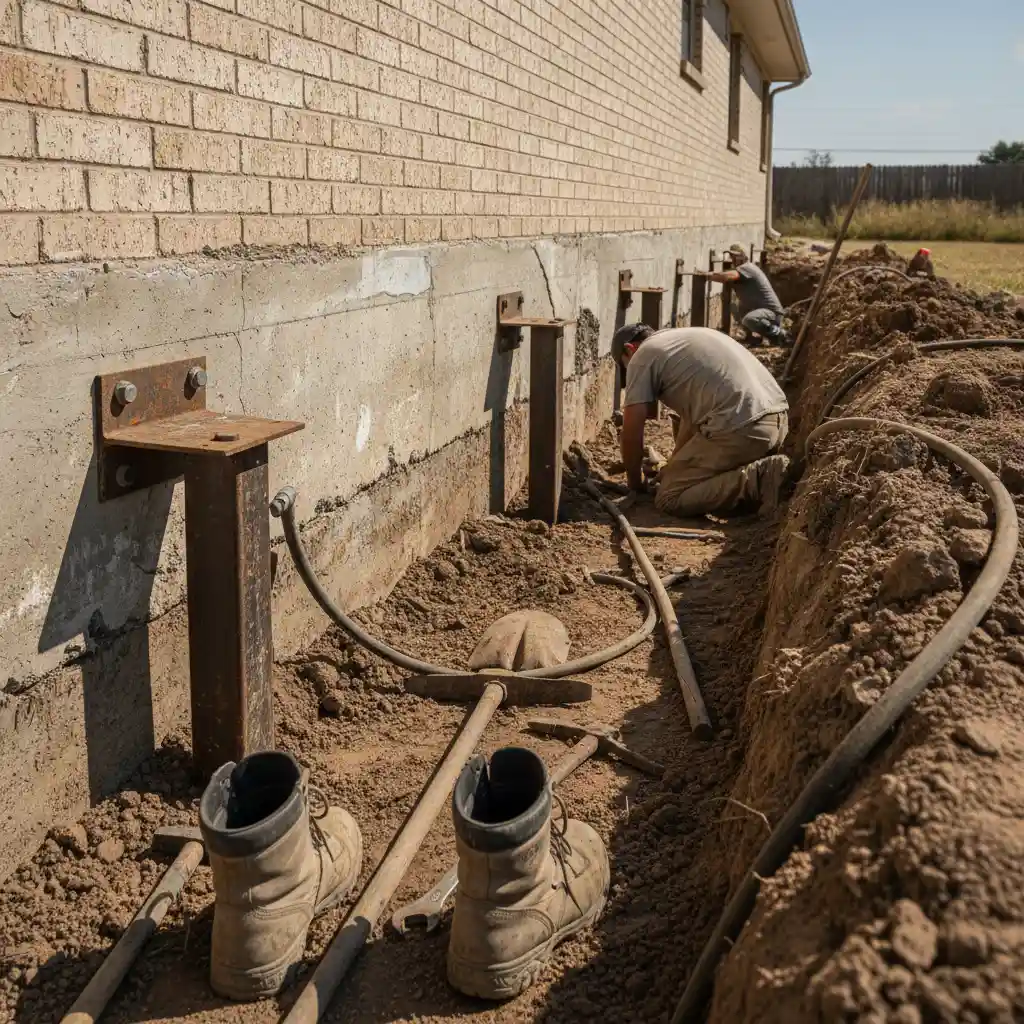
Our team in action — foundation-repair professionals serving Leander
Foundation Repair Methods We Use in Leander
Steel Push Piers
The most common structural repair solution for Leander homes experiencing settlement. Hydraulically driven steel pipe sections are pushed through unstable clay layers until they reach load-bearing Austin Chalk bedrock — typically at depths of 18 to 25 feet in most Leander neighborhoods. Steel push piers are ideal for exterior perimeter applications and can be installed with minimal disturbance to landscaping and hardscape.
Helical Piers
Helical piers use a screw-like steel shaft that is torque-driven into the ground rather than pushed. They are particularly well-suited for interior applications, new construction stabilization, and lighter structures such as porches, additions, and commercial outbuildings common in Leander’s growing commercial corridors along US-183 and SH-29.
Concrete Pressed Pilings
Pre-cast concrete cylinder pilings are pressed into the soil in sections. While less common than steel piers for deep bedrock applications, they can be appropriate for certain soil profiles in the Leander area and are a cost-effective option for specific project types.
Polyurethane Foam Injection (Slab Lifting)
For foundations experiencing void formation beneath the slab — particularly in areas where erosion or plumbing leaks have washed out supporting soil — expanding polyurethane foam is injected through small-diameter holes drilled in the slab. The foam fills voids, compacts loose soil, and lifts the slab back toward level. This method is especially useful in Leander’s newer neighborhoods where washout voids are discovered during routine inspection.
Interior Drainage and Moisture Management Systems
For properties in low-lying Leander areas near Brushy Creek tributaries or other drainage corridors, we install subsurface drainage systems to manage groundwater intrusion and prevent future soil saturation — one of the primary drivers of foundation instability in Leander’s clay-rich soils.
Ready for Structural Foundation Repair? Get Your Free Estimate Today.
Round Rock Foundation Repair Group serves Leander and the surrounding area — we’ll be on-site within 24 hours.
📞 Call (512) 220-3502Structural Foundation Repair Cost in Leander, TX
Understanding the cost of structural foundation repair in Leander requires a property-specific assessment, as no two foundations are identical. That said, we provide the following general ranges to help Leander homeowners plan and budget appropriately.
- Foundation Inspection: $200–$500 for a professional elevation survey and written assessment. Some companies offer free estimates; we recommend ensuring any inspection includes actual elevation measurements.
- Steel Push Pier Installation: $1,200–$1,800 per pier, installed. A typical Leander single-family home requires 8 to 16 perimeter piers, placing full project costs in the range of $9,600–$28,800 for pier work alone.
- Helical Pier Installation: $1,400–$2,000 per pier, depending on depth and torque requirements in Leander’s variable soil layers.
- Polyurethane Foam Slab Lifting: $2,000–$8,000 depending on the number and size of voids and the total area requiring treatment.
- Concrete Pressed Pilings: $600–$900 per piling, with typical projects requiring 10 to 20 pilings.
- Full Foundation Restoration (large homes or commercial): $25,000–$75,000+ for extensive underpinning, drainage, and structural repairs on larger Leander properties.
Leander-specific cost factors include the depth required to reach stable bedrock (deeper installations cost more), the presence of post-tension cables (which require specialized handling), accessibility constraints in newer high-density subdivisions, and the need for interior pier work under living spaces. Many homeowners in Leander also invest in concurrent drainage improvements, which add $1,500–$6,000 but significantly reduce the risk of future foundation movement. Learn more about foundation repair pricing
Leander Neighborhoods We Serve
Travisso
One of Leander’s newest master-planned communities, Travisso features homes built primarily from 2015 to the present on sloped terrain with significant cut-and-fill grading. Fill soil consolidation and differential settlement are common concerns within the first 5 to 10 years of construction. We are experienced with the post-tension slab foundations prevalent throughout Travisso and the specific drainage challenges created by the community’s hillside layout.
Crystal Falls
Established in the early 2000s, Crystal Falls is one of Leander’s most mature master-planned communities. Homes here are now entering their second decade, a period when expansive clay movement becomes most apparent. Stair-step brick cracking and interior door alignment issues are the most commonly reported symptoms. Many Crystal Falls homes require 10 to 14 piers for full perimeter stabilization.
Bryson
Bryson is a growing Leander community off Hero Way West with homes built from approximately 2016 onward. The neighborhood’s proximity to active drainage corridors and its mix of native and imported fill soils creates localized settlement risks. We adapt our pier depth recommendations based on soil boring data from this specific area.
Block House Creek Area
Older Leander neighborhoods near Block House Creek include homes from the 1980s and 1990s with conventional slab foundations that predate modern post-tension standards. These properties often show more advanced foundation distress and may require comprehensive repair programs combining pier installation with drainage improvements.
Foundation Maintenance Tips for Leander Homeowners
- Maintain consistent soil moisture: During Leander’s intense summer droughts — which can reach weeks without rain — use a soaker hose placed 12 to 18 inches from your foundation perimeter to prevent extreme clay shrinkage beneath the slab.
- Keep gutters clean and downspouts extended: Direct roof runoff at least 4 to 6 feet away from the foundation to prevent localized soil saturation during Leander’s storm events.
- Maintain positive lot grading: Ensure the ground slopes away from your home at a minimum of 6 inches over the first 10 feet — a standard that many Leander lots lose over time as soils settle and landscaping matures.
- Monitor and manage tree placement: Keep large trees — particularly live oaks and cedar elms native to Leander — at a distance at least equal to their mature canopy radius from your foundation.
- Address plumbing leaks promptly: A leaking water line or sewer line beneath your slab can erode supporting soil within weeks. Annual plumbing pressure tests are recommended for homes over 10 years old.
- Schedule annual foundation checks: A brief annual elevation check — especially after Leander’s wet spring and dry summer cycle — allows early detection of movement before it becomes structural damage.
- Avoid excessive watering near the foundation: Over-irrigation from sprinkler systems aimed at foundation-adjacent planting beds can cause localized soil heave, particularly problematic in Leander’s high-clay zones.
Why Choose Round Rock Foundation Repair Group for Leander Foundation Repair
Round Rock Foundation Repair Group has built its reputation by understanding the specific geological and environmental challenges that Central Texas homeowners face — and Leander is at the center of our service territory. We are not a national franchise applying generic repair templates. Every repair plan we develop is informed by hands-on experience with Leander’s clay soils, its drainage patterns, its specific neighborhood construction histories, and the way Williamson County’s seasonal weather cycles stress local foundations.
Our team brings specialized knowledge of both post-tension and conventional slab systems — critical in Leander, where the two foundation types are commonly found in adjacent homes. We work with licensed structural engineers when project complexity requires it, and we handle all permitting with the City of Leander’s Building and Development Services so you don’t have to navigate bureaucratic delays on your own.
We serve all of Leander and the surrounding communities, including Cedar Park, Round Rock, Georgetown, Austin, and many of the master-planned communities throughout Williamson County. View our full service area Our goal is simple: a stable, safe foundation and a Leander homeowner who sleeps better knowing the job was done right.
Call us at (512) 220-3502 to speak directly with a foundation specialist.
Frequently Asked Questions About Structural Foundation Repair in Leander, TX
How much does structural foundation repair cost in Leander, TX?
Costs vary widely based on the severity of damage, the number of piers required, and the method used. For a typical Leander single-family home, expect to invest between $9,000 and $25,000 for steel pier installation. Smaller repairs using polyurethane foam lifting may cost $2,000–$8,000. A professional inspection with elevation measurements is the only way to get an accurate estimate for your specific property.
How long does foundation repair take in Leander?
Most residential pier installations in Leander are completed within 1 to 3 days of active work, not counting the inspection and permitting phase (which typically takes 5 to 10 days). Larger projects on commercial properties or severely damaged foundations may require 1 to 2 weeks of installation time.
Will Leander’s clay soils cause my foundation to move again after repair?
Properly installed deep piers that reach stable Austin Chalk bedrock will not move with seasonal clay expansion and contraction. However, portions of the slab not supported by piers can still experience minor seasonal movement. This is why we also recommend moisture management practices and drainage improvements as part of any comprehensive Leander foundation repair program.
Is a permit required for foundation repair in Leander?
Yes. The City of Leander requires building permits for structural foundation repair work. Round Rock Foundation Repair Group handles all permit applications on your behalf and ensures all work is performed in compliance with Leander’s adopted building codes.
Can foundation repair be done on a post-tension slab?
Yes, but it requires specialized knowledge. Post-tension cables embedded in the slab must be located before any core drilling or pier installation. Our team has extensive experience working with post-tension foundations, which are extremely common throughout Leander’s Crystal Falls, Travisso, and Bryson neighborhoods.
How do I know if my Leander home needs foundation repair or just cosmetic patching?
Surface crack patching — filling cosmetic cracks without addressing underlying soil movement — is never a substitute for structural repair. The key distinction is whether your foundation is actively moving. An elevation survey will reveal differential settlement of more than 3/4 inch across a foundation footprint — the general threshold at which structural intervention is recommended. Cosmetic repairs only make sense after the underlying movement has been stabilized.
Does homeowner’s insurance cover foundation repair in Texas?
Most standard Texas homeowner’s insurance policies exclude foundation damage caused by soil movement, settling, or shrinkage — which covers the vast majority of Leander foundation problems. Damage caused by a sudden, specific event like a burst pipe may be covered. We can provide documentation of damage and repair scope to support any insurance claim you pursue.
How soon after the 2011 drought or other drought events should I have my foundation inspected?
Extreme drought events — like Leander’s record 2011 summer or the significant 2022 drought — can cause clay soils to shrink to unusual depths, potentially creating foundation movement that doesn’t fully manifest until rehydration occurs the following wet season. We recommend scheduling an inspection within 6 to 12 months after any significant multi-month drought period to catch movement before it accelerates.
Schedule Your Leander Foundation Inspection Today
Don’t let Leander’s expansive clay soils, seasonal droughts, or drainage challenges compromise the structural integrity of your home or commercial building. Round Rock Foundation Repair Group is ready to provide a thorough, honest assessment of your foundation’s condition — with no pressure and no guesswork.
We serve all of Leander, including Travisso, Crystal Falls, Bryson, and the surrounding Williamson County communities of Cedar Park, Round Rock, Georgetown, and Austin. Schedule your free consultation online or call us directly at (512) 220-3502. Our team is standing by to help you protect your most important investment with expert structural foundation repair you can trust.