Foundation Cracks in Georgetown, TX
Structural Foundation Cracks Specialists Serving Georgetown, TX
Expert foundation crack repair in Georgetown, TX. Round Rock Foundation Repair Group addresses clay soil settlement, slab cracks & more. Call (512) 220-3502 today.
- Licensed & Insured
- Locally Owned & Operated
- Free Inspection & Estimate
Request Your
Free EstimateFoundation cracks are fractures, separations, or breaks that develop in a home or building’s structural base — including slab foundations, pier-and-beam systems, and basement walls. In Georgetown, TX, these cracks are more than a cosmetic concern. The region’s expansive clay soils, dramatic seasonal rainfall swings, and the rapid development boom that has transformed Williamson County over the past two decades all contribute to elevated foundation stress that Georgetown homeowners face year after year.
Round Rock Foundation Repair Group specializes in diagnosing, repairing, and preventing foundation cracks across Georgetown and the surrounding Central Texas region. Our team understands the unique geological and environmental conditions that make Georgetown properties particularly vulnerable — from the Taylor Black Clay that underlies much of the eastern corridor to the limestone-heavy terrain near the San Gabriel River. Whether you’re dealing with hairline cracks or significant structural separation, we have the local expertise to provide lasting solutions.
Call us today at (512) 220-3502 to schedule your inspection.
Understanding Foundation Cracks in Georgetown, TX
Foundation cracks are among the most common — and most misunderstood — structural issues affecting residential and commercial buildings throughout Central Texas. At the most basic level, a foundation crack occurs when the soil beneath or around a structure shifts, settles unevenly, or exerts differential pressure against the foundation. This movement creates tension or compression forces that the concrete or masonry simply cannot absorb, resulting in visible fractures.
Not all foundation cracks are created equal. Engineers and foundation repair specialists classify them by orientation, width, depth, and activity level. Hairline cracks — those under 1/16 of an inch — are often the result of normal concrete curing shrinkage and may require only monitoring. Horizontal cracks, especially in block or poured concrete walls, frequently indicate lateral soil pressure and are generally considered the most structurally serious category. Diagonal cracks radiating from corners of windows and doors typically point to differential settlement, meaning one part of the foundation is sinking faster than another. Vertical and stair-step cracks in brick veneer or block foundations often signal seasonal soil movement rather than catastrophic failure, but still require professional evaluation.
Georgetown’s building stock tells a story of explosive growth. The city’s population grew from approximately 28,000 residents in 2000 to over 86,000 by 2023, making it one of the fastest-growing cities in the United States. This boom produced an enormous variety of construction types across a compressed timeline: 1970s and 1980s brick-veneer ranch homes in established neighborhoods like Berry Creek and the Old Town historic district, 1990s and early 2000s tract construction in Sun City Texas and Serenada, and post-2010 high-density development in areas like Wolf Ranch and Morningstar. Each era and style of construction presents its own foundation vulnerability profile, and Georgetown’s varied soil conditions mean that even adjacent homes can experience dramatically different foundation behavior.
Pier-and-beam foundations, common in older Georgetown homes built before 1970, develop cracks differently than post-tension or conventionally reinforced concrete slab foundations that dominate newer construction. Understanding which system your home uses is the essential first step in any competent crack assessment.
Why Foundation Cracks Are a Persistent Problem in Georgetown, TX
Expansive Taylor Black Clay and Austin Chalk
The most significant driver of foundation cracking in Georgetown is the soil itself. Eastern Georgetown and much of the Williamson County lowland corridor are underlain by Taylor Black Clay — one of the most problematic soil types in North America for structural foundations. This clay is classified as highly expansive, with a plasticity index frequently exceeding 40. When saturated, Taylor Black Clay can expand by as much as 30–40% of its dry volume, exerting upward and lateral pressures that can exceed 10,000 pounds per square foot — far beyond what most residential slabs are designed to resist. Conversely, during drought conditions, this same clay shrinks dramatically, leaving voids beneath slabs that can cause sudden, uneven settlement. Western Georgetown transitions to Austin Chalk limestone, which drains more predictably but presents its own challenges including dissolution cavities and highly variable bearing capacity.
Georgetown’s Rainfall Extremes
Georgetown averages approximately 33–35 inches of rainfall annually, but the distribution is the problem — not the total. Central Texas weather is characterized by prolonged drought periods punctuated by intense rainfall events. The May 2015 Memorial Day floods dropped over 11 inches of rain in a 24-hour period across Williamson County, saturating soils that had been in drought conditions for months. This rapid wet-dry cycling is the single most damaging hydrological pattern for expansive clay foundations. The 2011 Texas drought — the driest one-year period on record for many Central Texas stations — caused soil shrinkage so severe that foundation distress calls across Georgetown increased by an estimated 40% in the 12 months following the drought’s peak.
The Georgetown Development Boom and Construction Quality Variation
Georgetown’s rapid growth has not always been matched by uniform construction quality. Neighborhoods like Wolf Ranch (developed heavily after 2015), Morningstar (post-2018), and Parkside on the River (post-2019) were built quickly on land that had not always been adequately characterized for soil conditions. Post-tension slab foundations — now standard in new Georgetown construction — perform well when properly designed for local soil plasticity indices, but engineering shortcuts during high-volume building periods have left some homes in these communities with undersized slabs or inadequate stiffening beam depths. Sun City Texas, the large active-adult community in northwest Georgetown developed by Del Webb starting in 1995, encompasses over 9,000 homes built over multiple construction phases, each with slightly different foundation specifications — creating a patchwork of foundation performance across the community.
Tree Root Intrusion and Irrigation Patterns
Georgetown’s older neighborhoods, particularly around the historic downtown square and the Southwestern University campus area, feature mature live oak and cedar elm trees whose root systems can extend 2–3 times the tree’s canopy radius. These roots preferentially extract moisture from the soil directly beneath and adjacent to foundations, creating localized desiccation zones that cause differential settlement. In newer developments, aggressive irrigation of lawns and landscaping can have the opposite effect — over-saturating soils on one side of a home while the opposite side remains dry, inducing the same differential movement.
Signs You Need Foundation Crack Repair in Georgetown
Exterior Warning Signs
- Visible cracks in brick veneer, particularly stair-step patterns along mortar joints wider than 1/8 inch
- Separation between the brick and window or door frames exceeding 1/4 inch
- Cracks in the concrete slab perimeter visible along the exterior grade line
- Chimney leaning or separating from the main structure
- Gaps forming between the exterior wall and the roofline or soffit
Interior Warning Signs
- Diagonal cracks running from the corners of door frames or window openings toward the ceiling
- Doors and windows that stick, won’t latch, or have developed visible gaps in their frames
- Cracks in drywall — particularly those wider than a hairline or that reopen after patching
- Uneven or sloping floors detectable by placing a marble on the floor and watching it roll
- Cracks in tile flooring or grout lines separating without impact damage
Basement and Crawl Space Signs
- Horizontal cracks in foundation walls — treat these as urgent
- White mineral deposits (efflorescence) indicating ongoing water infiltration through cracks
- Sagging or bouncy floors above crawl spaces
Urgency Note: Horizontal foundation cracks, cracks wider than 1/2 inch, or any crack accompanied by sudden door or window failure should be evaluated within 48–72 hours. Do not delay on these indicators.
Our Foundation Crack Repair Process in Georgetown
Initial Consultation and Scheduling (Day 1)
When you call Round Rock Foundation Repair Group at (512) 220-3502, our Georgetown-familiar intake team will ask targeted questions about your home’s age, construction type, and the specific cracks you’ve observed. We schedule inspections typically within 2–5 business days, with expedited slots available for urgent situations.
Comprehensive On-Site Inspection (2–4 Hours)
Our inspection process goes well beyond a visual walk-around. We use manometer-based floor elevation surveys to map differential settlement to within 1/8-inch accuracy across your entire slab. We document every crack with photography, measure width and length, and probe for depth. We assess soil conditions at accessible exterior grade locations, review your drainage patterns, and evaluate irrigation system placement — all factors that are especially critical given Georgetown’s clay soil profile.
Soil and Engineering Assessment (1–3 Days)
For significant cracks or complex cases, we coordinate with licensed geotechnical engineers familiar with Georgetown’s Taylor Black Clay and Austin Chalk formations. This step ensures our repair recommendations are grounded in the actual soil behavior beneath your specific property — not generic regional assumptions.
Customized Repair Proposal (1–2 Days)
We provide a detailed written proposal specifying repair methods, materials, number and placement of any piers or underpinning, and projected timeline. We explain why each recommendation applies to your Georgetown home’s specific conditions.
Repair Execution (1–5 Days Depending on Scope)
Our crews mobilize with Georgetown-specific equipment setups. Simple crack injection projects may complete in a single day. Multi-pier underpinning projects typically require 2–4 days. We coordinate all necessary permits with the City of Georgetown Building Inspections Division and schedule required inspections.
Post-Repair Elevation Verification
After all repairs, we re-survey floor elevations and document the results against our pre-repair baseline. This gives you objective evidence of improvement.
Drainage and Maintenance Guidance
We walk through site-specific drainage and irrigation recommendations tailored to your Georgetown neighborhood’s soil type before closing out your project.
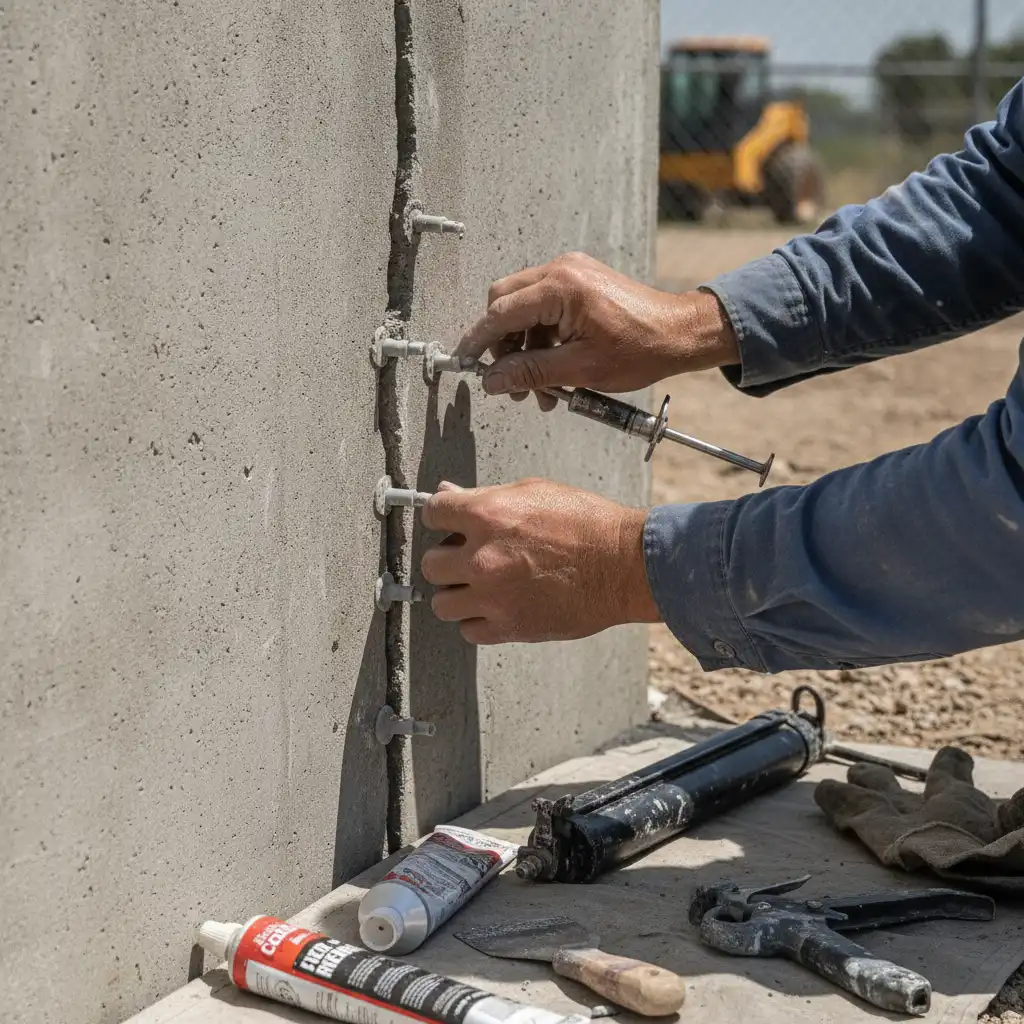
Our team in action — foundation-repair professionals serving Georgetown
Foundation Crack Repair Methods We Use in Georgetown
Epoxy and Polyurethane Crack Injection
For non-structural hairline to medium-width cracks in concrete slabs and poured walls, epoxy injection bonds the crack faces with a compound stronger than the surrounding concrete. Polyurethane foam injection is preferred for cracks with active water infiltration, as it expands and seals even in wet conditions. These methods are commonly used in Georgetown’s post-2000 slab homes where settlement has stabilized but cracks remain unsealed.
Steel Push Pier Underpinning
When differential settlement is the root cause of cracking, surface-level crack repair alone is inadequate. Steel push piers are hydraulically driven through unstable clay layers to reach load-bearing bedrock or dense strata — in Georgetown’s eastern zones, this often means penetrating 15–25 feet through Taylor Black Clay before reaching competent Austin Chalk. Once in place, the structure’s load transfers to the piers, often allowing partial to full lifting of settled sections.
Helical Pier Systems
For lighter structures, additions, porches, or areas with limited access, helical piers offer an efficient alternative. Their screw-like installation creates less vibration — an important consideration in Georgetown’s historic downtown district where adjacent structures may be sensitive to installation impacts.
Carbon Fiber Strap Reinforcement
Horizontal cracks in foundation walls indicating lateral soil pressure are stabilized using carbon fiber straps bonded to the interior wall face. These high-tensile straps prevent further inward movement without requiring excavation — a significant advantage in established Georgetown landscapes.
Slabjacking and Foam Lifting
For interior slab voids or settled concrete flatwork such as driveways and sidewalks, polyurethane foam injection lifts and stabilizes the slab from below. This method is minimally invasive and cures within 15 minutes, making it practical for occupied Georgetown homes.
Ready for Foundation Cracks? Get Your Free Estimate Today.
Round Rock Foundation Repair Group serves Georgetown and the surrounding area — we’ll be on-site within 24 hours.
📞 Call (512) 220-3502Foundation Crack Repair Cost in Georgetown, TX
One of the most common questions Georgetown homeowners ask is: “What will foundation crack repair cost?” The honest answer is that costs vary significantly based on crack severity, root cause, foundation type, and required repair method. Below are realistic ranges based on current Central Texas market conditions.
Typical Cost Ranges
- Crack Inspection: $200–$500 for a professional inspection with elevation survey. Many contractors credit this toward repair costs.
- Epoxy or Polyurethane Crack Injection: $500–$2,500 per project depending on crack count and linear footage.
- Carbon Fiber Wall Reinforcement: $1,000–$3,500 per strap installation location.
- Steel Push Pier Installation: $1,200–$1,800 per pier installed, with most Georgetown residential projects requiring 6–14 piers ($7,200–$25,200 typical range).
- Helical Pier Installation: $1,500–$2,500 per pier.
- Full Foundation Restoration (Complex Cases): $15,000–$50,000+ for extensive settlement with multiple repair methods required.
Georgetown-Specific Pricing Factors
Georgetown’s Taylor Black Clay soils often require piers to be driven deeper than in other Central Texas markets, increasing per-pier material and labor costs by 10–20% compared to areas with shallower competent bearing layers. Homes in Georgetown’s historic overlay district may require additional review coordination. Post-tension slab repair requires specialized cutting and re-tensioning equipment that adds to project costs compared to conventionally reinforced slabs.
Most foundation repair companies, including Round Rock Foundation Repair Group, offer financing options. We encourage you to get 2–3 written estimates and compare scope, not just price. Call (512) 220-3502 for a detailed, no-obligation quote.
Georgetown Neighborhoods We Serve
Sun City Texas
This massive active-adult community in northwest Georgetown features over 9,000 homes built in multiple phases from 1995 through the 2010s. Homes in earlier phases — particularly those built in the late 1990s — often have foundation specifications that predate updated Williamson County soil studies. We frequently address diagonal corner cracking and differential settlement in this community. Sun City Texas Foundation Repair
Berry Creek and Georgetown Village
These established neighborhoods feature homes primarily built in the 1990s and early 2000s. Their mature landscaping, including large live oak trees, makes root-induced differential desiccation a recurring foundation crack driver. Stair-step brick cracking is the most common presentation we see here.
Wolf Ranch and Morningstar
These high-growth post-2015 master-planned communities are built predominantly on post-tension slabs. Despite their relative youth, we are already seeing settlement-related cracking in some areas, likely related to inadequate soil preparation during rapid construction phases. Wolf Ranch Foundation Repair
Historic Downtown Georgetown
The blocks surrounding Georgetown’s historic square include structures dating to the late 1800s and early 1900s, many with unreinforced masonry or rubble stone foundations. These require specialized restoration approaches rather than standard modern repair methods.
Foundation Crack Prevention and Maintenance Tips for Georgetown Homeowners
- Maintain Consistent Soil Moisture Year-Round: In Georgetown’s climate, the most damaging condition is rapid moisture change. Use a soaker hose system around your foundation perimeter during dry periods to prevent clay shrinkage, maintaining soil at arm’s-length distance from the foundation.
- Grade Your Yard Away From the Foundation: Maintain a slope of at least 6 inches of drop over the first 10 feet from your foundation. Georgetown’s clay soils do not absorb water quickly — proper grading prevents ponding.
- Clean Gutters Seasonally: Georgetown receives intense spring and fall rainstorms. Clogged gutters overflow directly against the foundation, saturating one zone while others remain dry.
- Manage Trees Strategically: Keep large live oaks and cedar elms trimmed, and avoid planting large-canopy trees within 20 feet of your foundation slab edge.
- Inspect Plumbing Annually: In slab-on-grade homes, plumbing leaks beneath the slab are a leading cause of localized soil saturation and heave. Annual plumbing pressure tests can catch leaks before they cause structural damage.
- Monitor Irrigation Systems: Adjust seasonal irrigation schedules — Georgetown’s hot summers require more water, but over-irrigation against one foundation edge causes differential heave.
- Schedule Professional Inspections Every 3–5 Years: Proactive monitoring catches early-stage cracks before they become costly structural repairs.
Why Choose Round Rock Foundation Repair Group for Georgetown Foundation Cracks
Round Rock Foundation Repair Group brings deep, locally grounded expertise to every foundation crack project in Georgetown. Our crews work daily in the specific soil conditions — Taylor Black Clay, Austin Chalk transitions, San Gabriel River bottomland soils — that define Georgetown’s foundation challenges. We don’t apply cookie-cutter solutions; we engineer repairs based on your property’s actual soil behavior and construction type.
We serve Georgetown homeowners across every neighborhood, from the historic downtown district to the newest master-planned communities in the city’s rapidly expanding western and southern corridors. Our team coordinates directly with the City of Georgetown Building Inspections Division for all permitted work, ensuring your repair is properly documented for future resale.
We provide detailed written proposals so you understand exactly what work will be performed and why. Our commitment to transparent communication means no surprise costs or scope changes without your explicit approval.
For foundation crack assessment and repair across Georgetown and the surrounding region, call Round Rock Foundation Repair Group at (512) 220-3502. Schedule Your Georgetown Foundation Inspection
Frequently Asked Questions: Foundation Cracks in Georgetown, TX
How much does foundation crack repair cost in Georgetown, TX?
Costs range from $500–$2,500 for simple crack injection projects to $7,200–$25,000+ for pier-based underpinning repairs addressing active settlement. Georgetown’s deep Taylor Black Clay often requires piers driven to greater depths than other markets, which can increase per-unit costs by 10–20%. A professional inspection is the only reliable way to determine your project’s actual cost.
Are foundation cracks in Georgetown homes normal?
Hairline shrinkage cracks in new concrete are common and generally not structurally significant. However, Georgetown’s expansive clay soils mean that many cracks represent genuine soil-movement events rather than simple curing artifacts. Any crack wider than 1/8 inch, any horizontal crack, or any crack that has changed size over time deserves professional evaluation.
How long does foundation crack repair take?
Simple crack injection projects are typically completed in one day. Pier installation projects for a typical Georgetown single-family home generally require 2–4 days of active construction. Post-repair monitoring periods before final sign-off may extend the overall timeline by a few weeks for complex cases.
Will my homeowner’s insurance cover foundation crack repair in Georgetown?
Standard Texas homeowner’s insurance policies (HO-B and HO-A forms) typically exclude foundation settlement and soil movement — the primary causes of foundation cracking in Georgetown. Damage caused by sudden plumbing leaks beneath a slab may be covered under some policies. Review your specific policy and consider consulting a public adjuster if you believe your cracking has a covered cause.
My Georgetown home was built after 2010 on a post-tension slab. Can it really have foundation crack problems this soon?
Yes. Georgetown’s rapid construction pace post-2010 coincided with land development on soils that weren’t always thoroughly characterized. Post-tension slabs are more crack-resistant than conventional slabs but are not immune — especially when soil preparation was inadequate or when the post-tension design didn’t account for the specific plasticity index of the site’s clay. We’ve evaluated numerous Wolf Ranch and Morningstar homes with measurable settlement within 5–8 years of construction.
What’s the difference between a structural foundation crack and a cosmetic one?
Structural cracks compromise the load-bearing capacity of the foundation or indicate active, ongoing movement. Cosmetic cracks affect appearance only, with no ongoing movement or structural compromise. In Georgetown’s clay soil environment, distinguishing between the two requires professional elevation survey data and crack monitoring — visual assessment alone is often insufficient.
Do you serve the Sun City Texas community in Georgetown?
Yes. Sun City Texas is one of our most active service areas in Georgetown. The community’s phased construction history and the varied foundation specifications across its 9,000+ homes mean foundation performance varies significantly block by block. We are very familiar with the most common crack patterns in this community. Learn More About Sun City Texas Foundation Repair
How do I know if my Georgetown foundation crack is getting worse?
Mark both ends of any visible crack with pencil marks and note the date. Check monthly for extension beyond your marks. Photograph the crack at the same angle and lighting conditions monthly. A crack that extends, widens, or develops vertical offset between its two faces over a 60–90 day monitoring period is actively progressing and warrants immediate professional evaluation.
Get Expert Foundation Crack Repair in Georgetown, TX Today
Foundation cracks don’t resolve on their own in Georgetown’s demanding clay soil environment — they evolve. The longer active settlement goes unaddressed, the more extensive and costly the repair becomes. Round Rock Foundation Repair Group is ready to provide a comprehensive, Georgetown-specific assessment of your foundation’s condition.
Call us now at (512) 220-3502 to speak with a Georgetown-area foundation specialist. We serve all Georgetown neighborhoods including Sun City Texas, Wolf Ranch, Berry Creek, Morningstar, Georgetown Village, and the historic downtown district, as well as surrounding communities throughout Williamson County and the greater Austin metro area.
Request Your Free Foundation Crack Assessment — fast scheduling, detailed written proposals, and local expertise you can trust.