Foundation Patching in Leander, TX
Structural Foundation Patching Specialists Serving Leander, TX
Need foundation patching in Leander, TX? Round Rock Foundation Repair Group fixes cracks, spalling & voids fast. Free estimates. Call (512) 220-3502 today.
- Licensed & Insured
- Locally Owned & Operated
- Free Inspection & Estimate
Request Your
Free EstimateFoundation patching is a targeted repair method that addresses localized cracks, voids, and deterioration in your home or commercial building’s foundation — restoring structural integrity before minor damage escalates into a major failure. In Leander, TX, where rapid population growth has pushed construction onto challenging expansive clay soils and drought-prone terrain, foundation patching has become an essential service for thousands of homeowners and business owners across Williamson County.
Round Rock Foundation Repair Group brings deep regional expertise to every foundation patching project in Leander. Our team understands the specific geological conditions, seasonal moisture swings, and construction practices that define this corner of Central Texas. Whether you’re dealing with hairline cracks along a poured concrete slab or spalling concrete block damage in an older ranch-style home, we deliver precise, lasting repairs tailored to what Leander’s land and climate actually demand. Call us today at (512) 220-3502 to schedule a professional assessment.
Understanding Foundation Patching
Foundation patching refers to the process of filling, sealing, and reinforcing damaged sections of a building’s foundation without requiring full foundation replacement. It is a targeted intervention — one that addresses discrete problem areas such as horizontal or vertical cracks, spalled concrete surfaces, eroded mortar joints in block foundations, and voids created by soil settlement beneath the slab.
Historically, foundation patching techniques evolved alongside concrete construction. Early 20th-century builders relied on simple cement mortars to fill cracks, but modern patching now incorporates polyurethane foams, epoxy injection systems, hydraulic cements, and carbon fiber reinforcements. These advances allow repair specialists to not only fill a crack but restore it to near-original load-bearing capacity, prevent water infiltration, and stop progressive widening.
In Leander, the majority of residential construction consists of post-tensioned concrete slabs, which became the dominant foundation type in Central Texas beginning in the 1980s and accelerating through the 2000s and 2010s as the city grew from a quiet railroad town into one of the fastest-growing cities in the United States. The Texas Association of Builders and local Williamson County building records reflect a construction boom that brought tens of thousands of slab-on-grade homes to neighborhoods such as Crystal Falls, Travisso, and Bryson — all built on soils that expand and contract significantly with moisture changes.
Older homes in Leander’s original townsite area, some built in the 1950s and 1960s, may feature pier-and-beam or concrete block foundations that present different patching challenges, including mortar joint deterioration and wood rot near concrete interfaces. Commercial properties along Highway 183 and Ronald Reagan Boulevard include tilt-wall and reinforced concrete structures where crack patching and joint sealing are critical to maintaining both structural performance and code compliance.
Foundation patching is most effective when performed early — addressing problems while they remain localized rather than waiting for cracks to migrate across an entire foundation system. Schedule a Foundation Inspection to determine whether patching alone will resolve your specific situation.
Why Foundation Patching Is Needed in Leander, TX
Expansive Clay Soils: The Austin Chalk and Taylor Marl Problem
Leander sits at the geological boundary between the Austin Chalk formation and the Taylor Marl, two formations that underlie most of Williamson County. The Taylor Marl in particular contains highly expansive Vertisol clay soils — often called “black land prairie” soils — that can swell by 15% to 30% in volume when saturated and shrink dramatically during drought. The Texas A&M AgriLife Extension Service has documented shrink-swell values in Williamson County clays among the highest in the state. When the foundation soil expands unevenly, sections of the slab heave upward. When it contracts, voids form beneath concrete, causing the slab to crack and settle.
Recurring Drought and Flash Flood Cycles
The Central Texas climate delivers extreme moisture swings that are particularly destructive to foundations. The 2011 Texas drought — one of the most severe on record — caused widespread foundation cracking across Leander, Cedar Park, and Round Rock as clay soils lost moisture and contracted sharply. Many residents in subdivisions such as Summerlyn and Mason Hills first noticed diagonal stair-step cracks in brick veneer and interior sheetrock separations during that summer, when Williamson County received less than 50% of its average annual rainfall. Conversely, extreme rainfall events like those associated with Hurricane Harvey remnants in August 2017 and the 500-year flood events of 2015–2016 saturated soils rapidly, causing differential swelling that produced foundation heave in low-lying Leander neighborhoods near Brushy Creek tributaries.
Tree Root Intrusion and Moisture Competition
Many established Leander neighborhoods feature mature live oak and cedar elm trees planted within 10 to 15 feet of home foundations. These trees extract enormous amounts of moisture from clay soils — a single mature live oak can transpire up to 100 gallons of water per day — creating localized dry zones beneath foundation edges that lead to differential settlement and cracking.
Rapid Development and Variable Site Preparation
The speed of Leander’s development boom — particularly in master-planned communities like Crystal Falls, Travisso, and Bryson developed between 2005 and 2020 — occasionally resulted in insufficient soil compaction or inadequate moisture conditioning prior to slab pours. Homes built during these high-demand periods sometimes show early settlement cracking within just five to ten years of construction, making timely foundation patching especially important for residents in these newer subdivisions.
Aging Infrastructure in Original Leander
In older sections of Leander near the original townsite along South Highway 183 and West Crystal Falls Parkway, plumbing infrastructure dates to the 1970s and earlier. Leaking water and sewer lines — particularly cast-iron pipes that corrode over decades — introduce uncontrolled moisture beneath foundations, accelerating clay swelling and foundation damage in ways that require both plumbing repair and foundation patching to fully resolve.
Signs You Need Foundation Patching in Leander
Interior Warning Signs
- Diagonal cracks running from door and window corners at 45-degree angles through drywall
- Doors and windows that stick, jam, or no longer latch properly — especially interior hollow-core doors
- Visible gaps between wall surfaces and ceiling or floor trim
- Uneven or sloping floors measurable with a standard level, particularly in open living areas
- Cracks in ceramic tile grout lines running diagonally across kitchen or bathroom floors
Exterior Warning Signs
- Stair-step cracking in brick mortar joints along exterior walls — common in Leander homes with full brick or brick-veneer exteriors
- Horizontal cracks in poured concrete foundation walls greater than 1/8 inch in width
- Visible gaps between the foundation slab and the bottom course of brick
- Concrete spalling or flaking on exposed foundation surfaces
- Water staining or efflorescence (white mineral deposits) on foundation walls indicating moisture infiltration
Urgent Indicators Requiring Immediate Attention
- Cracks wider than 1/4 inch or cracks that are widening progressively over weeks or months
- Foundation cracks accompanied by a musty odor indicating active water intrusion
- Structural cracking visible in load-bearing walls or near the center of the home
If you observe any of these symptoms, request a foundation inspection promptly. Early patching costs a fraction of full structural foundation repair.
Our Foundation Patching Process in Leander, TX
Round Rock Foundation Repair Group follows a systematic, proven process designed specifically for Leander’s soil conditions, climate patterns, and construction types. Here is what to expect from start to finish:
Comprehensive Foundation Inspection (Day 1 — 2 to 3 Hours)
Our certified inspector performs a full interior and exterior evaluation of your foundation, documenting crack locations, widths, orientations, and any related symptoms such as floor slopes or door misalignment. We use digital measurement tools and, where appropriate, perform a moisture probe assessment of soils around the perimeter to identify areas of abnormal dryness or saturation — a critical step given Leander’s clay soil variability.
Soil and Site Assessment (Day 1 — Concurrent with Inspection)
We evaluate the grading around your home, the condition and proximity of trees, gutter downspout discharge points, and any visible signs of plumbing leaks. In Leander, we pay particular attention to whether the property sits on the Taylor Marl formation’s more expansive clay bands, which influences our patching material selection.
Repair Recommendation and Proposal (Day 1 to Day 3)
Within 48 hours of the inspection, we provide a written report with recommended patching methods, material specifications, and a detailed cost estimate. We explain clearly what the patching will and will not address, and whether any additional work — such as crawl space repair or drainage improvement — is advisable.
Site Preparation (Repair Day, 30 to 60 Minutes)
Our crew clears the work area, protects adjacent surfaces, and prepares cracks or voids by cleaning out loose debris, dust, and deteriorated material using compressed air and specialized wire brushing. Proper preparation is non-negotiable — patching materials bond only to clean, sound concrete.
Patching Application (Repair Day, 2 to 6 Hours Depending on Scope)
We apply the appropriate patching system — epoxy injection, polyurethane foam, hydraulic cement, or carbon fiber reinforcement — according to the crack type and moisture conditions present. For Leander’s seasonally dry conditions, we often use two-part epoxy systems that penetrate deeply into concrete substrate and cure to a strength exceeding that of the original concrete.
Curing and Quality Check (Same Day to 24 Hours)
We verify cure progress, test adhesion, and perform a final visual inspection before clearing the site. Most patching systems reach workable strength within 4 to 8 hours and full cure within 24 to 72 hours.
Post-Repair Documentation and Maintenance Guidance
We provide written documentation of all work performed and deliver a customized maintenance checklist addressing Leander-specific concerns such as soil moisture management during dry summers and proper tree-to-foundation spacing guidance.
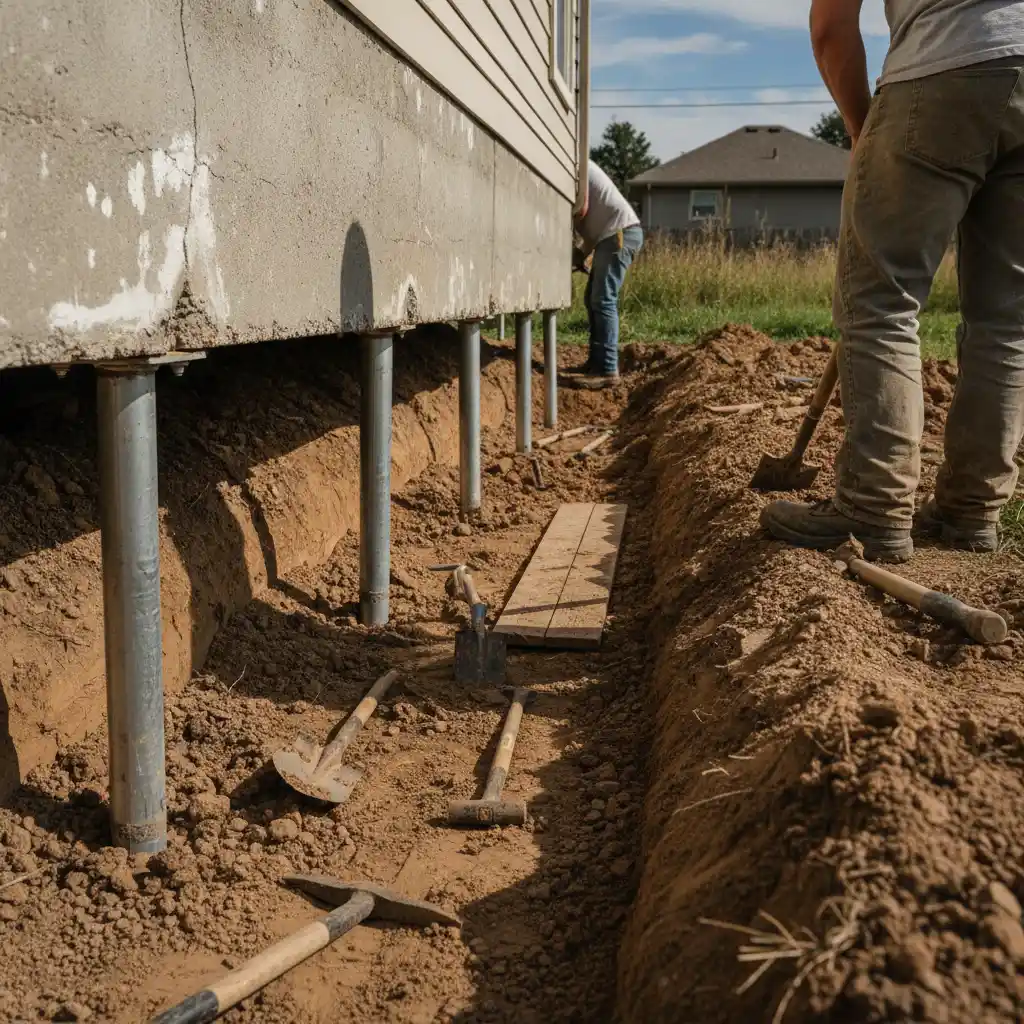
Our team in action — foundation-repair professionals serving Leander
Foundation Patching Methods and Approaches
Epoxy Injection
Epoxy injection is used for structural cracks in poured concrete slabs and walls where restoring tensile strength is the primary goal. Two-part epoxy resin is injected under low pressure into cracks as narrow as 0.002 inches, bonding crack faces together and creating a repair stronger than the surrounding concrete. This is the preferred method for dormant cracks in Leander’s post-tensioned slabs that have stabilized after a drought cycle.
Polyurethane Foam Injection
Polyurethane foam is used for cracks or voids that are actively leaking water or subject to ongoing minor movement. The foam expands to fill irregular voids and creates a flexible, waterproof seal. It is particularly useful for Leander homes near Brushy Creek drainage corridors where seasonal moisture movement continues to affect soil volumes after repair.
Hydraulic Cement Patching
Hydraulic cement is applied to surface spalling, eroded areas, and larger void patches, particularly in older Leander homes with concrete block or conventional poured-wall foundations. It sets rapidly even in the presence of moisture — important during Leander’s spring rain season.
Carbon Fiber Strap Reinforcement
For horizontal or bowing foundation wall cracks that indicate lateral soil pressure, carbon fiber straps are bonded across the crack face to prevent further inward movement. This method is used in structural foundation repair applications where patching alone is insufficient to arrest movement.
Slab Void Filling with Foam Lifting
When soil voids have formed beneath sections of the slab — common in Leander properties that experienced soil shrinkage during the 2011 or 2022 droughts — we can inject expanding polyurethane foam beneath the slab to fill voids and provide renewed sub-slab support prior to surface crack patching.
Ready for Foundation Patching? Get Your Free Estimate Today.
Round Rock Foundation Repair Group serves Leander and the surrounding area — we’ll be on-site within 24 hours.
📞 Call (512) 220-3502Foundation Patching Cost in Leander, TX
One of the most common questions we receive is: What does foundation patching cost in Leander? The honest answer is that costs vary considerably based on the extent and type of damage, the method required, and site-specific factors. Here is a realistic breakdown to help you budget:
Typical Cost Ranges
- Minor crack patching (1 to 3 hairline cracks, epoxy injection): $300 – $800
- Moderate crack repair (multiple cracks, surface spalling, hydraulic cement): $800 – $2,500
- Polyurethane foam injection for active water leaks: $500 – $1,500 per area
- Carbon fiber strap installation for bowing walls: $1,200 – $3,500 per strap location
- Comprehensive patching with void filling and multiple methods: $2,500 – $6,000+
Factors That Affect Foundation Patching Cost in Leander
- Number and length of cracks: Each linear foot of crack requiring injection adds to material and labor costs.
- Crack activity: Active or widening cracks require more comprehensive treatment than dormant cracks.
- Foundation type: Post-tensioned slabs common in Leander’s newer neighborhoods require careful material selection to avoid interfering with tension cables.
- Accessibility: Cracks beneath finished flooring, in tight garage corners, or along landscaped foundation edges take more labor time.
- Underlying cause: If a plumbing leak or drainage problem is contributing to foundation movement, those issues must be addressed alongside patching.
Foundation patching is nearly always significantly less expensive than full concrete foundation repair or pier installation, which can range from $8,000 to $30,000 or more in the Leander market. Early intervention through patching protects your investment. Call (512) 220-3502 for a free on-site estimate.
Leander Neighborhoods We Serve
Crystal Falls
Crystal Falls is one of Leander’s largest and most established master-planned communities, with homes built primarily between 2000 and 2015. Properties here sit on terrain with significant elevation changes and clay-heavy soils in the lower sections near Crystal Falls Parkway. We frequently address diagonal slab cracking and brick veneer separation in homes built during the mid-2000s construction rush in this neighborhood.
Travisso
Travisso is a newer upscale community developed from approximately 2015 onward on the western hillside terrain of Leander. The rocky limestone substrate transitions to clay-laden fill in many lots, creating mixed foundation behavior. Homes here are generally on post-tensioned slabs and benefit from early patching to prevent cosmetic cracks from deepening.
Bryson
Bryson is among Leander’s most recently developed large communities, with construction ongoing through the early 2020s. Some homeowners in Bryson have reported early settlement cracking within the first five years of ownership — a pattern consistent with soil consolidation on heavily developed clay terrain near Ronald Reagan Boulevard.
Summerlyn
Summerlyn’s affordable single-family homes, many built between 2005 and 2012, saw notable foundation stress during the 2011 drought. We provide ongoing home foundation repair and patching services throughout this neighborhood, and many Summerlyn residents benefit from our seasonal maintenance programs.
Foundation Maintenance Tips for Leander Homeowners
Preventing foundation damage in Leander requires active year-round maintenance given the city’s extreme climate swings. Follow these location-specific tips:
- Maintain consistent soil moisture: During Leander’s hot, dry summers — which can produce weeks of 100°F+ temperatures — use a soaker hose system placed 12 to 18 inches from your foundation perimeter to prevent clay soil from drying and contracting beneath slab edges.
- Ensure positive drainage away from the foundation: Grade soil so it slopes at least 6 inches downward over the first 10 feet away from your foundation. Leander’s clay soils pond water easily, and standing water against the foundation causes differential swelling.
- Maintain gutters and downspouts: Extend downspouts at least 5 feet from the foundation. Given Leander’s intense spring thunderstorm season, blocked gutters can dump thousands of gallons directly against the foundation in a single storm.
- Monitor large trees: Keep live oaks, cedar elms, and other mature trees at least 15 to 20 feet from your foundation, or install root barriers to redirect moisture-seeking roots.
- Inspect foundation perimeter seasonally: Check exposed foundation surfaces each spring and fall for new cracks, efflorescence, or soil pulling away from the foundation edge.
- Address plumbing leaks immediately: In older Leander sections, annual plumbing pressure tests can catch slow leaks before they saturate sub-slab soils.
- Avoid excessive mulch against the foundation: Deep mulch beds trap moisture and create uneven soil saturation zones along foundation edges.
Why Choose Round Rock Foundation Repair Group for Foundation Patching in Leander
Round Rock Foundation Repair Group has built its reputation across Williamson County and the greater Austin metro by delivering technically precise, honestly priced foundation repairs that address the real, underlying causes of damage — not just the surface symptoms. We are not a nationwide franchise applying generic solutions; we are a regional team that understands the Taylor Marl clays beneath Crystal Falls, the limestone-to-clay soil transitions in Travisso, and the drainage challenges along Brushy Creek corridors.
Our technicians are trained in both traditional concrete repair methods and modern epoxy and polyurethane injection systems. We carry full liability insurance and maintain all required Texas contractor qualifications for structural repair work. We serve Leander as part of our broader Central Texas territory that includes Cedar Park, Round Rock, Georgetown, Austin, and surrounding communities.
When you call us, you speak directly with a knowledgeable local representative — not an overseas call center. We arrive on time, explain our findings clearly, and price our work fairly. For foundation patching in Leander, TX, Round Rock Foundation Repair Group is the team your neighbors trust. Contact us at (512) 220-3502.
Frequently Asked Questions: Foundation Patching in Leander, TX
How much does foundation patching cost in Leander, TX?
Foundation patching in Leander typically ranges from $300 for a simple single-crack epoxy injection to $6,000 or more for comprehensive repairs involving multiple methods across a heavily damaged foundation. The wide range reflects differences in crack severity, foundation type, and the specific patching method required. We provide free on-site estimates so you receive an accurate price for your specific situation.
Is foundation patching a permanent fix?
When the underlying cause of cracking has been stabilized — whether through drainage improvements, moisture management, or soil remediation — properly performed epoxy injection and hydraulic cement patching can be permanent. However, if the soil movement causing the cracks continues, new cracking may develop over time. That is why our process includes a root-cause assessment alongside the patching work itself.
How long does foundation patching take in Leander?
Most residential foundation patching projects in Leander are completed in a single day. Minor crack injections may take as little as two to three hours. Larger projects involving multiple methods across extensive foundation areas may require two days. You can typically resume normal home use within 24 hours of most patching applications.
Will Leander’s summer heat affect the patching materials?
Yes — extreme heat can accelerate the cure time of certain epoxy systems and affect surface preparation. Our technicians schedule work for early morning hours during Leander’s peak summer months and select heat-appropriate material formulations. Properly installed patches perform reliably across Leander’s full temperature range, from winter lows near freezing to summer highs above 105°F.
My home is in Crystal Falls and I noticed cracks after the 2022 drought. Is patching enough?
The severe drought conditions across Williamson County in 2022 caused significant soil moisture loss and foundation movement in many Crystal Falls homes. Whether patching alone is sufficient depends on whether the cracks have since stabilized. Our inspection process includes monitoring crack widths and soil moisture levels to determine if movement is ongoing. If cracks are dormant and soils have re-stabilized, epoxy patching is highly effective. If movement is continuing, we may recommend additional structural foundation repair measures alongside patching.
Can I patch foundation cracks myself?
Hardware store crack fillers and hydraulic cement compounds are available for DIY application, but they address cosmetic appearance only — they do not restore structural continuity or prevent water infiltration as effectively as professional-grade two-part epoxy or polyurethane injection systems. More importantly, DIY patching without a professional assessment may mask symptoms of a more serious underlying problem. We recommend a professional inspection before any patching, even if you intend to handle minor cosmetic repairs yourself.
Do you serve neighborhoods near Leander, such as Cedar Park or Brushy Creek?
Yes. Round Rock Foundation Repair Group provides foundation patching and home foundation repair throughout the greater Leander area, including Cedar Park, Brushy Creek, Avery Ranch, Anderson Mill, Round Rock, Georgetown, Pflugerville, Austin, and all surrounding communities. We are familiar with the soil and construction conditions across this entire region.
What is the difference between foundation patching and full foundation repair?
Foundation patching targets specific, localized areas of damage — individual cracks, spalled surfaces, or small voids — without altering the overall position or support system of the foundation. Full structural foundation repair typically involves installing piers or piles to lift and re-level a settled foundation, which is necessary when the entire foundation has shifted from its original position. Patching is appropriate when the foundation is essentially level and stable but has developed localized cracks or surface deterioration.
Get Expert Foundation Patching in Leander, TX Today
Don’t let a small crack become a costly structural problem. The expansive clay soils, seasonal drought cycles, and rapid development history of Leander, TX make early foundation attention essential for every homeowner and commercial property owner in this community. Round Rock Foundation Repair Group is ready to assess your foundation, provide an honest evaluation, and deliver precise patching solutions built to last in Central Texas conditions.
Call us now at (512) 220-3502 to schedule your free foundation inspection and estimate. We serve all Leander neighborhoods — from Crystal Falls and Travisso to Bryson and Summerlyn — as well as Cedar Park, Round Rock, Georgetown, Austin, and the entire surrounding region. Fast scheduling. Local expertise. Real results.