Sinking Foundation in Georgetown, TX
Structural Sinking Foundation Specialists Serving Georgetown, TX
Is your Georgetown, TX foundation sinking? Round Rock Foundation Repair Group provides expert sinking foundation repair for Georgetown homes and businesses. Call (512) 220-3502.
- Licensed & Insured
- Locally Owned & Operated
- Free Inspection & Estimate
Request Your
Free EstimateA sinking foundation occurs when the soil beneath your home or commercial building can no longer adequately support the structure’s weight, causing it to settle unevenly, shift downward, or crack in progressive patterns. In Georgetown, TX, this problem is particularly prevalent due to the region’s expansive clay soils, dramatic seasonal moisture swings, and the rapid residential development that has transformed Williamson County over the past two decades.
Round Rock Foundation Repair Group has helped Georgetown homeowners and business owners stabilize, lift, and restore sinking foundations across the city’s diverse neighborhoods — from the historic downtown square district to the fast-growing master-planned communities along Ronald Reagan Boulevard and Williams Drive. Our team understands the specific geological and climatic conditions that make Georgetown one of the most foundation-challenging cities in Central Texas, and we bring that local knowledge to every inspection and repair project we undertake.
If you suspect your foundation is sinking, call us today at (512) 220-3502 for a professional evaluation.
Understanding Sinking Foundations
Foundation sinking — technically called differential settlement — happens when one portion of a structure descends at a different rate than another. Unlike uniform settlement, which can occur naturally and often without consequence over decades, differential settlement creates uneven stress loads across beams, walls, and slabs, leading to structural damage that worsens over time if left unaddressed.
Foundations in Central Texas predominantly fall into two categories: slab-on-grade foundations, which account for the vast majority of post-1970s construction in Georgetown, and pier-and-beam (raised) foundations, which are common in the city’s older neighborhoods built before World War II and into the 1960s. Each type responds differently to soil movement. Slab foundations tend to crack and heave in sections, while pier-and-beam structures may show more pronounced sagging between support points as beams lose their bearing.
Georgetown’s construction history is directly tied to its foundation challenges. The city’s population hovered around 15,000 residents as recently as 2000, then exploded past 75,000 by the early 2020s. This rapid development pushed builders into previously undeveloped land featuring caliche layers, limestone outcroppings, and deep pockets of shrink-swell clay — a combination that creates highly variable soil bearing capacities across relatively short distances. In some subdivisions, two adjacent lots can behave completely differently depending on which side of a limestone ridge they sit on.
Historically, Georgetown’s original structures built in the late 1800s near the courthouse square were constructed on rubble-stone or brick foundations — systems that have experienced their own unique deterioration patterns over more than a century of use. Meanwhile, the concrete slab foundations poured throughout the Sun City Texas retirement community, Teravista, and Wolf Ranch neighborhoods face contemporary challenges related to clay soil plasticity and inconsistent moisture management.
Understanding which foundation type your property has, combined with the specific soil profile beneath it, is the essential first step toward selecting the right repair strategy. Round Rock Foundation Repair Group performs thorough site evaluations that account for all these variables before recommending any course of action.
Signs You Need Sinking Foundation Repair in Georgetown
Interior Warning Signs
- Doors and windows that stick, won’t latch, or show visible gaps at corners
- Floors that feel bouncy, spongy, or slope noticeably — even a 1-inch drop across 20 feet is measurable concern
- Diagonal cracks at corners of door frames and window openings
- Cracks in drywall, particularly those wider than 1/4 inch or that reappear after patching
- Separation between walls and ceiling or between baseboards and flooring
- Visible gaps where interior walls meet exterior walls
Exterior Warning Signs
- Stair-step cracking in brick veneer — a hallmark sign of differential settlement
- Horizontal cracks in poured concrete foundation walls
- Gaps opening between the foundation and the bottom course of brick or siding
- Visible tilting or pulling away of chimneys from the main structure
- Standing water pooling against the foundation perimeter after Georgetown’s spring rains
Urgency Indicators
Seek immediate professional evaluation if you observe cracks wider than 1/2 inch, any crack accompanied by a visible vertical offset between the two sides, or if doors and windows have suddenly become completely inoperable. These signs suggest active, accelerating settlement that poses structural safety risk.
Our Sinking Foundation Repair Process in Georgetown, TX
Initial Consultation and Scheduling (Day 1)
Contact Round Rock Foundation Repair Group at (512) 220-3502 or through our online form. We gather preliminary information about your Georgetown property, including construction year, foundation type, and visible symptoms, and schedule your on-site inspection promptly.
Comprehensive Foundation Inspection (Day 2–5)
Our certified inspectors visit your Georgetown property and conduct a full evaluation using precision laser leveling equipment to map floor elevations across the entire structure. We identify the location, direction, and magnitude of settlement, assess soil conditions at the foundation perimeter, and document all visible crack patterns. For properties in areas like Sun City or Wolf Ranch with known fill-soil concerns, we may recommend a soil boring report from a licensed geotechnical engineer.
Engineering Analysis and Repair Plan (Days 5–10)
Based on inspection data, we develop a detailed repair scope that specifies pier locations, depths, methods, and expected outcomes. Our plans account for Georgetown’s expansive clay soil conditions and are calibrated to reach stable load-bearing strata — typically the Austin Chalk limestone layer, which in Georgetown generally lies between 10 and 25 feet below grade depending on location.
Site Preparation (Repair Day 1)
We protect landscaping, prepare access paths for equipment, and mark utility lines through the 811 call-before-you-dig notification system, which is especially important in Georgetown’s dense residential subdivisions where irrigation systems are common.
Foundation Repair Installation (1–3 Days Depending on Scope)
Pier systems are installed at pre-engineered locations around the foundation perimeter and, when necessary, beneath interior load-bearing points. Lifting is performed incrementally and monitored in real time to prevent over-correction.
Crack and Surface Repair (Days Following Lifting)
Once the foundation is stabilized, we address cosmetic and structural damage including crack injection, patching, and surface sealing where applicable.
Final Inspection and Documentation
We re-level the structure using laser equipment, document before-and-after elevation readings, and provide you with a full written report suitable for real estate disclosure, insurance, or lender requirements.
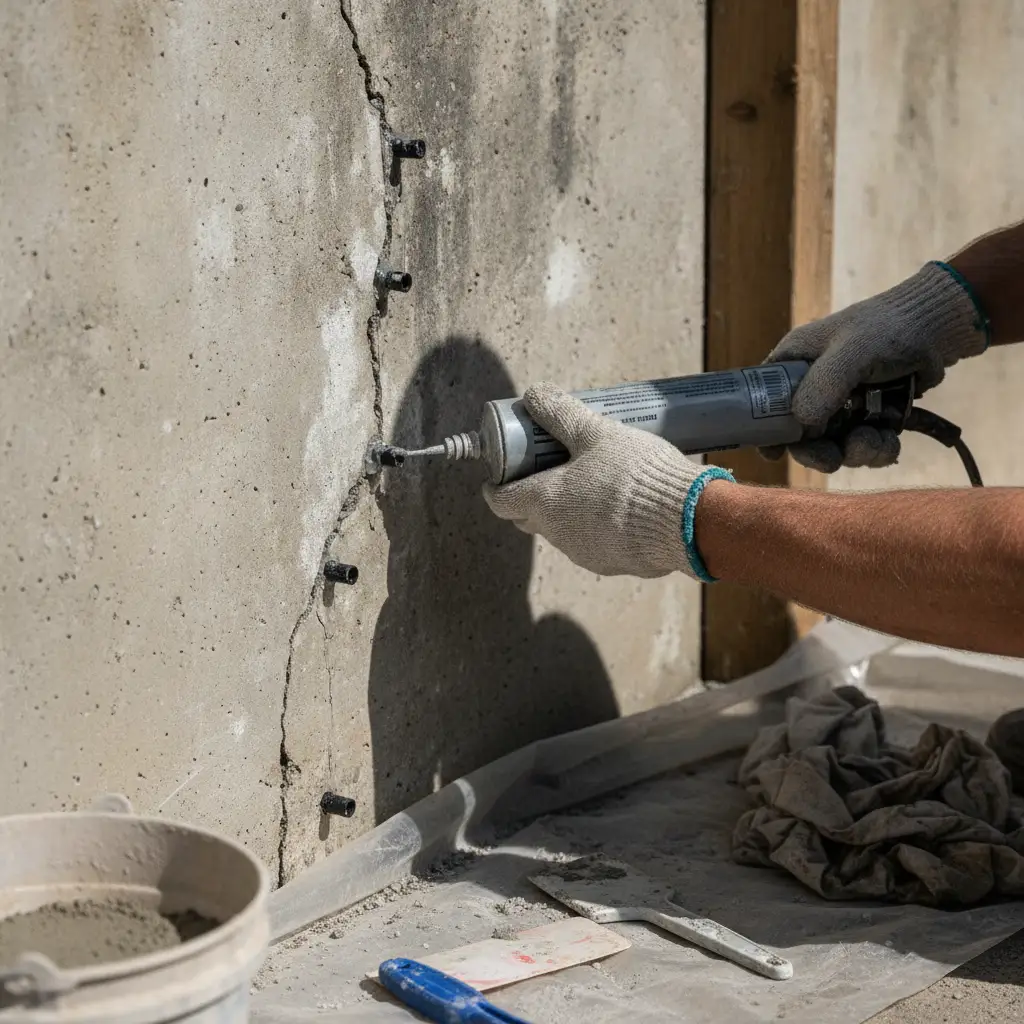
Our team in action — foundation-repair professionals serving Georgetown
Foundation Repair Methods We Use for Sinking Foundations
Steel Push Piers
The most common method we use for sinking foundations in Georgetown’s residential communities. Steel pipe sections are hydraulically driven through expansive clay soils until they reach the competent Austin Chalk limestone bedrock below. Push piers are ideal for heavier slab-on-grade homes found throughout Sun City, Wolf Ranch, and Berry Creek, where loads are sufficient to drive piers to refusal depth. Typical installation depth in Georgetown ranges from 14 to 22 feet.
Helical Piers
Helical (screw) piers are rotated into the soil mechanically and are particularly effective for lighter structures, additions, porches, and pier-and-beam conversions. They are well-suited for Georgetown’s older neighborhoods near the historic downtown square where lighter historic structures require careful load management.
Concrete Pressed Pilings
Pre-cast concrete cylinders pressed into the ground in sequence are a cost-effective option for certain Georgetown soil profiles, particularly where limestone bedrock is accessible at shallower depths. They are frequently used in Teravista and Forest Creek neighborhoods.
Slabjacking and Polyurethane Foam Lifting
For localized slab settlement caused by void formation beneath the slab — often seen after Georgetown’s drought cycles cause soil shrinkage — we offer mudjacking and high-density polyurethane foam injection to fill voids and re-level settled sections without full pier installation.
Crawl Space Support and Beam Repair
For Georgetown’s pier-and-beam homes, typically built prior to 1970 in neighborhoods near the Courthouse Square and along University Avenue, we reinforce or replace deteriorated wood beams, sister joists, and install new support piers to eliminate floor sagging and sinking.
Ready for Sinking Foundation? Get Your Free Estimate Today.
Round Rock Foundation Repair Group serves Georgetown and the surrounding area — we’ll be on-site within 24 hours.
📞 Call (512) 220-3502Sinking Foundation Repair Cost in Georgetown, TX
The cost of repairing a sinking foundation in Georgetown, TX varies considerably depending on the severity of the settlement, the foundation type, and the repair method required. Understanding the cost factors helps homeowners plan appropriately and evaluate quotes accurately.
For professional foundation inspections, costs typically range from $200 to $500 in the Georgetown market, with many companies offering free evaluations for straightforward residential cases.
Typical Price Ranges
- Minor slab repair (polyurethane foam lifting, small area): $800 – $2,500
- Moderate slab foundation repair (4–8 steel piers): $4,500 – $9,000
- Significant slab foundation repair (10–20 piers): $9,000 – $20,000
- Full perimeter slab stabilization (large home, 20+ piers): $18,000 – $35,000
- Pier-and-beam repair and restoration: $3,500 – $12,000 depending on extent of beam damage
- Commercial foundation repair: $25,000 – $100,000+ for larger structures
Georgetown-Specific Cost Factors
Several factors can influence pricing specifically in Georgetown. The depth required to reach the Austin Chalk limestone — which can range from 10 to 25 feet depending on whether your property sits in a low-lying area near the San Gabriel River or on higher terrain — directly affects pier material and labor costs. Properties in Sun City Texas with multiple structures or large footprints typically require more piers than compact urban lots near downtown. Homes on large lots in Berry Creek with mature trees may require additional soil remediation alongside structural repair.
For home foundation repair cost guidance or to request a detailed written estimate for your Georgetown property, contact our team at (512) 220-3502.
Georgetown Neighborhoods We Serve
Sun City Texas
Built in phases from 1995 through the 2010s, Sun City Texas spans thousands of acres with homes across multiple soil profiles. Western Sun City homes near the Brushy Creek drainage corridors frequently experience perimeter sinking due to clay soil shrinkage along drainage paths, while eastern sections show more uniform but deeper settlement patterns. We have completed repairs on dozens of Sun City properties and understand how each phase of development correlates to specific foundation behavior.
Wolf Ranch and Morningstar
These newer Georgetown communities, developed primarily between 2015 and 2022 along the South San Gabriel River, frequently deal with fill soil consolidation issues as newly placed graded soil continues to settle under structural loads. Our repair teams are well-acquainted with the specific grading and soil conditions in these subdivisions.
Berry Creek and Champions
Established in the late 1990s and early 2000s, Berry Creek’s large lots with mature tree canopy create aggressive root-driven moisture extraction beneath foundations. We commonly address asymmetric settlement in these homes caused by the localized soil drying effect of established live oaks and cedar elms.
Historic Downtown Georgetown
Properties near the Georgetown Courthouse Square, including commercial buildings and historic residences built as far back as the 1880s, require specialized repair approaches that respect historic fabric while providing modern structural stability. Our team has experience working with older rubble-stone and brick foundation systems common in this area.
Foundation Maintenance Tips for Georgetown Homeowners
Preventing or slowing foundation movement is possible with consistent year-round maintenance tailored to Georgetown’s clay soil and climate conditions.
- Maintain consistent soil moisture year-round. During Georgetown’s hot summers — when temperatures routinely exceed 100°F and drought conditions can develop quickly — water the soil along your foundation perimeter 2 to 3 times per week to prevent excessive clay shrinkage. A soaker hose placed 12 to 18 inches from the foundation edge is ideal.
- Ensure positive drainage away from the foundation. Georgetown’s spring rain events can deliver several inches in a short period. Grade landscaping so water flows away from the structure at a minimum slope of 6 inches over the first 10 feet.
- Keep gutters and downspouts clean and properly directed. Discharge downspouts at least 5 feet from the foundation, and consider underground discharge extensions in areas prone to pooling.
- Monitor large trees near your foundation. Trees within 30 feet of your home’s perimeter — especially cedar elms, live oaks, and pecans common throughout Georgetown — should be watered independently during droughts to reduce root moisture extraction from foundation soils.
- Inspect your foundation after Georgetown’s major rain-dry cycles. Spring and fall are the best times to walk your foundation perimeter and interior looking for new cracks or changes in existing ones.
- Avoid over-watering flower beds adjacent to the foundation. Excessive localized moisture creates differential expansion that can be just as damaging as drought drying.
- Repair plumbing leaks promptly. Slab leaks are a significant cause of localized foundation sinking throughout Georgetown’s established neighborhoods. A sudden soft spot or warm floor area warrants immediate investigation.
Why Choose Round Rock Foundation Repair Group for Your Georgetown Sinking Foundation
Round Rock Foundation Repair Group brings deep regional expertise to every sinking foundation project in Georgetown and across the greater Williamson County area. Our teams work regularly throughout Georgetown’s diverse neighborhoods — from the historic downtown district and Sun City Texas retirement community to the rapidly developing Wolf Ranch and Morningstar subdivisions — giving us firsthand knowledge of the soil profiles, construction vintages, and common failure patterns specific to each area.
We approach every project with transparency. Before any repair begins, you receive a detailed written inspection report, a clear explanation of your repair options, and straightforward pricing with no hidden fees. We use professional-grade steel pier systems, precision laser leveling equipment, and proven installation practices that align with the structural demands of Georgetown’s expansive clay environment.
Our service area covers Georgetown, TX comprehensively, along with surrounding communities including Round Rock, Cedar Park, Pflugerville, Austin, and many nearby neighborhoods and subdivisions. Whether your property is a classic 1960s pier-and-beam bungalow near the historic square or a 2019 production home in Wolf Ranch, we have the experience to assess, plan, and execute the right repair.
Call us at (512) 220-3502 to schedule your Georgetown foundation evaluation. Learn more about our full range of services including structural foundation repair and crawl space repair.
Frequently Asked Questions: Sinking Foundation in Georgetown, TX
How do I know if my Georgetown home has a sinking foundation versus normal settling?
All structures experience some minor, uniform settlement in the years immediately after construction. The concern is differential settlement — when one part of the foundation sinks more than another. In Georgetown, this is indicated by diagonal cracks at door and window corners, stair-step cracks in brick veneer, floors that slope visibly in one direction, or doors that suddenly won’t operate. A laser leveling survey by a foundation professional can quantify exactly how much movement has occurred and whether it is within acceptable tolerances.
How much does sinking foundation repair cost in Georgetown, TX?
Costs range broadly based on scope. Minor repairs using polyurethane foam lifting may run $800 to $2,500. A typical moderate residential slab repair requiring 8 to 12 steel piers generally costs between $7,000 and $14,000 in the Georgetown market. Larger homes or those with significant structural damage can see costs of $20,000 to $35,000 or more. Georgetown-specific factors like pier depth to reach Austin Chalk limestone and tree root interference can affect final pricing. We provide detailed written estimates at no obligation.
How long does sinking foundation repair take in Georgetown?
For a typical Georgetown residential slab foundation requiring 8 to 16 piers, on-site installation typically takes 1 to 2 full working days. Larger commercial projects or those involving significant interior pier installation may take 3 to 5 days. You can remain in your home throughout most repairs, though some interior access may be temporarily limited.
Does Georgetown’s drought cycle really damage foundations?
Absolutely. The 2011 Texas drought — the most severe single-year drought in Texas recorded history — caused a dramatic spike in foundation repair activity across Georgetown and Williamson County. When Georgetown received less than 15 inches of rainfall that year against a 35-inch average, the clay soils beneath thousands of slab foundations shrank and pulled away from foundation edges, triggering settlements of 1 to 3 inches in some cases. The same pattern repeats during any extended dry period, and Georgetown homeowners should be especially vigilant during summer and early fall when soil moisture deficit is greatest.
Will my homeowner’s insurance cover sinking foundation repair in Georgetown?
In most cases, standard homeowner’s insurance policies in Texas do not cover foundation damage caused by soil movement, settlement, or expansion — which are the primary drivers of sinking foundations in Georgetown. Coverage typically applies only to sudden, accidental events like a burst pipe that undermines foundation soils. We recommend contacting your insurance carrier directly and can provide detailed repair documentation to support any claim you may file.
Are newer Georgetown homes in Wolf Ranch or Morningstar at risk for sinking foundations?
Yes. While newer homes benefit from modern engineering standards, Georgetown’s newer subdivisions developed since 2015 face a specific risk: fill soil consolidation. Grading and pad preparation during rapid residential development can leave loosely compacted fill beneath foundations that continues to settle for several years post-construction. Wolf Ranch and Morningstar homeowners who notice symptoms within the first 5 to 7 years of occupancy should take them seriously rather than assuming “new homes don’t have foundation problems.”
What is the best time of year to repair a sinking foundation in Georgetown?
Foundation repair can be performed year-round in Georgetown’s mild climate. However, fall and early spring — when soil moisture is more moderate and neither at peak drought nor peak saturation — generally provide the most stable conditions for soil behavior during and immediately after repair. Repairing during or immediately following a major drought period requires careful monitoring to ensure soils re-stabilize after lifting.
Do you offer foundation repair services near me in Georgetown and surrounding areas?
Yes. Round Rock Foundation Repair Group serves all of Georgetown, TX, as well as Round Rock, Cedar Park, Austin, Pflugerville, Brushy Creek, and surrounding communities including Teravista, Forest Creek, Berry Creek, Avery Ranch, Sun City Texas, and more. Call (512) 220-3502 to confirm service availability at your address. You can also explore our foundation inspection services to get started.
Schedule Your Georgetown Sinking Foundation Evaluation Today
Don’t wait for a sinking foundation to become a structural emergency. Georgetown’s expansive Taylor Clay soils, seasonal drought-flood cycles, and diverse construction landscape make early intervention the most cost-effective strategy available to homeowners and commercial property owners.
Round Rock Foundation Repair Group is ready to visit your Georgetown property, assess your foundation’s condition with precision laser leveling tools, and provide you with a clear, honest repair recommendation. We serve all Georgetown neighborhoods including Sun City Texas, Wolf Ranch, Berry Creek, Morningstar, and the historic downtown district.
Call us now at (512) 220-3502 to speak with a Georgetown foundation specialist. You can also learn more about our full service offerings including concrete foundation repair and commercial foundation repair.
Your foundation supports everything above it — protect it with professionals who know Georgetown’s ground from the inside out.