Commercial Foundation Repair in Leander, TX
Fast, Reliable Commercial Foundation Repair in Leander, TX — Licensed & Insured
Need commercial foundation repair in Leander, TX? Round Rock Foundation Repair Group fixes expansive clay settlement, slab damage & more. Call (512) 220-3502.
- Licensed & Insured
- Locally Owned & Operated
- Free Inspection & Estimate
Request Your
Free EstimateCommercial foundation repair is the process of diagnosing, stabilizing, and restoring the structural base of business properties — including retail centers, office buildings, warehouses, medical facilities, and mixed-use developments. In Leander, TX, the explosive population growth of the past decade has accelerated commercial construction on soils notorious for extreme shrink-swell behavior, making professional foundation intervention a critical necessity rather than an optional upgrade.
Round Rock Foundation Repair Group brings deep regional expertise to every commercial project in Leander. Our team understands the specific geotechnical challenges posed by Leander’s expansive Blackland Prairie and Austin Chalk geology, the drainage patterns along Brushy Creek tributaries, and the building standards required by Williamson County. Whether your commercial property is a newly constructed tilt-wall warehouse near US-183 or an older retail strip along Crystal Falls Parkway, we deliver engineered solutions that protect your investment and keep your business operational. Call us at (512) 220-3502 to schedule a professional assessment.
Understanding Commercial Foundation Repair
Commercial foundation repair encompasses a broad range of structural interventions designed to halt movement, restore grade, and reinforce load-bearing capacity in non-residential or income-producing properties. Unlike residential foundation work, commercial repairs must account for heavier structural loads, stricter code compliance requirements from the International Building Code (IBC) as adopted by Williamson County, and the operational disruption costs that accrue when a business cannot function normally.
Historically, foundation engineering in Central Texas evolved alongside the region’s post-WWII suburban and commercial boom. Early builders in Williamson County frequently underestimated the destructive potential of montmorillonite clay — the dominant mineral in the region’s Blackland Prairie soils — leading to widespread foundation distress in structures built through the 1960s, 1970s, and 1980s. By the 1990s, the Texas Section of the American Society of Civil Engineers (ASCE) began issuing region-specific guidance for slab-on-grade construction, but legacy commercial buildings constructed before these standards remain vulnerable.
In Leander specifically, commercial development has occurred in three distinct waves: early agricultural-era structures near the historic downtown depot district, mid-century commercial buildings along US-183, and the modern mixed-use and big-box developments that began accelerating after Leander’s incorporation expansion in the early 2000s. Each era of construction presents different foundation typologies — pier-and-beam, conventional slab-on-grade, post-tensioned slab, and deep-drilled pier systems — each requiring a tailored repair strategy.
Commercial foundation repair also involves coordination with structural engineers, geotechnical consultants, and municipal inspectors in ways that purely residential work does not. A repair plan for a commercial property in Leander must often include engineered stamped drawings submitted to the City of Leander Building Department and may require special inspections under IBC Chapter 17. Round Rock Foundation Repair Group manages this entire process, from initial soil investigation through final permit sign-off, so business owners can focus on running their operations. Schedule a Foundation Inspection
Why Commercial Foundation Repair Is Needed in Leander, TX
Leander sits at the geological boundary between the Blackland Prairie to the east and the Edwards Plateau to the west, creating a uniquely challenging environment for commercial foundations. The soils directly beneath most of Leander’s commercial corridors — particularly along US-183, Crystal Falls Parkway, and Ronald Reagan Boulevard — are dominated by Taylor and Houston series clays with Plasticity Index (PI) values frequently measured between 35 and 55. Soils with PI values above 20 are considered highly expansive; Leander’s commercial zones routinely exceed that threshold by a significant margin.
These clays expand volumetrically by as much as 10–15% when saturated and shrink by a similar margin during drought conditions, exerting uplift pressures exceeding 10,000 pounds per square foot in severe cycles. Leander has experienced back-to-back extremes in recent years: the historic drought of 2022 drove soil moisture to record lows across Williamson County, causing significant differential settlement in commercial slabs throughout the area. This was immediately followed by above-average rainfall in 2023, causing rapid re-expansion that cracked foundation walls, broke utility lines, and buckled interior floor slabs in retail and office properties along the Crystal Falls commercial district.
The rapid pace of development in Leander has also created infrastructure-related challenges. The FM 2243 (Leander Road) commercial corridor and the growing business park near the Leander MetroRail station have seen extensive utility trenching and grading over the past five years. Poorly compacted trench backfill and altered drainage patterns have introduced new sources of differential moisture — a primary driver of foundation movement. Several commercial properties in the Lakeline Boulevard area have reported floor-level differentials of 2–4 inches within just three to five years of construction.
Root intrusion from Leander’s large population of live oak and cedar elm trees, which are prevalent in the landscaping of commercial properties along Crystal Falls Parkway and Toll 183A frontage roads, further desiccates clay soils beneath slabs during dry seasons, creating localized voids and subsidence zones. Additionally, the karst-influenced geology on Leander’s western edge — particularly in developments near Bar W Ranch and the Devine Lake area — introduces the risk of subsurface voids and dissolution features that require specialized geotechnical evaluation before standard repair methods can be applied.
Leander’s commercial building stock has also matured rapidly. Properties developed in the early 2000s in areas like Bryson and Crystal Falls are now 15–20 years old, reaching the age at which deferred foundation maintenance commonly becomes acute structural failure. Business owners and commercial property managers in these zones should treat foundation inspections as annual priorities, not reactive emergencies. Learn About Structural Foundation Repair
Signs You Need Commercial Foundation Repair in Leander
Structural Warning Signs
- Diagonal stair-step cracking in brick or masonry facades, particularly at building corners
- Interior sheetrock cracks wider than 1/8 inch running at 45-degree angles from door and window frames
- Visible gap between exterior walls and roofline or between columns and their bearing pads
- Sagging or bowing concrete floor slabs with measurable elevation differentials exceeding 1 inch
Operational and Functional Warning Signs
- Commercial doors that stick, bind, or no longer latch properly — especially after seasonal weather changes
- Windows that crack spontaneously or cannot be opened or closed without force
- Plumbing leaks beneath slab that recur after repair, indicating ongoing movement
- Uneven loading dock surfaces or warehouse floors that affect forklift operation
Urgent Red-Flag Indicators
- Any visible separation between a structural column and its footing pad
- Cracks in load-bearing concrete walls wider than 1/4 inch
- Sudden changes in crack size or number following heavy rainfall or extended drought
- Tenant complaints about sloping floors or doors that have changed behavior within a single season
If your Leander commercial property is exhibiting two or more of the above symptoms simultaneously, treat this as an urgent matter requiring professional evaluation within 30 days. Delayed intervention consistently results in higher repair costs and greater disruption to business operations. Request an Inspection Today
Our Commercial Foundation Repair Process in Leander
Initial Site Assessment and Elevation Survey (Days 1–2)
Our process begins with a comprehensive site walk-through and digital elevation survey using a Zip Level Pro-2000 precision altimeter. We map floor-level differentials across the entire commercial footprint, document all visible distress indicators with photographs, and review available as-built drawings. For Leander properties, we pay particular attention to proximity to drainage channels, utility easements, and tree zones.
Geotechnical and Soil Analysis (Days 3–7)
We coordinate soil borings or Plasticity Index testing when existing geotechnical data is unavailable — a common situation for pre-2005 commercial buildings in older Leander corridors. Understanding the specific clay profile beneath your slab is essential for pier depth specification and spacing design.
Engineered Repair Plan and Permitting (Days 7–21)
Our structural engineering partner produces a stamped repair plan that meets City of Leander Building Department requirements and Williamson County standards. We submit all permit applications and coordinate required special inspections, handling the bureaucratic process so your team does not need to.
Site Preparation and Business Continuity Planning (Days 14–21)
We develop a phased work schedule designed to minimize operational disruption. For occupied retail or office properties, we can sequence repair zones to keep portions of the building accessible throughout the project.
Foundation Repair Installation (Days 21–45, Varies by Scope)
Pier installation, void filling, slab lifting, or structural wall repair is executed per the engineered plan. Daily progress reports are provided to property managers and building owners throughout this phase.
Final Elevation Survey and Grade Restoration (Completion Week)
A post-repair elevation survey confirms that differential settlement has been corrected to within acceptable tolerances (typically ±3/8 inch for commercial floor slabs). Landscaping, concrete flatwork, and drainage features disturbed during installation are restored.
Documentation and Follow-Up Monitoring
We provide a complete project file including pre- and post-repair elevation data, permit records, and engineer-of-record sign-off. We schedule a follow-up inspection at six months to confirm stability, which is particularly important given Leander’s seasonal moisture extremes. Learn About Our Concrete Foundation Repair Services
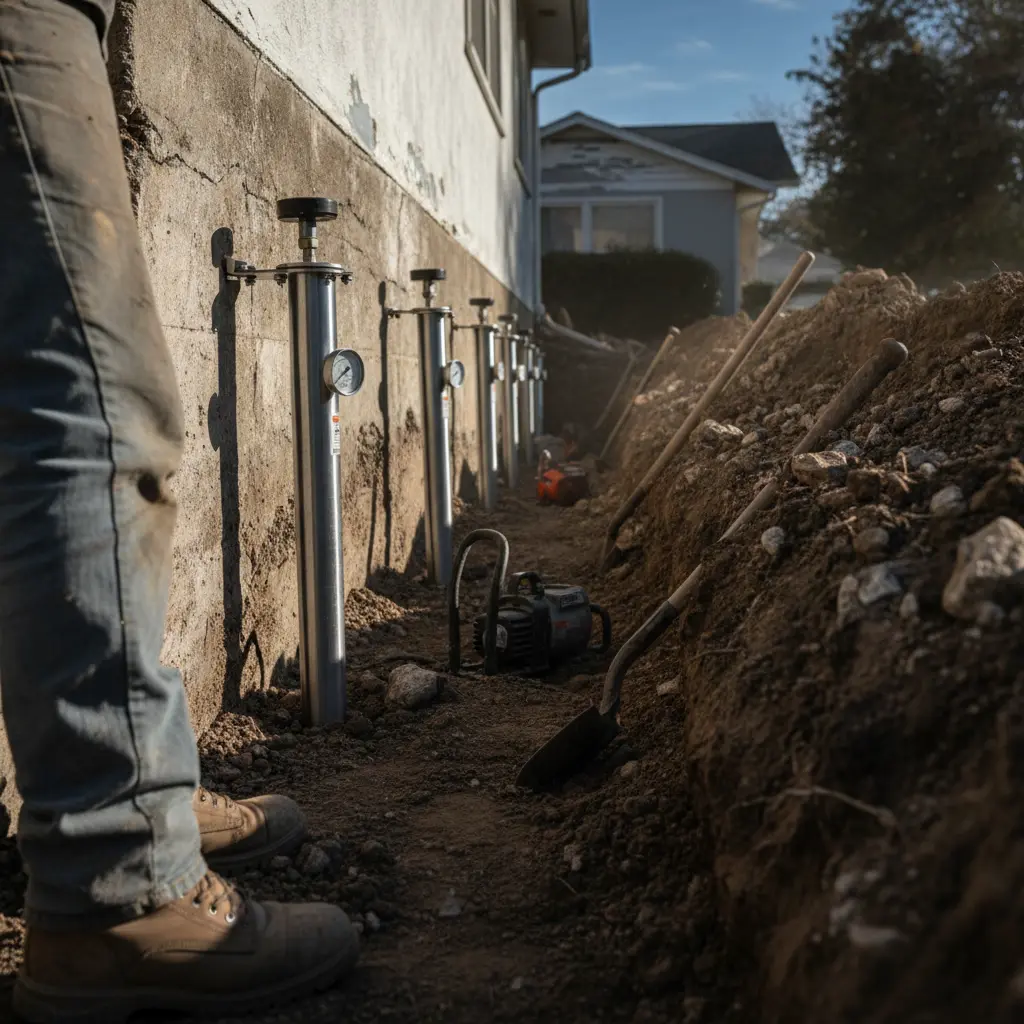
Our team in action — foundation-repair professionals serving Leander
Commercial Foundation Repair Methods We Use in Leander
Steel Push Pier Systems
For heavy commercial structures experiencing settlement due to soil consolidation or moisture-driven subsidence, hydraulically driven steel push piers are advanced through unstable surface soils to competent bearing strata — typically Austin Chalk bedrock found at depths of 15–35 feet beneath most of Leander’s commercial zones. Push piers are ideal for occupied buildings because installation is minimally invasive and does not require large equipment access inside the structure.
Helical Pier Systems
Helical piers are the preferred solution for lighter commercial structures, additions, and properties where Austin Chalk is deeper or less consistent — conditions common on Leander’s western growth edges near Bar W Ranch and Devine Lake. Helical piers can also be installed in tension applications to resist uplift forces from Leander’s highly expansive clays.
Polyurethane Foam Slab Lifting
For commercial floor slabs with voids or moderate settlement that do not require deep pier support, high-density polyurethane foam injection offers a rapid, minimally disruptive solution. This method is frequently used in Leander warehouse and distribution facilities where floor-level uniformity is critical for operational safety and forklift use.
Carbon Fiber Wall Stabilization
Commercial properties with bowing or cracking concrete block or poured-concrete perimeter walls benefit from carbon fiber strap reinforcement systems, which restore lateral resistance without excavation or wall replacement. Explore Foundation Restoration Options
Ready for Commercial Foundation Repair? Get Your Free Estimate Today.
Round Rock Foundation Repair Group serves Leander and the surrounding area — we’ll be on-site within 24 hours.
📞 Call (512) 220-3502Commercial Foundation Repair Cost in Leander, TX
The cost of commercial foundation repair in Leander varies significantly based on building size, foundation type, severity of damage, repair method required, and permitting complexity. Below are general ranges to help commercial property owners budget appropriately:
- Foundation Inspection and Elevation Survey: $500–$1,500 for standard commercial properties; $1,500–$4,000 for large or complex sites requiring geotechnical coordination
- Steel Push Pier Installation: $1,200–$1,800 per pier installed; most Leander commercial projects require 10–40 piers depending on building footprint and load distribution
- Helical Pier Installation: $1,500–$2,200 per pier installed, with depth and soil torque resistance affecting final pricing
- Polyurethane Foam Slab Lifting: $5–$25 per square foot of lifted area, making it cost-effective for moderate commercial floor void issues
- Total Project Ranges: Small commercial buildings (under 5,000 sq ft): $8,000–$30,000; Mid-size commercial properties (5,000–20,000 sq ft): $25,000–$100,000+; Large commercial or industrial facilities: Custom bid required
Leander-specific cost factors include Williamson County permit fees (typically $500–$2,000 for commercial foundation work), required special inspections under IBC Chapter 17 ($800–$2,500), and the additional pier depth often needed to reach competent Austin Chalk through deep clay overburden in eastern Leander commercial corridors. Phased repair schedules to accommodate occupied buildings may also add 10–15% to total project cost compared to unoccupied structures. Contact us at (512) 220-3502 for a detailed site-specific estimate. Get a Commercial Foundation Repair Estimate
Leander Neighborhoods and Commercial Areas We Serve
Crystal Falls Commercial District
The Crystal Falls Parkway corridor hosts retail centers, medical offices, and service businesses developed primarily between 2005 and 2015. Many of these properties are built on conventional slab-on-grade foundations over high-PI Taylor clay and are now reaching the age where deferred maintenance becomes acute. We have documented floor-level differentials of 1.5–3.5 inches in several Crystal Falls retail properties following the 2022–2023 drought-and-rehydration cycle.
US-183 / Leander Road Corridor
The older commercial strip along US-183 includes buildings from the 1970s and 1980s that were constructed before modern expansive soil design standards were adopted. Pier-and-beam structures in this corridor are particularly susceptible to wood deterioration and beam settlement, while older slab buildings show extensive long-term differential movement patterns.
Leander MetroRail Station Area
The transit-oriented development zone surrounding the Leander MetroRail station has seen intense mixed-use construction activity since 2018. Heavily disturbed and regraded soils in this area, combined with proximity to Brushy Creek drainage infrastructure, create elevated foundation risk for both new and recently constructed commercial properties.
Schedule Service in Your Leander NeighborhoodCommercial Foundation Maintenance Tips for Leander Property Owners
- Maintain Consistent Soil Moisture: Install commercial-grade automatic irrigation systems around your building perimeter and program them to run during Leander’s dry summer months (typically June–September) to prevent clay shrinkage beneath the slab edge.
- Direct All Roof Drainage Away from the Foundation: Ensure downspouts discharge at least 6–10 feet from the building perimeter. Leander’s clay soils saturate rapidly during intense rainfall events, and ponding water within 3 feet of the foundation is a leading cause of differential heave.
- Maintain Positive Grade: The finished grade around your commercial property should slope away from the foundation at a minimum of 6 inches over the first 10 feet per IBC drainage requirements.
- Monitor and Trim Perimeter Trees: Live oaks, cedar elms, and other large trees common in Leander commercial landscaping should be root-pruned or maintained at least 15–20 feet from foundation edges.
- Inspect Plumbing Annually: Schedule hydrostatic or camera plumbing tests every 2–3 years. Slab leaks are a primary cause of localized foundation settlement in Leander commercial properties.
- Document Crack Benchmarks: Photograph and date any cracks in walls or floors. Changes in crack width or length between seasonal photographs indicate active foundation movement requiring evaluation.
- Schedule Professional Inspections: Annual elevation surveys by a qualified foundation contractor provide early warning of developing movement before it becomes a costly structural emergency. Book Your Annual Foundation Inspection
Why Choose Round Rock Foundation Repair Group for Commercial Work in Leander
Round Rock Foundation Repair Group has built its reputation on deep knowledge of Central Texas geology and the specific challenges that Leander’s expansive clay soils and rapid commercial growth create for property owners. Our team works exclusively in the greater Williamson County and Travis County markets, meaning every technician, project manager, and estimator we deploy to your Leander commercial site understands local soil conditions, local permitting requirements, and the seasonal moisture patterns that drive foundation behavior in this specific region.
We offer complete commercial project management from initial soil investigation through engineered repair plan development, permit acquisition, installation, and post-repair monitoring. We coordinate directly with structural engineers and Williamson County inspection officials so your team does not need to navigate that process independently.
Our commitment to business continuity means we design repair sequences to keep your operations running wherever possible. We serve the full Leander commercial market as well as surrounding communities including Round Rock, Cedar Park, Georgetown, Austin, Pflugerville, and Brushy Creek. Call (512) 220-3502 to speak with a commercial foundation specialist today. Contact Round Rock Foundation Repair Group
Frequently Asked Questions: Commercial Foundation Repair in Leander, TX
How much does commercial foundation repair cost in Leander, TX?
Costs range from approximately $8,000 for small commercial properties with minor settlement to $100,000 or more for large facilities with extensive damage. The primary cost drivers in Leander are pier depth required to reach Austin Chalk bedrock, building size, permit and special inspection fees from Williamson County, and whether the project must be phased around an occupied business. We provide detailed, site-specific estimates at no cost after an initial inspection.
How long does commercial foundation repair take in Leander?
From initial inspection to project completion, most Leander commercial foundation repair projects take 4–8 weeks. This includes 2–3 weeks for engineering and permitting, followed by 1–3 weeks of active installation depending on scope. Large industrial or multi-building projects may extend to 3–4 months. Polyurethane foam slab lifting projects are often completable in 1–3 days with minimal disruption.
Do I need to close my business during foundation repair?
Not necessarily. Round Rock Foundation Repair Group designs phased repair programs specifically to maintain operational continuity for occupied Leander commercial properties. In most retail, office, and light commercial situations, we can sequence work to keep a significant portion of the building accessible. We will provide a clear operational impact assessment as part of your pre-project planning.
Why is commercial foundation damage so common in Leander specifically?
Leander’s commercial zones sit primarily on Taylor and Houston series expansive clays with Plasticity Index values of 35–55 — among the most aggressive in Central Texas. Combined with Leander’s recent population surge driving rapid construction on poorly understood fill soils, proximity to Brushy Creek drainage systems, and the extreme drought-and-rehydration cycle of 2022–2023, conditions here are particularly challenging for commercial foundations.
What is the difference between commercial and residential foundation repair?
Commercial repairs must address heavier structural loads, meet International Building Code requirements with engineered and stamped plans, obtain commercial building permits from the City of Leander, and undergo special inspections. The repair methods themselves (push piers, helical piers, foam lifting) are similar in principle but scaled and specified differently for commercial loads. Commercial projects also carry greater consequences for tenant relations, lease agreements, and business liability.
Can I get a foundation inspection before buying a commercial property in Leander?
Absolutely, and we strongly recommend it. Pre-purchase foundation inspections for commercial properties in Leander include a full elevation survey, visual distress documentation, and a written assessment of repair needs and estimated costs. This gives buyers critical information during due diligence and negotiation. Contact us at (512) 220-3502 to schedule a pre-purchase inspection. Learn About Our Foundation Inspection Services
How do I know if my Leander commercial building needs piers or just slab patching?
Slab patching addresses cosmetic surface damage and minor cracks but does not correct underlying movement. If your building has experienced measurable differential settlement (floor elevation differences of 3/4 inch or more), recurring crack patterns, or plumbing failures beneath the slab, deep pier underpinning is typically required to stabilize the foundation before any surface repairs are made. Our inspection process determines the appropriate solution for your specific situation.
Does Round Rock Foundation Repair Group serve areas outside of Leander?
Yes. We serve the full greater Leander region including Round Rock, Cedar Park, Georgetown, Austin, Pflugerville, Brushy Creek, Tech Ridge, Jollyville, Paloma Lake, Wells Branch, Teravista, La Frontera, Avery Ranch, Great Hills, Mayfield Ranch, Anderson Mill, Cat Hollow, Forest Creek, Behrens Ranch, and Sendero Springs. View All Service Areas
Get Expert Commercial Foundation Repair in Leander, TX Today
Don’t let foundation problems threaten the structural integrity of your Leander commercial property or disrupt your business operations. Round Rock Foundation Repair Group provides professional, engineered foundation repair solutions designed specifically for Leander’s expansive clay soils, Williamson County permitting requirements, and the real-world demands of commercial property ownership.
Take the first step today:
- Call us directly: (512) 220-3502
- Request an online assessment: Schedule Your Commercial Foundation Inspection
Our team is ready to evaluate your property, provide a transparent written estimate, and develop a repair plan that protects your investment and keeps your Leander business running. Contact Round Rock Foundation Repair Group now — because the longer foundation problems are ignored, the more expensive and disruptive they become.