
Foundation Inspection in Leander, TX
Thorough Foundation Inspection in Leander, TX — Honest Assessments
Need a foundation inspection in Leander, TX? Round Rock Foundation Repair Group provides precise slab and pier-and-beam inspections on Houston Black clay soils. Call (512) 220-3502.
- Licensed & Insured
- Locally Owned & Operated
- Free Inspection & Estimate
Request Your
Free EstimateA professional foundation inspection is a systematic evaluation of your home’s or building’s structural base — examining concrete slabs, pier-and-beam systems, footings, and surrounding soil conditions to identify current damage, developing problems, and risk factors before they escalate into costly repairs. In Leander, TX, where expansive clay soils, rapid population growth, and the region’s notorious drought-flood cycles create some of the most challenging foundation conditions in Central Texas, a timely inspection is not optional — it is essential.
Round Rock Foundation Repair Group brings hands-on expertise to every foundation inspection in Leander and the surrounding communities. Our licensed structural inspectors understand exactly how Leander’s unique geology, soil composition, and climate interact with residential and commercial foundations. Whether you have noticed a sticking door, a diagonal crack above a window frame, or you simply want peace of mind before purchasing a home, our team provides thorough, documented assessments you can rely on. Call us today at (512) 220-3502.
Understanding Foundation Inspection in Leander, TX
Foundation inspection is the disciplined process of visually and instrumentally evaluating a structure’s load-bearing base system to determine its current condition, identify deformation or distress, and recommend corrective action when necessary. A qualified inspector examines multiple components: the perimeter beam grade, interior slab flatness, crack patterns, moisture intrusion points, plumbing leak indicators, drainage configurations, and the soil behavior immediately adjacent to the structure.
Historically, Leander was a small railroad town established in 1882 along the Burnet Branch of the International-Great Northern Railroad. For most of the 20th century, construction here was sparse — modest ranches and farmhouses on large lots. That all changed dramatically in the 2000s and accelerated through the 2010s, when Leander became one of the fastest-growing cities in the United States. According to U.S. Census Bureau data, Leander’s population grew from roughly 7,500 in 2000 to over 73,000 by 2023. That explosive pace of development means tens of thousands of homes were built quickly, often on marginal soil profiles, with compressed construction timelines that sometimes allowed inadequate soil preparation.
Two foundation types dominate Leander’s housing stock. Post-tension slab-on-grade foundations are prevalent in subdivisions built after the mid-1990s — communities like Travisso, Crystal Falls, and Carneros Ranch. Pier-and-beam systems are more common in older properties near downtown Leander and along the Highway 183 corridor. Each type presents distinct inspection challenges. Post-tension slabs can experience tendon failure or differential settlement; pier-and-beam systems are susceptible to wood decay, moisture damage, and shifting perimeter piers as clay soils shrink and swell.
Commercial properties along Hero Way, the Ronald Reagan Boulevard corridor, and near the Leander Station transit hub face their own unique considerations, including higher live load requirements and the compounding effects of heavy foot traffic and parking-lot drainage on adjacent soil moisture content. A proper commercial foundation inspection accounts for all of these variables with standardized reporting formats that satisfy lenders, insurers, and municipal permitting offices.
Signs You Need a Foundation Inspection in Leander
Structural and Visual Interior Symptoms
- Diagonal cracks at the corners of door frames and window openings (stair-step crack pattern)
- Horizontal or vertical cracks wider than 1/8 inch in interior drywall
- Floors that feel noticeably uneven underfoot or show measurable slope when tested with a level
- Interior doors or windows that stick, refuse to latch, or have developed visible gaps at the frame
- Separation between walls and ceiling, or between walls and floor trim
Exterior Warning Indicators
- Cracks in the brick veneer or mortar joints, particularly stair-step cracks in masonry
- Visible gaps between the foundation beam and adjacent soil (soil pulling away from the edge)
- Cracks in the concrete slab visible in the garage floor or along the perimeter beam
- Chimney separating or leaning away from the main structure
Urgent Situations Requiring Immediate Inspection
- Any crack wider than 1/4 inch that has appeared or widened rapidly
- Visible bowing or bulging in a basement or crawl space wall
- Evidence of a plumbing slab leak combined with foundation cracking
- A home that has experienced a nearby sinkhole or significant tree removal
Our Foundation Inspection Process in Leander, TX
Scheduling and Pre-Inspection Research (1–2 Days Before)
When you call (512) 220-3502, our team gathers basic information about your property — address, construction year, foundation type, and the specific symptoms you have observed. We cross-reference publicly available Williamson County soil maps and prior permit history to arrive prepared.
Exterior Perimeter Walk (30–45 Minutes)
Our inspector walks the full perimeter of your foundation, noting grade elevations, drainage patterns, crack locations, soil separation, and the condition of any hardscape adjacent to the slab. In Leander, we pay particular attention to soil voids along the south and west elevations, which dry out fastest under summer sun exposure.
Interior Elevation Survey (45–60 Minutes)
Using a calibrated Zip Level Pro-2000 differential water level instrument, we take elevation readings at a grid of points across all interior floors. This produces a precise topographic map of your slab, identifying high and low spots to within 1/10 of an inch. The industry standard for acceptable differential movement in a residential slab is generally 1 inch over a 20-foot span; deviations beyond this threshold warrant further evaluation.
Crack Documentation and Classification (20–30 Minutes)
Every crack is photographed, measured with a crack comparator gauge, and classified by type (shrinkage, structural, heave-induced). Crack orientation and location relative to the elevation map help distinguish cosmetic settling from active structural movement.
Plumbing Correlation Check (15–20 Minutes)
In Leander, where cast-iron and early PVC drain lines are common in homes built between 1985 and 2005, we evaluate whether plumbing leaks may be contributing to localized soil saturation and heave. We recommend a hydrostatic plumbing test if crack patterns suggest under-slab moisture intrusion.
Moisture and Drainage Assessment (15–20 Minutes)
We assess gutters, downspout discharge points, and surface grade to determine whether water is being directed toward or away from the foundation. Improper drainage is a correctable cause of foundation movement that is often overlooked.
Written Report and Recommendations (Delivered Within 48 Hours)
You receive a comprehensive written report with annotated photographs, the elevation map, crack classification data, drainage findings, and a prioritized list of recommended actions. If repair is warranted, the report includes a detailed scope of work for your reference. Learn more about our full foundation inspection services
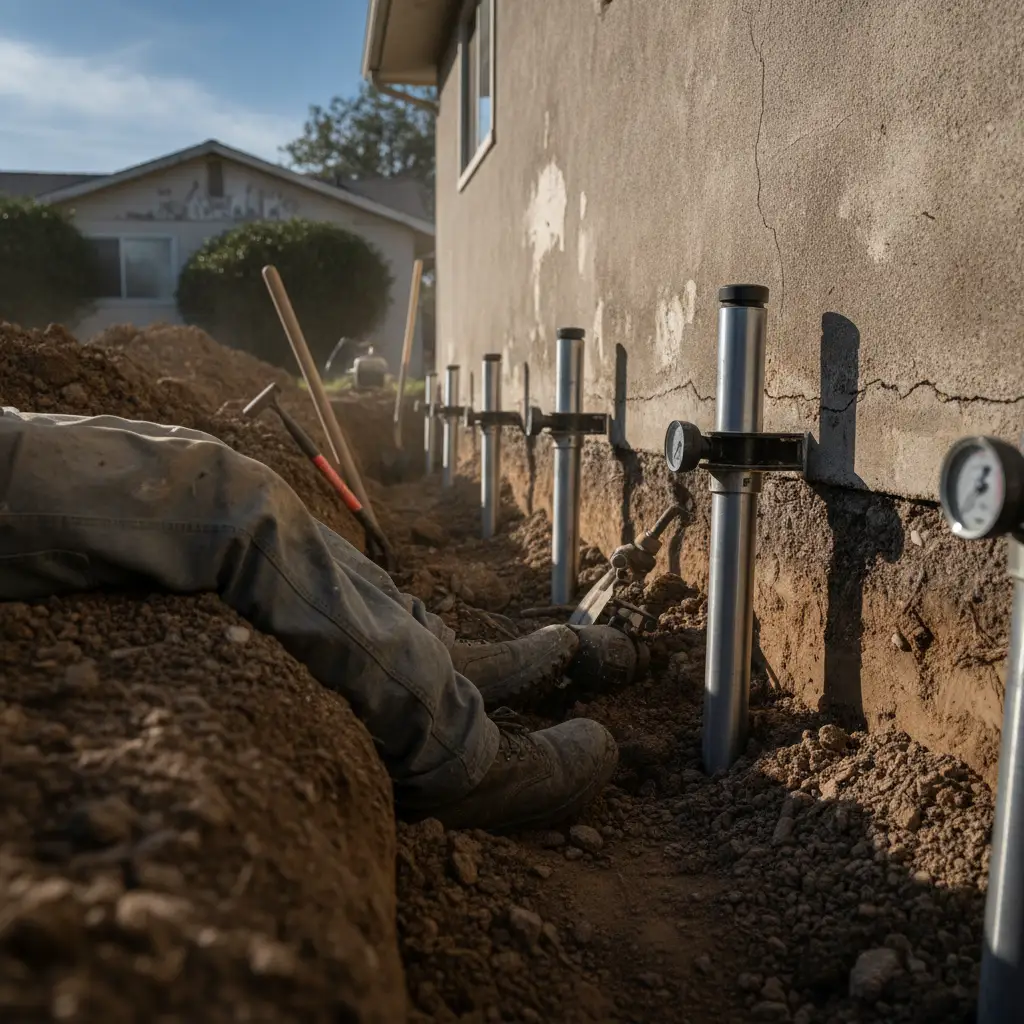
Our team in action — foundation-repair professionals serving Leander
Foundation Inspection Methods and Approaches
Differential Elevation Survey
The elevation survey using a precision digital level is the cornerstone of every residential and commercial inspection we perform in Leander. It provides objective, measurable data rather than subjective visual assessment alone. This method is especially valuable in Leander’s newer post-tension slab homes in Travisso and Crystal Falls, where interior finishes may conceal movement that the elevation survey reveals immediately.
Visual Crack Pattern Analysis
Experienced inspectors can read crack patterns the way a geologist reads rock strata. A crack radiating diagonally from a corner at 45 degrees typically indicates differential settlement; a wide horizontal crack in a stem wall indicates lateral soil pressure. In Leander’s Houston Black clay environment, heave cracks — which open upward rather than downward — require different repair strategies than settlement cracks.
Soil Moisture and Drainage Evaluation
We evaluate surface and subsurface moisture conditions using visual inspection, probe testing, and review of recent precipitation data relative to the inspection date. After extended dry periods — common in Leander’s June-through-September window — soil readings inform urgency of remediation.
Pier-and-Beam Crawl Space Inspection
For older Leander homes with pier-and-beam systems, our inspector physically enters the crawl space to assess wood beam condition, pier alignment, moisture barriers, ventilation adequacy, and signs of biological growth or insect damage. Explore our crawl space repair services
Commercial Structural Assessment
For commercial properties near Leander’s growing Hero Way and U.S. 183 commercial corridors, our commercial foundation inspection process follows protocols aligned with ASTM E2266 and incorporates load distribution analysis appropriate to retail, medical, and mixed-use occupancies. Learn about our commercial foundation repair services
Ready for Foundation Inspection? Get Your Free Estimate Today.
Round Rock Foundation Repair Group serves Leander and the surrounding area — we’ll be on-site within 24 hours.
📞 Call (512) 220-3502Foundation Inspection Cost in Leander, TX
Understanding foundation inspection costs in Leander helps you budget appropriately and avoid being caught off guard. Here is what you can generally expect:
Residential Inspection Pricing
- Basic visual inspection (under 2,000 sq ft): $250–$400
- Full elevation survey + written report (2,000–3,500 sq ft): $400–$650
- Large custom home or multi-story (3,500+ sq ft): $650–$950
- Pier-and-beam crawl space inspection: Add $100–$200 to base price
Commercial Inspection Pricing
- Small commercial (under 5,000 sq ft): $700–$1,200
- Medium commercial (5,000–20,000 sq ft): $1,200–$3,000
- Large or multi-tenant structures: Custom quote required
Factors That Affect Your Foundation Inspection Cost in Leander
Several variables influence final pricing specific to the Leander market. Properties in subdivisions built on fill soil — common in several developments along Ronald Reagan Boulevard — may require additional elevation measurement points, increasing time and cost. Homes with complex floor plans, multiple levels, or significant interior finishes that limit access also require more time on-site. Pre-purchase inspections in competitive Leander real estate situations sometimes include expedited 24-hour report delivery, which may carry a premium of $75–$150.
It is worth noting that many foundation repair companies in the Austin metro area offer free inspections, though these assessments are typically less detailed than a paid third-party inspection. For impartial results — particularly for real estate transactions or insurance claims — a fee-based inspection by an independent inspector is generally preferred. View more details on our foundation inspection pricing
Leander Neighborhoods We Serve
Crystal Falls
One of Leander’s premier master-planned communities, Crystal Falls features homes built primarily between 2000 and 2018. The rolling terrain here places some homes on sloped lots where differential settlement is elevated. Many homes here are post-tension slabs on Houston Black clay with limited moisture management landscaping.
Travisso
A newer community with homes built from 2015 to present, Travisso sits on some of the highest-elevation ground in Leander. While drainage is generally better here, the thin topsoil over limestone bedrock creates expansive pressure conditions that surprise many newer homeowners who experience cracking within the first three to five years.
Summerlyn
Summerlyn is a large, value-priced subdivision on Leander’s eastern edge where homes were built rapidly during the 2010 to 2020 growth surge. Inspector reports from this neighborhood frequently note inadequate soil compaction records and early-stage differential settlement in homes less than a decade old.
Downtown Leander / Old Town Area
The historic core near the Leander commuter rail station features a mix of pier-and-beam homes built in the 1950s through 1970s and newer infill construction. Older properties here have experienced decades of clay soil cycling and often show cumulative foundation fatigue requiring comprehensive restoration. Learn about our foundation restoration services
Foundation Maintenance Tips for Leander Homeowners
- Maintain consistent soil moisture year-round. In Leander’s hot, dry summers, use a soaker hose system placed 12–18 inches from your foundation perimeter to prevent the Houston Black clay from drying out and pulling away from your slab.
- Inspect and clean gutters each spring and fall. Williamson County’s spring storm season can overwhelm clogged gutters, concentrating water runoff directly against your foundation.
- Ensure positive grade away from the foundation. The first 6 feet of soil adjacent to your foundation should slope away at a rate of at least 6 inches of drop per 10 feet of horizontal run.
- Trim tree roots near the foundation. Live oaks and cedar elms within 15 feet of your slab can extract significant soil moisture, especially during dry summers.
- Monitor and repair plumbing leaks promptly. Even a slow under-slab leak can saturate the clay beneath your foundation and cause localized heave.
- Schedule a foundation inspection every 3–5 years. Proactive monitoring catches movement early — before it becomes expensive. Schedule your inspection today
- Document cracks with photographs and dates. Tracking crack progression over time helps inspectors distinguish active movement from historic, stable cracking.
Why Choose Round Rock Foundation Repair Group for Foundation Inspection in Leander
Round Rock Foundation Repair Group has built its reputation across the Central Texas market by delivering precise, honest, and actionable foundation inspections. We are not a national franchise with rotating crews — we are a locally operated team that understands the specific soil profiles, subdivision histories, and construction patterns that define Leander and Williamson County’s housing stock.
Our inspectors use calibrated instrumentation on every inspection — not just visual walkthroughs. Every report we produce is written in plain language with annotated photographs so that you, your real estate agent, or your attorney can understand exactly what we found and why it matters. We serve homeowners, commercial property owners, real estate buyers, sellers, and attorneys across Leander and throughout the greater Austin region.
We also offer the full spectrum of repair services — from structural foundation repair to concrete foundation repair and foundation patching — so if your inspection reveals a problem, we can move from diagnosis to solution without involving a second contractor. Call us at (512) 220-3502 to schedule your inspection.
Foundation Inspection in Leander, TX — Frequently Asked Questions
How much does a foundation inspection cost in Leander, TX?
Most residential foundation inspections in Leander range from $250 to $650 depending on home size, foundation type, and report complexity. Pier-and-beam crawl space inspections typically add $100–$200 to the base cost. Commercial inspections start around $700 for smaller properties.
How long does a foundation inspection take?
For a typical Leander home between 2,000 and 3,000 square feet, expect the on-site inspection to take 2 to 3 hours. Larger homes or properties with complex floor plans may require 3 to 4 hours. The written report is generally delivered within 48 hours of the on-site visit.
What soil type is under my Leander home, and why does it matter?
Most of Leander sits on Houston Black clay or closely related Vertisol-series soils — among the most expansive clay soils in North America. These soils can change volume by 4 to 6 inches vertically with seasonal moisture fluctuations. This movement is the primary cause of foundation distress in Leander, which is why local soil knowledge is essential to accurate foundation assessment.
My Leander home is only 8 years old. Do I still need a foundation inspection?
Yes. Many of the fastest-growing Leander subdivisions — including parts of Summerlyn and several communities along Ronald Reagan Boulevard — were built on fill soils that are still consolidating. We regularly inspect homes as new as three to five years old in Leander that show measurable differential settlement. Catching it early drastically reduces repair costs.
What is the difference between foundation inspection and a home inspection?
A general home inspection is a broad visual survey of all major systems — roof, HVAC, electrical, plumbing, and structure — conducted by a licensed home inspector. A specialized foundation inspection goes significantly deeper on the structural base: it includes precision elevation measurements, crack pattern analysis, soil and drainage evaluation, and a detailed repair scope if needed. For any property in Leander where foundation movement is suspected, a dedicated foundation inspection is strongly recommended in addition to a standard home inspection.
Will the 2011 drought effects still show up in my Leander foundation today?
Potentially, yes. The 2011 Texas drought caused severe, rapid soil desiccation across Williamson County. Foundations that experienced significant movement during that event and were never repaired may still show measurable elevation differentials, stair-step cracks, and door frame distortion today. Historic movement is a factor we specifically document and assess for stability during every inspection.
Does Round Rock Foundation Repair Group serve neighborhoods outside of Leander?
Yes. In addition to all Leander neighborhoods, we serve Round Rock, Cedar Park, Georgetown, Austin, Pflugerville, Brushy Creek, Avery Ranch, Great Hills, Behrens Ranch, Crystal Falls, Sendero Springs, Teravista, and many other communities throughout the greater Austin metro area. View our full service area
What happens if my inspection reveals a serious foundation problem?
Our written report will clearly outline the findings, severity classification, and recommended repair options with associated cost ranges. Round Rock Foundation Repair Group offers structural foundation repair, home foundation repair, and foundation restoration services, so you can move from inspection to repair with a single trusted contractor. We will walk you through every option and timeline before any work begins.
Schedule Your Foundation Inspection in Leander, TX Today
Leander’s expansive clay soils, rapid growth history, and extreme weather cycles make professional foundation inspection one of the most valuable investments a property owner can make. Whether you are buying a home in Crystal Falls, managing a commercial property on Hero Way, or concerned about cracks in your Summerlyn slab, Round Rock Foundation Repair Group is ready to provide the detailed, objective assessment your property deserves.
Do not wait until small cracks become structural emergencies. Call us now at (512) 220-3502 to schedule your foundation inspection in Leander, TX. Our team is standing by to answer your questions, provide a cost estimate, and get you on our inspection calendar — often within just a few days. Contact us online to request your inspection