Concrete Foundation Repair in Leander, TX
Fast, Reliable Concrete Foundation Repair in Leander, TX — Licensed & Insured
Need concrete foundation repair in Leander, TX? Round Rock Foundation Repair Group fixes settled slabs, cracks & more. Call (512) 220-3502 for a free estimate.
- Licensed & Insured
- Locally Owned & Operated
- Free Inspection & Estimate
Request Your
Free EstimateConcrete foundation repair is the professional process of diagnosing, stabilizing, and restoring damaged concrete foundations to their original structural integrity. In Leander, TX, this service is critically important due to the region’s expansive clay-heavy soils, volatile seasonal rainfall patterns, and the explosive residential growth that has placed thousands of homes on challenging terrain across the northern Williamson County corridor.
Round Rock Foundation Repair Group delivers expert concrete foundation repair services to homeowners and business owners throughout Leander and the surrounding Hill Country-adjacent communities. Our team understands the specific geological and environmental pressures that make Leander foundations uniquely vulnerable — from the reactive Blackland Prairie soils underlying neighborhoods like Crystal Falls and Mason Hills to the drainage challenges created by rapid development along Ronald Reagan Boulevard and US-183A. Whether your slab has developed diagonal cracks near doorframes, your floors are noticeably uneven, or you’ve noticed gaps forming between your walls and ceiling, we have the tools, techniques, and local knowledge to restore your foundation correctly and durably. Call us today at (512) 220-3502 for a professional assessment.
Understanding Concrete Foundation Repair in Leander, TX
Concrete foundation repair encompasses a wide range of structural interventions designed to arrest deterioration, restore load-bearing capacity, and prevent further movement in a home or commercial building’s foundation system. In central Texas, the overwhelming majority of residential structures built since the 1970s rely on post-tensioned or conventionally reinforced concrete slab foundations — a method chosen specifically because it distributes weight broadly across the soil surface rather than relying on deep piers alone.
Leander’s residential development history is relatively recent by Texas standards. The city’s population hovered around 7,500 residents as late as 2000, but rapid suburban expansion driven by the 2021-era tech migration to the Austin metro — combined with the opening of the MetroRail Red Line station in Leander — pushed the population past 75,000 by the mid-2020s. This means the vast majority of Leander’s housing stock was built within the last 25 years, during a period of accelerated construction that sometimes prioritized speed over long-term site preparation thoroughness.
When concrete foundations are poured on improperly compacted fill soil, or when lot grading is insufficient to direct water away from the slab perimeter, the foundation begins a slow process of differential settlement — meaning one part of the slab sinks or heaves at a different rate than another. This differential movement is the root cause of most structural cracking, sticking doors, and sloping floors seen in Leander homes.
Concrete foundation repair addresses these issues through methods including steel pier installation, pressed concrete piling, mudjacking, polyurethane foam injection, and surface crack patching. The appropriate method depends on the severity of movement, the soil conditions beneath the slab, the age of the structure, and the homeowner’s long-term goals. In Leander, where many homes sit atop the Ferris-Heiden clay soil complex — soils rated among the most expansive in Williamson County — choosing the right repair method is not a one-size-fits-all decision.
Commercial structures in the growing Leander business corridors near Highway 183 and Crystal Falls Parkway face similar challenges, though often with heavier load requirements that demand more robust engineered solutions. Learn more about our Commercial Foundation Repair services to understand how we approach larger-scale structural challenges.
Signs You Need Concrete Foundation Repair in Leander
Interior Warning Signs
- Diagonal cracks running from the corners of door frames or window frames at 45-degree angles
- Doors and windows that stick, jam, or no longer latch properly, particularly during summer dry months
- Floors that feel noticeably sloped when walking from room to room, especially on the perimeter of the home
- Cracks in drywall that recur even after patching and repainting
- Gaps appearing between the ceiling and interior walls, or between baseboards and the floor
Exterior Warning Signs
- Stair-step cracks in brick veneer along the exterior walls — a hallmark sign of differential settlement in Leander’s brick-clad homes
- Visible gaps between the slab edge and the soil around the perimeter of your home, particularly after summer droughts
- Cracks wider than 1/4 inch in the concrete slab visible in the garage floor or exposed foundation edges
- Separation between the chimney and the main structure
Urgent Indicators Requiring Immediate Inspection
- Horizontal cracks in foundation walls, which can indicate excessive lateral soil pressure
- Sudden worsening of symptoms after heavy rainfall or extended drought
- Visible bowing of walls or floors that feel spongy underfoot
If you notice any of these symptoms in your Leander home, contact Round Rock Foundation Repair Group at (512) 220-3502 promptly. Schedule a professional Foundation Inspection before conditions worsen.
Our Concrete Foundation Repair Process in Leander, TX
Round Rock Foundation Repair Group follows a structured, transparent repair process tailored to Leander’s unique soil and climate conditions. Here is what you can expect from start to finish:
Comprehensive Foundation Inspection (Day 1 — 2 to 4 Hours)
Our inspector visits your Leander property and performs a full assessment using elevation readings taken at grid points across the interior and exterior of the slab, typically every 5 to 8 feet. We document crack widths, locations, and directions, check doors and windows for binding, and evaluate drainage patterns around the foundation. We also review the age and construction history of your home — critical for properties in Leander’s older Crystal Falls or Block House Creek subdivisions.
Soil and Site Analysis (Days 1–3)
Because Leander’s soils vary significantly between developments, we assess the soil type, moisture content, and compaction beneath your slab. For homes near drainage features or on sloped lots common in Travisso and Mason Hills, we pay particular attention to water intrusion pathways.
Customized Repair Plan and Estimate (Days 3–5)
We prepare a written repair plan specifying the number of piers or the volume of foam injection needed, placement locations, and projected outcome. We provide transparent pricing with no hidden fees before any work begins.
Site Preparation and Access (Repair Day 1 — 2 to 4 Hours)
Our crew prepares the work areas, protecting landscaping, removing any hardscaping near pier placement points, and marking utility lines — we call 811 before every job in Williamson County.
Foundation Repair Execution (1 to 3 Days Depending on Scope)
Depending on the approved method, we install steel piers driven to bedrock or stable bearing soil, inject polyurethane foam beneath the slab, or perform surface patching and crack sealing. We lift the foundation to optimal elevation using hydraulic equipment and verify results with post-lift elevation readings.
Backfill, Grading, and Drainage Correction (Final Day)
We backfill pier holes, restore grading around the foundation perimeter to direct water away from the slab — especially important given Leander’s seasonal heavy rainfall — and advise on any needed downspout extensions.
Final Walkthrough and Documentation
We walk the property with you, review elevation readings before and after repair, and provide all documentation for your records and future real estate disclosures as required in Texas.
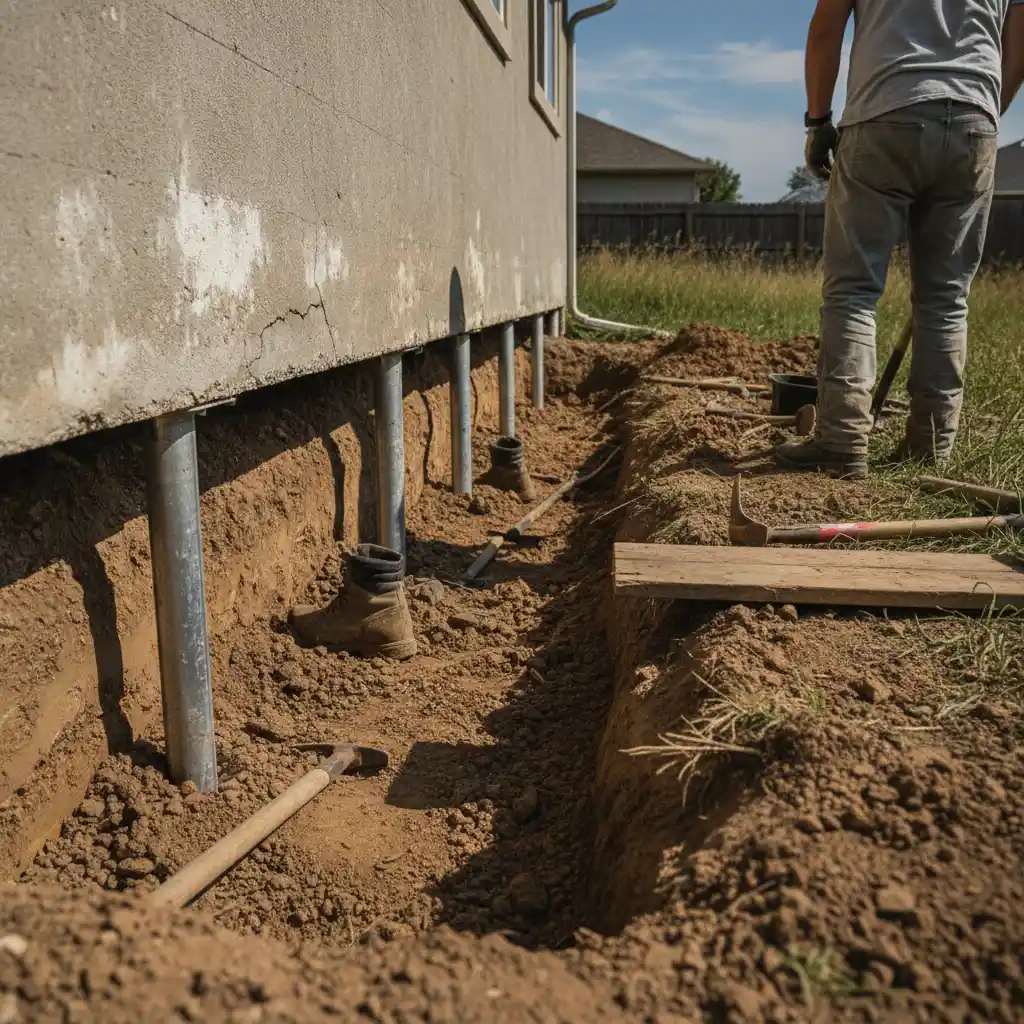
Our team in action — foundation-repair professionals serving Leander
Concrete Foundation Repair Methods We Use in Leander
Steel Pier Installation
Steel helical or push piers are driven through the unstable clay soils to bedrock or a load-bearing stratum, providing permanent, deep support. This is the most reliable long-term solution for Leander homes experiencing significant differential settlement, particularly in neighborhoods like Bryson and Travisso where clay soils extend 10 to 20 feet deep before reaching more stable limestone substrates. Learn more about Structural Foundation Repair using pier systems.
Pressed Concrete Pilings
Cylindrical concrete pilings pressed into the soil provide a cost-effective alternative to steel piers in areas where access is limited. Commonly used in older Block House Creek homes with tight landscaping around the perimeter.
Polyurethane Foam Injection
High-density expanding foam is injected beneath the slab through small drilled ports to fill voids and raise settled sections. This minimally invasive method is ideal for localized settlement in Leander’s garage floors, interior slab sections, and driveways where full pier systems are not warranted.
Mudjacking (Slabjacking)
A cement-soil slurry is pumped beneath settled concrete to lift and stabilize it. Effective for sidewalks, pool decks, and driveway aprons common in Leander’s master-planned communities.
Foundation Crack Patching and Sealing
Surface cracks are cleaned, routed, and filled with epoxy injection or polyurethane sealant to prevent water infiltration. Explore our Foundation Patching services for homes with minor cracking not requiring full structural intervention.
Ready for Concrete Foundation Repair? Get Your Free Estimate Today.
Round Rock Foundation Repair Group serves Leander and the surrounding area — we’ll be on-site within 24 hours.
📞 Call (512) 220-3502Concrete Foundation Repair Cost in Leander, TX
One of the most common questions we receive is about Concrete Foundation Repair in Leander, TX cost. Foundation repair pricing varies based on the severity of damage, the repair method used, the number of piers or treatment zones required, and site-specific factors like access and soil conditions. Below are typical ranges for Leander homeowners:
- Foundation Inspection: $200–$500 for a standalone professional inspection with elevation report
- Crack Patching and Sealing: $500–$2,500 for minor surface crack repairs
- Mudjacking / Slabjacking: $800–$3,500 depending on the area of coverage
- Polyurethane Foam Injection: $1,500–$5,000 for moderate void-filling and lifting
- Pressed Concrete Pilings: $2,500–$8,000 for a typical residential installation of 8–15 piers
- Steel Pier Systems: $6,000–$20,000+ for comprehensive stabilization of significant settlement, with the average Leander home requiring 10–18 piers
- Full Foundation Restoration: $10,000–$30,000 for severe cases requiring extensive pier networks and drainage correction
Leander-specific cost factors include the depth required to reach stable bearing soil beneath the Blackland Prairie clay transition (often 15–25 feet), which increases pier costs compared to areas with shallower limestone. Homes in newer developments like Bryson and Mason Hills with landscaping-heavy perimeters may also incur minor additional costs for access preparation.
Most homeowner’s insurance policies do not cover foundation repair caused by soil movement, though policies covering plumbing-induced damage may apply if a slab leak is the root cause. We provide detailed written estimates and work with you to understand all financing options available. Call (512) 220-3502 for a free estimate.
Leander Neighborhoods We Serve
Crystal Falls
One of Leander’s oldest and most established master-planned communities, Crystal Falls features homes built primarily between 1998 and 2012. These properties sit on some of the most reactive clay soils in western Williamson County and are now reaching the age range — 15 to 25 years — when foundation issues most commonly emerge. Stair-step brick cracking and sticking doors are frequent complaints from Crystal Falls homeowners.
Travisso
A newer luxury community developed in the 2015–2022 era on dramatically sloped terrain along FM 2243, Travisso homes face challenges related to cut-and-fill grading on limestone ridge terrain. Drainage management and differential settlement on fill portions of lots are the primary concerns here.
Block House Creek
One of Leander’s earliest subdivisions, with homes dating to the late 1980s and early 1990s, Block House Creek properties have aging foundations that predate modern post-tensioning standards. Many homes here have experienced multiple seasons of drought stress and are candidates for comprehensive Foundation Restoration services.
Bryson
A rapidly growing community near the new Leander commercial corridor along 183A, Bryson’s newer homes sit on heavily engineered lots that are still in their initial settlement period. Homeowners in Bryson should schedule proactive Foundation Inspections within the first 5 years of ownership.
Foundation Maintenance Tips for Leander Homeowners
The reactive clay soils throughout Leander make consistent foundation maintenance essential. Follow these location-specific best practices to reduce your risk of needing major repairs:
- Maintain consistent soil moisture year-round. During Leander’s hot, dry summers — when temperatures routinely exceed 100°F and rainfall can cease for 6–8 weeks — use a soaker hose system around your foundation perimeter to prevent extreme soil shrinkage. Run it 30–60 minutes, 3–4 times per week during drought.
- Ensure positive drainage away from your slab. Grading should slope at least 6 inches over the first 10 feet away from your foundation. Leander’s heavy thunderstorm events can deliver 2–4 inches of rain per hour, making proper grading critical.
- Clean and extend gutters and downspouts. Direct downspout discharge at least 5 feet away from the foundation perimeter, preferably into a French drain or swale.
- Monitor large trees near your foundation. Keep live oaks and cedar elms — common in Crystal Falls and Block House Creek — trimmed, and consider a root barrier if trees are within 15 feet of your slab.
- Fix plumbing leaks promptly. Even a slow slab leak can saturate subgrade soils over weeks. Watch your water meter for unexplained usage increases.
- Avoid over-watering landscape beds directly against the foundation. Saturated soils against the slab perimeter can cause heave in Leander’s clay soils just as readily as drying causes settlement.
- Schedule a professional inspection every 3–5 years. Proactive monitoring catches small issues before they become expensive problems.
Why Choose Round Rock Foundation Repair Group for Concrete Foundation Repair in Leander?
Round Rock Foundation Repair Group brings deep regional expertise to every Leander foundation project. We understand — from firsthand experience working across Williamson County — that Leander’s Blackland Prairie clay transition soils, seasonal drought cycles, and rapid development patterns create foundation challenges that demand more than generic repair solutions. Our team has evaluated and repaired foundations in virtually every Leander neighborhood, from the established homes of Crystal Falls and Block House Creek to the newest builds in Bryson and Travisso.
We serve homeowners throughout Leander and the surrounding communities including Cedar Park, Round Rock, Georgetown, Austin, Pflugerville, Brushy Creek, Avery Ranch, Anderson Mill, and beyond. View our full service area coverage to confirm we serve your neighborhood.
Our approach is built on honest assessment, transparent pricing, and technically sound repair methods matched to your specific site conditions. We never recommend more work than your foundation actually needs. We provide detailed written documentation of all work performed — important for Texas real estate disclosure requirements. For trusted, locally-focused concrete foundation repair in Leander, TX, call us at (512) 220-3502.
Frequently Asked Questions About Concrete Foundation Repair in Leander, TX
How much does concrete foundation repair cost in Leander, TX?
Costs range from approximately $500 for minor crack patching to $20,000 or more for comprehensive steel pier installation on a heavily settled home. The average Leander residential repair involving 10–15 steel piers typically runs between $8,000 and $15,000. Leander-specific factors like deep clay soils and hillside lots in areas like Travisso can push pier costs higher than the regional average due to the greater depth required to reach stable bearing soil.
How long does foundation repair take in Leander?
Most residential repairs are completed in 1 to 3 days of active work. A straightforward pier installation on a typical Leander slab home may be finished in a single day. Larger homes or those requiring drainage corrections may take 2–4 days. You can remain in your home throughout most repair processes.
Will foundation repair fix my sticking doors and cracked drywall?
Lifting and stabilizing the foundation frequently resolves door and window misalignment, though severely deformed frames may need adjustment after the repair settles. Drywall cracks can be patched after the structural work is complete and the foundation has stabilized — typically waiting 30 to 60 days post-repair before final cosmetic work is advisable.
Is foundation repair covered by homeowner’s insurance in Texas?
Standard Texas homeowner’s insurance policies (HO-3 and similar forms) exclude foundation damage caused by soil movement, which is the most common cause in Leander. However, if a plumbing leak beneath your slab caused or significantly contributed to the foundation damage, your policy’s dwelling coverage may apply. We recommend contacting your insurance provider and can provide documentation to support your claim if applicable.
How do I know if my Leander home’s foundation problem is serious?
Cracks wider than 1/4 inch, horizontal cracks in foundation walls, floors with noticeable slope measurable by a standard level (more than 1 inch over 8 feet), or doors that have completely stopped latching are all signs of significant movement requiring prompt professional evaluation. Schedule a Foundation Inspection with our team for a definitive assessment.
Do I need to worry about foundation issues in newer Leander homes built after 2015?
Yes. Many newer Leander developments including Bryson, Mason Hills, and parts of Travisso involve significant grading and fill soil work. Fill soils that were not adequately compacted will continue settling for years after construction. Newer homes built during the 2016–2022 Leander construction boom are now entering the 5–10 year window when fill settlement issues commonly become apparent.
What is the difference between foundation settlement and foundation heave?
Settlement occurs when soil beneath the foundation compresses or dries and shrinks, allowing the concrete to sink — common during Leander’s summer droughts. Heave occurs when soil absorbs moisture and expands upward, pushing the slab up — often seen after heavy rainfall following a drought period. Both cause differential movement and structural damage, but they require different treatment approaches, which is why accurate diagnosis before any repair is essential.
Can I sell my Leander home if it has foundation issues?
Texas law requires sellers to disclose known foundation problems on the Seller’s Disclosure Notice. Unrepaired foundation issues can significantly reduce your home’s market value and complicate mortgage financing. Completing a documented repair with a transferable warranty — and providing elevation reports before and after repair — typically protects and restores home value and satisfies lender requirements.
Get Expert Concrete Foundation Repair in Leander, TX Today
Don’t let Leander’s challenging clay soils and seasonal weather extremes put your home’s structural integrity at risk. The longer a foundation problem goes unaddressed, the more extensive — and expensive — the repair becomes. Round Rock Foundation Repair Group is ready to help you protect your most valuable investment with honest, thorough, and professionally executed concrete foundation repair services.
We serve Leander and all surrounding communities including Cedar Park, Round Rock, Georgetown, Austin, Pflugerville, Avery Ranch, Anderson Mill, Brushy Creek, and beyond.
Call us now at (512) 220-3502 to schedule your foundation inspection or to get a free estimate on your repair project. Our local team is standing by to answer your questions and get your Leander home back on solid ground.
Contact Round Rock Foundation Repair Group online to request a callback or submit your project details for a fast response.