Foundation Repair Methods in Georgetown, TX
Fast, Reliable Foundation Repair Methods in Georgetown in Georgetown, TX — Licensed & Insured
Discover proven foundation repair methods in Georgetown, TX. Round Rock Foundation Repair Group fixes slab, pier & beam, and commercial foundations. Call (512) 220-3502.
- Licensed & Insured
- Locally Owned & Operated
- Free Inspection & Estimate
Request Your
Free EstimateFoundation repair methods refer to the engineered techniques used to stabilize, lift, and restore a compromised foundation — whether it involves steel pier installation, pressed concrete pilings, carbon fiber wall reinforcement, or slab leveling with polyurethane foam. In Georgetown, TX, these methods are not one-size-fits-all. The region’s notorious expansive clay soils, dramatic seasonal moisture swings, and the legacy of rapid residential development across communities like Teravista, Serenada, and the Sun City neighborhood demand highly localized approaches.
At Round Rock Foundation Repair Group, we specialize in diagnosing and executing the right foundation repair method for every structure in Georgetown and the surrounding Williamson County corridor. From historic limestone cottages near the Georgetown Square to sprawling modern slab-on-grade homes in Wolf Ranch, our team brings deep regional knowledge and precision craftsmanship to every project. Call us today at (512) 220-3502 for a comprehensive foundation evaluation.
Understanding Foundation Repair Methods in Georgetown
Foundation repair is the process of arresting structural movement, restoring grade elevation, and reinforcing a building’s base to prevent further damage. It is not a single action but a family of methods — each engineered for specific soil conditions, structure types, load-bearing requirements, and failure modes. Understanding which method applies to your situation requires both geotechnical knowledge and construction experience.
Historically, foundations in Central Texas were built on post-tensioned concrete slabs or pier-and-beam systems resting directly atop the region’s naturally occurring Blackland Prairie soils. In the early 20th century, Georgetown’s downtown district saw construction of limestone block foundations — a durable but rigid system that cracks when the earth beneath heaves or subsides. By the 1970s and 1980s, slab-on-grade construction became the dominant residential method throughout Williamson County, with little engineering accommodation for the aggressive clay movement below.
Today, the primary foundation repair methods used across Georgetown include:
- Steel push piers and helical piers: Deep-driven piers that bypass unstable upper soils to reach load-bearing strata or bedrock.
- Pressed concrete pilings: Short-segment cylindrical pilings hydraulically driven into the soil, widely used in Central Texas for decades.
- Slab lifting with polyurethane foam (PolyLevel): High-density foam injected beneath a sunken slab to restore grade and fill voids.
- Carbon fiber strap reinforcement: Used to stabilize bowing or cracking basement and crawl space walls without excavation.
- Mudjacking (slabjacking): Pumping a cement-soil slurry beneath settled concrete to raise grade — common for driveways, sidewalks, and garage floors.
- Crawl space encapsulation and pier shimming: Targeted repairs for pier-and-beam homes experiencing moisture-related settling.
Georgetown’s building stock spans several eras. The 78626 and 78628 zip codes contain a mix of pre-1950 pier-and-beam homes, 1980s–2000s slab construction, and post-2010 master-planned community homes in developments like Wolf Ranch and Parkside on the River. Each era and build type carries different vulnerability profiles, and matching the correct repair method to the structure is what separates a lasting fix from a temporary patch.
For related repair services, see crawl space repair in Georgetown and concrete foundation repair options.
Signs You Need Foundation Repair in Georgetown
Interior Warning Signs
- Diagonal cracks running from door or window corners — especially at 45-degree angles from corners — indicating differential movement
- Doors and windows that stick, bind, or no longer latch properly, particularly during dry summer months in Georgetown
- Sloping or bouncy floors in pier-and-beam homes; uneven tile grout lines in slab homes
- Cracks in drywall, especially stair-step patterns along seams or separations at ceiling-wall joints
- Gaps appearing between interior walls and ceiling or floor trim
Exterior Warning Signs
- Stair-step cracking in brick veneer mortar joints — a hallmark of foundation settlement in Georgetown’s slab homes
- Visible gaps between the slab edge and brick or between the slab and porch/steps
- Cracks in the foundation stem wall or visible at the slab perimeter
- Leaning or bowing retaining walls near the structure
Urgency Indicators
Contact a professional immediately if you observe cracks wider than ¼ inch, doors that suddenly refuse to open or close in a new pattern, or any visible separation between structural elements. These may indicate active, accelerating movement requiring prompt intervention before damage escalates to plumbing, framing, or roofline distortion.
See also professional foundation inspection services to schedule a diagnostic assessment.
Our Foundation Repair Process in Georgetown, TX
Initial Contact and Scheduling (Day 1)
Call us at (512) 220-3502 or submit a request online. Our Georgetown-area scheduling coordinator will typically arrange a site visit within 1–3 business days, prioritizing urgent structural cases. We serve all Georgetown zip codes: 78626, 78628, and 78633.
Comprehensive Foundation Inspection (Day 1–2, 1–3 Hours On-Site)
Our certified inspector performs a full interior and exterior survey, including floor elevation mapping with a zip-level or digital manometer (measuring to 1/10 of an inch), crack pattern analysis, moisture probe readings, and a plumbing leak assessment recommendation if slab leaks are suspected. We document all findings with photographs and annotated diagrams.
Soil and Site Analysis (Days 2–3)
For Georgetown properties, our process includes reviewing USDA Web Soil Survey data for the specific parcel, identifying Heiden, Houston Black, or Burleson clay soil classifications common in Williamson County, and assessing drainage patterns, tree proximity, and irrigation system influence on soil moisture distribution.
Repair Plan and Proposal (Days 3–5)
We deliver a written repair plan specifying the recommended method, pier layout diagram, number of piers or lift points, expected elevation recovery, and a detailed cost proposal with itemized line items. We explain all options clearly so homeowners can make informed decisions.
Permitting (If Required, 3–10 Business Days)
Certain foundation repair scopes in Georgetown require a City of Georgetown building permit. We manage the permit application with the Georgetown Development Services department on your behalf, including any required engineering drawings for permitted projects.
Foundation Repair Execution (1–5 Days Depending on Scope)
Our crews mobilize with minimal landscape disruption. Steel pier installation typically proceeds at 8–15 piers per day. Foam injection jobs are often completed in a single day. We perform final elevation readings after all piers are loaded and lifting is complete to verify target grades are achieved.
Site Restoration and Final Walkthrough (Final Day)
We backfill, compact, and restore the work area. Our project manager conducts a final walkthrough, reviews all documentation with you, and explains post-repair care specific to Georgetown’s climate — including seasonal watering recommendations for the surrounding soil.
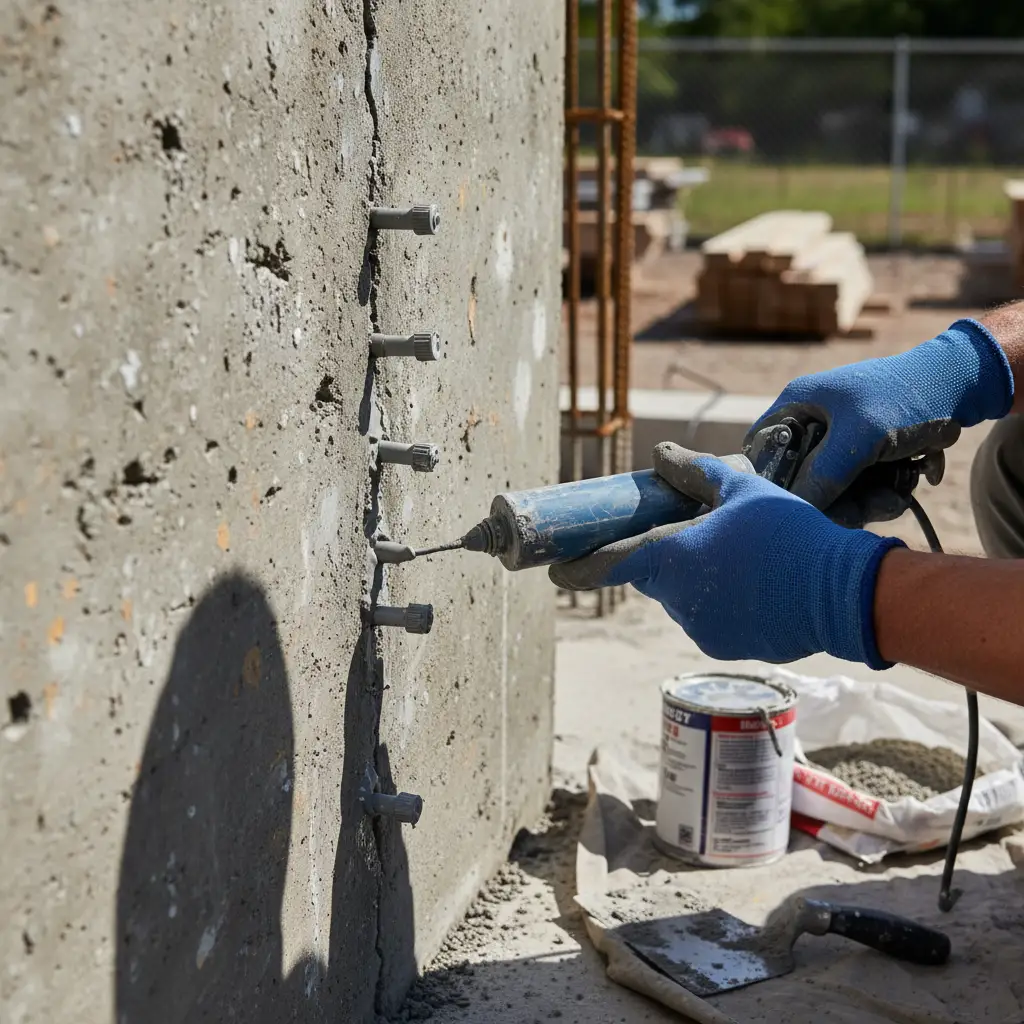
Our team in action — foundation-repair professionals serving Georgetown
Foundation Repair Methods and Approaches We Use in Georgetown
1. Steel Push Piers
Hydraulically driven steel pier sections are advanced through Georgetown’s upper clay layers (typically 20–40 feet) until reaching the competent limestone or dense caliche bearing strata characteristic of the Edwards Plateau transition zone. Ideal for significant settlement, heavier structures, and homes near the San Gabriel River corridor. Load capacity: 70,000–100,000 lbs per pier.
2. Helical Piers
Helical piers are screwed into the soil using torque-monitored hydraulic drives, providing immediate load capacity without the need for dead weight. Preferred for lighter structures, additions, porch repairs, and areas with limited access. Particularly effective in Georgetown’s sandy alluvial zones near creek bottoms.
3. Pressed Concrete Pilings
A time-tested Central Texas method, concrete cylinders are hydraulically pressed in sections to refusal depth. Cost-effective for moderately settled homes and widely used throughout Georgetown’s 1980s–2000s residential stock. Less suitable for heavily loaded commercial structures.
4. Polyurethane Foam Slab Lifting
High-density, two-part expanding foam is injected through 5/8-inch drill holes to fill voids and lift settled slab sections. Ideal for garage floors, interior slab panels, driveways, and sidewalks around Georgetown homes. Cures in 15 minutes; minimal disruption.
5. Carbon Fiber Wall Reinforcement and Drainage Correction
For crawl space structures and basement walls exhibiting inward bowing, carbon fiber straps provide tensile reinforcement without excavation. Paired with interior French drain or exterior grading corrections to address root moisture causes common in Georgetown’s established neighborhoods.
Learn more about structural foundation repair methods and home foundation repair solutions.
Ready for Foundation Repair Methods? Get Your Free Estimate Today.
Round Rock Foundation Repair Group serves Georgetown and the surrounding area — we’ll be on-site within 24 hours.
📞 Call (512) 220-3502Foundation Repair Methods Cost in Georgetown, TX
Foundation repair costs in Georgetown vary significantly based on method, scope, soil conditions, and structure type. Below are typical ranges based on current market conditions in Williamson County:
- Foundation Inspection: $200–$500 for a professional inspection with written report; some companies offer free estimates for repair projects.
- Pressed Concrete Pilings: $1,200–$1,800 per pier installed; average Georgetown slab home repair runs $5,000–$14,000 depending on pier count (typically 8–18 piers for a standard single-story home).
- Steel Push Piers: $1,500–$2,500 per pier; full-perimeter repairs on larger Georgetown homes can range from $12,000–$30,000+.
- Helical Piers: $1,800–$3,000 per pier installed; favored for targeted repairs and lighter structures.
- Polyurethane Foam Lifting: $800–$2,500 per zone; full driveway or interior slab lifts typically range $1,500–$5,000.
- Crawl Space Repairs: $3,000–$10,000+ depending on beam replacement, pier shimming, and encapsulation scope.
Georgetown-Specific Cost Factors
Georgetown’s high-PI Blackland soils often require deeper pier penetration — reaching 20–40 feet to hit reliable bearing — which increases material and labor cost compared to areas with shallower stable strata. Permitting fees through the City of Georgetown Development Services add $150–$400 for applicable projects. Homes in flood-adjacent zones near the San Gabriel River may require additional geotechnical assessments ($500–$1,500) prior to repair planning.
Financing options are available for qualifying Georgetown homeowners. Contact us at (512) 220-3502 for a free, no-obligation estimate. For more details, see foundation repair cost information.
Georgetown Neighborhoods We Serve
Sun City Georgetown
This large Del Webb active-adult community, built primarily from the late 1990s through the 2010s, features slab-on-grade construction on Georgetown’s characteristic Houston Black clay soils. The neighborhood’s age and extensive irrigation systems create localized moisture differentials that produce common differential settlement patterns. We regularly service Sun City homes with steel pier and pressed piling solutions.
Wolf Ranch
One of Georgetown’s fastest-growing master-planned communities, Wolf Ranch sits on mass-graded terrain with relatively young, disturbed soils. Early-phase homes built between 2018–2022 are now entering the 3–7 year window when post-construction soil consolidation settlement frequently manifests. Polyurethane lifting and targeted helical pier repairs are common here.
Serenada
An established subdivision northwest of Georgetown dating to the 1970s–1980s, Serenada homes are built on mature Blackland clay and feature aging slab construction. The 2011 drought caused notable foundation movement here. Many properties benefit from perimeter steel pier systems and updated drainage correction.
Georgetown Village and Berry Creek
These mid-2000s communities along the FM 971 and SH 195 corridors feature both slab and pier-and-beam construction. Mature Live Oak coverage accelerates localized clay desiccation, and aging plumbing increases slab leak risk. We address both structural repair and moisture source identification in these neighborhoods.
We also serve Round Rock, Cedar Park, and Austin.
Foundation Maintenance Tips for Georgetown Homeowners
Given Georgetown’s expansive clay soils and seasonal extremes, proactive maintenance can significantly extend the life of your foundation repair and reduce future movement risk:
- Maintain consistent soil moisture year-round. Use a soaker hose system placed 12–18 inches from your foundation perimeter during Georgetown’s dry summers (typically May–September) to prevent clay shrinkage and void formation beneath your slab.
- Ensure positive drainage away from the foundation. Grade soil so water flows away at a minimum slope of 6 inches over 10 feet — critical during Georgetown’s intense spring rain events.
- Clean gutters and extend downspouts. Direct roof runoff at least 5–6 feet from the foundation using splash blocks or underground drain extensions.
- Monitor and repair plumbing leaks promptly. Schedule a hydrostatic plumbing test every 5–7 years, especially for Georgetown homes built before 2005 with polybutylene or older PVC slab plumbing.
- Manage trees strategically. Avoid planting Live Oaks, Cedar Elms, or Hackberries within 20 feet of your foundation. For existing trees, root barriers can redirect moisture extraction away from the slab.
- Inspect your foundation annually. Walk the perimeter each spring after the wet season and each fall after the dry season — Georgetown’s two most revealing transition windows for new crack formation.
- Avoid overwatering near the foundation. Excessive irrigation creates heave in Georgetown’s clay soils just as surely as drought creates shrinkage.
Why Choose Round Rock Foundation Repair Group in Georgetown
Round Rock Foundation Repair Group has built its reputation serving homeowners and commercial property owners across Williamson County and the greater Austin metro. Our team understands the specific geotechnical challenges of Georgetown’s Blackland Prairie soils, the construction patterns of the area’s diverse housing stock, and the regulatory requirements of the City of Georgetown’s permitting process.
We bring the same rigorous diagnostic process to every project — whether it’s a historic pier-and-beam home near the Georgetown Square or a newly constructed slab home in Parkside on the River. Our repair plans are engineered for permanence, not temporary cosmetic fixes.
Every repair proposal includes a detailed written scope, a pier layout diagram, and transparent pricing with no hidden fees. We manage permitting, communicate proactively throughout the project, and restore your property with minimal disruption.
Serving Georgetown, Round Rock, Cedar Park, Austin, Pflugerville, Brushy Creek, Avery Ranch, Anderson Mill, and all surrounding communities — we are your local foundation repair specialists. Call (512) 220-3502 to schedule your Georgetown foundation evaluation today.
Explore our commercial foundation repair and foundation restoration services for all property types.
Frequently Asked Questions About Foundation Repair Methods in Georgetown, TX
What is the most common foundation repair method used in Georgetown?
In Georgetown, pressed concrete pilings and steel push piers are the two most frequently used methods for slab-on-grade homes. Pressed pilings are cost-effective for moderate settlement in mid-range homes, while steel piers are preferred for heavier structures or cases requiring deeper penetration into Georgetown’s limestone and caliche bearing layers. The best method depends on your specific soil profile, structure type, and the degree of settlement involved.
How much does foundation repair cost in Georgetown, TX?
Foundation repair in Georgetown typically ranges from $5,000 to $20,000 for residential slab repairs, with average projects falling between $8,000 and $14,000. Costs depend on the number of piers required, the repair method chosen, soil depth to bearing strata, and whether permits are required. We provide free, detailed written estimates — call (512) 220-3502 to schedule yours.
How long does foundation repair take in Georgetown?
Most residential foundation repairs in Georgetown are completed in 1–3 days once the project begins. The pre-construction phase — including inspection, plan development, and permitting if required — typically takes 1–3 weeks. Larger commercial projects or complex scopes may require 5–7 days of active repair work.
Will Georgetown’s clay soils cause my foundation to move again after repair?
Properly installed deep piers — steel push piers or helical piers reaching competent limestone bearing — bypass the expansive clay layer entirely, anchoring your structure to stable strata below the zone of seasonal moisture influence. This significantly reduces the risk of recurrence. However, no repair eliminates the underlying soil chemistry; ongoing maintenance, controlled irrigation, and drainage management remain important for Georgetown homeowners.
Do I need a permit for foundation repair in Georgetown?
Permit requirements depend on the scope of work. Many pier installations are performed under homeowner or contractor exemptions, but certain structural repair scopes — particularly those involving beam replacement, significant slab work, or engineered repair plans — require a permit from the City of Georgetown Development Services department. We review permit requirements for every project and manage the application process on your behalf when needed.
How do I know if my Georgetown home needs foundation repair or just cosmetic patching?
Cosmetic crack patching is appropriate only when cracks are stable, superficial, and not indicative of ongoing movement. Active structural movement is indicated by cracks wider than ¼ inch, recurring cracks that reopen after patching, door and window binding that changes seasonally, or measurable floor slope. A professional elevation survey using digital level equipment is the only reliable way to distinguish cosmetic from structural issues. See our foundation inspection service for details.
Does the 2011 drought damage still affect Georgetown foundations today?
Yes. The 2011 drought caused deep, dramatic soil moisture loss beneath Georgetown foundations, and in many cases, soils never fully re-saturated to pre-drought equilibrium. Homes that experienced movement in 2011 and received repairs at that time may have seen secondary movement in subsequent drought cycles (2022–2023). Homeowners in Serenada, Sun City, and other neighborhoods with 1990s–2000s construction should have any post-2011 repair work reassessed if new cracking has emerged.
Can you repair foundation issues in Georgetown commercial buildings?
Yes. We provide commercial foundation repair throughout Georgetown, including retail centers along Williams Drive and Austin Avenue, office buildings, light industrial structures, and multi-family properties. Commercial repairs often require engineered repair plans, and we coordinate with structural engineers as needed for permitted commercial scopes.
Schedule Your Georgetown Foundation Repair Evaluation Today
If your Georgetown home or commercial property is showing signs of foundation movement — sticking doors, cracked brick, sloping floors, or visible slab gaps — don’t wait for small problems to become costly structural emergencies. Round Rock Foundation Repair Group is ready to help with a thorough, honest assessment and a clear repair plan tailored to Georgetown’s unique soil and climate conditions.
Call us now at (512) 220-3502 to speak with a Georgetown foundation specialist or to schedule your on-site evaluation. We serve all Georgetown zip codes — 78626, 78628, and 78633 — as well as Round Rock, Cedar Park, Austin, Pflugerville, and all surrounding Williamson County communities.
Get the right repair method, the first time. Contact Round Rock Foundation Repair Group today.