Foundation Problems in Round Rock in Cedar Park, TX
Structural Foundation Problems in Round Rock Specialists Serving Cedar Park, TX
Dealing with foundation problems in Round Rock near Cedar Park, TX? Round Rock Foundation Repair Group offers expert inspections & repairs. Call (512) 220-3502 today.
- Licensed & Insured
- Locally Owned & Operated
- Free Inspection & Estimate
Request Your
Free EstimateFoundation problems are among the most serious structural challenges a property owner in Cedar Park, TX can face. Whether you’ve noticed diagonal cracks running from your door frames, sticky windows that no longer close properly, or visible gaps between your walls and ceiling, these are warning signs that your foundation may be shifting, settling, or failing beneath you. At Round Rock Foundation Repair Group, we specialize in diagnosing and resolving foundation problems across Cedar Park and the greater Round Rock area, where the region’s expansive clay soils and dramatic weather swings create some of the most challenging conditions for residential and commercial foundations in all of Central Texas.
Our experienced team brings deep local knowledge of Cedar Park’s unique geology, soil behavior, and construction history to every project. From older ranch-style homes in established Cedar Park neighborhoods to newer builds in master-planned communities, we deliver durable, code-compliant foundation solutions designed for this specific landscape. Call us today at (512) 220-3502 for a professional assessment.
Understanding Foundation Problems in Round Rock
Foundation problems encompass a broad spectrum of structural issues that occur when the ground beneath a building shifts, settles unevenly, or loses its load-bearing capacity. In Central Texas, and specifically in the Cedar Park and Round Rock corridor, foundations are most commonly constructed as post-tension concrete slabs, pier-and-beam assemblies, or conventional reinforced concrete slabs. Each type carries its own vulnerability profile, especially given the volatile soil conditions that define Williamson County and northern Travis County.
Historically, Cedar Park was a small agricultural community before rapid suburban development transformed it through the 1990s and 2000s. Much of the housing stock built during that boom era — particularly homes constructed between 1995 and 2010 — was placed on soils that were not thoroughly stabilized or compacted to current standards. As Cedar Park’s population surged past 79,000 residents, the volume of homes sitting atop problematic soils grew proportionally, making foundation repair a frequently needed service throughout the city.
Foundation problems are not purely a residential concern. Commercial structures, retail centers, and multi-family developments along Whitestone Boulevard and New Hope Drive also experience foundation movement due to the weight loads they place on expansive soils. When foundations fail, the consequences cascade through the entire structure: framing shifts, plumbing lines crack, doors and windows bind, and interior finishes separate or buckle.
The Blackland Prairie and Del Rio clay formations that run through Cedar Park and Round Rock are classified as high-plasticity clays, meaning they swell significantly when saturated and shrink dramatically during drought. This cyclical expansion and contraction — sometimes measured at 3 to 5 inches of vertical soil movement in a single season — is the primary driver of foundation distress in the area. Understanding this root cause is essential to selecting the right repair approach and ensuring the solution lasts for decades rather than months.
Foundation problems left unaddressed do not stabilize on their own. They worsen progressively, and early intervention is almost always significantly less expensive than deferred repair. Schedule a Foundation Inspection to catch problems early before minor settling becomes major structural failure.
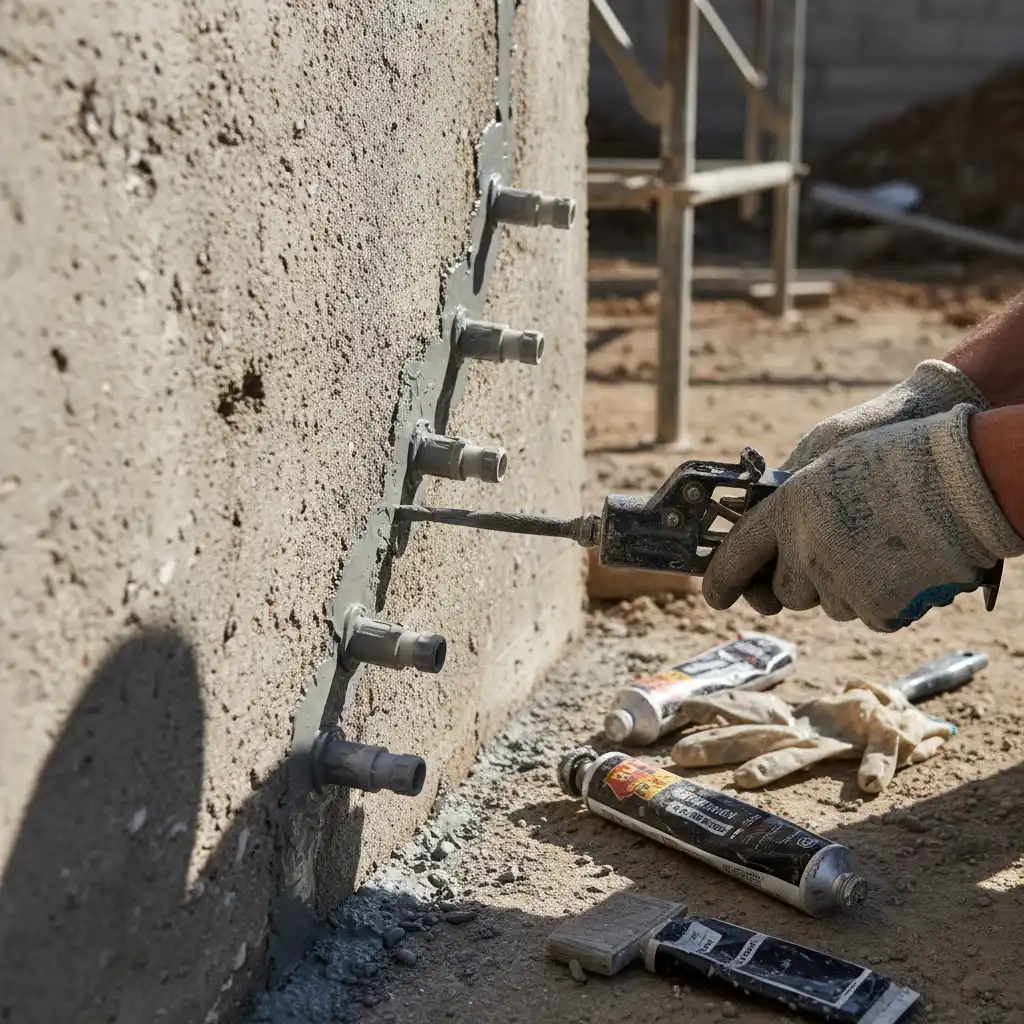
Our team in action — foundation-repair professionals serving Cedar Park
Why Foundation Problems Are So Common in Cedar Park, TX
Expansive Clay Soils
The dominant soil type beneath much of Cedar Park is classified by the USDA as Houston Black Clay and Austin Clay — both high-shrink-swell soils carrying a Potential Volume Change (PVC) rating of 4 to 6 or higher on the standard scale used by Texas geotechnical engineers. These soils can absorb water and expand by up to 30% in volume during wet seasons, then contract sharply as moisture evaporates during hot, dry summers. Neighborhoods built directly on undisturbed Blackland Prairie soils — including portions of Buttercup Creek, Cypress Canyon, and Ranch at Cypress Creek — are particularly susceptible to this movement cycle.
The Texas Drought Cycles
Central Texas experiences some of the most dramatic drought-to-flood swings in the nation. The historic 2011 drought — the worst single-year drought in Texas recorded history — caused widespread foundation damage across Cedar Park as soil moisture levels plummeted and clay soils contracted violently beneath existing slabs. Many homeowners in subdivisions like Riviera Springs and Cedar Park Estates first noticed significant cracking and door-frame distortion during and after that summer, when soil moisture deficits reached as deep as 8 to 10 feet below the surface. Similar, though less extreme, drought conditions in 2022 and 2023 renewed foundation movement across the same communities.
Seasonal Rainfall Variability
Cedar Park averages approximately 33 to 36 inches of annual rainfall, but that precipitation arrives in unpredictable bursts rather than steady increments. Flash flood events — such as the significant flooding that struck the Brushy Creek floodplain in May 2015 and again in October 2018 — can saturate foundation soils rapidly, causing upward heaving. Conversely, extended dry spells cause rapid soil moisture loss. This boom-and-bust moisture cycle, sometimes oscillating within a single calendar month, imposes constant stress on concrete slabs and pier systems.
Development-Era Construction Practices
Homes built in Cedar Park during the rapid growth period of 1998 to 2008 frequently sit on minimally engineered fill or on lots where native clay was not properly treated with lime stabilization prior to construction. Subdivisions like Forest Oaks, Crossing at Carriage Hills, and Twin Creeks contain homes from this era where soil preparation did not meet the more rigorous standards now required under current Williamson County and City of Cedar Park development codes. Post-tension slab failures are disproportionately common in this construction vintage.
Tree Root Intrusion and Landscaping
Cedar Park’s mature live oak and cedar elm tree canopy — a valued aesthetic feature of the community — creates localized soil moisture competition near foundations. Large trees within 15 to 20 feet of a structure can pull hundreds of gallons of moisture from foundation soils daily during summer months, creating differential drying that causes one side of a slab to drop while the other remains stable. Learn more about Home Foundation Repair solutions tailored to Cedar Park’s specific tree and soil conditions.
Signs You Need Foundation Problem Services in Cedar Park
Interior Warning Signs
- Diagonal cracks running at 45-degree angles from door frame corners or window corners
- Horizontal or stair-step cracks in drywall, particularly along interior load-bearing walls
- Floors that feel soft, springy, or visibly slope more than 1 inch per 8 feet of run
- Interior doors that stick, bind, or no longer latch without force
- Gaps between the floor and baseboards, or between the ceiling and crown molding
- Cracked or buckled floor tile, especially in centrally located bathrooms or kitchens
Exterior Warning Signs
- Visible cracks in the brick veneer, particularly stair-step cracks in mortar joints
- Gaps between the brick and window or door frames wider than 1/8 inch
- The foundation perimeter visibly dropping or rising relative to its original grade
- Chimney separating from the main structure
- Standing water pooling within 3 feet of the foundation after rain events
Urgency Indicators
If you observe cracks wider than 1/4 inch, visible structural bowing in walls, or sudden dramatic changes in door and window operation — especially following a dry summer or a heavy rainfall event — treat these as urgent. Contact Round Rock Foundation Repair Group at (512) 220-3502 immediately for an emergency foundation inspection.
Foundation Repair Methods We Use in Cedar Park, TX
Steel Push Piers
Steel push piers are driven hydraulically through unstable soil layers until they reach load-bearing bedrock or competent stratum — often limestone at depths of 18 to 30 feet beneath Cedar Park’s clay layers. This method is ideal for slab foundations experiencing significant settlement and is our most commonly used approach in Williamson County’s deep-clay zones. Learn about our Structural Foundation Repair services.
Helical Piers
Helical piers feature screw-like plates that are torqued into the ground mechanically, providing both compressive and tensile load capacity. They are well-suited for lighter structures, additions, porches, and properties with limited equipment access — common in Cedar Park’s older neighborhoods with narrow side yards.
Concrete Pressed Piles
Pressed concrete cylinders are hydraulically driven into the ground in segments. This method is cost-effective for moderate settlement scenarios and is commonly used throughout the Round Rock and Cedar Park corridor for residential post-tension slabs.
Polyurethane Foam Injection
For voids beneath settled concrete slabs, driveways, or interior floors, expanding polyurethane foam is injected through small drill holes to fill voids and lift settled sections with minimal disruption. This is frequently used in Cedar Park commercial properties along Whitestone Boulevard where downtime must be minimized. Explore our Concrete Foundation Repair options.
Crawl Space Repair and Encapsulation
For pier-and-beam homes — a construction type found in Cedar Park’s pre-1980 housing stock near the downtown core — we provide interior beam shimming, post replacement, and full crawl space encapsulation to control moisture infiltration from Cedar Park’s seasonally humid conditions. See our Crawl Space Repair services.
Ready for Foundation Problems? Get Your Free Estimate Today.
Round Rock Foundation Repair Group serves Cedar Park and the surrounding area — we’ll be on-site within 24 hours.
📞 Call (512) 220-3502Foundation Problem Repair Costs in Cedar Park, TX
Understanding the cost of foundation repair in Cedar Park helps property owners plan appropriately and avoid being caught off guard. Costs vary widely depending on the severity of the problem, the repair method required, soil conditions, and the size of the structure.
Typical Cost Ranges
- Foundation Inspection: $200 – $500 for a comprehensive professional assessment with elevation mapping
- Minor Foundation Patching and Crack Repair: $500 – $2,500 for surface crack filling and cosmetic repairs
- Concrete Pressed Piles (Per Pier): $350 – $500 per pier installed; average Cedar Park residential job requires 8 to 20 piers, totaling $3,500 – $12,000
- Steel Push Piers (Per Pier): $1,200 – $1,800 per pier; larger homes in Teravista or Forest Creek may require 15 to 25 piers, with total project costs ranging from $18,000 – $45,000 for severe cases
- Polyurethane Foam Injection: $1,500 – $5,000 depending on void size and number of injection points
- Crawl Space Repair and Encapsulation: $3,000 – $12,000 depending on square footage and scope
- Full Foundation Restoration for Large Commercial Structures: $30,000 – $150,000+
Cedar Park-Specific Cost Factors
Homes in western Cedar Park neighborhoods like Cypress Canyon, where the Balcones Escarpment creates a limestone-clay soil transition, often require specialized drilling equipment that adds 10 to 20% to pier installation costs. Properties in flood-prone areas adjacent to Brushy Creek may require additional drainage remediation work. Permit fees through the City of Cedar Park Building Department currently range from $150 to $400 for most foundation repair permits.
Call (512) 220-3502 for a free, no-obligation on-site estimate. See detailed Foundation Problems cost information.
Cedar Park and Round Rock Neighborhoods We Serve
Buttercup Creek, Cedar Park
Developed primarily in the late 1980s and early 1990s, Buttercup Creek sits on classic Blackland Prairie clay soils with minimal soil treatment. Homes here commonly present with perimeter settlement, stair-step brick cracks, and sticky interior doors — all classic high-plasticity clay responses.
Twin Creeks, Cedar Park
Built out between 2000 and 2008, Twin Creeks features homes on post-tension slabs over mixed clay and fill soils. The 2011 drought caused measurable movement in this subdivision, and we have completed numerous pier installations and foundation restorations here. Learn about Foundation Restoration services.
Teravista, Round Rock
Teravista’s relatively newer construction (2005–2015) does not insulate it from foundation problems. Expansive Del Rio clay beneath parts of this community drives ongoing differential settlement, particularly in homes with mature trees planted close to the foundation perimeter.
Forest Creek, Round Rock
Forest Creek’s established tree canopy creates significant foundation moisture variability. Older homes (1990s construction) on conventional slabs in this neighborhood frequently require interior pier installation due to center-lift heave patterns.
Avery Ranch, Austin (78717)
Straddling the Austin-Cedar Park boundary, Avery Ranch homes frequently exhibit foundation movement related to both clay soils and the subdivision’s retention pond system, which creates localized high-moisture zones adjacent to some lots.
Foundation Maintenance Tips for Cedar Park Homeowners
Proactive maintenance is the most cost-effective strategy for managing foundation health in Cedar Park’s challenging soil and climate environment. Follow these location-specific tips to minimize foundation movement risk:
- Maintain Consistent Soil Moisture Year-Round: Use a soaker hose system placed 12 to 18 inches from the foundation perimeter during dry summers and fall drought periods. Consistent moisture prevents the soil contraction that drives perimeter settlement in Cedar Park’s clay soils.
- Ensure Positive Drainage Away from the Foundation: Grade all landscaping soil to slope at least 6 inches downward within the first 10 feet from your foundation. Cedar Park’s heavy clay soils do not absorb water quickly, making surface drainage critical.
- Clean and Maintain Gutters Seasonally: Clogged gutters concentrate roof runoff at foundation corners, a leading cause of localized heave and settlement in Cedar Park homes.
- Keep Large Trees at Safe Distances: Avoid planting live oaks, cedar elms, or pecans within 15 feet of the foundation. For existing trees, consult an arborist about root barrier installation.
- Monitor Irrigation Systems: Broken or misdirected irrigation heads that saturate foundation-adjacent soil are a common cause of heave in Cedar Park’s irrigated subdivisions. Inspect heads seasonally.
- Inspect Plumbing for Leaks: Under-slab plumbing leaks — common in Cedar Park’s aging copper and cast-iron plumbing systems — saturate foundation soils and cause localized heave. Annual plumbing pressure testing is recommended.
- Schedule Annual Foundation Inspections: Cedar Park’s volatile seasonal soil moisture swings warrant annual professional monitoring. Book an annual Foundation Inspection with our team.
Why Choose Round Rock Foundation Repair Group in Cedar Park, TX
When you’re facing foundation problems in Cedar Park, you need a repair partner with genuine local expertise — not a national franchise that applies generic solutions to Cedar Park’s highly specific soil and climate conditions. Round Rock Foundation Repair Group is built around deep knowledge of the Williamson County and northern Travis County geological and climatic environment.
We have worked extensively across Cedar Park, Round Rock, Georgetown, Austin, Pflugerville, Brushy Creek, and surrounding communities, giving us firsthand familiarity with how foundations behave in each specific neighborhood — from the deep Blackland clays of Buttercup Creek to the limestone transition zones of Cypress Canyon to the fill-soil challenges of Twin Creeks.
Our team provides honest, transparent assessments. We do not recommend repairs that are not warranted, and we explain every option clearly before asking for your commitment. We serve both residential and commercial clients, handling everything from single-family home slab repairs to large commercial foundation restoration projects. Explore our Commercial Foundation Repair capabilities.
We are committed to delivering durable solutions that perform through Cedar Park’s punishing seasonal cycles. Call (512) 220-3502 to speak with a local expert today.
Frequently Asked Questions About Foundation Problems in Cedar Park, TX
How much does foundation repair cost in Cedar Park, TX?
Foundation repair costs in Cedar Park range widely based on the severity of the problem and the repair method required. Minor patching and crack repairs may cost $500 to $2,500, while a mid-range residential pier installation project typically runs $8,000 to $18,000. Severe cases requiring 20 or more steel push piers can reach $30,000 to $45,000. Cedar Park’s clay soil conditions and, in western neighborhoods, limestone drilling requirements can push costs above the regional average. Contact us at (512) 220-3502 for a free site-specific estimate.
How long does foundation repair take in Cedar Park?
Most residential foundation repair projects in Cedar Park are completed in 1 to 3 days once work begins. Larger commercial projects or complex residential repairs may take 4 to 7 days. The inspection, proposal, and permitting phase typically adds 5 to 10 business days before physical work starts.
Why are foundation problems so common in Cedar Park specifically?
Cedar Park sits on some of the most expansive clay soils in Central Texas, classified as Houston Black and Austin Clay with high plasticity index ratings. Combined with Cedar Park’s extreme drought-to-flood weather cycles — as demonstrated dramatically during the 2011 drought — these soils impose constant movement stress on foundations. Rapid development between 1998 and 2008 also resulted in a large housing inventory built on inadequately prepared soils.
Can I sell my Cedar Park home with known foundation problems?
Texas law requires disclosure of known material defects, including foundation issues, when selling a home. Unrepaired foundation problems significantly affect property value and can derail financing approvals. Repairing foundation problems before listing typically increases sale price by more than the cost of repair and removes a major buyer concern.
Will my homeowner’s insurance cover foundation repair in Cedar Park?
Standard homeowner’s insurance policies in Texas typically exclude foundation damage caused by soil movement, drought, or settlement — the most common causes in Cedar Park. Coverage may apply if foundation damage results from a sudden, accidental plumbing leak. We recommend reviewing your specific policy and consulting your insurer before assuming coverage applies.
Do I need a permit for foundation repair in Cedar Park?
Permit requirements vary depending on the scope and method of repair. The City of Cedar Park Building Inspection Division requires permits for structural foundation work in most cases. Round Rock Foundation Repair Group handles all permit applications on your behalf as part of our project management process.
How can I tell if my Cedar Park home has foundation problems or just normal settling?
All structures experience minor settling, especially in Cedar Park’s active clay soils. Warning signs that indicate problematic — rather than cosmetic — movement include cracks wider than 1/8 inch, cracks that return after being patched, doors or windows that suddenly become difficult to operate, or visible floor slope measurable with a level. A professional elevation survey is the definitive way to distinguish normal settling from active structural movement. Schedule a Foundation Inspection to get a definitive answer.
Do you serve areas outside Cedar Park?
Yes. Round Rock Foundation Repair Group serves Cedar Park, Round Rock, Georgetown, Austin, Pflugerville, Brushy Creek, Tech Ridge, Wells Branch, Jollyville, and surrounding communities including Teravista, La Frontera, Avery Ranch, Great Hills, Mayfield Ranch, Anderson Mill, Cat Hollow, Forest Creek, Behrens Ranch, Sendero Springs, and Paloma Lake. View our complete service area.
Contact Round Rock Foundation Repair Group Today
Don’t wait for foundation problems in Cedar Park to become a structural crisis. Whether you’ve noticed the first hairline crack in your drywall or you’re dealing with doors that no longer close and floors that visibly slope, the experienced team at Round Rock Foundation Repair Group is ready to help. We serve Cedar Park, Round Rock, Georgetown, Austin, and all surrounding communities with honest assessments, expert repairs, and solutions engineered for Central Texas’s unique soil and climate conditions.
Call us now at (512) 220-3502 to schedule your professional foundation inspection. Same-week appointments are typically available throughout the Cedar Park area. You can also send us a message online and a local foundation expert will respond promptly. Protecting your foundation means protecting your entire investment — let’s get started today.