Foundation Settling in Cedar Park, TX
Structural Foundation Settling Specialists Serving Cedar Park, TX
Struggling with foundation settling in Cedar Park, TX? Round Rock Foundation Repair Group fixes Taylor Clay settling issues fast. Free estimates — call (512) 220-3502.
- Licensed & Insured
- Locally Owned & Operated
- Free Inspection & Estimate
Request Your
Free EstimateFoundation settling is the gradual downward movement of a home or building’s foundation as the soil beneath it shifts, compresses, or loses volume over time. In Cedar Park, TX, this process is accelerated by the region’s notorious expansive clay soils, seasonal drought cycles, and the rapid development that has reshaped the Brushy Creek corridor over the past two decades. Left unaddressed, settling can progress from minor cosmetic cracks to severe structural compromise affecting your home’s safety and resale value.
Round Rock Foundation Repair Group brings deep regional expertise to every foundation settling case in Cedar Park. Our team understands the specific soil profiles found beneath neighborhoods like Avery Ranch and Anderson Mill, the moisture fluctuations tied to Central Texas weather patterns, and the construction standards common to homes built during Cedar Park’s explosive growth era of the 1990s through 2010s. If your home is showing signs of uneven settling, we are ready to help. Call us today at (512) 220-3502.
Understanding Foundation Settling in Cedar Park, TX
Foundation settling refers to the natural and often unavoidable process by which a structure’s foundation moves downward relative to its original elevation. Engineers distinguish between uniform settling, where the entire foundation descends at roughly the same rate and causes minimal structural damage, and differential settling, where different sections of the foundation sink at different rates, generating stress, cracks, and misalignment throughout the structure.
All foundations experience some degree of settling immediately after construction as the disturbed soil beneath them re-compresses under the weight of the new structure. In typical conditions, this initial settling period lasts one to three years and produces movement of less than half an inch. In Cedar Park and the broader Williamson County area, however, the underlying geology creates conditions where settling continues well beyond that initial window and can accumulate several inches of differential movement over the lifespan of a building.
Cedar Park experienced a population boom that took it from roughly 5,000 residents in 1990 to over 80,000 by the early 2020s. This rapid development meant that thousands of homes were constructed quickly on land that had not been thoroughly tested for soil bearing capacity. Many parcels along the RM 1431 corridor and near Brushy Creek were developed with minimal soil remediation, leaving homes on foundations that were never ideally suited to the underlying conditions.
Slab-on-grade foundations dominate Cedar Park’s residential landscape, accounting for the vast majority of single-family homes built after 1985. These post-tension and conventionally reinforced concrete slabs are particularly vulnerable to differential settling because they lack the deep pier systems that might anchor a structure to more stable soil strata below the active zone. Commercial structures along Whitestone Boulevard and US-183A tend to use drilled pier foundations, but even these can experience movement when soil conditions shift dramatically.
Understanding the distinction between cosmetic settling and structural settling is critical. Hairline cracks in drywall near door frames may be cosmetic. Cracks wider than one-quarter inch, doors that no longer latch, or floors that slope more than one inch per eight feet are warning signs of structural differential settling that require professional evaluation immediately.
Why Foundation Settling Is a Serious Concern in Cedar Park, TX
The Taylor Clay Problem
Cedar Park sits primarily atop Taylor Clay and Austin Chalk formations, a geological combination that creates some of the most challenging foundation conditions in the entire state of Texas. Taylor Clay — formally classified as a highly expansive Vertisol — can absorb water and swell by as much as 10 to 15 percent of its volume, then shrink by an equivalent amount as it dries. This cyclical swelling and shrinkage, sometimes called the “active zone” effect, extends as deep as 10 to 15 feet below the surface in the Cedar Park area, meaning standard shallow foundations are constantly subjected to vertical forces they were not always designed to accommodate.
Drought Cycles and the August Effect
Central Texas drought cycles hit Cedar Park’s foundations particularly hard. The exceptional drought of 2011 — one of the worst single-year droughts in Texas recorded history — caused measurable foundation movement across thousands of homes in Williamson County. Soil moisture levels dropped so drastically that many foundations in neighborhoods such as Sendero Springs and Forest Creek experienced differential settling of one to three inches within a single season. The summers of 2022 and 2023 brought similarly extreme conditions, with Cedar Park recording multiple consecutive months of below-normal rainfall and temperatures exceeding 100°F for stretches of 30 or more consecutive days. Each dry season draws moisture from the soil, causing shrinkage; each wet season partially rehydrates the clay, causing uplift. Over time, this repeated cycling creates cumulative, uneven movement.
Rapid Development and Soil Disturbance
The mass grading events that preceded Cedar Park’s suburban expansion disturbed natural soil layering across large portions of the city. Subdivisions built in the Avery Ranch area (78717) and around the Anderson Mill corridor (78750) were constructed on heavily cut-and-filled terrain. Fill soils that were not adequately compacted continue to consolidate under structural loads, producing ongoing settling years or even decades after construction. Homes built between 1995 and 2008 in these areas are statistically among the most likely to exhibit differential settling symptoms today.
Tree Root Influence and Plumbing Leaks
Live oak and cedar elm trees — both common throughout Cedar Park’s residential landscaping — draw enormous amounts of moisture from the soil during summer months. A mature live oak within 20 feet of a foundation can remove hundreds of gallons of water per week from the surrounding soil, creating localized drying and differential shrinkage directly beneath slab edges. Additionally, aging PVC plumbing under older Cedar Park slabs (particularly in homes built before 2000) is prone to pinhole leaks that introduce moisture asymmetrically beneath the foundation, further driving uneven settling and potential upheaval.
Proximity to Brushy Creek
Neighborhoods situated within the Brushy Creek floodplain or along its tributary drainages face an added layer of complexity. Seasonal flooding events deposit saturated soils that can take months to return to equilibrium moisture levels, creating zones of softened bearing capacity that accelerate settling in low-lying areas of Cat Hollow and portions of Brushy Creek itself.
Signs You Need Foundation Settling Services in Cedar Park
Interior Warning Signs
- Diagonal cracks running from the corners of door frames or windows at 45-degree angles
- Doors or windows that stick, bind, or no longer close flush with their frames
- Cracks in drywall wider than one-eighth inch, particularly in recurring patterns
- Gaps appearing between walls and ceilings or walls and floors
- Sloping or bouncy floors that were previously level
- Separation of baseboards from the floor or wall surface
Exterior Warning Signs
- Stair-step cracking in brick veneer or mortar joints along exterior walls
- Visible gaps between the slab edge and the soil or landscape materials around the perimeter
- Cracks in the concrete foundation itself, especially horizontal or vertical cracks wider than one-quarter inch
- Chimney leaning or separating from the main structure
Urgency Indicators
If you observe multiple symptoms simultaneously, or if any single crack has grown noticeably in the past 30 to 90 days, treat the situation as urgent. Rapid progression during Cedar Park’s summer dry season — typically June through September — signals active, ongoing differential settling that will worsen without intervention. Contact Round Rock Foundation Repair Group at (512) 220-3502 for an immediate assessment.
Our Foundation Settling Repair Process in Cedar Park
Initial Consultation and Visual Assessment (Day 1)
Our process begins with a thorough phone consultation followed by an on-site visit to your Cedar Park property. We document all visible symptoms, photograph crack patterns, and review any available construction or soil report documents. This step typically takes two to three hours on-site.
Elevation Survey and Structural Mapping (Day 1–2)
Using digital manometer survey equipment, our technicians map the elevation of your entire slab or foundation system to an accuracy of one-tenth of an inch. This survey reveals the exact pattern and magnitude of differential settlement and allows us to identify the origin point of movement — critical information for Cedar Park homes where clay shrinkage may be isolated to one side of the structure.
Soil and Moisture Analysis (Day 2–5)
We assess soil moisture conditions around your foundation perimeter, including beneath the slab where accessible. In Cedar Park, this step often reveals asymmetric moisture conditions caused by large trees on one side of the home, irrigation inconsistencies, or localized plumbing leaks. If a plumbing leak is suspected, we recommend a hydrostatic pressure test before proceeding with repair.
Custom Repair Plan and Proposal (Day 3–7)
Based on the elevation survey and soil analysis, we develop a site-specific repair plan. We present this plan with full transparency, explaining why each repair location was selected and what outcome you can expect. Cedar Park homes often require a combination of interior and perimeter pier placement due to the deep active zone in Taylor Clay soils.
Foundation Repair Execution (Day 7–14 Typical)
Our crews mobilize to perform the agreed repairs. Pier installation for a typical Cedar Park home requires one to three days of active work. Concrete patching and surface restoration follow immediately after lifting and stabilization are confirmed.
Post-Repair Elevation Verification (Day of Completion)
After repairs are complete, we re-run the full elevation survey to document achieved lift and confirm that the foundation is now within acceptable tolerances. Results are provided to you in a written report.
Documentation and Ongoing Recommendations
We provide a complete repair record suitable for disclosure during a future home sale, along with a site-specific maintenance plan addressing the Cedar Park soil and climate conditions most relevant to your property.
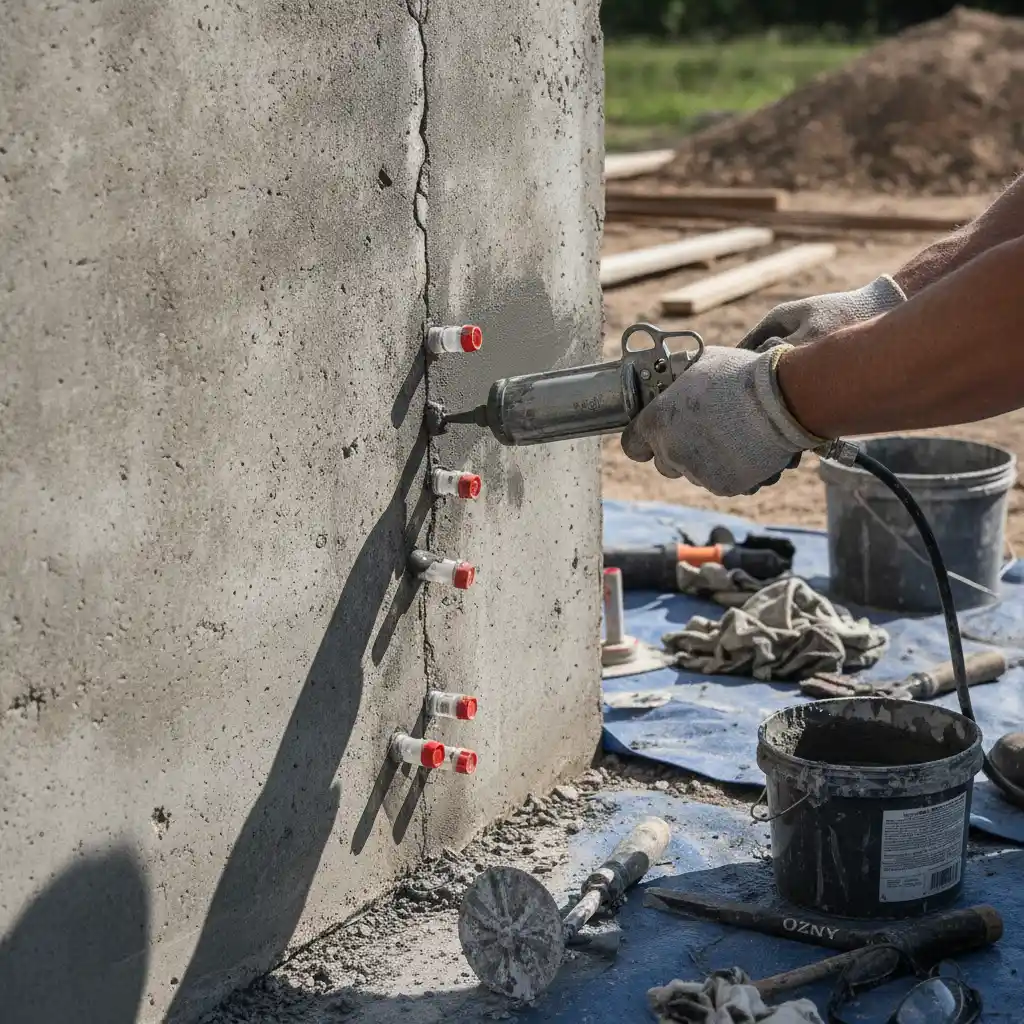
Our team in action — foundation-repair professionals serving Cedar Park
Foundation Settling Repair Methods We Use in Cedar Park
Pressed Steel Piers (Push Piers)
Push piers are hydraulically driven steel pipe sections that are pressed through the settling soil until they reach bedrock or a stable load-bearing stratum. In Cedar Park, the Austin Chalk formation typically provides a reliable bearing layer at depths of 20 to 40 feet beneath the surface. Push piers are ideal for homes experiencing significant differential settling and are our most commonly used method in the Avery Ranch and Sendero Springs neighborhoods.
Helical Piers
Helical piers feature screw-like steel plates that are torqued into the soil to achieve bearing capacity. They are particularly well-suited for new construction support, lighter structures, and situations where access limitations prevent heavy hydraulic equipment from reaching perimeter areas. Cedar Park’s interior courtyard homes and additions frequently benefit from helical pier solutions.
Concrete Pressed Pilings
Pre-cast concrete cylinder piers are pressed to refusal beneath the foundation and have been used successfully in the Austin market for decades. They perform well in the moderate settling scenarios common in older Cedar Park neighborhoods where differential movement is less than two inches.
Slab Stabilization and Void Fill
In cases where soil voids have formed beneath an interior slab without significant perimeter settlement, we use grout injection or polyurethane foam injection to fill voids and restore bearing support. This method is minimally invasive and requires no excavation, making it ideal for Cedar Park commercial properties along Whitestone Boulevard where operational downtime must be minimized.
Drainage Correction
Because many Cedar Park foundation settling cases are driven by chronic moisture imbalance, drainage correction — including French drain installation, downspout extension, and re-grading — is often incorporated as a critical component of a complete repair plan. Addressing the root moisture cause prevents recurrence of settling after pier installation.
Ready for Foundation Settling? Get Your Free Estimate Today.
Round Rock Foundation Repair Group serves Cedar Park and the surrounding area — we’ll be on-site within 24 hours.
📞 Call (512) 220-3502Foundation Settling Repair Cost in Cedar Park, TX
Foundation settling repair costs in Cedar Park, TX vary significantly based on the severity of differential movement, the number of piers required, soil access conditions, and the chosen repair method. Below are general ranges based on our regional experience:
- Minor settling repairs (1–5 piers, cosmetic cracking only): $1,500 – $4,500
- Moderate settling repairs (6–12 piers, differential movement under 2 inches): $5,000 – $12,000
- Significant settling repairs (13–20+ piers, multiple problem zones): $12,000 – $25,000+
- Commercial foundation settling repair: $15,000 – $80,000+ depending on building size and pier depth
- Slab void filling / polyurethane injection: $800 – $3,500
- Drainage correction and moisture management add-ons: $1,000 – $6,000
Cedar Park-Specific Cost Factors
Several local conditions affect pricing in Cedar Park specifically. The depth required to reach Austin Chalk bedrock — typically 25 to 40 feet in this area — increases the number of pier sections required per location, adding $150 to $300 per pier location compared to areas with shallower bearing strata. Homes in Avery Ranch with narrow side-yard access may require hand-dig excavation rather than mechanical equipment, increasing labor costs by 15 to 25 percent. Post-tension slab homes, which are common in Cedar Park developments built after 1995, require additional care during pier installation to avoid cutting tensioned cables, which can add $200 to $500 per pier in engineering oversight costs.
We provide detailed written estimates at no cost following our on-site assessment. Financing options are available for qualifying homeowners. Call (512) 220-3502 to schedule your free evaluation.
Cedar Park Neighborhoods We Serve
Avery Ranch (78717)
Avery Ranch is one of Cedar Park’s largest master-planned communities, with most homes built between 2000 and 2012 on cut-and-fill terrain adjacent to Brushy Creek. The combination of fill soils and Taylor Clay creates above-average settling risk. We regularly serve Avery Ranch homeowners experiencing corner pop cracking and door frame misalignment. Foundation Repair in Avery Ranch
Anderson Mill (78750)
Anderson Mill straddles the Cedar Park–Austin border and features a mix of homes built from the mid-1970s through the early 1990s. These older foundations, many of which are conventionally reinforced rather than post-tensioned, have experienced three to four full drought cycles and show higher rates of perimeter pier repair needs.
Sendero Springs (Round Rock, TX 78681)
Sendero Springs sits at the northern edge of our Cedar Park service zone. Homes here, built primarily between 2003 and 2010, are located on moderately expansive soils and have been affected by both the 2011 and 2022 drought events. We serve this community regularly for both residential and HOA-related foundation concerns.
Cat Hollow (Brushy Creek, TX 78681)
Cat Hollow homes near Brushy Creek’s floodplain edges face seasonal moisture fluctuation that accelerates differential settling. Many homes here require drainage correction in addition to pier installation for a durable long-term repair outcome.
Foundation Settling Prevention Tips for Cedar Park Homeowners
- Maintain consistent soil moisture year-round. Use a soaker hose system around your foundation perimeter during Cedar Park’s dry season (May through October) to prevent the dramatic soil shrinkage that drives differential settling. Target soil that feels damp 4 to 6 inches below the surface.
- Keep large trees at least 15 to 20 feet from your foundation. Live oaks and cedar elms common in Cedar Park landscaping can remove critical moisture from foundation soils during summer months.
- Ensure positive drainage away from your slab. The soil around your perimeter should slope away at a minimum of 6 inches over the first 10 feet to prevent water pooling against the foundation.
- Extend downspouts at least 4 to 6 feet from the foundation. Cedar Park’s clay soils cannot absorb heavy rainfall quickly; concentrated roof runoff near the foundation creates localized saturation and heaving.
- Inspect under-slab plumbing regularly. Older Cedar Park homes should have plumbing pressure-tested every five to seven years to catch pinhole leaks before they destabilize soil beneath the slab.
- Schedule annual foundation inspections. Post-summer inspections — September through October — are ideal for Cedar Park homeowners to catch any dry-season settling before winter rains rehydrate soils and mask symptoms.
- Avoid over-irrigating directly against the foundation. While moisture maintenance is important, excessive water on one side creates the same uneven conditions as drought-side drying. Schedule a Foundation Inspection
Why Choose Round Rock Foundation Repair Group for Cedar Park Foundation Settling
Round Rock Foundation Repair Group was built to serve the specific foundation challenges of Central Texas communities, and Cedar Park is at the heart of our service territory. We are not a national franchise applying generic solutions — we are a regional team with direct, hands-on experience working with Taylor Clay soils, Austin Chalk bedrock, and the particular construction standards used throughout Williamson County’s development boom.
Our technicians are trained in the use of digital elevation survey equipment, allowing us to document your foundation’s exact condition before and after every repair. This precision-first approach means we install only the piers and interventions your home actually needs — no upselling, no unnecessary work.
We serve Cedar Park and all surrounding communities including Round Rock, Georgetown, Austin, Pflugerville, Tech Ridge, Brushy Creek, Jollyville, Paloma Lake, Wells Branch, Teravista, La Frontera, Great Hills, Mayfield Ranch, Behrens Ranch, and Forest Creek. When you call us at (512) 220-3502, you speak with a local expert who knows your neighborhood, not a call center. Learn More About Our Foundation Repair Services
Frequently Asked Questions About Foundation Settling in Cedar Park, TX
How much does foundation settling repair cost in Cedar Park, TX?
Most residential foundation settling repairs in Cedar Park range from $3,500 to $15,000 depending on the number of piers required, the depth to bedrock, and site access conditions. Minor cases involving fewer than five pier locations may fall below $4,000, while significant differential settling requiring 15 or more piers can exceed $20,000. We provide free written estimates after an on-site evaluation. Call (512) 220-3502 to schedule yours.
How long does foundation settling repair take in Cedar Park?
Most residential repairs are completed in one to three days of active work once materials and equipment are mobilized. The full process from initial consultation to completed repair typically spans one to two weeks. Commercial projects may require longer depending on building size and pier count.
Is foundation settling normal in Cedar Park, TX?
Some initial settling is normal in any new construction. However, Cedar Park’s expansive Taylor Clay soils mean that ongoing or differential settling is unusually common here compared to areas with more stable soil profiles. Settling that produces visible cracking, sticking doors, or sloping floors is not normal and should be evaluated promptly.
What caused my Cedar Park home to settle more during the summer of 2022?
The summer of 2022 brought extreme drought conditions to Cedar Park, with multiple consecutive months of record heat and below-average rainfall. This caused significant moisture loss in the underlying Taylor Clay, triggering accelerated shrinkage and foundation movement across thousands of local homes. If your symptoms appeared or worsened during that period, your foundation likely experienced active drought-induced settling.
Can foundation settling damage be fixed permanently?
Modern pier systems — particularly steel push piers driven to Austin Chalk bedrock — provide long-term stabilization by bypassing the active clay zone entirely and anchoring the foundation to a stable bearing stratum. While no solution offers a 100 percent guarantee against future movement in Cedar Park’s challenging soil environment, properly installed piers combined with moisture management practices provide durable results for the vast majority of homeowners.
Do I need to vacate my home during foundation settling repairs?
In most cases, you do not need to leave your home during repair. Foundation pier installation is performed from the exterior perimeter and, where needed, through small interior access points. Utilities are typically not interrupted. We will notify you in advance if any specific repair scenario in your home requires temporary displacement.
Will my homeowner’s insurance cover foundation settling in Cedar Park?
Standard homeowner’s insurance policies in Texas generally exclude coverage for foundation settling caused by soil movement, which is classified as a gradual or maintenance-related issue rather than a sudden loss event. Some policies include limited coverage for settling caused by plumbing leaks. We recommend reviewing your policy and contacting your insurance agent directly. We can provide documentation of the settling’s origin and progression to support any claim you choose to file.
How do I know if my Avery Ranch home needs foundation repair or just cosmetic patching?
Cosmetic patching addresses surface cracks without correcting the underlying movement. If cracks return within six to twelve months of patching, or if you are observing functional symptoms like sticking doors, uneven floors, or growing exterior gaps, your home needs structural repair rather than cosmetic treatment. An elevation survey is the definitive diagnostic tool — it reveals the magnitude and pattern of differential settling regardless of what the surface cracks look like. Request a Free Foundation Inspection Today
Get Expert Foundation Settling Help in Cedar Park, TX Today
Foundation settling in Cedar Park is a serious concern shaped by local clay soils, seasonal drought cycles, and the realities of the region’s rapid development. Every month of delay allows differential movement to compound, widening cracks, misaligning structural members, and reducing the value and safety of your home or commercial property.
Round Rock Foundation Repair Group is ready to assess your Cedar Park foundation with precision digital survey tools, provide a transparent repair proposal, and execute lasting solutions backed by regional expertise. Our team serves Cedar Park and all surrounding communities throughout Central Texas.
Call us now at (512) 220-3502 to schedule your free foundation settling evaluation. Do not wait until the next dry season turns a manageable repair into a major structural project. We are here to help — locally, honestly, and expertly.
Contact Round Rock Foundation Repair Group