Slab Leaks in Cedar Park, TX
Structural Slab Leaks Specialists Serving Cedar Park, TX
Expert slab leak detection & repair in Cedar Park, TX. Round Rock Foundation Repair Group serves Avery Ranch, Brushy Creek & beyond. Call (512) 220-3502 today.
- Licensed & Insured
- Locally Owned & Operated
- Free Inspection & Estimate
Request Your
Free EstimateSlab leaks are one of the most damaging and deceptive plumbing problems a homeowner can face. A slab leak occurs when water supply or drain lines running beneath your concrete foundation begin to leak, allowing water to saturate the soil underneath your home and erode the structural base that everything above it depends on. In Cedar Park, TX, where expansive clay soils, rapid residential growth, and dramatic seasonal temperature swings create a uniquely challenging environment for foundations, slab leaks are far more common than most homeowners realize.
At Round Rock Foundation Repair Group, we specialize in identifying, diagnosing, and resolving slab leaks throughout Cedar Park and the surrounding communities. Our team understands the local geology, construction patterns, and environmental pressures that contribute to slab leak damage in this region. Whether you’ve noticed a sudden spike in your water bill, warm spots on your floor, or visible cracks along your walls, our experts are equipped to provide fast, thorough, and lasting solutions. Call us today at (512) 220-3502 to schedule your inspection.
Understanding Slab Leaks in Cedar Park, TX
A slab foundation is a thick concrete pad, typically 4 to 6 inches deep, poured directly on prepared soil and used as the base of a home or commercial building. In Central Texas, slab foundations became the dominant construction method beginning in the 1950s and accelerated through the post-war suburban boom of the 1960s and 1970s. By the time Cedar Park incorporated as a city in 1973 and began its explosive growth through the 1990s and 2000s, virtually every new residential structure was built on a concrete slab.
Within or directly beneath these slabs, builders route copper or galvanized steel water supply lines and cast-iron or PVC drain lines. Over time, these pipes can fail for a variety of reasons — corrosion from mineral-heavy water, physical abrasion from shifting soil, pressure changes from ground movement, or simple age-related deterioration. When a leak develops, water migrates into the soil beneath the slab, softening it, eroding it unevenly, and creating voids that cause the foundation to settle or crack.
What makes slab leaks particularly dangerous is their invisibility. Because the pipes are encased in or beneath concrete, a leak can persist for months or even years before visible damage alerts the homeowner. During that time, water is silently undermining the structural integrity of the foundation, encouraging mold growth inside walls and subflooring, and driving up water bills without any obvious explanation.
In Cedar Park, homes built during the rapid development waves of the 1980s, 1990s, and early 2000s frequently used copper pipe systems that are now reaching the age range — 20 to 40 years — at which pinhole corrosion and joint failure become statistically common. The area’s water supply, drawn largely from the Brushy Creek Regional Water Authority, carries mineral content and chloramine levels that accelerate copper pipe degradation compared to softer water sources found elsewhere in Texas.
Cedar Park’s commercial corridors along Highway 183A, Whitestone Boulevard, and 1431 also feature slab-on-grade construction for retail, office, and industrial buildings, making slab leaks a concern not just for homeowners but for business owners throughout the city.
Why Slab Leaks Are a Critical Issue in Cedar Park, TX
Cedar Park sits atop some of the most geologically active soil conditions in all of Central Texas. The area is underlain primarily by the Austin Chalk formation and Taylor Marl, two geological layers that produce highly expansive clay soils at the surface. These soils — classified by the USDA as Vertisols and locally identified as Houston Black clay and Heiden clay loam — are notorious for their dramatic volume changes in response to moisture content.
During wet seasons or periods of heavy rainfall, Cedar Park’s clay soils absorb water and expand by as much as 30 to 40 percent in volume. During droughts — such as the exceptional drought of 2011, one of the most severe on record for Central Texas when Williamson County received less than 12 inches of rainfall for the entire year — those same soils shrink dramatically, pulling away from foundation edges and creating differential settlement. This constant swell-and-shrink cycle generates enormous lateral and vertical pressure on buried pipes, causing joints to separate and pipe walls to crack or deform over time.
The drought of 2022 presented similar conditions across Williamson County, with Cedar Park recording temperatures above 100°F for more than 60 consecutive days and soil moisture levels dropping to record lows in several neighborhoods. These events consistently correspond with surges in foundation-related service calls, including slab leak diagnoses, throughout communities like Avery Ranch, Forest Creek, and Behrens Ranch.
Cedar Park’s rapid population growth — the city grew from approximately 5,000 residents in 1990 to over 82,000 by 2023 — created significant pressure on residential developers to build quickly and affordably. Some neighborhoods developed in the late 1990s and early 2000s, including portions of Brushy Creek and Sendero Springs, were graded and built on fill soil that had not fully compacted before construction. Fill soil is inherently more susceptible to settlement and movement, which amplifies stress on buried plumbing systems.
Additionally, the extensive tree coverage in established Cedar Park neighborhoods contributes to slab leak risk. Large live oaks, cedar elms, and Texas red oaks — common throughout neighborhoods like Cat Hollow and Great Hills along the Cedar Park border — have root systems that aggressively seek moisture, often wrapping around or compressing buried drain lines. In drought conditions, these roots extend even deeper and wider in search of water, increasing the risk of pipe displacement or crushing.
Cedar Park’s water infrastructure itself plays a role. Older neighborhoods serviced by aging water mains experience periodic pressure fluctuations, particularly during peak summer demand. Pressure surges above the standard 60–80 PSI range can stress interior supply lines running beneath slabs, accelerating joint failure at elbows and connection points. Homes along the older sections of Cypress Creek Road and FM 1431 near the Williamson County line are particularly vulnerable due to the age of both the structures and the water delivery infrastructure serving them.
Signs You Need Slab Leak Service in Cedar Park
Utility and Structural Warning Signs
- Unexplained increases in your monthly water bill of 20 percent or more without a change in usage habits
- Your water meter continues to move when all faucets, appliances, and irrigation systems are fully shut off
- Low water pressure throughout the home that has developed gradually over weeks or months
- New cracks appearing in interior drywall, particularly diagonal cracks running from door and window corners
- Visible cracks in exterior brick veneer or stucco, especially near the base of the structure
- Doors or windows that have recently become difficult to open, close, or latch properly
Physical and Environmental Indicators
- Warm or hot spots on tile or hardwood floors, indicating a hot water line leak beneath the slab
- The sound of running water or hissing when no water is in use anywhere in the home
- Damp, wet, or discolored carpet or flooring with no obvious source of moisture above
- Mold or mildew odors concentrated in specific rooms at floor level
- Visible pooling of water on the exterior perimeter of your home’s foundation during dry weather
Urgency Indicators
If you observe multiple symptoms simultaneously, or if any single symptom appeared suddenly, treat it as an emergency. A significant active slab leak can displace thousands of gallons of water within days, accelerating foundation damage that may cost tens of thousands of dollars to repair if left unaddressed.
Our Slab Leak Detection and Repair Process in Cedar Park
Initial Consultation and Site Assessment (Day 1)
We begin with a detailed phone consultation to understand your symptoms, followed by an on-site visit to your Cedar Park property. Our technician reviews your home’s construction era, foundation type, and the specific neighborhood’s known soil and drainage conditions. We check your water meter, inspect your water heater, and document all visible symptoms before any testing begins.
Electronic Leak Detection (Day 1–2)
Using professional-grade electronic listening equipment and ground microphones, we pinpoint the exact location of the leak beneath your slab without excavation. In Cedar Park homes where tile, hardwood, or luxury vinyl flooring is common, this non-invasive step is critical before any concrete work is considered. We also use thermal imaging cameras to identify temperature differentials caused by hot water leaks.
Pressure Testing and Line Isolation (Day 1–2)
We pressure-test individual supply lines to confirm which specific line is failing and to measure the severity of the loss. This step also confirms whether the leak is in a hot water line, cold water line, or drain system — each of which calls for a different repair approach.
Foundation and Soil Evaluation (Day 2)
Because Cedar Park’s expansive clay soils may have already shifted in response to the leak, we assess the current condition of your foundation using elevation measurements and visual inspection. This determines whether the leak has caused secondary foundation movement requiring additional structural intervention. Schedule a Foundation Inspection
Repair Method Selection and Permitting (Day 2–5)
We present you with a clear repair plan, including method options, timelines, and transparent pricing. For work requiring penetration of the slab, we coordinate with the City of Cedar Park’s Building Inspection Division to obtain necessary permits before work begins.
Repair Execution (Day 3–7 depending on method)
Our licensed plumbing and foundation crew completes the repair using the approved method. All concrete cuts are made precisely, work areas are kept clean and contained, and all disturbed soil beneath the slab is properly re-compacted before concrete is restored.
Post-Repair Testing and Documentation (Day 7–8)
We conduct a final pressure test to confirm the repair is complete and leak-free. You receive written documentation of all work completed, which is valuable for insurance claims and future home sales. We also provide recommendations for any monitored follow-up given Cedar Park’s soil movement patterns.
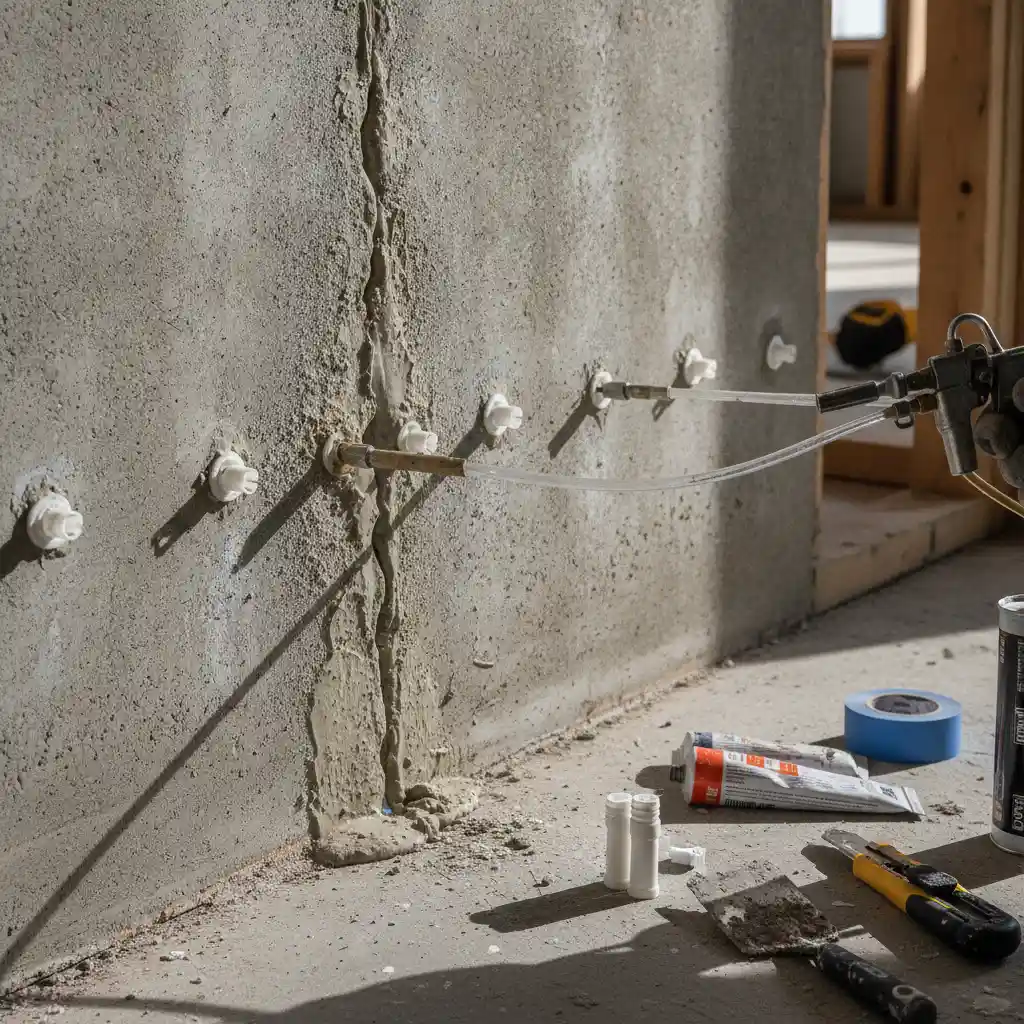
Our team in action — foundation-repair professionals serving Cedar Park
Slab Leak Repair Methods Used in Cedar Park
Spot Repair (Targeted Slab Penetration)
The most common method for isolated leaks in Cedar Park homes where our electronic detection has precisely identified a single failure point. We make a controlled cut through the concrete slab, access and repair or replace the damaged section of pipe, then restore the concrete. This approach minimizes disruption and is cost-effective when the leak is localized. Best suited for newer homes in neighborhoods like Forest Creek and Teravista where overall pipe condition remains sound.
Pipe Rerouting (Overhead Re-piping)
When a pipe is severely corroded, repeatedly failing, or located in a difficult-to-access area of the slab, rerouting the line through the walls and attic space above the slab eliminates the need to excavate. This method is increasingly common in older Cedar Park homes — particularly those built in the 1980s near the original FM 1431 corridor — where copper supply lines have reached end-of-life condition throughout the system.
Pipe Lining (Epoxy Coating)
For drain line leaks where the pipe retains structural integrity but has developed interior corrosion or small cracks, epoxy lining allows us to restore the pipe from the inside without excavation. A flexible epoxy-saturated liner is inserted and cured in place, creating a new pipe within the old one. This method works well in Cedar Park commercial properties along the Highway 183A corridor where business disruption must be minimized.
Full Repipe
In cases where multiple leaks are detected or the entire supply system is deteriorating, a complete repipe using modern PEX (cross-linked polyethylene) pipe is the most cost-effective long-term solution. PEX is more flexible than copper, resists corrosion, and handles the soil movement stresses common in Cedar Park far better than rigid pipe systems.
Ready for Slab Leaks? Get Your Free Estimate Today.
Round Rock Foundation Repair Group serves Cedar Park and the surrounding area — we’ll be on-site within 24 hours.
📞 Call (512) 220-3502Slab Leak Repair Cost in Cedar Park, TX
Understanding the cost of slab leak repair in Cedar Park helps homeowners plan appropriately and avoid being caught off guard. Costs vary significantly based on leak location, pipe type, repair method, and the degree of secondary foundation damage involved.
Typical Cost Ranges
- Electronic Leak Detection Only: $150–$400. A standalone detection service for homeowners who need confirmation before filing an insurance claim or deciding on a course of action.
- Spot Repair (Minor Leak, Single Location): $500–$2,000. Includes concrete saw cutting, pipe repair or replacement at the failure point, and concrete patching.
- Pipe Rerouting (Single Line): $1,500–$4,000. Varies based on pipe length, access difficulty, and finish restoration required after wall penetration.
- Epoxy Pipe Lining: $1,000–$3,500. Price scales with linear footage of pipe treated.
- Full Repipe (Whole-Home PEX): $4,000–$15,000 depending on home size, number of fixtures, and access complexity.
- Secondary Foundation Repair (if settlement has occurred): $3,000–$20,000+ depending on severity. Learn About Structural Foundation Repair
Cedar Park-Specific Cost Factors
Homes in Cedar Park with post-tension slab foundations — common in neighborhoods built after 1995 — require additional care and specialized expertise during any slab penetration work, which may add $200–$600 to spot repair costs. Williamson County permit fees for plumbing work typically range from $75–$200. Homes with premium tile or hardwood flooring require professional flooring restoration after concrete work, which is typically quoted separately. Many Cedar Park homeowners’ insurance policies cover sudden and accidental slab leaks; we provide full documentation to support your claim. Call (512) 220-3502 for a free, itemized estimate.
Cedar Park Neighborhoods We Serve
Avery Ranch
Developed primarily between 2000 and 2010, Avery Ranch homes sit on post-tension slabs over highly expansive Heiden clay soils. Many of the original copper supply lines in this neighborhood are now entering the 20–25 year range when pinhole leaks become most common. We have extensive experience with the specific slab depths and pipe configurations used by the dominant builders active in Avery Ranch during its development period.
Brushy Creek and Cat Hollow
These established communities feature homes from the late 1980s and early 1990s with traditional slab foundations and original copper plumbing. The area’s mature tree canopy — particularly large live oaks — creates elevated root intrusion risk for drain lines. Brushy Creek’s proximity to Brushy Creek itself also contributes to more variable soil moisture levels than higher-elevation parts of Cedar Park.
Sendero Springs and Behrens Ranch
Developed in the early 2000s on land that required significant grading, portions of these neighborhoods are built on compacted fill. Fill soil continues settling for years after construction, creating ongoing pipe stress. Homeowners here often experience slab leak symptoms earlier in their home’s lifespan than residents of neighborhoods built on native ground.
We also serve Round Rock, Georgetown, Austin, Pflugerville, Wells Branch, Jollyville, and all surrounding communities.
Slab Leak Prevention Tips for Cedar Park Homeowners
- Monitor your water meter monthly. Turn off all water in your home and check whether the meter moves. Early detection of a small leak prevents catastrophic damage. Cedar Park Water’s online portal allows usage monitoring between billing cycles.
- Maintain consistent soil moisture around your foundation. During Cedar Park’s intense summer droughts, use a soaker hose system set 12–18 inches from your foundation perimeter to prevent the extreme soil shrinkage that stresses buried pipes.
- Set your home’s water pressure to 60–80 PSI. Install a pressure regulator if you haven’t already. High water pressure accelerates joint failure in buried supply lines.
- Have your plumbing inspected every 5–7 years if your Cedar Park home was built before 2005 and still has original copper supply lines.
- Keep large trees trimmed and root barriers installed near known drain line paths, particularly in neighborhoods with mature live oak coverage like Cat Hollow and Brushy Creek.
- Check your water heater temperature. Settings above 120°F accelerate corrosion in hot water supply lines running beneath your slab.
- Address foundation cracks immediately. New cracks in your slab or walls can indicate soil movement that is simultaneously stressing your buried pipes. Schedule a Foundation Inspection
Why Choose Round Rock Foundation Repair Group for Slab Leaks in Cedar Park
At Round Rock Foundation Repair Group, we are not a general plumbing service that occasionally handles slab leaks. Our entire operation is built around foundation systems and the plumbing complications that arise from foundation movement in Central Texas’s uniquely challenging soil environment. We understand how Cedar Park’s expansive clay geology, drought cycles, and construction eras interact to create the specific types of slab leak failures we see every day throughout Williamson County and the greater Austin metro area.
Our technicians are trained in both structural foundation assessment and advanced leak detection, which means we can identify not just where your leak is, but what the leak has already done to your foundation and what steps are needed to address both problems in the correct order. Many contractors fix the pipe and miss the foundation damage — or fix the foundation and miss the ongoing leak. We address the full picture.
We serve Cedar Park and the surrounding communities of Round Rock, Georgetown, Austin, Pflugerville, Avery Ranch, Forest Creek, Brushy Creek, and beyond. When you call (512) 220-3502, you reach a local team that knows your neighborhood, your soil conditions, and your home’s construction type.
Frequently Asked Questions About Slab Leaks in Cedar Park, TX
How do I know if I have a slab leak or just a regular plumbing leak?
A key indicator is where the symptoms appear. If you have wet walls near a visible pipe, the issue is likely above-slab. Slab leak symptoms — warm floors, sounds of running water with no fixtures active, sudden foundation cracks, or a constantly moving water meter — point to below-slab issues. Professional electronic detection is the only reliable way to confirm and locate a slab leak accurately.
How much does slab leak repair cost in Cedar Park?
Costs in Cedar Park typically range from $500 for a minor spot repair to $15,000 or more for a full repipe in a larger home. The average Cedar Park homeowner pays between $1,500 and $4,500 for a standard slab leak repair including detection, repair, and concrete restoration. Post-tension slabs — common in Cedar Park neighborhoods built after 1995 — may add $200–$600 to repair costs due to the care required around tensioning cables.
Does my homeowner’s insurance cover slab leaks in Cedar Park?
Many Texas homeowner’s insurance policies cover the water damage resulting from a sudden and accidental slab leak, though they typically do not cover the repair of the pipe itself. Policies vary significantly. We provide complete written documentation, pressure test reports, and photographic evidence to support your insurance claim. We recommend contacting your insurer before work begins to understand your specific coverage.
How long does slab leak repair take?
Detection and assessment typically take 1–2 days. A spot repair can be completed in 1–3 days after permitting. A pipe rerouting project typically takes 2–5 days. A full repipe of a Cedar Park home may require 3–7 days depending on home size and complexity. We work efficiently to restore your water service as quickly as possible.
Why are slab leaks so common in Cedar Park specifically?
Cedar Park’s combination of highly expansive clay soils, recurring severe drought cycles — particularly the historic droughts of 2011 and 2022 — aging copper plumbing in homes built during the 1990s and early 2000s growth boom, and mineral-rich water supply creates conditions that accelerate pipe failure beneath slabs. The city’s rapid development also means many homes were built on fill soil that continues to move years after construction.
Can a slab leak damage my foundation?
Yes, significantly. Water from a slab leak saturates the clay soil beneath your foundation unevenly, causing differential settling where one part of the slab sinks while another remains stable. This creates cracks, sticking doors and windows, and in severe cases, structural compromise. In Cedar Park’s expansive clay environment, even a moderate slab leak can accelerate foundation movement that would have taken years to develop under dry conditions. Learn About Structural Foundation Repair
Should I repair or repipe my Cedar Park home?
If your home was built before 2000 and still has original copper supply lines, a single slab leak is often an early sign that the entire system is nearing end of life. If a second leak develops within 2–3 years of a spot repair, repiping the entire home with modern PEX pipe is almost always the more cost-effective long-term solution. We assess each situation individually and provide honest recommendations based on your pipe condition and home’s history.
Do you need a permit for slab leak repairs in Cedar Park?
Yes, the City of Cedar Park requires permits for plumbing work that involves penetrating a slab or modifying supply line routing. We handle the entire permitting process with the City of Cedar Park’s Building Inspection Division on your behalf, ensuring all work meets current code requirements and protecting you legally and for future resale.
Contact Round Rock Foundation Repair Group for Slab Leaks in Cedar Park, TX
Don’t let a hidden slab leak silently destroy your Cedar Park home’s foundation. The longer a slab leak goes undetected, the greater the damage to your concrete slab, your soil stability, and your home’s structural integrity. Cedar Park’s expansive clay soils and drought-prone climate mean that water intrusion beneath your foundation can cause disproportionate damage in a very short period of time.
Round Rock Foundation Repair Group is ready to help. We serve Cedar Park, Round Rock, Georgetown, Austin, Avery Ranch, Forest Creek, Brushy Creek, Sendero Springs, and all surrounding communities with expert slab leak detection, repair, and foundation assessment.
Call us now at (512) 220-3502 to schedule your inspection. Our team is standing by to protect your home and your investment.
Request a Free Estimate Online