Foundation Cracks in Cedar Park, TX
Structural Foundation Cracks Specialists Serving Cedar Park, TX
Dealing with foundation cracks in Cedar Park, TX? Round Rock Foundation Repair Group offers expert diagnosis & repair for Cedar Park’s expansive clay soils. Call (512) 220-3502.
- Licensed & Insured
- Locally Owned & Operated
- Free Inspection & Estimate
Request Your
Free EstimateFoundation cracks are fractures, fissures, or separations that develop in the concrete, block, or masonry elements supporting your home or commercial building. In Cedar Park, TX, these cracks are not merely cosmetic concerns — they are often early warning signals of deeper structural movement driven by the region’s expansive clay soils, dramatic seasonal moisture swings, and rapid development patterns that have transformed this community over the past two decades.
Round Rock Foundation Repair Group specializes in diagnosing and repairing foundation cracks across Cedar Park and the greater Austin metro area. Our team understands the unique geological and climatic pressures that Cedar Park properties face, from the black Vertisol soils along Brushy Creek to the limestone-rich terrain in newer subdivisions near 183A. Whether you own a mid-2000s tract home in Ranch at Brushy Creek or a recently built property near Bell Boulevard, our engineers and repair technicians bring localized expertise to every project. Call us today at (512) 220-3502 to schedule your foundation inspection.
Understanding Foundation Cracks in Cedar Park, TX
Foundation cracks form when the forces acting on a structure’s base — soil pressure, moisture changes, thermal expansion, and structural load — exceed the tensile or compressive strength of the foundation material. Understanding the mechanics behind these cracks is essential to distinguishing a hairline settlement crack from a progressive structural failure.
Types of Foundation Cracks
Hairline cracks are thin surface fractures typically less than 1/16 of an inch wide. They commonly appear in poured concrete foundations as the concrete cures and are often considered cosmetic, though they can widen over time if underlying soil conditions are unstable.
Vertical cracks run straight up and down or slightly diagonal. When narrow and stable, they often result from normal concrete shrinkage. When wider than 1/4 inch or accompanied by displacement, they indicate differential settlement.
Horizontal cracks in basement walls or stem walls are among the most serious crack types, typically indicating lateral soil pressure bowing the wall inward. While Cedar Park homes rarely have traditional basements, stem walls on pier-and-beam structures can exhibit similar patterns.
Diagonal or stair-step cracks are extremely common in Cedar Park masonry and brick veneer homes. These cracks follow the mortar joints in a stair-step pattern and almost always signal differential settlement — one portion of the foundation sinking at a different rate than another.
Horizontal slab cracks appear on the surface of concrete slab foundations and can indicate heaving from soil moisture expansion beneath the slab, a phenomenon particularly prevalent in Cedar Park’s Vertisol and Houston Black clay zones.
Historical Context in Cedar Park
Cedar Park’s explosive residential growth — transitioning from a small community of roughly 5,000 residents in 1990 to over 80,000 by the early 2020s — means the city contains an enormous stock of homes built quickly during high-demand periods. Many subdivisions constructed between 1998 and 2012 used post-tension slab foundations that, while efficient at construction time, require careful moisture management to perform correctly on the region’s reactive soils. The combination of construction-era decisions and soil conditions has made foundation cracking one of the most commonly reported home issues among Cedar Park homeowners.
Signs You Need Foundation Crack Repair in Cedar Park
Visible Structural Symptoms
- Diagonal cracks running from the corners of door frames or window frames toward the ceiling
- Stair-step cracking in exterior brick veneer, especially on the south or west-facing elevations
- Horizontal cracks in stem walls or garage foundation walls wider than 1/8 inch
- Slab surface cracks visible after removing flooring, particularly in a radiating or grid pattern
- Cracks that have grown visibly wider over a period of weeks or months
Interior Warning Signs
- Doors that stick, drag, or fail to latch properly, particularly interior hollow-core doors
- Windows that jam, crack their frames, or develop gaps at corners
- Gaps appearing between crown molding and the ceiling, or between baseboards and the floor
- Sloping or bouncy floors, especially in pier-and-beam homes in older Cedar Park neighborhoods
- Drywall cracks appearing at 45-degree angles from corners of openings
Urgent Red Flags
- Any crack wider than 1/2 inch requires immediate professional evaluation
- Cracks accompanied by wall bowing, leaning, or visible displacement
- Water intrusion through foundation cracks after rain events
- Sudden appearance of multiple new cracks following a significant rain event or drought break
If you notice any of these warning signs, contact Round Rock Foundation Repair Group at (512) 220-3502 for a prompt assessment. Schedule a Professional Foundation Inspection
Our Foundation Crack Repair Process in Cedar Park
Round Rock Foundation Repair Group follows a structured, transparent repair process tailored specifically to Cedar Park’s soil and construction conditions. Here is what you can expect from first contact through final inspection:
Initial Consultation and Site Review (Day 1–2)
We begin with a phone consultation to gather information about your property, crack history, and any recent changes in moisture conditions around your home. We review available soil survey data for your specific Cedar Park location and schedule an on-site visit within 1–2 business days for most Cedar Park addresses.
Comprehensive Foundation Inspection (Day 2–3)
Our inspector performs a full evaluation of your foundation, including exterior crack mapping, interior elevation readings using digital manometers accurate to 1/10 of an inch, and assessment of drainage patterns, landscaping grade, and moisture sources. We document all findings with photographs and measurements. Learn More About Our Inspection Process
Soil and Moisture Assessment (Day 3–5)
Given Cedar Park’s reactive clay soils, we conduct a moisture profile evaluation around the foundation perimeter, checking for zones of excessive dryness or saturation that indicate irrigation imbalance or drainage failures specific to your neighborhood’s grading conditions.
Repair Plan and Proposal (Day 5–7)
We prepare a written repair plan identifying crack types, recommended repair methods, pier placement locations if needed, and a detailed cost estimate. We walk through the proposal with you in plain language, explaining why each recommended action addresses your Cedar Park property’s specific conditions.
Repair Execution (Day 7–14, varies by scope)
Our crew mobilizes with equipment appropriate to your property type. Epoxy or polyurethane injection repairs for isolated cracks typically complete in one day. Pier installation projects in Cedar Park’s clay soils typically require 2–5 days depending on the number of piers and site access conditions.
Post-Repair Moisture Management Setup (Day of completion)
We advise on and, where needed, assist with implementing a foundation moisture management plan: downspout extensions, drainage corrections, and soaker hose irrigation placement calibrated to Cedar Park’s seasonal rainfall patterns.
Final Walk-Through and Documentation (Day of completion)
We conduct a final inspection, provide you with a written repair summary, and explain ongoing monitoring recommendations specific to Cedar Park’s climate cycles.
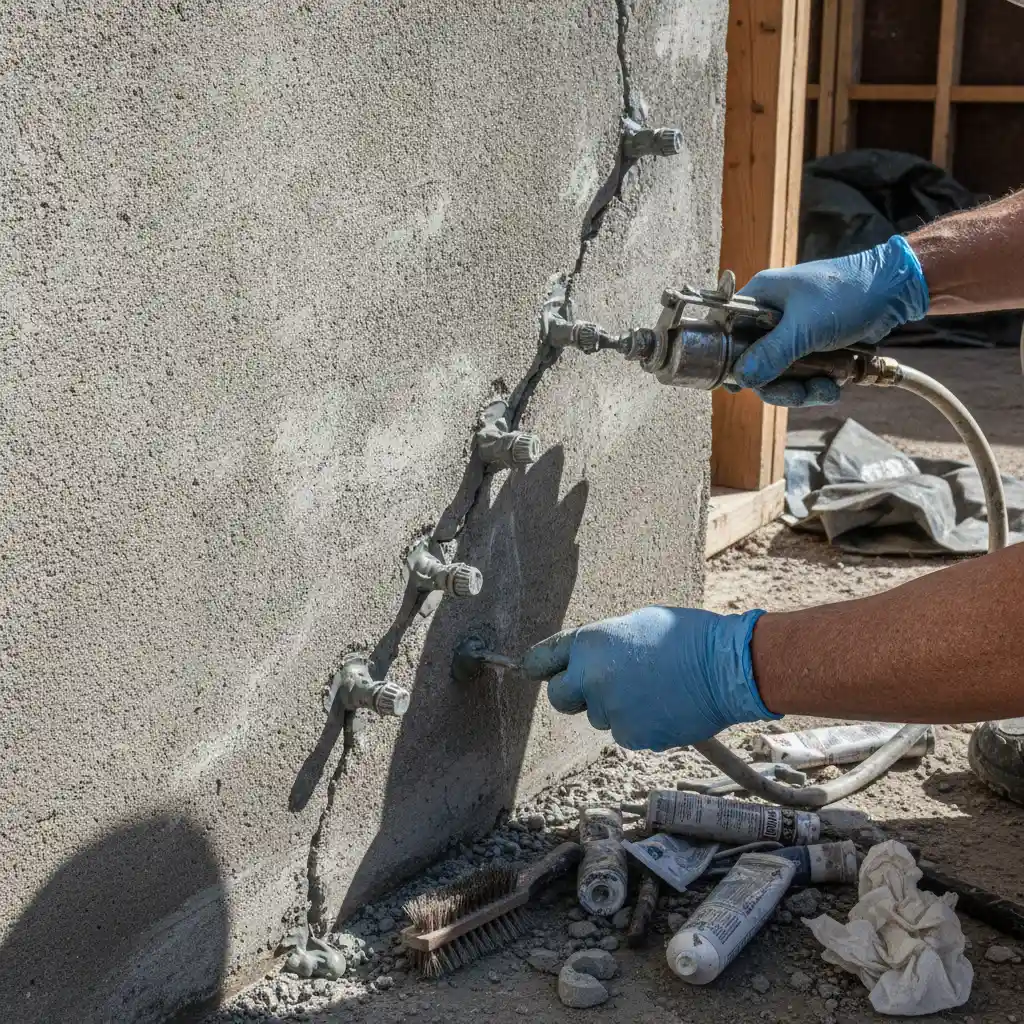
Our team in action — foundation-repair professionals serving Cedar Park
Foundation Crack Repair Methods We Use in Cedar Park
Epoxy Injection
For structural cracks in poured concrete foundations where the crack is stable and dry, high-viscosity epoxy injection restores tensile strength equal to or greater than the original concrete. This method is ideal for Cedar Park homes with isolated vertical cracks in monolithic slabs caused by normal concrete curing shrinkage or minor point-load settlement.
Polyurethane Foam Injection
When cracks are actively leaking or located in areas subject to ongoing minor movement, flexible polyurethane foam injection provides a watertight seal that accommodates slight future movement. This approach is frequently used in Cedar Park properties along Brushy Creek’s flood-adjacent zones where seasonal moisture fluctuation continues after initial repair.
Carbon Fiber Straps and Wall Anchors
For stem walls or foundation walls showing horizontal cracking or bowing, carbon fiber reinforcement straps bonded to the wall surface provide tensile resistance against lateral soil pressure without requiring excavation. Wall anchors connected to deadman anchors in stable soil beyond the affected zone are used for more advanced bowing conditions. Explore Our Structural Foundation Repair Services
Pier Underpinning (Push Piers and Helical Piers)
When cracking results from deep differential settlement, underpinning with steel push piers or helical piers transfers the foundation load past Cedar Park’s reactive clay layers to stable bedrock or load-bearing strata, which in most Cedar Park locations is encountered at depths of 18–30 feet. Learn About Our Concrete Foundation Repair Options
Slabjacking and Foam Lifting
For sections of concrete slab that have settled and cracked due to soil voids beneath, polyurethane foam lifting restores grade and closes crack gaps by filling subsurface voids with expanding foam injected through small drilled ports, minimizing surface disruption.
Ready for Foundation Cracks? Get Your Free Estimate Today.
Round Rock Foundation Repair Group serves Cedar Park and the surrounding area — we’ll be on-site within 24 hours.
📞 Call (512) 220-3502Foundation Crack Repair Cost in Cedar Park, TX
Understanding the cost of foundation crack repair helps Cedar Park homeowners plan appropriately. Repair costs vary significantly based on crack type, severity, underlying cause, and the repair method required.
Typical Cost Ranges
- Cosmetic crack patching (surface sealing): $300–$800 per crack location, suitable for hairline shrinkage cracks with no active movement
- Epoxy injection repair: $400–$1,200 per crack, depending on crack length and access conditions
- Polyurethane foam injection: $500–$1,500 per crack zone, commonly used for wet or actively moving cracks
- Carbon fiber strap installation: $1,200–$2,500 per strap, with most projects requiring 2–6 straps
- Pier underpinning (per pier): $1,500–$3,000 per pier installed; most Cedar Park residential projects require 6–15 piers, placing total pier costs between $10,000 and $40,000 for full-perimeter stabilization
- Foam slab lifting: $800–$3,500 depending on slab area and void volume
Cedar Park-Specific Cost Factors
Cedar Park’s dense clay soils increase pier installation time and equipment wear, which is factored into local pricing. Properties in areas with limited equipment access — such as homes on narrow lots in Buttercup Creek or townhomes near Bell Boulevard — may incur additional mobilization costs of $500–$1,500. Post-tension slab homes, which are common throughout Cedar Park subdivisions built after 1995, require specialized cutting protocols that add $200–$600 to injection repair costs.
Foundation repair costs in Cedar Park are generally consistent with or slightly above Austin metro averages due to soil complexity and construction density. Get Detailed Cost Information for Foundation Repair Contact us at (512) 220-3502 for a free, no-obligation estimate tailored to your property.
Cedar Park Neighborhoods We Serve
Buttercup Creek
One of Cedar Park’s established neighborhoods, Buttercup Creek contains homes largely built between 1985 and 2000 on Houston Black clay soils with high shrink-swell potential. Older pier-and-beam homes in this area frequently require beam replacement and post shimming, while slab homes built in the late 1990s show stair-step cracking from perimeter differential settlement. Home Foundation Repair Services
Twin Creeks
Developed primarily between 2000 and 2008, Twin Creeks features post-tension slab foundations on deep clay profiles. Homeowners here commonly report diagonal cracking near garage door openings and interior hallway ceiling cracks following the 2011 and 2022 drought years. Moisture management and targeted pier installation are the most common interventions.
Ranch at Brushy Creek and Cypress Canyon
These newer neighborhoods near the Brushy Creek greenbelt corridor experience elevated subsurface moisture from seasonal creek flooding and subsurface drainage. Foundation cracks in these areas often involve both settlement and heave components, requiring combined repair strategies. Crawl Space Repair for Brushy Creek Area Homes
Lakeline Area Commercial District
Commercial properties along Lakeline Mall Drive and the 183A corridor face unique foundation challenges from heavy foot-traffic loading and parking lot drainage that concentrates water against building perimeters. Our commercial foundation repair services address these conditions directly. Commercial Foundation Repair in Cedar Park
Foundation Crack Prevention and Maintenance Tips for Cedar Park Homeowners
- Maintain consistent soil moisture year-round. Use a soaker hose system placed 12–18 inches from your foundation perimeter during Cedar Park’s dry summer months (typically June through September) to prevent the extreme soil desiccation that causes cracking. Run soakers 2–3 hours, three times per week during drought conditions.
- Ensure positive drainage away from your foundation. Maintain at least a 6-inch drop in grade over the first 10 feet away from your home to prevent water pooling at the slab edge.
- Extend downspouts at least 4–6 feet from the foundation. Disconnected or short downspout extensions are one of the leading causes of localized foundation cracking in Cedar Park’s clay soils.
- Avoid planting trees or large shrubs within 10–15 feet of your foundation. Live oaks and cedar elms — common in Cedar Park landscaping — have root systems that extract significant moisture from the soil, causing localized shrinkage and cracking.
- Inspect and clean gutters each fall and spring. Clogged gutters overflow and dump concentrated water volumes directly against your foundation perimeter.
- Monitor and document any cracks you observe. Photograph cracks with a scale reference (a coin or ruler) and re-photograph every 30–60 days to identify active movement before it worsens.
- Schedule a professional inspection after major weather events. Following significant drought-breaking rains or freezing events like those experienced during February 2021, have your foundation evaluated promptly. Schedule a Post-Storm Foundation Inspection
Why Choose Round Rock Foundation Repair Group for Cedar Park Foundation Cracks
Round Rock Foundation Repair Group has built its reputation by developing deep expertise in the specific soil, climate, and construction conditions of the Cedar Park, Round Rock, and greater Austin metro region. We are not a national franchise applying generic repair templates — we are a locally operated team that understands why a home in Buttercup Creek behaves differently than one in Twin Creeks, and why the same crack pattern may demand different solutions in different Cedar Park neighborhoods.
Our approach begins with honest diagnosis. We will never recommend pier installation when crack injection and drainage correction will solve the problem, and we will never minimize a serious structural issue to close a lower-cost sale. Our inspection reports are detailed, measurable, and written in plain language so you can make an informed decision.
We serve Cedar Park, Round Rock, Georgetown, Austin, Pflugerville, Brushy Creek, and all surrounding communities, giving us unmatched familiarity with this region’s foundation challenges. Our team stays current with engineering best practices and uses materials and methods appropriate to Central Texas conditions.
Call us at (512) 220-3502 or contact us online to speak with a foundation specialist who knows Cedar Park.
Frequently Asked Questions About Foundation Cracks in Cedar Park, TX
How much does it cost to repair foundation cracks in Cedar Park, TX?
Repair costs range from $300–$800 for simple surface crack patching to $10,000–$40,000 or more for full pier underpinning on a home with significant differential settlement. Epoxy or polyurethane crack injection projects most commonly fall in the $1,500–$6,000 range for Cedar Park residential properties. The wide range reflects the significant variation in crack causes, severity, and required repair methods across Cedar Park’s diverse soil zones and home construction eras.
Are foundation cracks in Cedar Park homes normal?
Minor hairline shrinkage cracks are common in any concrete structure and are generally considered normal. However, Cedar Park’s expansive clay soils mean that cracks here are more likely to be progressive than in regions with stable soils. A crack that seems minor in spring may be significantly wider by fall after a dry summer. Any crack wider than 1/8 inch, any diagonal crack originating at door or window corners, or any crack accompanied by sticking doors or windows warrants a professional evaluation.
How long does foundation crack repair take in Cedar Park?
Simple epoxy or polyurethane injection repairs are typically completed in a single day. Projects requiring pier installation generally take 2–5 days depending on pier count and site access. Most Cedar Park homeowners can expect their repair project to be complete within 1–2 weeks of contract signing, though scheduling may be extended during peak demand periods following major drought-breaking rain events.
Will my homeowner’s insurance cover foundation crack repair in Cedar Park?
Standard homeowner’s insurance policies in Texas typically exclude foundation damage caused by soil movement, settling, or shrinkage — which covers most Cedar Park foundation crack scenarios. Coverage may be available if cracking results from a covered sudden event, such as a plumbing leak beneath the slab. We recommend reviewing your policy with your insurance agent and can provide detailed documentation of observed conditions to support any claim you choose to file.
Do Cedar Park’s post-tension slabs crack differently than conventional slabs?
Yes. Post-tension slabs use tensioned cables embedded in concrete to resist bending forces from soil movement. When these slabs crack, it sometimes indicates a cable has broken or that differential movement has exceeded the cable system’s capacity. Repairing cracks in post-tension slabs requires specialized equipment and must be done without cutting active tendons. Round Rock Foundation Repair Group has experience with Cedar Park’s extensive post-tension slab inventory and performs all injections and penetrations in compliance with post-tension slab protocols.
How do Cedar Park’s droughts affect foundation cracks?
Extended droughts — such as the 2010–2011 drought and the 2022 summer drought — cause Cedar Park’s reactive clay soils to dry and shrink dramatically beneath foundation perimeters, withdrawing support and allowing the slab edge or perimeter beam to drop. When rains return, rapid rehydration can cause heaving in the interior zones where soil retained more moisture. This differential movement — perimeter dropping during drought, interior heaving when moisture returns — produces the diagonal and stair-step cracks seen widely across Cedar Park neighborhoods following every major drought cycle.
What is the difference between foundation patching and structural foundation repair?
Foundation patching addresses the visible crack without correcting the underlying cause. It is appropriate for stable, cosmetic cracks that have not moved in years. Structural foundation repair addresses both the crack and the root cause — whether that is soil instability, moisture imbalance, or load capacity issues — to prevent future cracking. In Cedar Park, where soil conditions remain active, structural repair with attention to drainage and moisture management is almost always more appropriate than patching alone for cracks wider than 1/8 inch. Learn About Foundation Patching Services Explore Structural Foundation Repair
Can I sell my Cedar Park home with foundation cracks?
Texas law requires sellers to disclose known foundation defects. Repaired foundation cracks with documentation from a licensed engineer or professional repair company are generally more attractive to buyers than undisclosed or unaddressed cracks. Many Cedar Park home sales are delayed or fall through due to foundation issues discovered during buyer inspections. Proactive repair prior to listing can improve sale price and reduce transaction friction significantly.
Get Expert Foundation Crack Repair in Cedar Park Today
Foundation cracks in Cedar Park homes are common — but they are not something to ignore. Cedar Park’s expansive clay soils, seasonal drought cycles, and rapid residential development history create the conditions for progressive foundation movement that worsens with every passing season.
Round Rock Foundation Repair Group is ready to evaluate your property, explain your options honestly, and deliver repairs built for Cedar Park’s specific conditions. We serve Cedar Park, Round Rock, Georgetown, Austin, Pflugerville, and all surrounding communities.
Call us now at (512) 220-3502 to speak directly with a foundation specialist. You can also submit a contact form online and we will respond within one business day. Don’t let a crack become a crisis — reach out to Round Rock Foundation Repair Group today.