
Foundation crack repair is the process of diagnosing, sealing, and structurally reinforcing cracks that develop in a home or commercial building’s foundation system. In Leander, TX — one of the fastest-growing cities in the United States — foundation cracking is an especially pressing concern due to the region’s expansive clay soils, dramatic seasonal moisture swings, and rapid residential development across hillside terrain.
Round Rock Foundation Repair Group serves homeowners and business owners throughout Leander and the greater North Austin corridor. Our licensed technicians understand the specific geological and climatic conditions that drive foundation damage in this area, from the heavy Blackland Prairie clay soils near Crystal Falls to the caliche-heavy substrates found in newer developments along US-183. Whether you’re dealing with hairline cracks, stair-step fractures, or major structural separation, we provide transparent, accurate cost estimates and durable repair solutions tailored to Leander’s unique environment.
Call us today at (512) 220-3502 for a professional foundation inspection and detailed cost breakdown.

Foundation crack repair encompasses a range of techniques designed to stop active cracking, restore structural integrity, and prevent future deterioration of a building’s base system. Cracks form for many reasons — differential settlement, hydrostatic pressure, freeze-thaw cycling, tree root intrusion, and poor initial construction practices — and each cause demands a distinct repair methodology.
Historically, Leander was a small agricultural community along the Balcones Fault Zone before experiencing explosive growth following the construction of US-183A (the Leander Toll Road) in 2007 and the expansion of Capital Metro’s MetroRail commuter line. Thousands of homes were built rapidly across geologically complex terrain during the 2005–2015 boom, many on lots with inadequate soil preparation or shallow pier systems. This construction era left a substantial inventory of homes now reaching the age threshold — typically 10 to 15 years — when foundation movement becomes most visible.
Read moreShow less
Leander’s housing stock spans several construction types relevant to foundation repair decisions. Older ranch-style homes built in the 1970s and 1980s along Crystal Falls Parkway and FM 2243 often sit on conventional concrete slab foundations that were not engineered for the region’s expansive soils. Newer planned community homes in Crystal Falls, Bryson, and Mason Hills utilize post-tensioned slabs, which require specialized repair approaches distinct from traditional poured concrete methods. A small percentage of properties in the rural eastern portions of Leander feature pier-and-beam construction, common in homes built before 1970.
Foundation crack repair in this context is not simply cosmetic patching. It involves understanding why the crack occurred, what movement is ongoing, and what load-bearing implications exist. Effective repair begins with a proper engineering-informed inspection, continues through appropriate material application or structural reinforcement, and concludes with drainage and soil management recommendations to prevent recurrence. In Leander, skipping any of these steps often leads to repeat failures within two to five years.
Schedule a Foundation Inspection in Leander, TX
Why Foundation Crack Repair Is Needed in Leander, TX
Expansive Clay Soils and the Blackland Prairie
The majority of Leander’s residential neighborhoods — including Crystal Falls, Bryson, Travisso, and Mason Hills — are underlain by Austin Chalk and Taylor Marl formations, which produce some of Texas’s most expansive clay soils. These soils, classified as Houston Black Clay and Heiden Clay by the USDA, can swell up to 30–40% in volume when saturated and shrink dramatically during drought. The Texas State Climatologist has documented soil moisture deficits of 6 to 10 inches below the surface during extended dry periods in Williamson County, precisely the depth range where most residential foundations are anchored.
The 2011 and 2022 Texas Droughts
Two major drought events have left lasting marks on Leander foundations. The 2011 drought — the worst single-year drought in Texas recorded history — caused severe soil contraction across Williamson County, with many Leander homeowners reporting new cracks appearing between June and October of that year. More recently, the 2022 summer drought, which produced 70+ consecutive days above 100°F in the greater Austin area, accelerated soil shrinkage beneath thousands of Leander slabs, particularly in lower-elevation neighborhoods near Brushy Creek and the South Fork San Gabriel River tributary corridors.
Rapid Development and Fill Soil Issues
Leander’s annexation and development pace — the city grew from approximately 7,500 residents in 2000 to over 75,000 by 2023 — outpaced soil engineering scrutiny in many subdivisions. Developments like Savannah, Benbrook Ranch, and portions of the 1890 Ranch area used significant amounts of imported fill soil to level hillside lots along the Balcones Escarpment. Fill soil that was not properly compacted to geotechnical specifications (typically 95% Standard Proctor density) settles unevenly over 5 to 15 years, creating differential movement that cracks foundations.
Tree Root Intrusion Near Older Neighborhoods
Mature live oaks and cedar elms — both common in established Leander neighborhoods along FM 2243, Bagdad Road, and Crystal Falls Parkway — extract enormous amounts of moisture from surrounding soils during summer months. A mature live oak can draw 150 gallons of water per day from the surrounding soil, creating localized drying zones directly adjacent to foundation perimeters. This effect is most pronounced within 15–25 feet of the tree’s trunk and directly correlates with slab edge settlement patterns seen throughout older Leander properties.
Plumbing Leaks and Utility Corridor Erosion
Leander’s aging utility infrastructure in neighborhoods built before 2000 also contributes to foundation cracking. Polybutylene and early PVC supply lines in homes along Bagdad Road and the older sections of Block House Creek have documented leak histories. Even small, slow leaks of 0.5–1.5 gallons per hour beneath a slab create sustained localized soil saturation, causing upward heave and subsequent cracking when the leak is eventually repaired and soils dry out.
Free, no-obligation estimates
Talk to Round Rock Foundation Repair Group
Tell us what you need and we’ll take it from there.
Signs You Need Foundation Crack Repair in Leander, TX
Interior Warning Signs
- Diagonal cracks running from the corners of door frames or window frames at 45-degree angles
- Doors and windows that stick, jam, or no longer close flush within their frames
- Cracks in drywall, particularly those wider than 1/8 inch or that have grown over time
- Uneven or sloping floors, detectable by placing a marble on the floor and observing its movement
- Gaps appearing between walls and ceiling or between baseboards and the floor
Exterior Warning Signs
- Stair-step cracks in brick veneer or concrete block walls — a signature indicator of differential settlement
- Horizontal cracks in foundation walls, which indicate lateral soil pressure and require urgent evaluation
- Visible separation between the foundation slab and the brick or siding above it
- Cracks wider than 1/4 inch anywhere on the foundation perimeter
Urgency Indicators
Certain signs demand immediate professional assessment: cracks that have appeared or grown rapidly within weeks, any crack accompanied by water intrusion, cracks that are wider at the top than the bottom (indicating active downward settlement), or any visible bowing or displacement of foundation walls. In Leander’s climate, post-drought crack appearances between August and November are particularly common and should not be deferred past the following spring rainy season.
Get a Free Foundation Inspection Today
Our process
Our Foundation Crack Repair Process in Leander, TX
Round Rock Foundation Repair Group follows a structured, multi-step process tailored to Leander’s specific soil conditions and building types. Here’s what to expect from initial contact through project completion:
- 01
Initial Consultation and Site Review (Day 1, 30–60 Minutes)
We begin with a phone consultation to understand your concerns, followed by scheduling an on-site visit. We review available information about your neighborhood’s soil type, construction era, and any known drainage or utility issues in your area of Leander.
- 02
Comprehensive Foundation Inspection (Day 1–3, 1–2 Hours On-Site)
Our technician conducts a full interior and exterior assessment, measuring crack widths, lengths, and orientations with precision gauges. We use a digital floor level survey to map elevation changes across the slab in 4-foot increments — a critical step for id
- 03
Engineering Report and Cost Estimate (Days 3–5)
Based on inspection findings, we produce a written report detailing crack causes, severity classification (cosmetic, moderate, or structural), recommended repair methods, and a line-item cost estimate. We clearly distinguish between immediate structural needs
- 04
Permit Coordination (If Required, Days 5–10)
Major structural repairs in Leander may require permits through the City of Leander Building and Development Services department. We handle all permit applications on your behalf, ensuring compliance with the 2021 International Building Code as adopted by the
- 05
Site Preparation and Crew Mobilization (Day of Work)
We protect interior flooring, landscaping, and utility access points before work begins. For pier installations or slab lifting, we mark all underground utilities with Texas 811 locates at least 48 hours in advance.
- 06
Repair Execution (1–5 Days Depending on Scope)
Repairs are performed using the selected method — polyurethane injection, epoxy injection, pier installation, slab lifting, or carbon fiber reinforcement — with all materials curing according to manufacturer and engineering specifications. In Leander’s summer
- 07
Final Inspection, Documentation, and Follow-Up (Day of Completion)
We conduct a post-repair walkthrough with the homeowner, document all completed work with photographs, and provide written maintenance recommendations specific to your home’s soil and drainage conditions.
Foundation Crack Repair Methods Used in Leander, TX
Polyurethane Foam Injection
Best suited for active water-infiltrating cracks and non-structural hairline fractures. Expanding polyurethane foam is injected under pressure, filling the crack and creating a flexible, waterproof seal that can accommodate minor future soil movement. This method is frequently used in Leander crawl space foundations and basement walls where seasonal moisture intrusion is the primary concern.
Epoxy Injection
Used for structural cracks where restoring the tensile strength of the concrete is the priority. Two-part epoxy systems are injected at low pressure through surface ports, bonding crack faces together with a strength often exceeding the original concrete. This method is most effective when soils have stabilized — making post-drought timing critical in Leander’s climate.
Steel Push Pier and Helical Pier Installation
For foundations experiencing active settlement, steel push piers or helical piers are driven through unstable surface soils to competent bedrock or dense bearing strata — typically Austin Chalk at 12–20 feet depth beneath Leander’s surface soils. This method permanently stabilizes the foundation and may allow hydraulic lifting to restore original elevation.
Carbon Fiber Straps and Wall Reinforcement
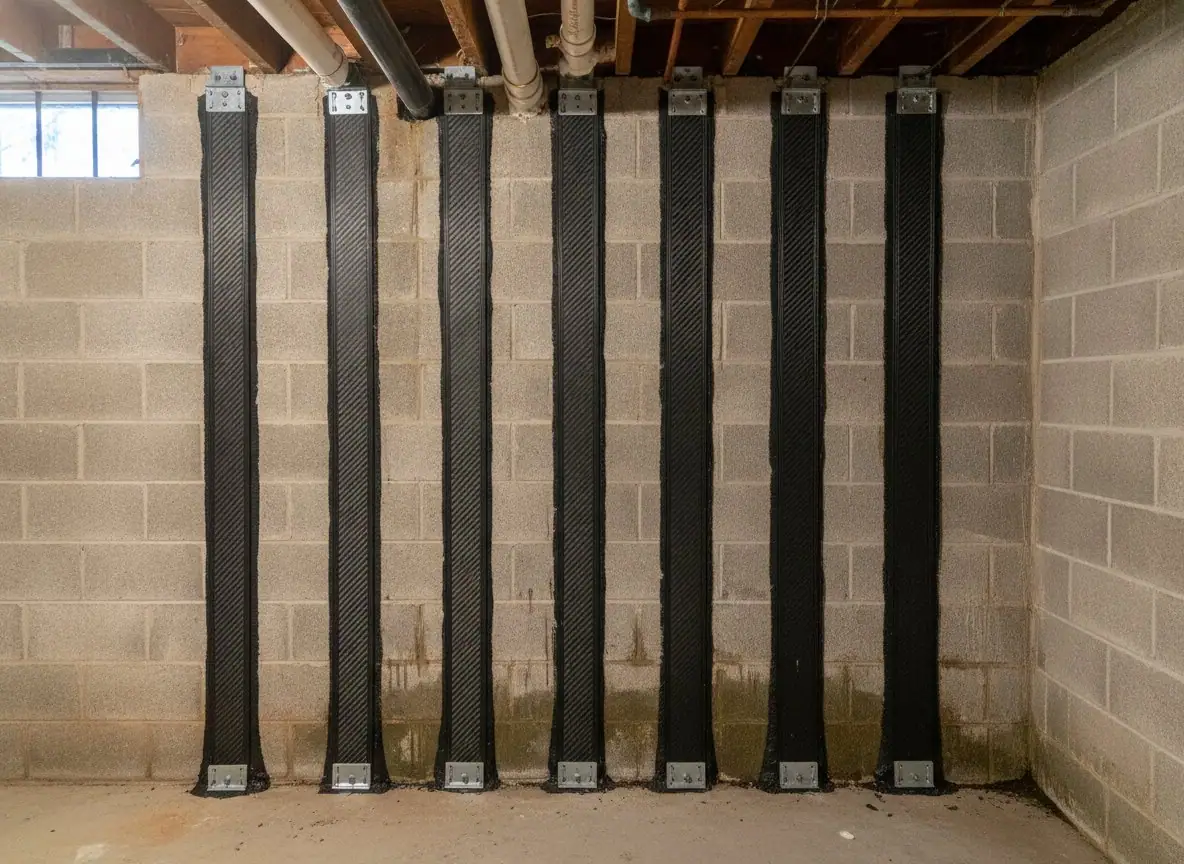
For horizontal or bowing foundation wall cracks caused by lateral soil pressure — more common in Leander properties with significant cut-and-fill grading — carbon fiber straps are bonded to the wall surface to prevent further inward movement without requiring full excavation.
Slab Lifting via Polyurethane Foam (PolyLeveling)
Sunken or uneven concrete slabs — including garage floors, driveways, and interior slabs — are lifted by injecting expanding polyurethane foam beneath the slab through small 5/8-inch drill holes. This method is minimally invasive and particularly well-suited to Leander’s post-tensioned slab homes.
Foundation Crack Repair Cost in Leander, TX: What to Expect
Foundation crack repair costs in Leander vary significantly based on crack severity, repair method, and the extent of structural work required. The following ranges reflect current market pricing in the Williamson County area:
- Hairline Crack Sealing (Cosmetic): $300–$800 per crack for polyurethane or surface-applied sealant treatments on non-structural cracks.
- Epoxy Injection (Structural Cracks): $500–$1,500 per crack, depending on crack length and depth. Most Leander slab repairs in this category range from $800–$2,500 total.
- Pier Installation (Settlement Stabilization): $1,200–$2,000 per pier, with most Leander homes requiring 8–15 piers for full perimeter stabilization. Total costs typically range from $10,000–$25,000 for full pier systems.
- Carbon Fiber Strap Installation: $400–$700 per strap, with most wall reinforcement projects requiring 3–6 straps ($1,500–$4,500 total).
- Slab Lifting (PolyLeveling): $800–$3,500 depending on the square footage of affected slab area.
Read moreShow less
Leander-Specific Cost Factors
Several local factors influence pricing in Leander. Pier depth requirements are typically greater here than in sandy-soil markets because Austin Chalk bedrock may sit 15–22 feet below grade, requiring more material and labor. Post-tensioned slabs in newer Crystal Falls or Bryson homes require specialized handling to avoid cutting tensioned cables, which adds $500–$1,500 in engineering coordination costs. Additionally, Leander’s permit fees for structural foundation work currently range from $150–$400 depending on project scope.
Homeowners should budget for a professional inspection ($200–$500, often credited toward repair costs) before accepting any estimate. Beware of quotes that skip the inspection phase.
Learn More About Foundation Repair Costs in the Greater Austin Area
Neighborhoods We Serve in Leander, TX
Crystal Falls
One of Leander’s premier master-planned communities, Crystal Falls features homes built primarily between 2002 and 2018 on rolling hillside terrain with significant cut-and-fill grading. The combination of imported fill soils and expansive native clay creates elevated differential settlement risk. Many homes here use post-tensioned slabs requiring specialized repair protocols.
Bryson
A newer development along US-183 North, Bryson’s homes — largely built after 2015 — sit on some of Leander’s flattest terrain but over clay-heavy soils with high shrink-swell potential. Younger homes here are beginning to show early-stage cracking as post-construction soil consolidation continues.
Mason Hills and Travisso
These hillside communities in western Leander near Ranch Road 2243 feature some of the most geologically complex building sites in the area, with limestone outcroppings and shallow soil depths creating uneven foundation bearing conditions. Older portions of Mason Hills (built 1985–2000) show higher rates of foundation movement than newer sections.
Block House Creek and Bagdad Road Corridor
This established area of central Leander contains the city’s oldest residential stock, with homes dating to the 1970s and 1980s on conventional slab foundations. Mature tree canopies along Block House Creek Drive and FM 2243 contribute to moisture extraction issues, and aging polybutylene plumbing in some homes adds under-slab leak risk to the foundation equation.
Foundation Maintenance Tips for Leander, TX Homeowners
Preventing foundation cracks from forming or worsening is far less expensive than repairing them. Given Leander’s climate and soils, the following maintenance practices are especially important:
- Maintain Consistent Soil Moisture Year-Round: Use a soaker hose system placed 12–18 inches from the foundation perimeter during Leander’s dry summers (May–September) to prevent extreme soil shrinkage. Run for 30–45 minutes every 3–4 days during drought conditions.
- Ensure Positive Drainage Grading: Soil around your foundation should slope away at a minimum of 6 inches over the first 10 feet. Flat or inward-sloping grades are extremely common in Leander’s hillside lots and should be corrected.
- Clean and Maintain Gutters Seasonally: Leander’s spring storm season (March–May) generates significant roof runoff. Clogged gutters dump water directly at the foundation perimeter. Clean gutters twice yearly and ensure downspouts discharge at least 4 feet from the foundation.
- Manage Large Trees Proactively: Keep large live oaks and cedar elms trimmed and consider root barriers if trees are within 15 feet of the foundation.
- Monitor Plumbing for Leaks Annually: Schedule a plumbing pressure test every 2–3 years, particularly in homes built before 2005 with older pipe materials.
- Inspect Foundation Perimeter Seasonally: Walk your foundation perimeter each spring and fall, photographing any new or changed cracks with a ruler for scale.
- Avoid Overwatering Landscape Beds: Drip irrigation systems adjacent to the foundation can cause localized soil heave — a common issue in Leander’s newer neighborhoods with HOA-mandated landscaping.
Why Choose Round Rock Foundation Repair Group for Foundation Crack Repair in Leander, TX
Round Rock Foundation Repair Group brings deep regional expertise to every foundation crack repair project in Leander. Our technicians are thoroughly familiar with Williamson County’s soil profiles, Leander’s specific development history, and the repair challenges unique to both post-tensioned and conventional slab systems common throughout the area.
We serve the entire Leander community and surrounding areas including Cedar Park, Georgetown, Round Rock, Austin, Pflugerville, Brushy Creek, and Avery Ranch, giving us a broad perspective on how foundation performance varies across North Austin’s diverse geological zones.
Our services include Structural Foundation Repair, Foundation Restoration, Commercial Foundation Repair, Foundation Inspection, Crawl Space Repair, Foundation Patching, Home Foundation Repair, and Concrete Foundation Repair — providing a complete solution under one roof.
Read moreShow less
We provide written, itemized estimates before any work begins, with no surprise charges. Our team communicates transparently about what repairs are structurally necessary versus cosmetically optional, empowering homeowners to make informed decisions. We stand behind every repair we perform and are available for follow-up consultations as your home’s foundation continues to be monitored over time.
Learn More About Round Rock Foundation Repair Group
FAQ
Frequently Asked Questions: Foundation Crack Repair Cost in Leander, TX
How much does foundation crack repair cost in Leander, TX?
Costs vary widely depending on crack severity and the repair method required. Simple crack sealing starts around $300–$800 per crack. Structural epoxy injection typically runs $500–$1,500 per crack. Full foundation stabilization with pier systems commonly ranges from $10,000–$25,000 for a typical Leander single-family home. We provide a detailed, no-obligation estimate after our inspection.
Does homeowner’s insurance cover foundation crack repair in Leander?
In most cases, standard homeowner’s insurance policies in Texas exclude foundation damage caused by soil movement, settlement, or drought — the primary causes in Leander. Coverage may apply if the crack was caused by a sudden, covered event such as a plumbing leak. We recommend reviewing your policy carefully and can provide documentation to support insurance claims where applicable.
How long does foundation crack repair take in Leander?
Minor crack injections can be completed in a single day. Pier installation projects for a full foundation perimeter typically take 2–4 days. More complex commercial or multi-building projects may extend to 1–2 weeks. We provide a timeline estimate specific to your project during the inspection phase.
My Leander home was built in 2012 on a post-tensioned slab. Does that change my repair options?
Yes, significantly. Post-tensioned slabs, common in Leander developments built after 2005 including Crystal Falls and Bryson, contain steel cables under tension that cannot be cut during repair. This limits certain pier placement options and requires specialized drilling techniques. We have extensive experience with post-tensioned slab repair in Leander and will identify cable locations through documentation and scanning before any work begins.
How do I know if a crack is structural or cosmetic in my Leander home?
Generally, cracks wider than 1/4 inch, horizontal cracks, cracks that are wider at one end, cracks accompanied by door or window sticking, or cracks showing displacement between the two faces are indicators of structural concern. Hairline cracks under 1/16 inch with no associated symptoms are often cosmetic. Only a professional inspection with floor-level measurements can definitively determine severity — do not rely on visual assessment alone, especially with Leander’s active clay soils.
Will foundation repair affect my home’s resale value in Leander?
Documented, professionally repaired foundation cracks with a transferable warranty generally have a neutral to positive effect on resale value compared to unrepaired cracks, which Texas sellers are required to disclose. Buyers in Leander’s competitive real estate market increasingly request foundation inspection contingencies, and having documented repairs ready can accelerate the closing process.
How often do I need to have my foundation inspected in Leander?
Given Leander’s expansive clay soils and weather variability, we recommend a professional foundation inspection every 3–5 years for homes showing no symptoms, and annually for homes that have had prior repairs or show early-stage cracking. Following major drought events — such as the 2011 and 2022 droughts — an inspection within 6–12 months is advisable regardless of visible symptoms.
Do you serve areas near Leander, such as Cedar Park and Brushy Creek?
Yes. Round Rock Foundation Repair Group serves Leander and all surrounding communities including Cedar Park, Georgetown, Round Rock, Austin, Pflugerville, Brushy Creek, Avery Ranch, Anderson Mill, Great Hills, Forest Creek, Behrens Ranch, Sendero Springs, and many other neighborhoods throughout the North Austin area.
Get Your Foundation Crack Repair Estimate in Leander, TX Today
Don’t let foundation cracks worsen through another Leander summer drought or spring rain cycle. The sooner a professional assesses your foundation, the more cost-effective your repair options will be. Round Rock Foundation Repair Group provides honest, thorough foundation inspections and detailed cost estimates for homeowners and business owners throughout Leander and the surrounding North Austin region.
Call us now at (512) 220-3502 to speak directly with a foundation repair specialist. We’ll schedule your inspection at a time that works for you and deliver a clear, written estimate with no pressure and no hidden fees.
Serving Leander, Cedar Park, Georgetown, Round Rock, Austin, Pflugerville, Brushy Creek, and surrounding communities.
Request a Foundation Inspection in Leander, TX
Get in touch
Find foundation repair help near you
Request a free estimate online or give us a call — our team will follow up quickly.
- Call us(512) 220-3502
- Visit1 Chisholm Trail Rd suite 450 room j, Round Rock, TX 78681
- HoursMon-Sat: 7:00 am – 7:00 pm