Foundation Crack Repair in Leander, TX
Fast, Reliable Foundation Crack Repair in Leander, TX — Licensed & Insured
Expert foundation crack repair in Leander, TX. Round Rock Foundation Repair Group fixes slab, concrete & structural cracks caused by Leander’s expansive clay soils. Call (512) 220-3502.
- Licensed & Insured
- Locally Owned & Operated
- Free Inspection & Estimate
Request Your
Free EstimateFoundation crack repair is the process of diagnosing, sealing, and structurally reinforcing cracks that develop in a home or building’s foundation — whether those cracks appear in poured concrete slabs, block walls, or pier-and-beam systems. In Leander, TX, where expansive clay soils, rapid population growth, and volatile seasonal weather create uniquely aggressive conditions for foundation movement, crack repair is not a cosmetic concern — it is a structural necessity.
At Round Rock Foundation Repair Group, we provide professional foundation crack repair services tailored specifically to the geological and climatic realities of the Leander area. From established neighborhoods near Crystal Falls Parkway to newer developments along US-183A, our team understands how local soil behavior, drainage patterns, and construction practices contribute to foundation distress. We deliver lasting structural solutions backed by experienced craftsmanship and a commitment to protecting your most valuable asset — your property.
Call us today at (512) 220-3502 to schedule a professional foundation inspection in Leander, TX.
Understanding Foundation Crack Repair
Foundation crack repair encompasses a range of techniques designed to address fractures in a building’s foundational structure, prevent further deterioration, and restore structural integrity. Not all foundation cracks are equal. Some are superficial, resulting from normal concrete curing and shrinkage. Others indicate serious structural movement that, if left untreated, can compromise the safety and value of an entire structure.
Historically, Central Texas — including communities like Leander — was built atop soils that engineers and geologists classify as highly reactive. The region’s settlement and development boom of the 1990s through the 2000s, and the unprecedented growth surge of the 2010s and early 2020s, resulted in thousands of homes and commercial buildings being constructed quickly over soils that were not always adequately tested or prepared. Many of those structures are now reaching the age — typically 10 to 25 years — when deferred soil movement becomes visible as foundation cracking.
In Leander specifically, the building stock includes a wide mix of property types: post-tension slab foundations in master-planned communities like Travisso and Crystal Falls, pier-and-beam structures in older sections near the historic downtown, and commercial tilt-wall construction along major corridors like SH-29. Each building type presents different crack profiles and requires different repair approaches.
Foundation crack repair methods have evolved considerably over the past two decades. Modern techniques include epoxy injection for structural bonding, polyurethane foam injection for waterproofing active leaks, carbon fiber strap reinforcement for bowing walls, and helical pier systems for underpinning sinking foundations. Understanding which method applies to a specific crack type, soil condition, and structural configuration is the foundation — no pun intended — of effective repair.
When homeowners and property managers in Leander understand that crack repair is a technical discipline rather than a simple patch job, they make better decisions about who to trust with this critical work. Schedule a Foundation Inspection to get a professional assessment before damage worsens.
Why Foundation Crack Repair Is Needed in Leander, TX
Expansive Clay Soils: The Root Cause
Leander, TX sits atop geological formations dominated by Taylor Clay and Austin Chalk — two soil types notorious among geotechnical engineers for extreme volumetric change in response to moisture. Taylor Clay, which underlies much of the Leander and Cedar Park corridor, can expand by as much as 30% in volume when saturated and shrink dramatically during dry periods. This cyclical swell-and-shrink behavior exerts upward pressure (heave) and downward pull (settlement) on foundations, generating cracks over time.
The Soil Survey of Williamson County, which covers Leander’s northern portions, and the Travis County survey covering southern sections, both flag these soils as having “very high” shrink-swell potential — a designation that carries specific engineering implications for foundation design and maintenance.
Leander’s Extreme Weather Cycles
Leander experiences dramatic precipitation swings that accelerate soil movement. The area averages approximately 32 inches of annual rainfall, but that rainfall is highly uneven. Extended drought periods — such as the severe Central Texas drought of 2011, when Williamson County recorded less than 14 inches of rain and soil moisture deficits reached record depths — cause significant soil shrinkage beneath slabs. When rains return, rapid re-saturation can cause heave events that crack previously stable foundations.
The 2011 drought alone is widely cited by local foundation contractors as the triggering event for a wave of crack-related claims that continued for years afterward in communities like Crystal Falls, Travisso, and the older platted subdivisions near Leander Road. Similarly, the 2022–2023 period of alternating drought and heavy rainfall — including flash flooding events along Brushy Creek tributaries that flow through Leander — renewed foundation stress across many residential neighborhoods.
Rapid Development and Site Preparation Issues
Leander’s population has grown from approximately 7,500 residents in 2000 to over 75,000 by 2023 — a tenfold increase in roughly two decades. This pace of development meant that many subdivision lots were graded, filled, and built upon without adequate time for soil consolidation. Fill soils placed beneath slab foundations in developments like Mason Hills, Bryson, and Lakeline Ranch can settle unevenly for years after construction, generating differential foundation movement and crack formation.
Drainage Challenges
Leander’s topography includes gentle rolling terrain that, when disrupted by residential development, creates localized drainage problems. Improper grading around homes — particularly in neighborhoods where lot grading was done to meet minimum code rather than optimal drainage standards — allows water to pond near foundation perimeters. This concentrated moisture intrusion accelerates soil swelling near edges, causing differential heave that manifests as diagonal corner cracks and step cracks in brick veneer.
Learn About Crawl Space Repair for homes where poor drainage has affected subfloor systems as well as foundation slabs.
Signs You Need Foundation Crack Repair in Leander
Visible Structural Indicators
- Diagonal cracks running at 45-degree angles from corners of door frames or window openings
- Horizontal cracks in block or concrete walls, which often indicate lateral soil pressure
- Stair-step cracks in brick mortar joints along exterior walls
- Vertical cracks wider than 1/4 inch in poured concrete foundation walls
- Cracks that are wider at the top than at the bottom, indicating settlement
- Cracks that are wider at the bottom than at the top, indicating heave
Interior Warning Signs
- Doors and windows that stick, jam, or no longer close flush — especially interior doors in the center of the home
- Gaps appearing between walls and ceilings or walls and floors
- Cracks in drywall that reopen after being patched and repainted
- Uneven or sloping floors, detectable by placing a marble on the floor and observing which direction it rolls
- Tile grout cracking in bathroom or kitchen floors without obvious impact cause
Urgent Red Flags
- Cracks accompanied by water intrusion after rain events
- Sudden appearance of multiple new cracks following a drought or heavy rainfall
- Structural wall displacement visible from outside the home
- Gaps wider than 1/2 inch anywhere in the foundation system
If you observe any of these signs at your Leander property, contact Round Rock Foundation Repair Group at (512) 220-3502 immediately for an assessment.
Our Foundation Crack Repair Process in Leander, TX
Our repair process is structured to ensure that every intervention is informed, precise, and built to last in the specific soil and climate conditions of the Leander area.
Comprehensive Foundation Inspection (Day 1 — 2–4 Hours)
We begin with a thorough on-site inspection of your property. Our team evaluates interior and exterior crack patterns, measures floor elevations using a Zip-Level precision altimeter to detect differential settlement as small as 1/8 inch, and reviews the property’s drainage conditions and landscaping. We also research the soil survey data specific to your parcel — a step that is particularly important in Leander given the variability between Taylor Clay and Austin Chalk formations across the city.
Crack Classification and Root Cause Analysis (Day 1 — Included in Inspection)
Not every crack requires the same repair. We classify each crack by type (structural vs. non-structural), orientation, width, length, and activity (active vs. dormant). This classification determines the repair method recommended and ensures we are addressing root causes, not just symptoms.
Written Repair Proposal and Engineering Review (Days 2–5)
We provide a written proposal detailing recommended repair methods, materials, timeline, and cost. For complex or large-scale repairs — common in Leander’s larger custom homes in areas like Travisso or Crystal Falls — we coordinate with licensed structural engineers as needed.
Site Preparation (Repair Day, First 1–2 Hours)
Before repair begins, we prepare the work area. This includes excavation where underpinning is required, surface cleaning and grinding for injection work, and protecting interior finishes near repair zones.
Foundation Crack Repair Execution (1–3 Days Depending on Scope)
Repair is performed using the method(s) most appropriate for your specific crack type and soil conditions. All materials used meet or exceed industry standards and are selected for performance in Central Texas heat and humidity cycles.
Drainage and Grading Corrections (Same Day or Follow-Up Visit)
Where drainage issues contributed to the cracking, we address grading, downspout extensions, and French drain recommendations to reduce the risk of recurrence — a critical step given Leander’s clay-heavy soils.
Post-Repair Inspection and Documentation (Final Day)
We conduct a final walkthrough, document the completed repairs with photographs, and provide the homeowner with a written summary of work performed — useful for real estate disclosures and insurance records.
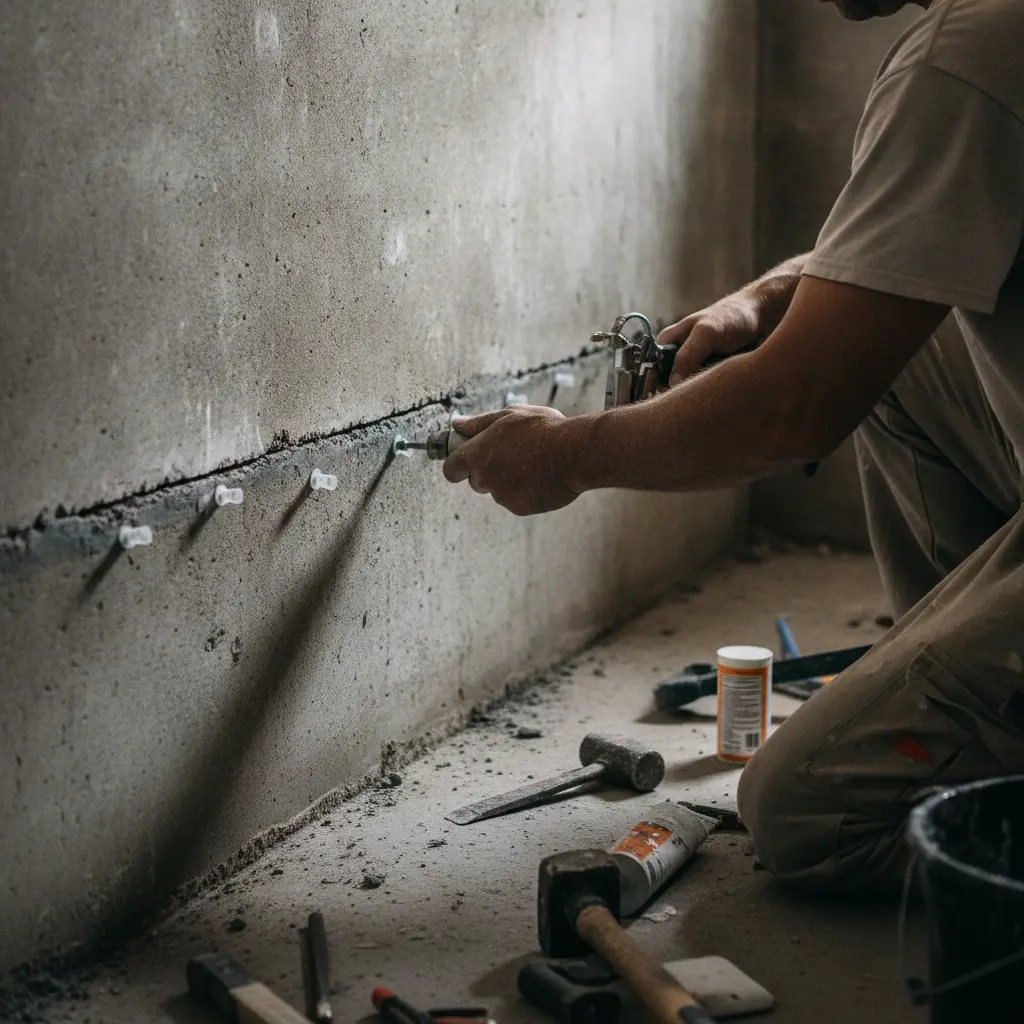
Our team in action — foundation-repair professionals serving Leander
Foundation Crack Repair Methods Used in Leander
Epoxy Injection
Best used for dormant structural cracks in poured concrete foundations, epoxy injection bonds crack faces together with a material stronger than the original concrete. This method is ideal for homes in Leander’s newer slab-on-grade subdivisions where a crack has stabilized and the goal is to restore structural continuity. Epoxy injection is not recommended for active or water-bearing cracks.
Polyurethane Foam Injection
Polyurethane foam expands to fill cracks and is flexible, making it the preferred method for waterproofing active cracks where moisture intrusion is occurring. This method is frequently used in Leander homes where storm drainage issues cause periodic water entry through foundation wall cracks during heavy Central Texas rain events.
Carbon Fiber Strap Reinforcement
For foundation walls showing horizontal cracking or inward bowing — a condition caused by lateral soil pressure, common in Leander homes with landscaped berms or retaining walls adjacent to foundation walls — carbon fiber straps provide tensile reinforcement that prevents further movement without requiring excavation.
Helical Pier and Push Pier Underpinning
When cracks result from foundation settlement rather than surface cracking alone, underpinning with steel helical or push piers transfers the structure’s load to stable soil or bedrock below the reactive clay layer. In Leander, stable bearing strata — typically Austin Chalk — is often found at depths of 10 to 25 feet depending on location.
Foundation Patching and Resurfacing
For non-structural surface cracks and spalling, Foundation Patching provides an effective, cost-efficient solution that restores surface integrity and prevents moisture infiltration that could accelerate deeper damage.
Ready for Foundation Crack Repair? Get Your Free Estimate Today.
Round Rock Foundation Repair Group serves Leander and the surrounding area — we’ll be on-site within 24 hours.
📞 Call (512) 220-3502Foundation Crack Repair Cost in Leander, TX
One of the most common questions we receive is: “What does foundation crack repair cost in Leander?” The honest answer is that costs vary significantly based on crack severity, repair method, and the extent of underlying foundation movement. Below is a realistic cost framework for Leander homeowners.
Typical Cost Ranges
- Minor crack sealing and patching: $300–$800 per crack, typically for superficial or shrinkage cracks requiring epoxy or polyurethane injection
- Carbon fiber wall reinforcement: $400–$600 per strap, with most bowing wall projects requiring 3–8 straps ($1,200–$4,800 total)
- Underpinning with helical or push piers: $1,500–$3,500 per pier, with average Leander residential projects requiring 8–16 piers ($12,000–$56,000 for full perimeter repair)
- Comprehensive slab foundation repair (crack injection + pier installation): $8,000–$25,000 for typical Leander single-family homes
- Commercial foundation crack repair: $15,000–$100,000+ depending on building size and structural complexity
Leander-Specific Cost Factors
Several local factors influence pricing in Leander. The depth required to reach stable Austin Chalk bedrock varies across the city — homes on the western side near Crystal Falls Parkway may require deeper pier installations than those in eastern Leander near the Metro Rail corridor, affecting per-pier costs. Additionally, Leander’s rapid growth has created strong demand for foundation contractors, and scheduling can affect project timelines.
We recommend getting a detailed written estimate before committing to any repair. Request a Free Foundation Inspection to receive an accurate assessment and cost proposal for your specific property.
Leander Neighborhoods We Serve
Crystal Falls
One of Leander’s premier master-planned communities, Crystal Falls features homes built primarily between 2000 and 2015 on post-tension slab foundations. The neighborhood’s rolling terrain and clay-heavy soils have generated a notable number of corner crack and door-frame distortion issues as homes have aged. We have extensive experience with post-tension slab crack assessment in this neighborhood.
Travisso
Travisso is a newer luxury community in western Leander where large custom homes — many exceeding 3,500 square feet — sit on slabs over expansive clay formations. The combination of large slab area and reactive soil creates amplified differential movement, and diagonal cracking at structural corners is among the most common repair needs we address here.
Mason Hills and Bryson
These growing communities on Leander’s eastern and northern edges include homes built during the high-growth years of 2015–2022. Many lots in these areas include compacted fill material, and some homes are now experiencing first-cycle settlement cracking as fill soils consolidate — a common 5-to-10-year phenomenon in rapidly developed Texas suburbs.
Historic Downtown Leander
Older homes near downtown Leander along South West Drive and adjacent streets often feature pier-and-beam foundations built before 1980. These structures require specialized crawl space and pier-and-beam repair approaches distinct from modern slab repair techniques.
Foundation Crack Prevention Tips for Leander Homeowners
- Maintain consistent soil moisture. During Leander’s dry summer months — often stretching from June through September — use a soaker hose system around your foundation perimeter to prevent excessive clay shrinkage. Keep soil visibly moist but not saturated, maintaining moisture within 18 inches of the foundation edge.
- Ensure positive drainage away from the foundation. The ground around your home should slope away at a minimum of 6 inches over the first 10 feet. Flat or negative grades are among the top causes of foundation cracking in Leander.
- Extend downspouts at least 5 feet from the foundation. Concentrated roof runoff discharged at the foundation base is a leading cause of localized heave cracking.
- Avoid large trees within 15–20 feet of the foundation. Texas Live Oak and Cedar Elm — common in Leander landscaping — draw significant moisture from soil and can cause differential drying beneath slabs.
- Inspect your foundation twice yearly. Walk the perimeter in spring (post-rainy season) and fall (post-drought) to catch early crack development before it becomes structural.
- Do not over-irrigate landscaping beds along foundation walls. Excessive moisture from landscaping irrigation against the foundation perimeter causes heave in Leander’s expansive clays.
- Address plumbing leaks promptly. Under-slab plumbing leaks in Leander homes are a significant but often overlooked cause of localized soil saturation and heave cracking.
Why Choose Round Rock Foundation Repair Group for Foundation Crack Repair in Leander
Round Rock Foundation Repair Group brings deep, localized expertise to every foundation crack repair project in Leander and the surrounding communities. We are not a national franchise applying generic solutions — we are a regional team that understands the specific behavior of Taylor Clay soils, the drainage challenges of Williamson County topography, and the construction characteristics of Leander’s various residential and commercial building eras.
We serve Leander homeowners across all neighborhoods — from Travisso and Crystal Falls to Mason Hills and historic downtown — and we extend our services throughout the broader Central Texas region including Cedar Park, Round Rock, Georgetown, Austin, Pflugerville, Brushy Creek, Avery Ranch, Anderson Mill, and many other communities.
Our commitment is to honest assessment, transparent pricing, and durable repairs. We will never recommend more work than your foundation genuinely needs, and we will always explain the cause of your cracking — not just the cure. Schedule Your Inspection Today or call us at (512) 220-3502.
For commercial properties, we also offer specialized Commercial Foundation Repair services tailored to the unique demands of business facilities in the Leander area.
Frequently Asked Questions: Foundation Crack Repair in Leander, TX
How much does foundation crack repair cost in Leander, TX?
Costs in Leander range from $300–$800 for minor crack injection to $12,000–$56,000+ for full pier underpinning projects. The majority of residential crack repair projects in Leander fall between $3,000 and $15,000 depending on the number and severity of cracks and whether underpinning is required. Contact us for a free on-site assessment and written estimate.
Are all foundation cracks serious?
No. Hairline cracks less than 1/16 inch wide in concrete are typically the result of normal curing shrinkage and are not structurally significant. However, cracks wider than 1/4 inch, horizontal cracks, cracks accompanied by water intrusion, or cracks that have measurably widened over time should always be evaluated by a professional. In Leander’s reactive clay environment, even minor cracks should be monitored closely.
How long does foundation crack repair take in Leander?
Simple crack injection repairs can be completed in 4–8 hours in a single day. Projects requiring pier underpinning typically take 2–5 days for an average Leander home. Larger custom homes in communities like Travisso or Crystal Falls with extensive damage may require up to 2 weeks for complete foundation restoration.
Will my homeowner’s insurance cover foundation crack repair in Leander?
Standard homeowner’s insurance policies in Texas typically exclude foundation damage caused by soil movement — which is the primary cause of foundation cracking in Leander. Coverage may apply if cracking results from a covered peril such as a sudden plumbing leak beneath the slab. We recommend reviewing your policy and consulting your insurance agent. We can provide detailed repair documentation to support any claim you submit.
Does the 2011 drought still affect Leander foundations today?
Yes, in some cases. The 2011 drought caused deep soil desiccation across the Leander area — in some locations, moisture deficits extended 6 to 8 feet below grade. While soils have partially recovered, homes that experienced significant movement during that period may have dormant cracks that remain structurally compromised and should be inspected and repaired if they haven’t been already.
What is the difference between foundation crack repair and foundation restoration?
Foundation crack repair addresses specific fractures in the foundation system. Foundation Restoration is a more comprehensive process that may include crack repair, underpinning, drainage correction, and surface resurfacing to return a severely compromised foundation to near-original structural condition. Restoration is typically recommended when multiple repair interventions are needed across a large portion of the foundation.
Can I sell my home in Leander with foundation cracks?
Texas law requires sellers to disclose known material defects, including foundation cracks. Unrepaired foundation damage can significantly reduce your home’s appraised value and complicate mortgage financing. Repairing cracks before listing — and providing documentation of professional repair — can protect your sale price and accelerate closing. We provide transferable documentation that supports real estate transactions.
Do you serve areas near Leander like Cedar Park and Round Rock?
Yes. Round Rock Foundation Repair Group serves Leander and all surrounding communities including Cedar Park, Round Rock, Georgetown, Austin, Pflugerville, Brushy Creek, Tech Ridge, Jollyville, Wells Branch, Avery Ranch, Anderson Mill, Behrens Ranch, Sendero Springs, Forest Creek, Paloma Lake, Teravista, La Frontera, Mayfield Ranch, Cat Hollow, and Great Hills. View Our Full Service Area.
Contact Round Rock Foundation Repair Group for Foundation Crack Repair in Leander, TX
Don’t let foundation cracks compromise the safety, value, or comfort of your Leander home or commercial property. The expansive clay soils and volatile weather cycles of Central Texas make proactive foundation care essential — and the sooner cracks are professionally assessed and repaired, the lower the ultimate cost of remediation.
Round Rock Foundation Repair Group is ready to help. Call us today at (512) 220-3502 to speak with a foundation specialist, or use our online contact form to request your professional foundation inspection in Leander, TX. We serve Leander and all surrounding communities across the greater Austin metro region.
Request Your Free Foundation Inspection Now