Foundation Cracks in Leander, TX — Expert Repair You Can Trust
Structural Foundation Cracks Specialists Serving Leander, TX
Suffering from foundation cracks in Leander, TX? Round Rock Foundation Repair Group offers expert diagnosis & repair. Call (512) 220-3502 for a free inspection.
- Licensed & Insured
- Locally Owned & Operated
- Free Inspection & Estimate
Request Your
Free EstimateFoundation cracks are one of the most serious structural concerns a homeowner or business owner can face. In Leander, TX, where rapid population growth has led to accelerated construction on challenging expansive clay soils, foundation cracking is not just common — it is a predictable outcome without proper intervention. Foundation cracks range from superficial hairline fractures in surface concrete to deep structural fissures that compromise the integrity of your entire building.
Round Rock Foundation Repair Group brings specialized expertise in diagnosing and repairing foundation cracks throughout Leander and the greater Williamson County area. Our team understands the unique geological and climatic pressures that affect Leander properties, and we tailor every repair plan to match the specific conditions of your home or commercial building. Whether you own a newer construction in Crystal Falls or an established home near Hero Way, we are your local foundation crack specialists.
Call us today at (512) 220-3502 to schedule a professional foundation inspection.
Understanding Foundation Cracks in Leander, TX
A foundation crack is any fracture, gap, or separation that forms in the concrete, masonry, or structural material that makes up a building’s foundation. These cracks develop as a result of stress forces that exceed the tensile strength of the foundation material. While concrete is extremely strong under compression, it is relatively weak under tension — meaning lateral pressure, differential settlement, and moisture-driven expansion can all generate cracks over time.
Foundation cracks are broadly categorized into two types: structural cracks and non-structural cracks. Non-structural cracks, such as shrinkage cracks that appear during the curing of new concrete, are typically hairline fractures less than 1/16 of an inch wide and do not threaten the building’s stability. Structural cracks, by contrast, are wider, often diagonal or horizontal, and indicate that the foundation is being subjected to movement forces it was not designed to withstand.
In Leander specifically, the combination of expansive clay soils — particularly the Houston Black Clay and Taylor Clay formations found throughout Williamson County — and the region’s dramatic wet-dry weather cycles creates conditions that are especially punishing to concrete foundations. When clay soils absorb moisture during wet seasons, they swell with tremendous force, pushing against foundation walls and slabs. When the same soils dry out during Central Texas droughts, they shrink, removing the support from beneath the foundation and causing differential settlement.
Leander’s explosive residential growth since the early 2000s has resulted in thousands of homes built on lots where soil preparation may have been rushed to meet construction timelines. Many neighborhoods that were developed between 2005 and 2015 are now reaching the age at which foundation movement becomes most apparent, typically 8 to 15 years after construction. This means a large portion of Leander’s housing stock is currently entering a high-risk window for foundation crack development.
Both slab-on-grade foundations — the dominant foundation type in Leander — and pier-and-beam foundations found in older sections of the city are susceptible to cracking. Understanding the type and cause of a crack is the essential first step toward choosing the correct repair method. Schedule a professional foundation inspection to get a definitive assessment.
Why Foundation Crack Repair Is Needed in Leander, TX
Expansive Clay Soils Beneath Leander Neighborhoods
The soils underlying most of Leander’s residential neighborhoods are classified as Vertisols — specifically Houston Black Clay and Taylor Clay. These soils have a shrink-swell coefficient among the highest in Texas, with linear extensibility measurements commonly exceeding 6 centimeters per meter of depth. When these soils absorb water, they can expand with a lateral pressure exceeding 2,000 pounds per square foot — easily enough to fracture a concrete slab or push a foundation wall inward. Neighborhoods built on the flatter terrain northeast of Ronald Reagan Boulevard, including portions of Travisso and Mason Hills, sit directly atop some of the thickest clay deposits in the area.
Extreme Wet-Dry Climate Cycles
Central Texas experiences dramatic swings between wet and dry periods that are particularly hard on foundations. The 2011 Texas drought — one of the most severe single-year droughts in recorded state history — caused extraordinary soil shrinkage across Williamson County. Leander received fewer than 14 inches of rainfall that year against a normal annual average of approximately 32 inches. This event caused widespread foundation cracking and differential settlement that homeowners are still repairing today. More recently, the February 2021 Winter Storm Uri froze soil moisture rapidly, causing frost heave and additional foundation movement for properties in Leander’s Devine Lake area and surrounding subdivisions.
Rapid Development and Soil Compaction Practices
Leander’s population grew from approximately 7,000 residents in 2000 to over 75,000 by 2023 — a tenfold increase in just over two decades. This pace of growth put enormous pressure on developers to complete homes quickly, and in some cases soil compaction and preparation protocols were not given adequate time. Subdivisions in the Crystal Falls, Carneros Ranch, and Block House Creek areas that were developed during the peak construction years of 2006 through 2012 are now among the most commonly reported areas for foundation crack complaints in the city.
Tree Root Activity
Leander’s urban canopy includes a significant number of mature Live Oak and Cedar Elm trees, both of which produce aggressive, wide-spreading root systems. Root intrusion beneath slab foundations removes moisture from the soil in a localized area, accelerating differential settlement. Properties along Lakeline Boulevard and in the older, established sections near Hero Way are particularly susceptible to tree root-related foundation cracking.
Drainage and Slope Issues
Several Leander neighborhoods were developed with drainage designs that have proven inadequate as impervious cover has increased. Ponding water adjacent to foundation edges saturates clay soils unevenly, creating localized uplift that causes diagonal cracking from corners of door frames and windows — one of the most recognizable signs of foundation trouble in Leander homes.
Signs You Need Foundation Crack Repair in Leander
Visible Cracks
- Horizontal cracks in basement or stem wall foundations (high urgency — indicates lateral soil pressure)
- Diagonal stair-step cracks in brick or block mortar joints wider than 1/4 inch
- Vertical cracks in poured concrete walls wider than 1/8 inch
- Cracks that are wider at the top than at the bottom, indicating settlement
- New cracks appearing after periods of prolonged rain or drought
Interior Symptoms
- Drywall cracks appearing diagonally from the corners of doors and windows
- Floors that slope, bounce, or feel uneven underfoot
- Gaps forming between walls and ceilings or between walls and floors
- Tile grout cracking or tiles popping loose on slab floors
Exterior and Structural Symptoms
- Doors or windows that stick, refuse to latch, or have developed visible gaps in their frames
- Gaps appearing between the chimney and the main structure of the home
- Visible separation between the garage slab and the main foundation
- Water intrusion through foundation cracks after rainfall events
If you observe any of these symptoms — especially horizontal cracks or cracks wider than 1/4 inch — contact Round Rock Foundation Repair Group at (512) 220-3502 immediately for an urgent inspection.
Our Foundation Crack Repair Process in Leander, TX
We follow a systematic, proven process for diagnosing and repairing foundation cracks in Leander properties. Every step is adapted to account for local soil conditions and building types.
Initial Consultation and Site Review (Day 1)
Our process begins with a phone or online consultation to gather preliminary information about your property. We review publicly available soil survey data for your specific Leander address, including USDA Web Soil Survey classifications, to begin understanding the subsurface conditions before we arrive on site.
Comprehensive Foundation Inspection (Day 1–2)
Our certified inspector visits your property and performs a full assessment using laser levels, crack monitors, and moisture meters. We measure the width, length, and orientation of all visible cracks, assess floor levelness across the entire footprint, and inspect both interior and exterior surfaces. In Leander, we pay particular attention to the soil moisture differential between the perimeter and center of slabs, which is frequently the primary driver of crack formation here. Learn more about our inspection process.
Engineering Assessment and Repair Plan (Days 3–5)
Based on inspection data, we develop a detailed repair plan. For structural cracks, this plan specifies the repair method, number of piers or injection ports required, expected post-repair elevation changes, and estimated timeline. We present this plan to you in a written document with clear cost breakdowns.
Site Preparation (Repair Day 1)
We prepare the work area by protecting landscaping and interior flooring, locating all underground utilities, and staging equipment. In Leander neighborhoods with tight lot lines like portions of Block House Creek, we use compact equipment specifically suited for limited-access sites.
Foundation Crack Repair Execution (Days 1–3 Depending on Scope)
Repair work is performed according to the approved plan. Whether we are injecting epoxy or polyurethane, installing helical piers, or performing concrete patching, we adhere to strict quality control protocols at every stage of execution.
Post-Repair Verification (Final Repair Day)
After repairs are complete, we re-level the structure where applicable, re-measure floor elevations, and perform a final visual inspection of all treated cracks to confirm closure and alignment.
Documentation and Follow-Up (Within 2 Weeks)
We provide a complete repair report including before-and-after measurements, photos, and product documentation. We schedule a follow-up check at 30 days post-repair to confirm stability, which is especially important during Leander’s seasonal soil transition periods.
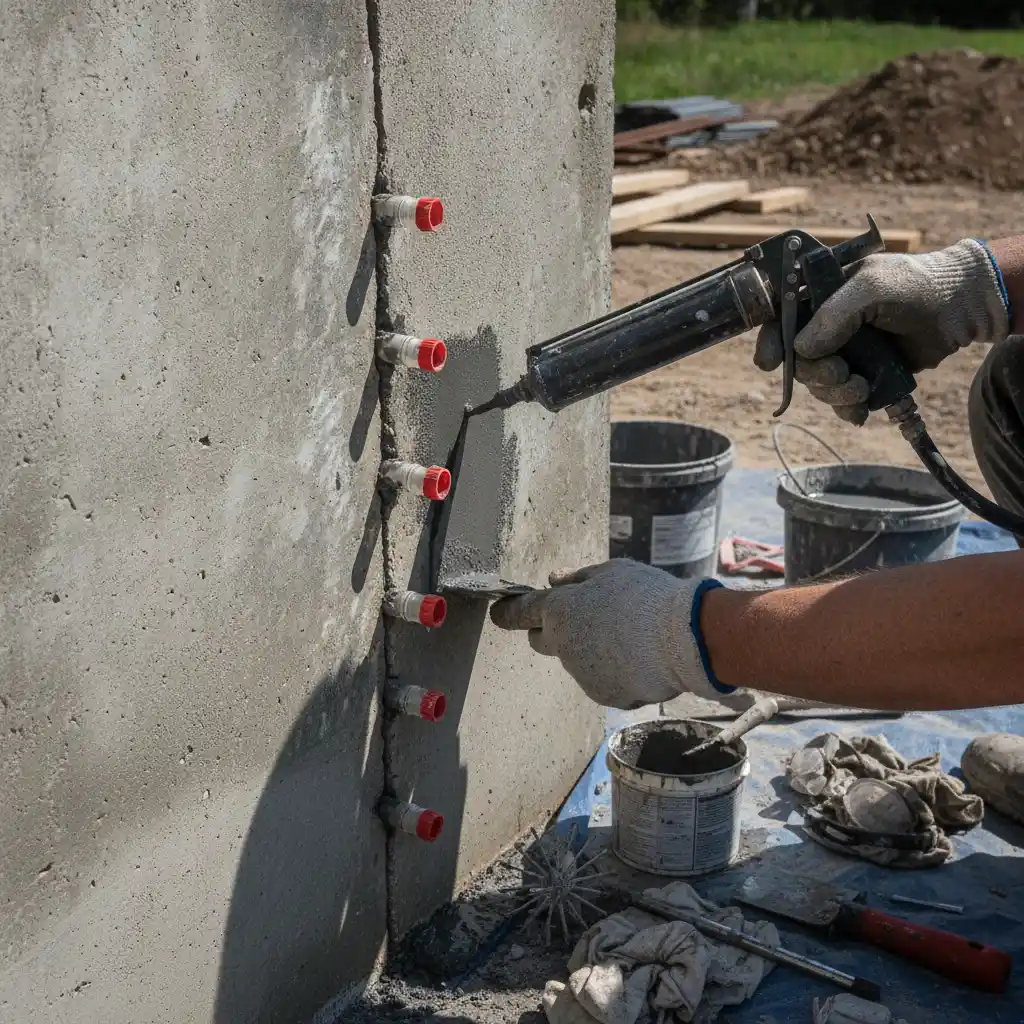
Our team in action — foundation-repair professionals serving Leander
Foundation Crack Repair Methods Used in Leander
Epoxy Injection
Epoxy injection is used for structural cracks in poured concrete walls and slabs where the crack is stable and the goal is to restore monolithic strength. Two-part epoxy resin is injected under controlled pressure through ports placed along the crack length. Cured epoxy achieves compressive strengths exceeding 10,000 psi — stronger than the surrounding concrete. This method is ideal for hairline to moderate cracks in Leander homes that have stabilized after seasonal soil movement.
Polyurethane Foam Injection
Polyurethane foam is the preferred method when water infiltration through a crack is the primary concern or when the crack is in active movement. The expanding foam seals the crack against moisture while remaining flexible enough to accommodate minor ongoing movement — making it well suited for Leander’s wet-season conditions. Learn more about our concrete foundation repair services.
Helical and Push Pier Installation
When foundation cracking is caused by differential settlement, pier systems are required to stabilize and lift the foundation back toward its original elevation. Helical piers are screwed into competent load-bearing soil beneath the unstable clay layer — in Leander, this typically means reaching the Edwards Limestone or Austin Chalk formations at depths of 15 to 25 feet. Push piers use the building’s weight as resistance during hydraulic driving. Explore our structural foundation repair options.
Foundation Patching and Resurfacing
For non-structural surface cracks and spalling, we use polymer-modified concrete patching compounds that bond tenaciously to existing concrete and resist the thermal cycling common in Central Texas. View our foundation patching services.
Carbon Fiber Strap Reinforcement
Horizontal cracks in stem walls caused by lateral soil pressure are stabilized using high-tensile carbon fiber straps bonded to the wall surface. This method prevents further inward movement without the excavation required by traditional steel beam bracing — a major advantage on Leander’s narrower suburban lots.
Ready for Foundation Cracks? Get Your Free Estimate Today.
Round Rock Foundation Repair Group serves Leander and the surrounding area — we’ll be on-site within 24 hours.
📞 Call (512) 220-3502Foundation Crack Repair Cost in Leander, TX
One of the most common questions we receive is: How much does foundation crack repair cost in Leander? The honest answer is that costs vary significantly based on the severity, type, and underlying cause of the cracking. Below are realistic ranges based on current Leander market conditions.
Typical Cost Ranges
- Minor crack patching and sealing: $300 – $800 per crack location
- Epoxy injection (per crack, up to 10 linear feet): $500 – $1,200
- Polyurethane foam injection for water intrusion: $600 – $1,500 per affected area
- Carbon fiber strap installation: $400 – $600 per strap; most projects require 3–8 straps
- Helical or push pier installation: $1,200 – $2,000 per pier; most Leander slab jobs require 8–16 piers
- Full foundation stabilization with pier system: $8,000 – $22,000 for average Leander homes
- Comprehensive structural foundation repair including crack repair: $15,000 – $35,000 for severe cases
Factors That Affect Your Cost
- Depth to load-bearing soil or bedrock beneath your specific Leander lot
- Accessibility of the foundation perimeter (landscaping, fencing, structures)
- Number and severity of active cracks
- Whether interior cosmetic repairs (drywall, flooring) are included
- Current soil moisture conditions and season (dry-season repairs may require additional site preparation)
Foundation crack repair costs in Leander are generally consistent with the broader Austin metropolitan market, though properties in hillier terrain near the 183A corridor may incur slightly higher pier installation costs due to access challenges. We provide detailed written estimates at no obligation. Call (512) 220-3502 or request a free inspection online.
Leander Neighborhoods We Serve
Crystal Falls
One of Leander’s most established master-planned communities, Crystal Falls features homes built primarily between 2002 and 2016. Properties here sit on some of the deepest clay deposits in the Leander area, and homes on the community’s lower-elevation lots frequently exhibit diagonal corner cracking associated with differential settlement. Many Crystal Falls homes are now in the 10-to-20-year age range where foundation movement becomes most active.
Block House Creek
Block House Creek is an older Leander neighborhood with homes dating from the late 1980s through early 2000s. The mature tree canopy here — particularly large Live Oaks — creates localized soil desiccation beneath slabs. Pier-and-beam foundations in this neighborhood’s older sections are particularly prone to crawl space moisture issues that accompany foundation cracking. Learn about our crawl space repair services.
Travisso
Travisso is a newer luxury development in far northwest Leander with homes built from 2015 onward. Despite being newer construction, Travisso properties on northwest-facing slopes have experienced grading-related drainage issues that concentrate water against foundation perimeters, causing early-onset cracking in homes less than 10 years old.
Mason Hills and Carneros Ranch
These mid-2000s neighborhoods were developed during Leander’s most rapid growth phase. Homes here commonly range from 1,800 to 3,500 square feet on slab foundations and are now entering the highest-risk age window for soil-movement-related foundation cracking throughout the greater Williamson County region.
Maintenance Tips to Prevent Foundation Cracks in Leander
Preventing foundation cracks — or slowing their progression — requires consistent attention to moisture management and soil conditions around your Leander home. Follow these location-specific tips.
- Maintain consistent soil moisture year-round. During Leander’s hot, dry summers (when temperatures regularly exceed 100°F), use a soaker hose around your foundation perimeter to prevent the clay soil from drying and shrinking. Aim to keep the soil consistently moist — not saturated — from June through September.
- Ensure proper grading. The soil around your foundation should slope away at a minimum of 6 inches of drop over the first 10 feet. Many Leander properties have settled into negative grades over time; re-grading is inexpensive and highly effective.
- Clean gutters and extend downspouts. Downspouts should discharge water at least 4 to 6 feet from the foundation. Blocked gutters are a leading cause of perimeter soil saturation in Leander’s spring storm season.
- Monitor large trees. Maintain root barriers between large Live Oaks, Cedar Elms, and your foundation. Consider consulting an arborist if trees are within 15 feet of your slab.
- Inspect your foundation annually. Walk the full perimeter of your home each spring and fall, looking for new cracks, changes in existing cracks, or shifts in the gap between your foundation and exterior cladding.
- Address plumbing leaks immediately. Leaking water lines beneath a slab — a common issue in Leander homes with older copper or PVC supply lines — are among the fastest ways to cause catastrophic differential settlement.
- Avoid excessive watering near the foundation. Overwatering flower beds adjacent to the foundation can cause clay soil to swell and exert uplift pressure on the slab edge.
Why Choose Round Rock Foundation Repair Group for Foundation Cracks in Leander
Round Rock Foundation Repair Group is the trusted name for foundation crack repair throughout Leander and the surrounding Williamson County communities. Our team has direct, hands-on experience with the specific soil types, construction practices, and climate patterns that affect properties in this region — knowledge that national chains simply cannot replicate.
We have worked in virtually every Leander neighborhood, from the older pier-and-beam homes near the historic town center to the newest master-planned communities along 183A. This local experience means we arrive at your property already knowing what soil conditions to expect, what depth piers typically need to reach in your area, and what repair approaches have the best long-term outcomes for Leander’s unique environment.
We use industry-leading materials from trusted manufacturers, and our repair techniques follow guidelines established by the International Concrete Repair Institute (ICRI) and the Foundation Performance Association (FPA-SC). Every project is completed by trained, experienced technicians — not subcontractors.
We also serve the greater area including Round Rock, Cedar Park, Georgetown, and Austin. Call us at (512) 220-3502 to speak with a local expert today.
Frequently Asked Questions About Foundation Cracks in Leander, TX
How much does foundation crack repair cost in Leander, TX?
Costs range from as little as $300 to $800 for minor crack sealing to $15,000 or more for full structural stabilization with a pier system. The most common foundation crack repair projects in Leander — involving epoxy or polyurethane injection for moderate cracking on a slab-on-grade home — typically run between $2,500 and $7,500. We provide written, itemized estimates after a free on-site inspection.
Are foundation cracks in Leander homes dangerous?
It depends entirely on the type and severity of the crack. Hairline shrinkage cracks less than 1/16 inch wide are generally cosmetic. However, horizontal cracks in stem walls, diagonal cracks wider than 1/4 inch, and cracks that are actively growing are serious structural indicators that require immediate professional evaluation. Do not ignore widening cracks — they rarely stop progressing on their own in Leander’s clay soil environment.
How long does foundation crack repair take in Leander?
Most crack injection and patching projects are completed in one to two days. Projects that include pier installation typically take three to five business days depending on the number of piers required and site accessibility. The inspection and planning phase adds another three to five business days before physical work begins.
Why do so many Leander homes have foundation cracks?
Leander sits on some of the most expansive clay soils in Texas — specifically Houston Black Clay and Taylor Clay — which shrink and swell dramatically with moisture changes. Combined with the extreme wet-dry cycles of Central Texas weather and the rapid development pace of the 2000s and 2010s, a large percentage of Leander’s housing stock is susceptible to foundation movement. The 2011 drought and the February 2021 Winter Storm Uri both caused widespread foundation damage across the area.
Is foundation crack repair covered by homeowners insurance in Texas?
In most cases, standard homeowners insurance policies in Texas do not cover foundation cracking caused by soil movement, drought, or gradual settlement — which are the most common causes in Leander. Coverage may apply if the crack was caused by a sudden, specific event such as a plumbing failure. We recommend reviewing your policy and consulting with your insurance agent. We can provide documentation of the repair for your records regardless of the insurance outcome.
Can I repair foundation cracks myself?
Surface-level cosmetic cracks in non-load-bearing areas can sometimes be addressed with DIY concrete patching products. However, structural cracks — especially those caused by differential settlement or lateral soil pressure — require professional diagnosis and repair. Incorrectly sealing a structural crack without addressing the underlying cause can actually accelerate damage by trapping moisture or masking active movement. For any crack wider than 1/8 inch or showing active growth, professional repair is strongly recommended.
How do I find foundation crack repair near me in Leander, TX?
Round Rock Foundation Repair Group is locally based and serves all of Leander and the surrounding communities including Crystal Falls, Block House Creek, Travisso, Mason Hills, and Carneros Ranch, as well as Cedar Park, Round Rock, Georgetown, and Austin. Call us directly at (512) 220-3502 or request a free inspection online and we will schedule a visit at your convenience — typically within 48 to 72 hours of your initial contact.
What is the best time of year to repair foundation cracks in Leander?
Foundation crack repair can be performed year-round in Leander, but late fall through early spring — when soil moisture is more stable — often produces the most consistent results for pier installation and leveling work. However, do not wait for an ideal season if you are observing active or structural cracking. Delaying repair allows damage to compound, increasing both repair complexity and cost.
Contact Round Rock Foundation Repair Group for Foundation Cracks in Leander, TX
Don’t let foundation cracks put your Leander home or commercial property at risk. Whether you’ve noticed a hairline fracture or a significant structural crack, the experienced team at Round Rock Foundation Repair Group is ready to help. We serve all of Leander — from Crystal Falls to Travisso to Block House Creek — as well as Cedar Park, Georgetown, Round Rock, Austin, and the surrounding communities.
Getting started is simple:
- Call us: (512) 220-3502
- Request a free inspection: Schedule your free Leander foundation inspection today
- Learn more about our services: Structural Foundation Repair | Commercial Foundation Repair | Foundation Restoration
Our team is standing by to provide an honest, professional assessment of your foundation and a clear path forward. Call (512) 220-3502 now — because foundation problems don’t get better with time.