Foundation Problems in Leander, TX: Expert Diagnosis & Repair Solutions
Structural Foundation Problems in Leander Specialists Serving Leander, TX
Dealing with foundation problems in Leander, TX? Round Rock Foundation Repair Group offers expert inspection and repair for Leander’s clay soils. Call (512) 220-3502.
- Licensed & Insured
- Locally Owned & Operated
- Free Inspection & Estimate
Request Your
Free EstimateFoundation problems in Leander, TX are among the most pressing structural concerns facing homeowners and business owners in this rapidly growing community. From hairline cracks in concrete slabs to severe differential settlement, foundation issues can compromise the safety, value, and livability of any structure. Leander’s unique combination of expansive clay soils, dramatic seasonal moisture swings, and accelerating residential development creates an environment where foundation distress is not just possible — it is exceptionally common.
At Round Rock Foundation Repair Group, we specialize in identifying, diagnosing, and resolving every category of foundation problem across Leander and the surrounding Central Texas region. Our team brings deep local knowledge of Williamson County geology, native soil behavior, and the construction patterns common to Leander’s booming subdivisions. Whether you are dealing with a sloping floor in a newer home off Hero Way or stair-step cracks in a mature property near Old Town Leander, we deliver reliable, lasting solutions tailored to your specific situation.
Call us today at (512) 220-3502 for a professional foundation inspection.
Understanding Foundation Problems in Leander
Foundation problems encompass a broad spectrum of structural conditions that affect the integrity of the base upon which a building is constructed. At their core, these issues occur when the soil beneath a structure moves, shifts, or loses its load-bearing capacity — causing the foundation to settle unevenly, crack, bow, or heave. Understanding the nature of these problems is essential before any repair strategy can be properly implemented.
In Leander, the overwhelming majority of foundations are poured concrete slab-on-grade systems, which became standard in Central Texas residential construction during the post-war suburban expansion of the 1950s and accelerated through the 1980s and 1990s. These slab foundations rest directly on the native soil, meaning any movement in that soil is transmitted directly to the structure above. Pier-and-beam foundations, which were common in older homes built prior to 1960, are also found in historic sections of Leander and present their own category of issues including rotted wood beams, compromised piers, and sagging floor systems.
Foundation problems are broadly categorized into settlement, heave, lateral movement, and deterioration. Settlement occurs when soil compresses or erodes beneath the foundation, causing portions to sink. Heave is the opposite — expansive soils absorbing moisture swell upward, lifting sections of the slab. Lateral movement is most common in basement or retaining wall situations, while deterioration describes chemical or physical breakdown of the concrete itself.
Leander’s construction boom, which intensified dramatically after 2010 with major master-planned communities like Crystal Falls, Travisso, and Bryson being developed, introduced tens of thousands of new slab foundations into a challenging geotechnical environment. Many of these newer homes were constructed on sites that required significant earthwork and fill soil placement — conditions that dramatically increase the risk of differential settlement in the years following construction. Understanding how Leander’s development history intersects with its geology is the first step toward addressing foundation problems effectively.
Learn more about our full range of services: foundation repair services in Central Texas
Why Foundation Problems Are So Common in Leander, TX
Expansive Clay Soils: The Primary Culprit
The dominant soil type beneath most of Leander is Houston Black clay and related Vertisol soils — classified by geotechnical engineers as highly expansive, with a Plasticity Index (PI) often exceeding 40. These soils can absorb water and expand in volume by as much as 30% to 40%, then shrink dramatically during dry conditions. The differential movement between wet and dry cycles routinely measures 2 to 4 inches of vertical displacement across a single foundation footprint — more than enough to crack concrete slabs, distort door frames, and separate brick veneer.
Extreme Drought and Flood Cycles
Central Texas is defined by severe weather extremes. The 2011 Texas drought — one of the worst single-year droughts in recorded state history — caused catastrophic soil shrinkage across Williamson County, triggering a wave of foundation failures in Leander neighborhoods including Crystal Falls, Travisso, and homes along Ronald Reagan Boulevard. In contrast, heavy rainfall events like the Memorial Day Floods of 2015 and the October 2018 flooding along Brushy Creek saturated soils to depths of 18 to 24 inches, causing rapid heave in low-lying areas. This repeated expansion-and-contraction cycle fatigues concrete slabs over time, accelerating cracking and settlement.
Rapid Development on Disturbed Soils
Leander’s population has grown from approximately 7,600 residents in 2000 to over 75,000 by 2023 — a tenfold increase in two decades. This growth required massive grading and fill operations across previously undeveloped cedar brush land. Fill soils placed during site preparation for subdivisions like Bryson, Mason Hills, and Summerlyn often lack proper compaction documentation, and these loosely placed soils consolidate under load over 5 to 15 years following construction, producing classic differential settlement patterns.
Tree Root Intrusion and Moisture Depletion
Native Texas Live Oaks and Cedar Elms, which are common throughout established Leander neighborhoods near US-183 and in older sections around Crystal Falls Drive, have aggressive root systems that extract significant moisture from clay soils. A single mature Live Oak can remove hundreds of gallons of soil moisture per week during summer months, creating localized soil shrinkage zones directly beneath slabs that lead to edge settlement — one of the most common foundation failure patterns in the area.
Seasonal Drainage Challenges
Many Leander lots, particularly in older subdivisions along Bagdad Road and near the South Fork of the San Gabriel River, experience poor surface drainage due to flat topography and clay soil’s naturally low permeability. Water that ponds near foundation perimeters for extended periods creates the conditions for both hydrostatic pressure buildup and localized heave — compounding the foundation stress already imposed by seasonal drying.
Signs You Need Foundation Problem Services in Leander
Interior Warning Signs
- Diagonal cracks at the corners of doors and windows, particularly in drywall or plaster — typically indicating differential settlement
- Doors and windows that stick, jam, or no longer latch properly, especially after dry summer months
- Floors that slope, feel springy underfoot, or have visible gaps at baseboards
- Cracks in tile flooring, especially running diagonally across a room
- Separation between ceiling and interior walls
Exterior Warning Signs
- Stair-step cracking in brick veneer mortar joints — a classic sign of foundation settlement in Leander’s brick-clad homes
- Visible gaps between the brick facade and window or door frames
- Cracks in the concrete foundation beam visible along the home’s perimeter
- Separation between the chimney and main structure
Urgent Red Flags
- Cracks wider than ¼ inch in the foundation slab or exterior walls
- Doors that will not close at all or rooms that feel visibly out of plumb
- Water intrusion through foundation cracks following rainfall events
- Sagging or bouncing floors in pier-and-beam homes indicating failed supports
If you notice any of these signs, schedule a professional inspection immediately: contact Round Rock Foundation Repair Group
Our Foundation Problem Resolution Process in Leander
Addressing foundation problems in Leander requires a disciplined, systematic approach that accounts for the local soil conditions, construction types, and seasonal variables unique to Williamson County. Our process is designed to deliver accurate diagnosis and lasting repair outcomes.
Comprehensive Foundation Inspection (1–2 Hours)
Our certified inspectors conduct a thorough visual and instrumental survey of your entire foundation system. This includes interior elevation readings taken at a grid of points across the floor using a Zip Level Pro digital elevation tool, exterior crack mapping with width measurements, and drainage pattern assessment. We note lot grade, proximity of trees, and any prior repair evidence. In Leander’s clay-soil environment, we pay particular attention to edge settlement patterns and moisture variations around the perimeter.
Geotechnical Assessment and Report (2–3 Business Days)
Following the on-site inspection, we compile a detailed written report documenting all findings, elevation differential measurements, identified failure mechanisms, and soil moisture observations. For complex cases — particularly in newer Leander subdivisions built on fill soils — we may recommend a third-party soil boring report to confirm subsurface conditions before prescribing a repair scope.
Repair Proposal and Method Selection (1 Business Day)
We present a clear, itemized repair proposal that outlines the recommended method, number and placement of repair points, expected outcomes, and total cost. We walk you through all options, explaining how each method applies to your home’s specific conditions in Leander’s geotechnical environment.
Site Preparation and Access (Day 1 of Repair)
Our crew excavates access points along the foundation perimeter as needed, protects landscaping, and establishes work zones. In tight Leander subdivisions with minimal side yard clearance, we use compact equipment to minimize site disturbance.
Foundation Repair Execution (1–5 Days Depending on Scope)
Repair work proceeds according to the approved method — pier installation, slabjacking, wall stabilization, or crawl space remediation. All work follows engineered specifications adapted to Leander’s soil and loading conditions.
Post-Repair Elevation Verification
Upon completion, we re-run the full elevation survey to confirm that differential has been corrected to within acceptable tolerances — typically less than ¾ inch across the foundation footprint.
Documentation and Homeowner Briefing
We provide complete documentation of work performed, including before-and-after elevation readings, materials used, and maintenance recommendations specific to your Leander property’s soil and drainage conditions.
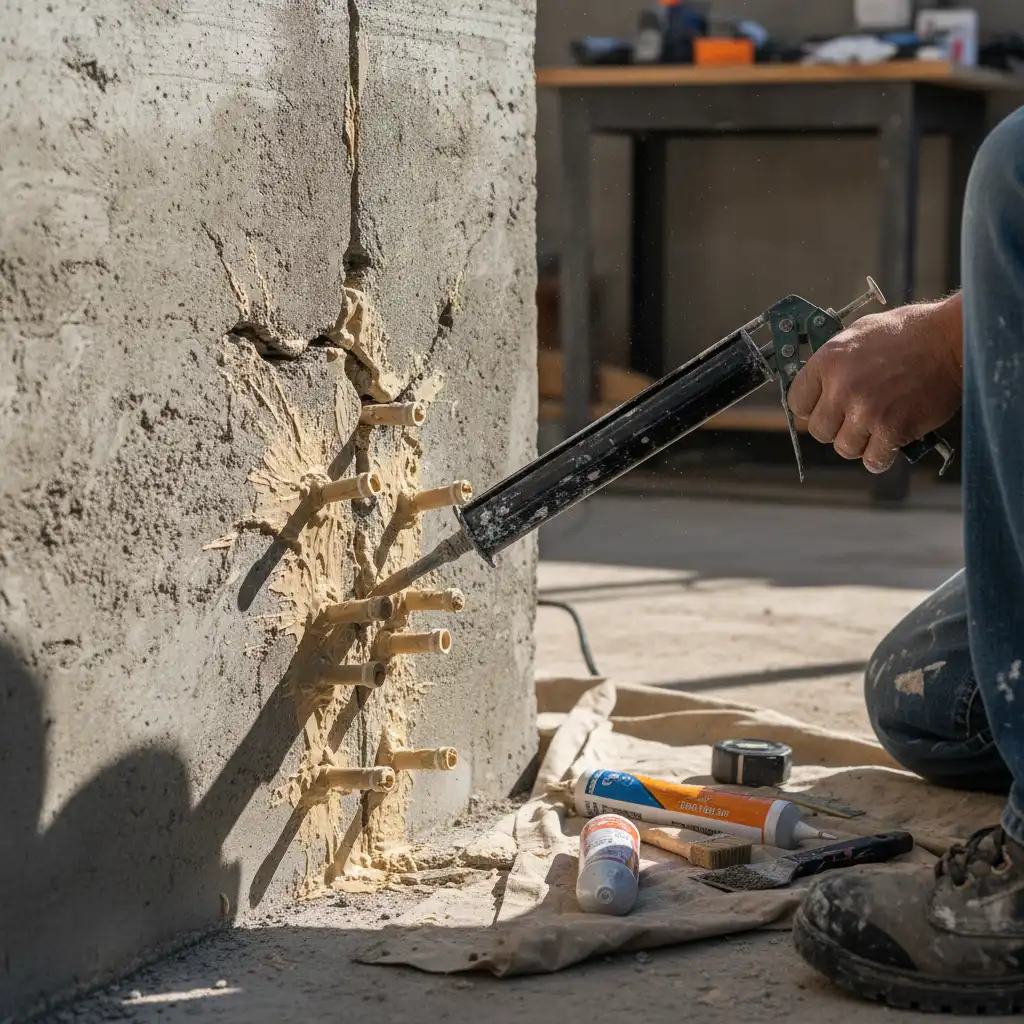
Our team in action — foundation-repair professionals serving Leander
Foundation Repair Methods We Use in Leander
Steel Push Piers
For significant settlement in Leander’s expansive clay zones, hydraulically driven steel push piers are advanced through unstable surface soils to reach bedrock or load-bearing strata at depths typically ranging from 15 to 30 feet beneath the surface. This method is ideal for homes in Travisso, Crystal Falls, and other hilltop subdivisions where shallow limestone bedrock provides an excellent bearing layer. Push piers permanently stabilize the foundation and can often restore lost elevation.
Helical Piers
Helical piers are screwed into the soil rather than pushed, making them effective in areas with lighter loads or where access is restricted — particularly useful for additions, porches, and commercial structures in Leander’s growing commercial corridor along US-183.
Slab Pier Systems (Interior Piers)
Interior slab piers address settlement in the middle of a slab that exterior piers cannot reach. Our crew cuts access holes through the interior slab, installs piers to bearing depth, then patches the concrete — a technique commonly needed in Leander’s larger open-plan homes built in the 2000s.
Polyurethane Foam Injection
For minor slab voids and lifting needs — particularly effective in addressing localized heave recovery or settling concrete flatwork on Leander driveways and walkways — high-density polyurethane foam is injected beneath the slab to fill voids and provide stabilization.
Crawl Space Repair and Encapsulation
Older pier-and-beam homes in established Leander neighborhoods near the city’s historic core benefit from crawl space beam replacement, pier shimming, and full encapsulation to control the moisture that accelerates wood decay in Central Texas humidity conditions.
Ready for Foundation Problems? Get Your Free Estimate Today.
Round Rock Foundation Repair Group serves Leander and the surrounding area — we’ll be on-site within 24 hours.
📞 Call (512) 220-3502Foundation Problem Repair Costs in Leander, TX
One of the most common questions we receive is: what does foundation repair cost in Leander? While every project is unique, understanding the typical cost ranges and the factors that influence pricing helps homeowners budget appropriately and avoid surprises.
Typical Cost Ranges
- Foundation Inspection: $200 – $500 (often credited toward repair if you proceed)
- Minor crack patching and surface repair: $500 – $1,500
- Pier installation (per pier): $1,200 – $1,800 per steel push pier; most Leander slab homes require between 8 and 20 piers
- Average full perimeter pier repair (Leander single-family home): $8,500 – $22,000
- Crawl space repair and encapsulation: $3,500 – $12,000 depending on scope
- Commercial foundation repair: $15,000 – $80,000+ depending on building size and failure type
Factors That Affect Cost in Leander
Leander’s geotechnical conditions directly affect repair complexity and cost. Homes built on deep fill soils in newer subdivisions like Bryson or Mason Hills may require additional piers or deeper installations to reach competent bearing strata, increasing per-pier costs. Properties with extensive landscaping, hardscape, or limited access along narrow side yards in dense subdivisions may incur additional labor costs for site preparation. The depth to limestone bedrock varies across Leander — homes on the plateau above Travisso often reach bearing rock at 15–18 feet, while homes on valley floors near Brushy Creek may require 25–35 foot installations.
Financing and Value Considerations
Foundation repair is a direct investment in your home’s structural integrity and resale value. Unrepaired foundation problems in Leander’s competitive real estate market can reduce a home’s value by $20,000 to $50,000 or more and complicate mortgage transactions. We discuss financing options during the proposal process. foundation repair financing options
Leander Neighborhoods We Serve
Crystal Falls
One of Leander’s most established master-planned communities, Crystal Falls features homes built primarily between 2000 and 2015 on a mix of native clay and imported fill soils. The area’s hilly terrain creates both drainage opportunities and risk — homes on slope edges frequently experience edge settlement on the downhill side, requiring pier systems tailored to the grade differential.
Travisso
This newer luxury community, with most homes built after 2015, sits on elevated terrain with relatively shallow access to Cretaceous limestone bedrock. While bedrock bearing is advantageous, the thin clay layer over rock creates unpredictable heave patterns during wet seasons that require careful diagnosis to distinguish from settlement.
Bryson
Bryson is one of Leander’s newest large-scale developments, with construction beginning around 2017. Many lots required significant fill placement, making differential settlement in the 5–15 year post-construction window a primary concern for early homeowners. We have established expertise in the fill consolidation issues specific to this community.
Old Town Leander
The historic core of Leander, with homes dating to the early-to-mid 20th century, features a mix of pier-and-beam and early slab construction. Aging wood beam systems, outdated perimeter piers, and decades of expansive soil cycling make this area a frequent candidate for crawl space repair and structural restoration.
Foundation Maintenance Tips for Leander Homeowners
Proactive maintenance can significantly reduce the risk and severity of foundation problems in Leander’s demanding clay-soil environment. Follow these location-specific recommendations to protect your investment year-round.
- Maintain consistent soil moisture year-round. During Leander’s dry summers — particularly from June through September when rainfall routinely drops below 2 inches per month — use a soaker hose system placed 18 inches from the foundation perimeter to prevent extreme soil shrinkage.
- Ensure positive drainage away from the foundation. Maintain a grade of at least 6 inches of fall over the first 10 feet around your home’s perimeter to direct surface runoff away from the slab.
- Keep gutters and downspouts clear and properly extended. Direct downspout discharge at least 6–10 feet from the foundation to prevent concentrated moisture loading near the perimeter beam.
- Manage large trees near the foundation. Trees within 20 feet of the foundation — especially Live Oaks common throughout Leander — should be monitored for root intrusion and moisture depletion effects.
- Inspect for cracks seasonally. Photograph any existing cracks each fall and spring to track whether they are growing — cracks that widen more than 1/16 inch between seasons warrant professional evaluation.
- Repair plumbing leaks immediately. Leaks beneath a slab introduce localized moisture that causes dramatic heave in Leander’s reactive clay soils. Address any signs of under-slab plumbing failure without delay.
- Avoid planting shrubs or flower beds directly against the foundation. Irrigated landscaping beds trap moisture against the slab perimeter, creating uneven moisture conditions.
Why Choose Round Rock Foundation Repair Group for Foundation Problems in Leander
When you are facing foundation problems in Leander, the company you choose matters enormously. Round Rock Foundation Repair Group has built its reputation on honest assessments, technical excellence, and genuine knowledge of the Central Texas geotechnical environment that defines our service area.
We understand that Leander’s Blackland Prairie clay, its dramatic drought-flood climate cycles, and its rapid development on disturbed soils create conditions that require more than a generic repair solution. Our team is trained to distinguish between cosmetic cracking and structural failure, between seasonal movement and progressive settlement, and between conditions that require immediate intervention and those that can be monitored.
We serve homeowners, real estate professionals, property managers, and commercial building owners across Leander and the broader Williamson County area. Our inspection reports are detailed, readable, and accepted by lenders and real estate agents for transaction purposes. We provide clear, itemized proposals without hidden fees.
Our service area extends to Round Rock, Cedar Park, Georgetown, Austin, Pflugerville, Brushy Creek, Avery Ranch, Crystal Falls, and all surrounding communities — meaning our local expertise is matched by regional depth and resources. learn more about our company and team
Call us today at (512) 220-3502 to speak with a local foundation specialist.
Frequently Asked Questions: Foundation Problems in Leander, TX
How much does foundation repair typically cost in Leander, TX?
Most residential foundation repairs in Leander range from $8,500 to $22,000 for a full pier system on a standard single-family home. Minor repairs such as crack patching can cost $500 to $1,500, while complex commercial projects may exceed $50,000. Leander’s variable soil depth and the prevalence of fill soils in newer subdivisions can affect pricing. We provide free written estimates after a paid inspection that details all cost factors specific to your property.
How long does foundation repair take in Leander?
A typical residential pier installation in Leander takes 1 to 3 days depending on the number of piers and site accessibility. Crawl space repairs may take 2 to 5 days. The inspection and proposal phase typically adds 3 to 5 business days before work begins. We schedule work around Leander’s seasonal weather — avoiding pier installation during extended wet periods that can affect soil bearing conditions.
Is foundation movement in Leander seasonal or structural?
Both types occur in Leander. Seasonal movement — where doors stick in summer and ease in winter — is caused by normal expansion and contraction of clay soils in response to moisture change. Structural movement involves progressive, non-reversible settlement or heave that continues over time regardless of season. A professional elevation survey repeated across two or more seasons is the most reliable way to distinguish between these conditions.
Do newer homes in Leander developments like Bryson or Travisso have foundation problems?
Yes. Newer homes in Leander are not immune to foundation problems. In developments built on significant fill soils — particularly in Bryson and portions of Mason Hills — differential settlement often emerges within 5 to 10 years of construction as fill materials consolidate under the structure’s load. We frequently inspect homes as young as 4 to 6 years old in these communities that are already showing measurable differential settlement exceeding 1 inch.
Will my homeowner’s insurance cover foundation repair in Leander?
Standard homeowner’s insurance policies in Texas typically exclude foundation damage caused by soil movement, settling, or shrinkage — the primary causes in Leander. Coverage may apply if the foundation damage is caused by a sudden, covered peril such as a plumbing leak or a covered flood event. We recommend reviewing your specific policy and consulting with your insurer. We can provide documentation of our findings to support insurance claims where applicable.
What is the difference between foundation settlement and heave in Leander?
Settlement occurs when soil beneath the foundation compresses or loses moisture and volume, causing the foundation to drop — most common during Leander’s dry summers. Heave occurs when clay soils absorb water and swell upward, pushing the foundation up — most common following heavy rainfall or over-irrigation. Both conditions crack slabs and distort structures, but they require different repair approaches. Misdiagnosing heave as settlement and installing piers can actually worsen the condition, which is why accurate diagnosis is critical.
Are there foundation issues specific to homes near Brushy Creek in Leander?
Yes. Properties near the South Fork of the San Gabriel River and Brushy Creek corridors in southwest Leander face elevated moisture levels in surface soils year-round, increasing heave risk. These areas also experienced significant flooding during the 2015 Memorial Day floods and the October 2018 rain events, which saturated soils to significant depths. Homes in low-lying areas near these waterways should be inspected for both heave damage and any lateral soil pressure effects on foundation perimeter beams.
How do I find reliable foundation repair near me in Leander, TX?
Look for a foundation repair company with documented experience in Williamson County’s specific soil conditions, the ability to provide a detailed written inspection report with elevation measurements, and clear references from completed projects in Leander neighborhoods. Round Rock Foundation Repair Group serves Leander and all surrounding communities with local expertise and transparent pricing. Contact us at (512) 220-3502.
Schedule Your Foundation Inspection in Leander Today
If you have noticed cracks, sticking doors, sloping floors, or any other warning signs of foundation problems in your Leander home or commercial property, do not wait. Foundation issues in Central Texas’s reactive clay soils are progressive — early intervention is almost always less expensive and less disruptive than delayed repair.
Round Rock Foundation Repair Group is ready to provide an honest, thorough assessment of your foundation’s condition and a clear path to resolution. We serve Leander and all surrounding communities including Round Rock, Cedar Park, Georgetown, Austin, Pflugerville, and Brushy Creek.
Call us now at (512) 220-3502 to speak directly with a local foundation specialist. You can also submit a service request online and we will contact you within one business day. Protect your home — get the answers you need today.