Foundation Settling in Leander, TX
Structural Foundation Settling Specialists Serving Leander, TX
Struggling with foundation settling in Leander, TX? Round Rock Foundation Repair Group offers expert repair for Leander’s expansive clay soils. Call (512) 220-3502.
- Licensed & Insured
- Locally Owned & Operated
- Free Inspection & Estimate
Request Your
Free EstimateFoundation settling is the gradual downward movement of a structure’s base caused by shifts in the underlying soil, changes in moisture content, or the natural compression of fill material over time. In Leander, TX, this phenomenon is especially prevalent due to the area’s expansive clay-heavy soils and dramatic seasonal rainfall swings that cause the ground to swell and shrink repeatedly throughout the year.
Unlike sudden foundation failure, settling often develops slowly — making it easy to overlook until structural damage becomes severe. Leander’s rapid residential growth over the past two decades means thousands of homes sit on soil that has never fully stabilized, increasing the risk for both new and established properties alike.
Round Rock Foundation Repair Group brings deep local knowledge and proven repair techniques to homeowners and business owners throughout Leander. Our team understands the specific geology, climate patterns, and construction history of this community, allowing us to deliver targeted solutions that last. Call us today at (512) 220-3502 to schedule your inspection.
Understanding Foundation Settling in Leander, TX
Foundation settling refers to the downward or differential movement of a building’s foundation relative to its original position. It falls into two broad categories: uniform settling, where the entire structure descends evenly, and differential settling, where one part sinks more than another. Differential settling is the more destructive of the two and is the type most commonly seen in Leander.
Historically, the land that makes up modern Leander was largely undeveloped ranchland and cedar-covered terrain through the mid-20th century. As Williamson County experienced explosive population growth beginning in the 1990s and accelerating through the 2010s, large tracts of previously untouched soil were cleared, graded, and built upon rapidly. When construction crews disturb and recompact native soil, or when fill material is brought in to level sloped terrain, the ground takes years — sometimes decades — to fully consolidate under the weight of a structure.
The soil profile beneath Leander is dominated by Austin Chalk and Taylor Marl formations, overlaid in many areas by the Lewisville and Houston Black clay series — soils classified by the USDA as having a shrink-swell potential rated “very high.” These soils expand significantly when wet and contract sharply when dry, with volume changes of up to 30% recorded in local geotechnical studies. Every wet season followed by a dry summer becomes a cycle of stress for any foundation sitting on this material.
Settling affects all building types in Leander. Single-family slab-on-grade homes built during the rapid subdivision booms of the late 1990s and 2000s — neighborhoods like Crystal Falls and Bryson — are particularly susceptible. Older pier-and-beam homes near downtown Leander face different challenges, with wood deterioration and soil erosion undermining support piers over decades. Commercial buildings along US-183A and the Ronald Reagan Boulevard corridor deal with heavier load concentrations that accelerate differential settlement when the underlying soil is unstable.
Understanding what is happening beneath your Leander property is the essential first step toward protecting your investment. Schedule a Professional Foundation Inspection to get a clear picture of your home’s condition.
Why Foundation Settling Is a Persistent Problem in Leander, TX
Expansive Clay Soils
The dominant soil type beneath most of Leander is classified as a Vertisol — a clay-rich soil that cracks deeply when dry and swells dramatically when wet. Specifically, the Houston Black clay series, which covers much of western Williamson County, can absorb enough water to increase in volume by 25–30%. When Leander receives even a single heavy rainfall event after weeks of drought, the soil directly beneath and around a foundation can shift by fractions of an inch within 24 to 48 hours. Repeated across hundreds of seasonal cycles, this movement weakens the structural integrity of any foundation, regardless of how well it was originally poured.
Drought Conditions and Record Dry Spells
The Central Texas drought of 2011 — one of the most severe single-year droughts in Texas history, with Leander recording fewer than 12 inches of rainfall for the year against a normal average of approximately 32 inches — caused widespread foundation damage across Williamson County. Homeowners in Crystal Falls, Trails of Shiloh, and older sections near downtown Leander reported cracking, sticking doors, and visible slab separation in numbers that overwhelmed local repair contractors. The subsequent El Niño-driven rains of 2015 and 2016 then caused rapid re-swelling of those same dried soils, compounding existing damage. This drought-flood cycle is not a one-time event; it is a recurring feature of the Central Texas climate that every Leander homeowner must plan for.
Rapid Development and Fill Soil
Leander’s population grew from approximately 7,600 residents in 2000 to over 67,000 by 2022 — nearly a 10-fold increase. This pace of development required the rapid preparation of previously undisturbed land, often involving significant earthwork to level the naturally hilly terrain west of US-183. Fill soils placed during grading operations compact unevenly under structural loads, especially when the fill was not adequately tested or compacted to engineering specifications. Subdivisions built between 2003 and 2012 along the Ronald Reagan Boulevard corridor and near Leander Road are now entering the age range — 15 to 20 years — when inadequate fill compaction begins to manifest as noticeable settling.
Tree Root Intrusion and Moisture Draw
Leander’s landscape features native Live Oak and Cedar Elm trees with aggressive root systems. These roots draw enormous amounts of moisture from the soil during summer months, desiccating the clay directly beneath nearby foundations. A mature Live Oak within 20 feet of a foundation can remove hundreds of gallons of water per day from the surrounding soil, causing localized shrinkage and differential settling on the side of the home closest to the tree.
Aging Infrastructure and Plumbing Leaks
Older sections of Leander, including areas near East Crystal Falls Parkway and the neighborhoods established in the late 1980s and early 1990s, now have plumbing systems approaching 30–35 years of age. Slow slab plumbing leaks — often undetected for months — saturate the soil beneath a foundation unevenly, causing isolated swelling and upheaval that is frequently mistaken for simple settling. A thorough foundation inspection can identify whether water intrusion is contributing to movement.
Signs You Need Foundation Settling Repair in Leander
Interior Warning Signs
- Diagonal cracks running from the corners of door frames or window frames — often at a 45-degree angle
- Doors and windows that stick, jam, or no longer latch properly despite no recent humidity changes
- Visible gaps between the ceiling and interior walls, or between the floor and baseboards
- Sloping or uneven floors, particularly noticeable when rolling a marble or ball across the room
- Cracks in drywall that reappear after patching — a sign of ongoing movement
Exterior Warning Signs
- Stair-step cracking in brick veneer, following the mortar joints diagonally
- Visible gaps between the exterior brick and the window or door frames
- Separation between the chimney and the main roofline
- Cracks in the concrete slab visible in the garage floor or along exterior walkways
Urgency Indicators
Certain signs demand immediate professional evaluation: cracks wider than 1/4 inch, any crack that is actively growing, visible bowing of interior walls, or a floor slope measurable at more than 1 inch per 10 feet. If your Leander home exhibits any of these conditions, contact Round Rock Foundation Repair Group at (512) 220-3502 without delay.
Our Foundation Settling Repair Process in Leander, TX
Round Rock Foundation Repair Group follows a structured, transparent repair process tailored specifically to Leander’s soil conditions and building types. Here is what to expect from start to finish.
Comprehensive Foundation Inspection (Day 1 — 2–3 Hours)
Our certified inspector visits your Leander property and conducts a full evaluation, including interior and exterior visual assessment, floor elevation readings using a digital manometer (accurate to 1/100 of an inch), moisture probing around the perimeter, and plumbing pressure testing when indicated. We document every crack, gap, and elevation differential found.
Soil and Site Analysis (Days 1–3)
Given Leander’s complex soil profile, we review available geotechnical data for your area and assess drainage patterns around your property. Homes near the Lake Travis watershed drainage corridors and those on the western ridgelines above Crystal Falls receive particular attention to slope-related drainage issues that accelerate settling.
Engineering Report and Repair Plan (Days 3–7)
We prepare a detailed written repair plan specifying the number of piers, placement locations, target depths (typically 15–25 feet to reach stable Austin Chalk bedrock in the Leander area), and estimated lift potential. This document is provided to you before any work begins.
Site Preparation and Access (Day of Repair)
Our crew protects your landscaping, marks utility lines through 811 Texas One Call, and sets up access to pier installation points around the perimeter and, when needed, beneath the interior slab.
Pier Installation and Foundation Lift (Days 1–3 of Repair)
Using hydraulic equipment, we install piers to bedrock depth and then carefully apply controlled lifting pressure to return the settled sections of foundation toward their original elevation. Lifts are performed gradually — typically no more than 1/4 inch per stage — to prevent cracking in the superstructure.
Crack Repair and Cosmetic Restoration
After the foundation is stabilized, we address structural cracks in the slab or stem walls using epoxy injection or polyurethane foam, depending on crack type and location. Learn more about our Foundation Patching services.
Final Elevation Survey and Documentation (Final Day)
A post-repair elevation survey is conducted and compared to the pre-repair baseline. Results are documented and provided to you for insurance and resale purposes.
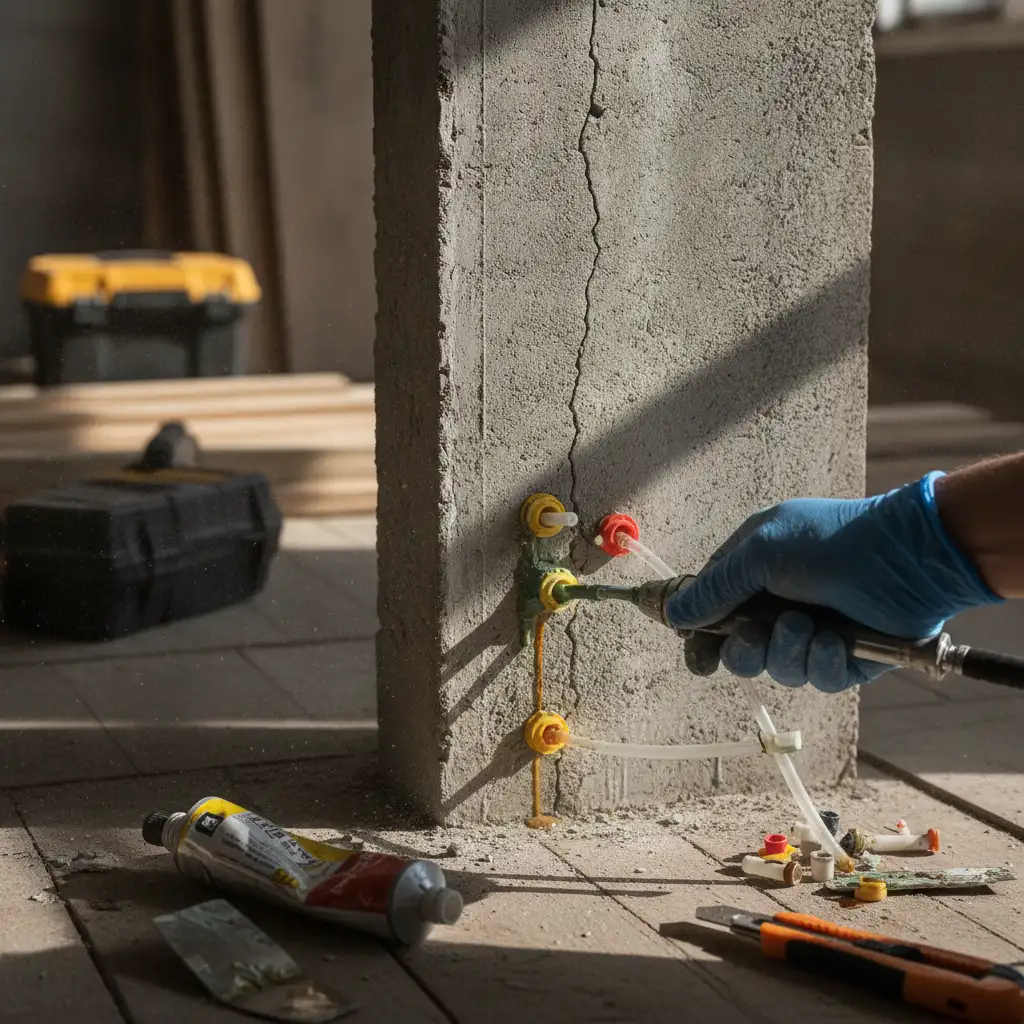
Our team in action — foundation-repair professionals serving Leander
Foundation Settling Repair Methods Used in Leander
Steel Push Piers
Steel push piers are the most common method used for slab-on-grade homes in Leander experiencing significant differential settling. Tubular steel sections are hydraulically driven through the unstable clay layers to the Austin Chalk bedrock — typically at depths of 15–25 feet beneath most Leander neighborhoods. Once at bedrock, the piers permanently transfer the structure’s load to stable ground, eliminating future soil-related movement. This method is ideal for homes in Crystal Falls, Bryson, and Trails of Shiloh where expansive clay depth is substantial.
Helical Piers
Helical piers — essentially large steel screws driven into the earth — are preferred in situations where access is limited (interior pier placement) or where soil resistance is insufficient for hydraulic push methods. They are also well-suited for lighter residential structures and for crawl space foundation repair in Leander’s older pier-and-beam homes near the historic downtown core.
Pressed Concrete Piles
This cost-effective option involves hydraulically pressing pre-cast concrete cylinders into the ground in segments. While not suitable for the deepest settling cases, pressed piles perform well in moderate settling situations on budget-conscious projects and are frequently used in Leander neighborhoods built in the late 1990s where settling is in the early-to-mid range.
Slab Foam Lifting (Polyurethane Injection)
For minor settling of concrete flatwork — driveways, sidewalks, pool decks, and garage floors — polyurethane foam injection lifts and re-levels sunken slabs within hours. This method is non-invasive and dries to full strength in 15 minutes, making it practical for Leander commercial properties along US-183A that cannot afford extended downtime.
Ready for Foundation Settling? Get Your Free Estimate Today.
Round Rock Foundation Repair Group serves Leander and the surrounding area — we’ll be on-site within 24 hours.
📞 Call (512) 220-3502Foundation Settling Repair Cost in Leander, TX
One of the most common questions we receive is: What does foundation settling repair cost in Leander? The honest answer is that costs vary significantly based on the extent of settling, foundation type, and repair method required. Here are realistic ranges based on our experience in the Leander market.
Typical Cost Ranges
- Foundation Inspection: $300–$500 for a professional inspection with written report and elevation readings
- Minor Settling Repair (1–4 piers, limited cracking): $2,500–$5,500
- Moderate Settling Repair (5–10 piers, moderate differential movement): $6,000–$12,000
- Extensive Settling Repair (10+ piers, significant differential, interior piers required): $12,000–$25,000+
- Crawl Space / Pier-and-Beam Repair: $4,000–$10,000 depending on scope
- Slab Foam Lifting for Flatwork: $800–$3,000
Leander-Specific Cost Factors
Several local factors influence pricing in Leander. The depth required to reach stable bedrock — which varies from approximately 12 feet in eastern Leander to over 25 feet along the elevated terrain near Crystal Falls — directly affects per-pier installation cost. Properties with mature Live Oak trees within 15 feet of the foundation may require additional piers to address localized desiccation zones. Homes built on steeply graded lots along the Williamson County ridge lines often require specialized equipment access, adding to labor costs.
We encourage Leander homeowners to obtain multiple written estimates. Be cautious of unusually low bids that do not include post-repair elevation documentation or use below-grade pier depths insufficient for local soil conditions. Request your free inspection estimate today.
Leander Neighborhoods We Serve
Crystal Falls
One of Leander’s largest master-planned communities, Crystal Falls features homes built primarily between 2000 and 2015. Properties on the western elevated lots sit above deeper clay profiles and are particularly vulnerable to drought-related settling. Many homes here are now 15–20 years old — prime age for initial settling symptoms to emerge.
Bryson
A newer community with significant construction activity from 2015 onward. Fill soils used in this development area are still consolidating, and we regularly inspect homes here for early-stage differential settling that is best addressed before worsening.
Trails of Shiloh
Built largely in the mid-2000s, Trails of Shiloh homes sit on classic Houston Black clay. The neighborhood’s tree-lined streets feature numerous mature Live Oaks that create localized soil desiccation challenges during summer months.
Downtown Leander / Historic Core
Older pier-and-beam homes in and near the historic downtown area — some dating to the 1960s and 1970s — face wood deterioration and decades of cumulative soil movement. Crawl space repair is frequently needed alongside foundation work in this area.
Foundation Maintenance Tips for Leander Homeowners
Preventing excessive foundation settling starts with proactive property maintenance. These tips are tailored specifically to Leander’s climate and soil conditions.
- Maintain consistent soil moisture year-round. During Leander’s dry summer months (typically June–September), use a soaker hose system placed 18–24 inches from the foundation perimeter to prevent extreme soil desiccation beneath the slab.
- Ensure proper grading away from the foundation. The soil around your home should slope away at a minimum of 6 inches of drop over the first 10 feet to prevent water pooling during Leander’s heavy spring rains.
- Clean and maintain gutters and downspouts. Direct downspout discharge at least 5 feet away from the foundation to prevent localized soil saturation.
- Monitor trees near the foundation. Keep large trees — especially Live Oaks and Cedar Elms common in Leander — at least 15–20 feet from the foundation or install root barriers.
- Inspect plumbing annually. Request a plumbing pressure test every 3–5 years, especially in homes more than 20 years old, to catch slow slab leaks before they saturate the subgrade.
- Caulk and seal exterior cracks promptly. Small cracks in brick mortar or exterior caulk lines allow water to penetrate and change soil moisture levels unevenly.
- Schedule a professional elevation check every 3–5 years. Baseline elevation documentation helps detect slow settling trends before they require major intervention.
Why Choose Round Rock Foundation Repair Group for Leander Foundation Settling
When your Leander home’s foundation shows signs of settling, you need a team that understands the specific soil, climate, and construction conditions that define this community — not a national franchise operating from a generic playbook.
Round Rock Foundation Repair Group has built its reputation across Williamson County by delivering honest assessments, transparent pricing, and repairs engineered for local conditions. We understand the difference between settling behavior on the eastern Leander clay flats and the deeper soil profiles found on the elevated lots above Crystal Falls. We know how the 2011 drought reshaped foundation risk across entire Leander subdivisions, and we have the repair documentation to prove what works in this soil.
Our services span the full range of foundation needs: Structural Foundation Repair, Foundation Restoration, Commercial Foundation Repair, Home Foundation Repair, and Concrete Foundation Repair. Each project receives a written scope of work, clear timelines, and post-repair elevation documentation.
Call us today at (512) 220-3502 to speak with a local Leander foundation specialist.
Frequently Asked Questions About Foundation Settling in Leander, TX
How much does foundation settling repair cost in Leander, TX?
Costs in Leander typically range from $2,500 for minor repairs involving one to four piers up to $25,000 or more for extensive differential settling requiring interior and perimeter pier systems. The depth required to reach the Austin Chalk bedrock beneath your specific property — which varies from 12 to over 25 feet across Leander — is one of the most significant cost drivers. We provide detailed written estimates after every inspection.
How long does foundation settling repair take in Leander?
Most residential foundation settling repairs in Leander are completed within one to three days of active work. The inspection, engineering plan, and scheduling process typically adds one to two weeks before repair work begins. Larger commercial projects or homes with extensive interior pier requirements may take up to five days of on-site work.
Is foundation settling covered by homeowners insurance in Texas?
Standard Texas homeowners insurance policies typically do not cover foundation settling caused by soil movement, drought, or gradual settlement. Coverage may exist if settling is proven to result from sudden, accidental events such as a burst pipe causing soil saturation. We recommend reviewing your policy with your insurance agent and can provide documentation of findings to support any claim you choose to file.
How do I know if my Leander home has settling versus normal foundation movement?
Some minor seasonal movement — cracks less than 1/16 inch that open and close with seasons — can be considered within normal range for Leander’s expansive clay soils. Differential settling becomes a structural concern when: cracks are larger than 1/4 inch, floor slopes exceed 1 inch per 8 feet, cracks continue to grow between seasons, or doors and windows become permanently inoperable. A professional elevation reading is the only definitive way to distinguish cosmetic movement from structural settling.
Do Leander’s new homes in Bryson and other recent developments settle?
Yes — in fact, newer homes in developments built after 2010 are often at higher short-term risk for settling because fill soils used during site preparation have not yet fully consolidated under structural load. Bryson, Benbrook Ranch, and similar communities are entering the 8–15 year range where fill consolidation settling typically becomes apparent. Early inspection and proactive maintenance can prevent minor movement from becoming a major repair.
Can I sell my Leander home if it has foundation settling?
Texas law requires sellers to disclose known foundation issues. Unrepaired settling will typically cause lenders to require repairs before closing, and it will appear in buyer inspection reports. Homes with properly repaired and documented foundation repairs — including post-repair elevation surveys — typically sell without significant pricing penalties. We provide transferable documentation packages for this purpose.
What is the best time of year to repair foundation settling in Leander?
Foundation repair can be performed year-round in Leander. However, fall — after the dry summer has concluded but before heavy winter rains — is an ideal time because soil moisture conditions are transitioning toward equilibrium, reducing the risk of additional movement immediately after repair. Avoid scheduling during the peak of drought conditions when extremely dry soil may shift after initial moistening during the repair process.
Does Round Rock Foundation Repair Group serve areas near Leander?
Yes. In addition to Leander, we serve Cedar Park, Round Rock, Georgetown, Austin, Pflugerville, Brushy Creek, Avery Ranch, Anderson Mill, Great Hills, and all surrounding communities throughout the greater Williamson County area. View our full service area.
Get Expert Foundation Settling Help in Leander, TX Today
Foundation settling in Leander is not a problem that resolves on its own. Leander’s expansive clay soils, cyclical drought conditions, and rapid residential development have created one of the most challenging foundation environments in Central Texas — and every season of delay allows settling to progress further and repair costs to grow.
Round Rock Foundation Repair Group is ready to help. Whether you have noticed a sticking door, a diagonal crack in your brick, or an uneven floor in your Crystal Falls or Bryson home, our team will assess your situation honestly and provide a clear, written repair plan tailored to your property.
Call us now at (512) 220-3502 to schedule your Leander foundation inspection. You can also submit a contact request online and a local specialist will follow up promptly. Do not wait — protect your Leander home today.