Sinking Foundation in Leander, TX
Structural Sinking Foundation Specialists Serving Leander, TX
Expert sinking foundation repair in Leander, TX. Round Rock Foundation Repair Group fixes sinking slabs fast. Call (512) 220-3502 for a free inspection today.
- Licensed & Insured
- Locally Owned & Operated
- Free Inspection & Estimate
Request Your
Free EstimateA sinking foundation occurs when the soil beneath your home or commercial building can no longer adequately support the structural load, causing the foundation to drop, shift, or settle unevenly. In Leander, TX, this problem is not merely common — it is accelerated by the region’s notorious expansive clay soils, dramatic seasonal moisture swings, and the rapid residential growth that has placed thousands of new homes on soil that was never fully stabilized before construction.
At Round Rock Foundation Repair Group, we specialize in diagnosing and permanently resolving sinking foundation issues across Leander and the surrounding Central Texas communities. Our team understands the specific geological and climatic pressures unique to this area, from the Blackland Prairie clay zones near Crystal Falls Parkway to the limestone-heavy terrain closer to the Hill Country edge. When your foundation sinks, every day of delay compounds structural risk. Call us today at (512) 220-3502 for an expert inspection and honest assessment.
Understanding Sinking Foundations
Foundation sinking — technically referred to as differential settlement — happens when one or more sections of a foundation descend below their original position at a rate or depth inconsistent with the rest of the structure. Unlike uniform settlement, which is a natural and often harmless process that occurs gradually after construction, differential settlement creates stress fractures, structural misalignment, and, if left unaddressed, catastrophic failure.
Foundations in Leander and across Central Texas were historically built using slab-on-grade construction, a method dominant in Texas since the post-World War II building boom of the 1950s. This method places a concrete slab directly on the prepared soil without a deep basement, making it highly susceptible to movement when the underlying soil shifts. Pier-and-beam foundations, common in older Leander homes built before the 1970s, face different but equally serious sinking risks when wooden beams rot or soil support erodes beneath them.
The prevalence of sinking foundations in Leander is directly tied to the city’s explosive growth. Between 2010 and 2023, Leander grew from approximately 26,000 residents to well over 75,000, making it one of the fastest-growing cities in the United States. This rapid expansion pushed residential development into previously undisturbed soil zones — particularly in communities like Travisso, Crystal Falls, and Bryson — where adequate soil compaction and pre-construction geotechnical surveys were sometimes insufficient to prevent long-term settlement issues.
Both residential and commercial structures in Leander are affected. Single-family homes, retail strip centers along US-183, and multi-family developments near the Leander Metro Rail station all exhibit signs of foundation sinking with regularity. Understanding the mechanics of the problem is the first step toward lasting repair.
Signs You Need Foundation Repair in Leander
Interior Warning Signs
- Diagonal cracks running from the corners of door frames or window frames at 45-degree angles
- Doors and windows that stick, jam, or no longer latch properly
- Gaps appearing between walls and ceilings or walls and floors
- Uneven, sloping, or bouncy floors, particularly in pier-and-beam homes
- Cracks in drywall, especially stair-step patterns in older brick interior walls
Exterior Warning Signs
- Stair-step cracks in brick veneer or mortar joints, particularly at corners
- Visible gaps between the brick facade and window or door trim
- The foundation slab visible below the brick weep holes is dropping or pulling away
- Concrete porch or garage floor separating from the main structure
- Standing water pooling consistently near the foundation after rainfall
Urgency Indicators
If you observe cracks wider than 1/4 inch, a noticeable slope across your floor measurable with a level, or doors that have become completely inoperable, these indicate active and accelerating sinking that requires immediate professional evaluation. Do not delay — sinking at this stage can compromise structural integrity rapidly, particularly during Leander’s wet-season soil expansion events.
Our Sinking Foundation Repair Process in Leander
Comprehensive Foundation Inspection (Day 1 — 2–4 Hours)
Our certified inspectors arrive at your Leander property and conduct a thorough evaluation using digital floor level mapping, crack measurement tools, and soil probing. We document every observable symptom, measure elevation differentials across the slab, and assess exterior drainage patterns relative to your specific lot and neighborhood grading — factors that vary significantly between, for example, a Crystal Falls home on sloped limestone terrain versus a Summerlyn home on flat clay soil.
Soil and Site Analysis (Day 1–3)
Based on your location within Leander, we evaluate likely soil composition and historical movement data. For properties in known high-clay zones, we may recommend a soil plasticity assessment before finalizing the repair plan. We also review plumbing integrity to rule out active leaks contributing to soil saturation.
Custom Repair Plan and Estimate (Day 3–5)
We provide a detailed written repair proposal outlining the recommended method, number and placement of piers or other support systems, projected timeline, and total cost. We walk you through every component so there are no surprises.
Site Preparation and Permitting (Day 5–10)
Where required by the City of Leander building codes, we obtain necessary permits before work begins. Site preparation includes protecting landscaping and establishing safe work zones around the foundation perimeter.
Foundation Repair Execution (Day 10–14, Duration Varies)
Our crews install the approved repair system — typically pier installation, slab lifting, or a combination — following manufacturer specifications and local soil depth requirements. In Leander’s clay-dominant zones, piers are typically driven 15 to 20 feet deep to reach stable load-bearing strata below the active soil zone.
Foundation Leveling and Adjustment (Same Day as Step 5)
After pier installation, we systematically lift and re-level the foundation to restore it as close to original grade as structurally safe. This process is carefully managed to avoid causing secondary cracking from over-lifting.
Final Inspection and Site Restoration (Final Day)
We conduct a final elevation check, restore disturbed soil and landscaping, and provide you with documentation of the completed work, pier placement maps, and maintenance guidance specific to Leander’s seasonal conditions.
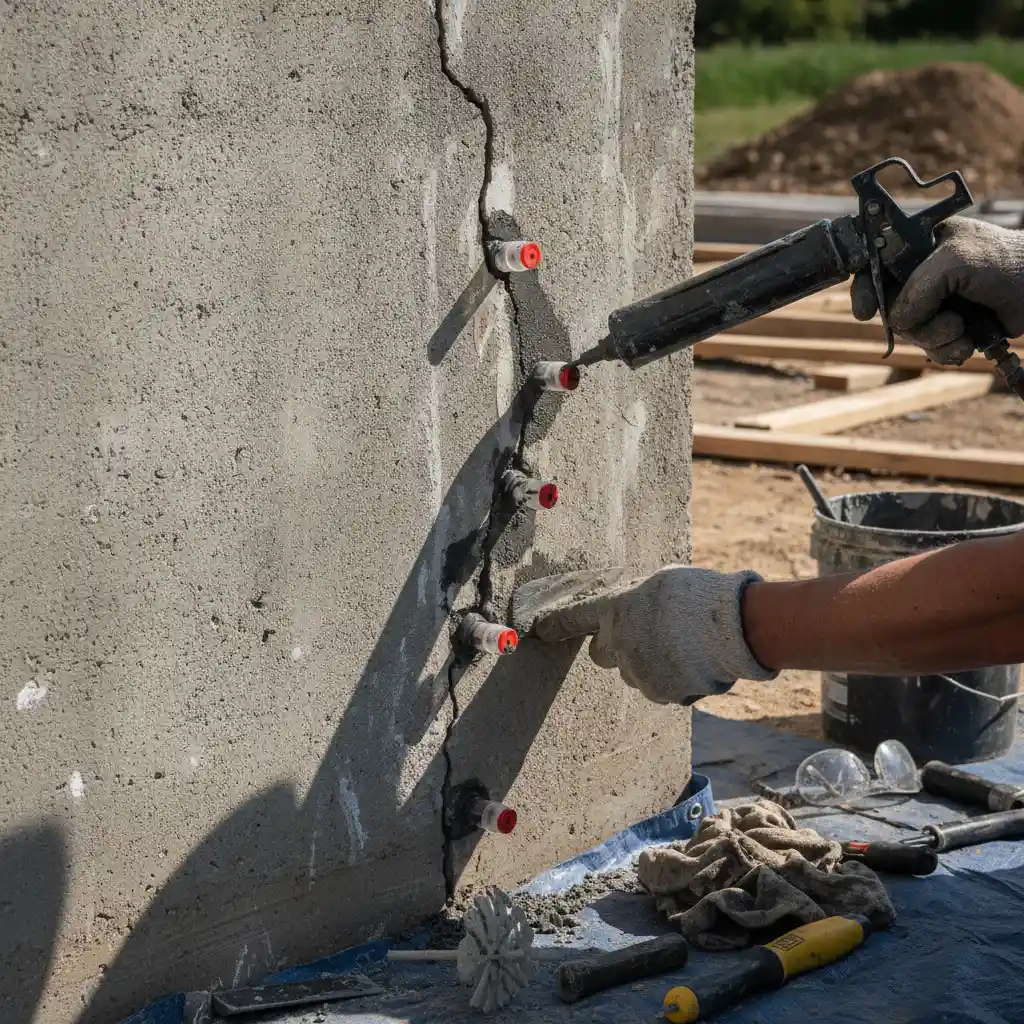
Our team in action — foundation-repair professionals serving Leander
Foundation Repair Methods We Use in Leander
Steel Push Piers
Steel push piers are the most commonly used method for sinking foundation repair in Leander. Hydraulic equipment drives steel pier sections through the expansive clay layers — which can extend 8 to 15 feet deep in Leander’s Blackland Prairie zones — down to competent bedrock or load-bearing strata. Once set, the piers permanently support the foundation independent of soil conditions. This method is ideal for homes in Summerlyn, Mason Hills, and other clay-dominant neighborhoods.
Helical Piers
Helical piers are screwed into the ground using hydraulic torque motors and are particularly effective in areas where access is limited or where lighter loads need support. They are frequently used for crawl space repair, additions, and pier-and-beam homes common in older Leander neighborhoods near downtown. They reach stable soil faster in areas where limestone is shallower, such as properties closer to the Hill Country edge near Crystal Falls.
Slab Pier Systems (Interior Piers)
For slab foundations sinking in interior zones not accessible from the perimeter, interior pier systems involve controlled excavation through the slab itself to install support piers beneath the interior foundation. This method is used when perimeter work alone cannot address interior differential settlement.
Mudjacking and Polyurethane Foam Lifting
For moderately sunken concrete slabs — driveways, walkways, garage floors, and patios — mudjacking or polyurethane foam injection can lift and stabilize the slab by filling voids beneath it. This is a cost-effective solution for non-structural concrete surfaces in Leander properties.
Drainage Correction
Because many Leander sinking foundation cases are caused or accelerated by poor drainage — particularly on lots graded during the rapid development years of 2015–2020 — we often pair structural repairs with French drain installation, surface regrading, or gutter extension systems to eliminate the moisture source driving ongoing soil movement.
Ready for Sinking Foundation? Get Your Free Estimate Today.
Round Rock Foundation Repair Group serves Leander and the surrounding area — we’ll be on-site within 24 hours.
📞 Call (512) 220-3502Sinking Foundation Repair Cost in Leander, TX
The cost of repairing a sinking foundation in Leander, TX varies based on the severity of settlement, the number of piers required, the method used, and site-specific access conditions. Below are realistic cost ranges based on work performed across the Leander and greater Central Texas market.
- Foundation Inspection: $200–$500 (often credited toward repair costs)
- Steel Push Pier Installation: $1,200–$1,800 per pier; most Leander homes require 8 to 20 piers depending on slab size and settlement area
- Helical Pier Installation: $1,400–$2,000 per pier
- Full Perimeter Repair (Average Leander Home, 1,800–2,400 sq ft): $8,500–$22,000
- Interior Pier Addition: $500–$1,000 per pier, plus excavation costs
- Mudjacking / Foam Lifting: $500–$2,500 depending on slab area
- Drainage Correction Add-On: $1,500–$6,000 depending on system complexity
Leander-Specific Pricing Factors
Homes in Leander’s newer master-planned communities like Bryson or Travisso — where lot grading was more aggressive — sometimes require additional piers due to larger settlement footprints. Older homes near downtown Leander on pier-and-beam systems may require beam replacement in addition to pier work, adding $2,000–$8,000 to total project cost. Soil depth to stable strata in Leander’s clay zones typically requires piers driven 15–22 feet, which is on the deeper end for Central Texas and affects per-pier pricing.
Contact us at (512) 220-3502 for a free, no-obligation estimate specific to your property. Schedule a Foundation Inspection
Leander Neighborhoods We Serve
Crystal Falls
Crystal Falls is one of Leander’s premier master-planned communities, with homes built primarily between 2003 and 2018. The community’s hilly limestone terrain near its western sections provides relatively stable soil, but the eastern portions of Crystal Falls overlie expansive clay, and homes built during the 2012–2016 high-growth period frequently report sinking near the garage and front elevation. Foundation Repair in Crystal Falls
Summerlyn
Summerlyn, built predominantly between 2008 and 2016, sits almost entirely on deep Blackland Prairie clay soil. This neighborhood consistently produces some of the highest concentrations of foundation sinking calls in Leander, particularly after dry summers. Slab-on-grade homes here are highly vulnerable to seasonal differential settlement.
Travisso
Travisso is one of Leander’s newest luxury communities, with construction ongoing since 2015. Despite higher construction standards, some Travisso homes built on fill-graded lots along the community’s higher elevation pads have shown premature settlement within 5–7 years of construction. The combination of high-end finishes and sinking foundations makes early intervention especially cost-effective here.
Mason Hills and Bryson
Both neighborhoods represent mid-2010s construction on primarily clay-dominant soil with aggressive lot grading. Drainage issues are particularly common here, making combined structural repair and drainage correction the standard recommendation for homes in these communities.
Foundation Maintenance Tips for Leander Homeowners
- Maintain Consistent Soil Moisture Year-Round: During Leander’s dry summers (June–September), use a soaker hose placed 12–18 inches from the foundation perimeter to keep clay soils from shrinking excessively. Run it 30–60 minutes every 2–3 days during drought conditions.
- Ensure Positive Drainage Away from Foundation: The soil grade around your Leander home should slope away from the foundation at a minimum of 6 inches over the first 10 feet. Re-grade or add soil as needed after each rainy season.
- Keep Gutters Clean and Downspouts Extended: Extend downspouts at least 5 feet from the foundation. Clogged gutters that overflow near the foundation are a leading cause of localized soil saturation and sinking.
- Monitor and Repair Plumbing Leaks Promptly: Have slab plumbing leak-tested every 5–7 years, especially in homes over 15 years old. A small plumbing leak beneath a Leander slab can saturate 10–20 square feet of clay soil within months.
- Manage Trees Near the Foundation: Keep large trees — especially live oaks and pecans common in Leander — at least 15–20 feet from the foundation. Their roots extract moisture from clay soil aggressively during drought.
- Inspect Foundation Annually: Walk your foundation perimeter each spring and fall. Look for new cracks wider than 1/8 inch or any change in crack patterns. Early detection in Leander’s active soil environment prevents minor issues from becoming major repairs.
- Address Sprinkler System Leaks Immediately: Leaky irrigation heads near the foundation are a surprisingly common cause of localized sinking in Leander’s newer subdivisions.
Why Choose Round Rock Foundation Repair Group for Sinking Foundation Repair in Leander
Round Rock Foundation Repair Group brings specialized knowledge of Central Texas geology, soil behavior, and the specific construction patterns that define Leander’s housing stock. Our team has repaired foundations across the full spectrum of Leander’s neighborhoods — from older pier-and-beam homes near downtown to newer slab homes in Travisso and Bryson — and we understand exactly how Leander’s clay soils, seasonal weather patterns, and rapid development history interact to create foundation problems.
We provide transparent, detailed estimates with no pressure tactics. Every repair recommendation we make is grounded in what your specific property actually needs, not a one-size-fits-all approach. Our crews are experienced in the soil depth requirements, permitting processes, and drainage challenges unique to Leander.
We also serve the broader Central Texas region, including Round Rock, Cedar Park, Georgetown, and Austin. Call us today at (512) 220-3502 or request a free inspection online.
Frequently Asked Questions About Sinking Foundations in Leander, TX
How much does it cost to repair a sinking foundation in Leander, TX?
Most sinking foundation repairs in Leander range from $8,500 to $22,000 for a typical single-family home, depending on how many piers are needed and the severity of settlement. Smaller jobs involving 4–6 piers may run $6,000–$9,000, while larger homes or those with significant interior settlement can reach $25,000 or more. We provide free, detailed estimates after inspection.
How long does sinking foundation repair take in Leander?
Most residential foundation repairs in Leander are completed in 1 to 3 days of active work. The full process — from inspection through final documentation — typically takes 2 to 3 weeks when accounting for soil analysis, permitting (where required), and scheduling. We work efficiently to minimize disruption to your household.
Is my sinking foundation covered by homeowner’s insurance?
In most cases, standard homeowner’s insurance policies in Texas do not cover foundation sinking caused by soil movement, drought, or normal settlement — which are the primary causes in Leander. Coverage may apply if the sinking was caused by a sudden and accidental plumbing leak. We recommend reviewing your specific policy and can provide detailed repair documentation to support any claim.
Why is my Leander home’s foundation sinking when it was just built 5 years ago?
This is a common concern in Leander’s newer subdivisions like Bryson, Travisso, and Grand Mesa at Crystal Falls. Newer homes can sink due to fill soil consolidation, inadequate pre-construction soil compaction, or first-time exposure to Leander’s drought-flood moisture cycles. The 2011 drought and the 2021 Winter Storm Uri were particularly damaging to homes built in the 2010–2020 period.
How do I know if my foundation is sinking or just has cosmetic cracks?
Cosmetic cracks are typically hairline-thin (under 1/16 inch), horizontal, and do not widen over time. Structural sinking indicators include diagonal cracks at door and window corners, cracks wider than 1/4 inch, doors and windows that no longer function properly, measurable floor slope, and exterior stair-step cracking in brick. A professional inspection with digital elevation mapping will confirm the difference.
Do I need a permit to repair my foundation in Leander?
The City of Leander may require a building permit for foundation repair work depending on the scope and method. Round Rock Foundation Repair Group handles all permitting coordination as part of our service — you don’t need to navigate that process alone.
Will foundation repair fix the cracks in my drywall and doors that won’t close?
Foundation repair stabilizes and, where possible, restores the foundation to its original elevation, which often significantly reduces or eliminates interior symptoms like sticking doors and wall cracks. However, cosmetic repairs to drywall, trim, and brick mortar are separate from structural repair and are the homeowner’s responsibility after the foundation is stabilized. We advise waiting 30–60 days after repair before making cosmetic fixes, as the structure may continue minor adjustment.
Can I sell my Leander home with a sinking foundation?
In Texas, sellers are legally required to disclose known foundation issues. A sinking foundation can significantly reduce your home’s value and complicate financing for buyers. Repairing the foundation before listing — and providing documentation of the completed work — typically yields a better sale price and faster closing than selling as-is. Contact us to discuss pre-sale foundation repair options. Get a Free Inspection Before You List
Get Expert Sinking Foundation Repair in Leander, TX Today
Don’t let a sinking foundation put your Leander home or business at risk. Whether you’ve noticed sticking doors, cracked walls, or visible slab separation, the time to act is now — before Leander’s next drought or heavy rainfall season accelerates the damage further.
Round Rock Foundation Repair Group is ready to provide a thorough inspection, honest assessment, and lasting repair solution tailored to your property’s specific soil conditions and structural needs.
Call us now at (512) 220-3502 to schedule your free foundation inspection. You can also submit a request online and our Leander-area team will respond promptly. Serving Leander, Round Rock, Cedar Park, Georgetown, Austin, and all surrounding communities across Central Texas.