Foundation Repair Methods in Leander, TX
Fast, Reliable Foundation Repair Methods in Leander in Leander, TX — Licensed & Insured
Discover proven foundation repair methods in Leander, TX. Round Rock Foundation Repair Group offers slab, pier & crawl space repair. Call (512) 220-3502.
- Licensed & Insured
- Locally Owned & Operated
- Free Inspection & Estimate
Request Your
Free EstimateFoundation repair methods encompass the specialized techniques, materials, and engineering approaches used to stabilize, restore, and protect a building’s structural base. In Leander, TX — one of the fastest-growing cities in the United States — the combination of expansive clay soils, aggressive seasonal drought cycles, and rapid residential construction makes selecting the right foundation repair method absolutely critical to the long-term safety of your property.
At Round Rock Foundation Repair Group, we have built our reputation throughout the greater Williamson County area by delivering precision-driven foundation solutions tailored to the specific geological and climatic realities of Leander and its surrounding communities. Whether you are dealing with a shifting pier-and-beam home in an older Leander neighborhood or a modern slab-on-grade structure in a newer master-planned development, our certified team applies proven methods to restore structural integrity and protect your investment. Call us today at (512) 220-3502 for a professional assessment.
Understanding Foundation Repair Methods in Leander
Foundation repair is not a single action — it is a discipline that draws from geotechnical engineering, structural analysis, and decades of field experience. The methods used to repair a foundation vary significantly based on the type of foundation system installed, the underlying soil composition, the degree of movement that has already occurred, and the structural load the foundation must continue to support.
Historically, Leander was a small railroad town established in the 1880s along the Burnet Branch of the International-Great Northern Railroad. For most of the 20th century, its population remained modest, and its building stock consisted largely of pier-and-beam construction built on wooden supports above crawl spaces. These older structures are particularly vulnerable to wood rot, moisture intrusion, and settling caused by the region’s shrink-swell clay soils.
Beginning in the early 2000s and accelerating dramatically after 2010, Leander experienced explosive residential growth. The city’s population surpassed 70,000 residents by the early 2020s, and thousands of slab-on-grade foundations were poured across new subdivisions including Travisso, Crystal Falls, and Bryson. Slab foundations in this region face unique stresses because they are laid directly on Blackland Prairie clay, which expands when wet and contracts sharply during drought — creating cyclical movement that can crack concrete, distort door frames, and compromise load-bearing walls over time.
Understanding which repair method is appropriate requires evaluating not just the visible damage but the root cause of foundation movement. Common foundation types encountered in Leander include monolithic slab foundations, post-tension cable slabs (common in homes built after 1990), traditional pier-and-beam systems, and, in commercial properties, deep drilled pier systems designed to reach stable bedrock below the active soil zone. Each type demands a distinct repair approach, and applying the wrong method can accelerate damage rather than arrest it.
Why Foundation Repair Methods Are Needed in Leander, TX
Leander sits squarely within the Texas Blackland Prairie geological zone, where the dominant soil type — Austin Clay and Taylor Clay — has a plasticity index routinely measured between 35 and 60. This means the soil can change volume by 8 to 12 percent or more depending on moisture content. During a normal Texas dry season, the upper 6 to 8 feet of soil can lose enough moisture to shrink significantly, pulling away from foundation edges and eliminating lateral support. When rains return, the soil re-expands, pushing upward and inward against the concrete.
The drought conditions of 2011 and the historically severe drought of 2022 hit Williamson County with particular force, and Leander neighborhoods including Crystal Falls, Savannah Ranch, and Travisso reported a notable spike in foundation-related service calls during and immediately following both events. The 2011 Texas drought — the worst single-year drought on record in the state — caused Palmer Drought Severity Index readings of -6 or worse across much of central Texas, and it accelerated foundation movement in thousands of homes built on shallow slab systems.
Leander’s position along the Balcones Escarpment also introduces a secondary geological factor: the transition zone between the soft, deep clay soils of the eastern prairies and the harder limestone formations to the west. Homes built in neighborhoods like Bryson or along the western reaches of Crystal Falls may sit partially on clay and partially on caliche or limestone outcroppings, creating differential settlement — meaning different parts of the foundation move at different rates. This uneven movement is one of the most damaging conditions a foundation can experience, and it requires targeted repair methods to re-level and stabilize each affected zone independently.
Additionally, Leander’s rapid growth has led to significant land grading and drainage modification across its hillier western terrain. Improperly graded lots in newer subdivisions can channel rainwater directly toward foundation perimeters. Studies by the Texas A&M AgriLife Extension Service have shown that foundation-adjacent moisture variation of even 2 to 3 percentage points of volumetric water content is sufficient to initiate measurable slab movement. Poor guttering, inadequate downspout extensions, and the heavy clay caliche soil common in areas like North Leander near Ronald Reagan Boulevard contribute directly to accelerated foundation deterioration that demands professional repair.
Finally, the Cedar Park-Leander area receives an average of 34 inches of rainfall annually, but that rainfall is highly variable — concentrated in spring storms and often absent for months at a stretch. This feast-or-famine moisture cycle puts foundations through repeated stress, and without professional intervention using the correct repair method, structural damage compounds over time.
Signs You Need Foundation Repair in Leander
Interior Warning Signs
- Doors and windows that stick, drag, or no longer latch properly — especially interior doors near the center of the home, which are often first to show differential settlement
- Diagonal cracks running from the corners of door frames or window frames toward the ceiling
- Cracks in drywall wider than 1/8 inch, particularly those that return after patching
- Floors that feel bouncy, spongy, or noticeably out of level (more than 1 inch of slope per 10 feet is a cause for immediate evaluation)
- Gaps forming between the wall and the ceiling or between the floor and the baseboard
Exterior Warning Signs
- Step-pattern cracks in brick veneer or masonry — a classic indicator of differential settlement in Leander’s common brick-clad homes
- Horizontal cracks in mortar joints, which signal lateral soil pressure
- Visible gaps between the exterior wall and the porch, garage slab, or driveway
- Soil pulling away from the foundation perimeter — visibly exposing the bottom of the foundation wall by 1 inch or more
Urgent Indicators Requiring Immediate Attention
- Cracks in the foundation slab itself that are wider than 1/4 inch or show vertical displacement
- Bowing or leaning walls
- Plumbing leaks detected beneath the slab, which accelerate soil erosion and foundation movement
Our Foundation Repair Process in Leander
Comprehensive Foundation Inspection (Day 1 — 2 to 4 Hours)
Our certified inspector visits your Leander property and conducts a full structural evaluation using a digital manometer to measure floor elevation at multiple grid points, a crack mapping survey of all interior and exterior surfaces, and a visual assessment of drainage conditions around the foundation perimeter. We also review any available soil reports or previous repair records for your address.
Soil and Site Analysis (Days 1–3)
Because Leander’s soils vary by neighborhood and even by lot, we assess the soil plasticity characteristics, current moisture levels, and drainage patterns specific to your property. Homes in the eastern portions of Leander near US-183 face deeper, more uniform clay profiles, while western Leander properties near Ronald Reagan Boulevard may encounter caliche layers that influence pier depth requirements.
Engineering Consultation and Repair Plan (Days 3–7)
We develop a site-specific repair plan specifying the method, number of piers or supports required, target depths, and expected lift measurements. For post-tension slab systems — common in Leander homes built between 1995 and 2015 — we coordinate with a licensed structural engineer before any work begins.
Site Preparation (Day of Work — 1 to 2 Hours)
We protect landscaping, mark utility lines with Texas 811 (call before you dig), and set up equipment access. In dense neighborhoods like Crystal Falls where lot sizes are compact, we use compact-footprint equipment to minimize yard disturbance.
Foundation Repair Execution (1 to 3 Days Depending on Method)
Our crew installs the specified repair system — whether steel push piers, helical piers, concrete pressed piers, or slab void fill — methodically from the most settled areas outward. Lift measurements are checked throughout the process.
Final Leveling and Grouting (Same Day as Execution)
After piers are set and lift is achieved, void spaces beneath the slab are filled with polyurethane foam or cement grout as appropriate to eliminate subsurface voids common in Leander’s clay soil after dry periods.
Drainage Recommendations and Final Report (Within 1 Week)
We provide a written post-repair report with before-and-after elevation readings, a site drainage evaluation, and maintenance recommendations tailored to your Leander property’s specific conditions.
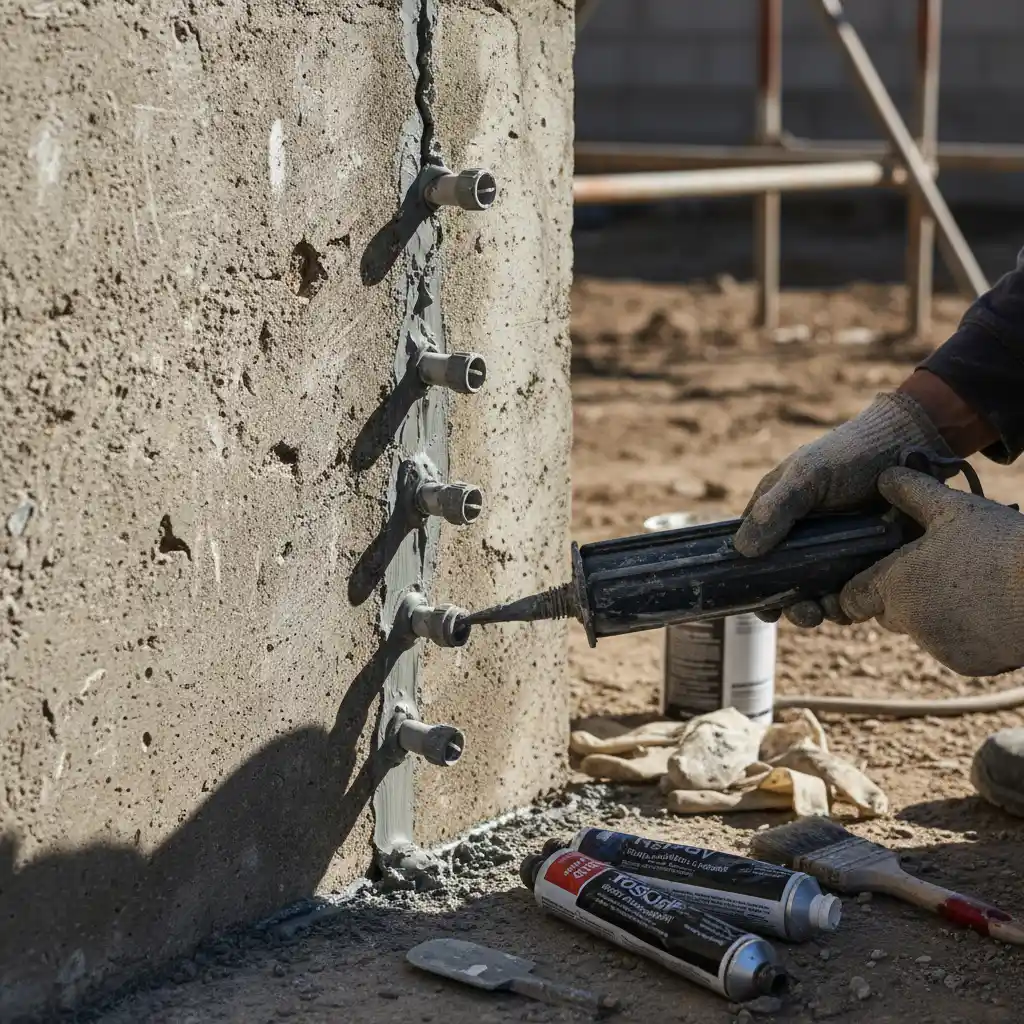
Our team in action — foundation-repair professionals serving Leander
Foundation Repair Methods and Approaches Used in Leander
Steel Push Piers
Steel push piers are hydraulically driven through unstable soil until they reach load-bearing strata — in Leander’s western zones, this often means reaching limestone bedrock at depths of 20 to 35 feet. This method is ideal for heavily settled slab foundations and provides a permanent, verifiable support solution. It is our most commonly recommended method for homes in Crystal Falls and Travisso experiencing more than 2 inches of differential settlement.
Helical Piers
Helical piers use screw-like steel shafts rotated into the soil to reach stable bearing depth. They are particularly well-suited for lighter structures, additions, porches, and homes in areas where soil access is restricted. Helical piers are a preferred solution for older pier-and-beam homes in historic Leander near the downtown area off Old Town Leander.
Concrete Pressed Piers
Concrete cylinder piers are hydraulically pressed into the soil using the weight of the structure itself. They offer a cost-effective option for homes with moderate settlement on relatively uniform clay soil profiles. This method is frequently applied in mid-Leander neighborhoods built in the early 2000s.
Slab Void Fill — Polyurethane Foam Injection
After extended droughts, Leander’s clay soils can shrink away from beneath a slab, leaving unsupported voids. Polyurethane foam injection fills these voids rapidly and with minimal excavation, restoring slab support without major disruption to interior finishes. Learn more about our concrete foundation repair services
Crawl Space Repair and Pier Replacement
For older pier-and-beam homes, we replace deteriorated wooden piers with adjustable steel supports and address moisture intrusion with vapor barriers and improved ventilation. Explore our crawl space repair solutions
Ready for Foundation Repair Methods? Get Your Free Estimate Today.
Round Rock Foundation Repair Group serves Leander and the surrounding area — we’ll be on-site within 24 hours.
📞 Call (512) 220-3502Foundation Repair Methods Cost in Leander, TX
Understanding the cost of foundation repair in Leander requires recognizing that no two projects are identical. Pricing varies based on the repair method selected, the extent of foundation movement, soil conditions on your specific lot, and the accessibility of work areas. The following ranges reflect typical project costs in the Leander and greater Williamson County market:
- Minor crack repair and patching: $500 – $2,500 for isolated surface cracks with no significant settlement
- Concrete pressed pier installation: $1,200 – $1,800 per pier, with most Leander slab homes requiring 8 to 16 piers ($9,600 – $28,800 total range)
- Steel push pier installation: $1,500 – $2,500 per pier, reflecting the greater depth required to reach bedrock in western Leander’s geological profile
- Helical pier installation: $1,400 – $2,200 per pier
- Polyurethane void fill: $2,000 – $6,000 depending on the number and size of voids beneath the slab
- Full crawl space repair and pier replacement: $4,000 – $15,000 depending on home size and scope
- Commercial foundation repair: $20,000 – $100,000+ depending on building size and structural complexity
Leander-specific cost factors include the higher pier depths required in western Leander’s transitional geology, the potential need for engineering sign-off on post-tension slab systems, and increased equipment access complexity in dense newer subdivisions. Many homeowners find that their homeowner’s insurance does not cover foundation movement caused by soil shrinkage, making it essential to address problems early before costs escalate. Schedule a no-obligation foundation inspection today
Leander Neighborhoods We Serve
Crystal Falls
One of Leander’s largest master-planned communities, Crystal Falls features homes primarily built between 2002 and 2018 on slab-on-grade foundations. The hillier terrain in the western portions of Crystal Falls creates varied soil depth profiles, and many properties experience differential settlement due to partial clay and partial caliche substrate beneath their slabs.
Travisso
A newer development in northwestern Leander, Travisso’s homes were built from approximately 2014 onward on limestone-adjacent soils. Properties here often require deeper pier installation to bypass caliche hardpan layers before reaching stable bearing strata.
Bryson
Bryson is a newer community straddling the Leander-Liberty Hill corridor, with homes built largely after 2016. Rapid construction and grading changes in this area have led to drainage issues on some lots, making moisture management a key part of any foundation repair strategy.
Historic Downtown Leander Area
The older residential blocks near downtown Leander contain the city’s original pier-and-beam housing stock, some dating to the early 1900s. These properties require crawl space evaluation, wood pier replacement, and vapor barrier installation to address decades of moisture exposure. View our home foundation repair services
Foundation Maintenance Tips for Leander Homeowners
- Maintain consistent soil moisture year-round. Use a soaker hose system set to run 20 to 30 minutes three times per week during Leander’s dry summer months (typically June through September) to prevent clay soil from drying and shrinking away from your foundation.
- Extend downspouts at least 5 to 6 feet from the foundation. Leander’s clay soil does not absorb water quickly, and concentrated roof runoff near the foundation edge is a leading cause of seasonal heave.
- Maintain a positive grade away from the foundation. The ground should slope away at a minimum of 1 inch per foot for the first 6 feet around the perimeter.
- Inspect and clean gutters twice annually — before the spring storm season and before fall — to prevent overflow saturation near foundation edges.
- Avoid planting large trees or shrubs within 10 feet of your foundation. Live oak and cedar trees, both common in the Leander landscape, extract significant soil moisture through their root systems.
- Monitor interior door alignment seasonally. Catching changes early in Leander’s dry-wet cycles allows for less costly intervention.
- Schedule a professional foundation inspection every 3 to 5 years, particularly if your home was built before 2005 or is located in a known settling area. Book your foundation inspection here
Why Choose Round Rock Foundation Repair Group for Your Leander Home
Round Rock Foundation Repair Group has deep roots in the greater Williamson County area, and our team understands the specific geological, climatic, and construction conditions that affect foundations in Leander, TX better than out-of-state franchise operators ever could. We have worked in every major Leander neighborhood from the historic downtown blocks to the newest streets in Travisso and Bryson.
Our approach is diagnosis-first. We never recommend a repair method without first completing a thorough site-specific evaluation, because applying the wrong method to a Leander clay-soil foundation can accelerate movement rather than stop it. Our crews are trained in all major repair systems — steel piers, helical piers, pressed concrete piers, void fill, and crawl space restoration — so our recommendation is always based on what is right for your property, not what is easiest for us to install.
We serve homeowners, investors, and commercial property owners across Leander, Cedar Park, Round Rock, Georgetown, Austin, and the surrounding communities. Contact us at (512) 220-3502 or visit our website to schedule your inspection. Contact our Leander foundation repair team today
Frequently Asked Questions About Foundation Repair Methods in Leander, TX
How do I know which foundation repair method is right for my Leander home?
The correct method depends on your foundation type (slab, post-tension slab, or pier-and-beam), the extent and pattern of movement, and the soil conditions on your specific lot. A professional inspection using elevation measurements and soil assessment is the only reliable way to make this determination. We provide detailed inspections for all Leander properties before recommending any repair approach.
How much does foundation repair typically cost in Leander, TX?
Most residential foundation repair projects in Leander range from $8,000 to $25,000 depending on the method, number of piers, and severity of movement. Minor crack patching may cost as little as $500, while extensive pier installations in western Leander’s deeper soil profile can reach $30,000 or more. We provide itemized written estimates at no charge after inspection.
How long does foundation repair take in Leander?
Most residential pier installations are completed in one to three days. Crawl space repairs may take two to four days. The inspection and engineering review process typically adds three to seven days before work begins, particularly for post-tension slab systems which require sign-off from a licensed structural engineer.
Why are foundations in Leander more prone to movement than in other Texas cities?
Leander sits directly on the Texas Blackland Prairie clay formation, which has one of the highest shrink-swell potentials of any soil type in North America. Combined with Leander’s highly variable rainfall — swinging from drought conditions with Palmer Drought Severity Index readings of -4 or worse (as occurred in 2011 and 2022) to heavy spring storms — the soil beneath foundations undergoes more dramatic volumetric change than in areas with sandier or more stable soils.
Does foundation repair in Leander require a permit?
The City of Leander may require permits for certain structural foundation repairs, particularly those involving post-tension slab systems or significant structural modification. We handle permit coordination as part of our service, and our team is familiar with the City of Leander Building Inspection Division’s requirements.
Will my homeowner’s insurance cover foundation repair in Leander?
Standard homeowner’s insurance policies in Texas typically exclude foundation movement caused by soil expansion and contraction — the most common cause of foundation damage in Leander. Coverage may exist if the damage was caused by a covered peril such as a sudden plumbing leak beneath the slab. We recommend reviewing your specific policy and can provide documentation to support insurance claims where applicable.
Can I stay in my home during foundation repairs?
In most cases, yes. The majority of our exterior pier installation work does not require homeowners to vacate. Interior work such as slab void fill may require temporary relocation of furniture, but rarely requires leaving the home overnight. We will clearly communicate any exceptions specific to your project before work begins.
Do you offer foundation repair services in areas surrounding Leander?
Absolutely. In addition to Leander, we serve Cedar Park, Round Rock, Georgetown, Austin, Tech Ridge, Brushy Creek, Pflugerville, Jollyville, Avery Ranch, Anderson Mill, and numerous master-planned communities throughout the region. View our complete service area coverage
Get Expert Foundation Repair in Leander, TX Today
If you have noticed cracked walls, sticking doors, uneven floors, or any other warning signs of foundation movement at your Leander home or business, do not wait. Foundation problems in Leander’s expansive clay soils compound quickly — especially as we move into another dry Texas summer. The sooner a qualified professional evaluates your foundation, the more options you have and the lower your repair cost is likely to be.
Round Rock Foundation Repair Group is ready to help. Our experienced team serves all of Leander, from Crystal Falls and Travisso to downtown Leander and Bryson. Call us now at (512) 220-3502 to schedule your comprehensive foundation inspection. You can also reach out through our website to request a callback or submit your property details for a preliminary assessment. Request your free foundation inspection in Leander today