Foundation Patching in Pflugerville, TX
Structural Foundation Patching Specialists Serving Pflugerville, TX
Need foundation patching in Pflugerville, TX? Round Rock Foundation Repair Group fixes cracks in local clay soil conditions. Call (512) 220-3502 for a free inspection.
- Licensed & Insured
- Locally Owned & Operated
- Free Inspection & Estimate
Request Your
Free EstimateFoundation patching is a targeted repair method that addresses localized cracks, voids, spalling, and surface deterioration in concrete and masonry foundations before minor damage escalates into a full structural failure. Unlike complete foundation replacement, patching focuses precision repair materials directly onto compromised zones, restoring load-bearing capacity while preserving the surrounding intact concrete.
In Pflugerville, TX, the expansive clay soils common to the Blackland Prairie corridor create a uniquely demanding environment for residential and commercial foundations. Seasonal drought-and-rain cycles cause the ground beneath homes and businesses to shrink and swell repeatedly, opening micro-fractures that widen over time. Round Rock Foundation Repair Group has worked extensively across Pflugerville and the greater North Austin metro, delivering professional foundation patching solutions calibrated to the specific soil profiles, slab construction eras, and weather patterns found here. Call us today at (512) 220-3502 to schedule a free evaluation.
Understanding Foundation Patching
Foundation patching refers to the process of filling, sealing, and reinforcing discrete areas of a foundation that have experienced cracking, honeycombing, moisture infiltration, or surface deterioration without requiring the removal and replacement of the entire slab or footing system. The technique draws on decades of development in structural concrete repair, formalized through standards established by the American Concrete Institute (ACI) and the International Concrete Repair Institute (ICRI), which outline surface preparation grades, patching material selection criteria, and application protocols.
Modern patching materials have advanced significantly from simple Portland cement mortars. Today, contractors use polymer-modified cementitious mortars, epoxy injection compounds, polyurethane foam fillers, and fiber-reinforced overlays depending on the nature and depth of the defect. Each material carries a different compressive strength rating, bond strength, flexibility index, and moisture tolerance — factors that matter enormously in a climate like Pflugerville’s where thermal cycling and ground movement are constants.
In the context of Central Texas, foundation patching has become one of the most commonly requested repair services because of how widespread slab-on-grade construction is throughout the region. The vast majority of homes built in Pflugerville from the 1980s onward use post-tensioned or conventionally reinforced concrete slab foundations. These slabs were engineered to flex slightly with soil movement, but when that movement exceeds design tolerances — as frequently happens during extended drought periods — cracking and surface delamination occur. Patching provides an effective, cost-conscious first response that can extend the functional life of a foundation by years or even decades when performed correctly.
Commercial properties in Pflugerville’s Stone Hill Town Center corridor and along SH-130 also rely on foundation patching to address the unique stresses placed on thicker industrial and retail slabs. Forklift traffic, heavy shelving loads, and large HVAC systems concentrate point loads that can initiate localized cracking even in relatively young structures. Early patching intervention prevents these localized failures from propagating and becoming far more expensive structural problems.
Why Foundation Patching Is Needed in Pflugerville, TX
Pflugerville sits squarely atop the Austin Chalk and Taylor Marl formations, which are overlaid with Houston Black clay — a soil type classified by the USDA as a Vertisol. This soil has a plasticity index (PI) that routinely measures between 40 and 60, meaning it is highly expansive. During wet periods it absorbs water and swells; during drought it contracts, sometimes losing 3 to 5 inches of volume in the top 10 feet of soil. That repeated vertical movement transmits tremendous stress to any concrete structure sitting on top of it.
Pflugerville and the surrounding areas have experienced several severe drought years that directly drove foundation damage claims across the city. The 2011 Texas drought — the worst single-year drought in recorded state history — was particularly devastating. By August 2011, the Palmer Drought Severity Index for the Austin-Round Rock area reached -6.0 (extreme drought), and foundation repair contractors across the metro reported call volumes three to four times above normal. Neighborhoods in Pflugerville built on streets like Heatherwilde Boulevard and Immanuel Road, where lot grading concentrates runoff away from structures, saw disproportionate soil moisture loss beneath interior slab sections, triggering the center-lift and edge-drop patterns that lead to cracking.
The 2022–2023 drought cycle reinforced how persistent this problem is. Travis County and Williamson County (which both encompass parts of Pflugerville’s city limits and ETJ) recorded below-average rainfall for 14 consecutive months between mid-2022 and late 2023. Areas near Pflugerville’s Blackhawk neighborhood and along Pecan Street experienced notable increases in foundation-related service calls, with homeowners reporting hairline cracks that had visibly widened compared to prior inspections.
Construction era also plays a role. Homes built in Pflugerville during the rapid suburban expansion of the late 1990s and early 2000s — particularly in subdivisions like Windermere, Falcon Pointe, and Villages of Hidden Lake — used slab designs that were adequate for typical soil movement but were not engineered for the increasingly extreme moisture fluctuations now being observed. Slab thicknesses in these developments commonly range from 4 to 6 inches, and post-tension cables are spaced at 4-foot intervals, leaving sections vulnerable when soil voids open beneath them.
Additionally, Pflugerville’s growth has brought significant impervious cover in the form of roads, parking lots, and rooftops that concentrate stormwater runoff and, conversely, prevent natural soil recharge during dry periods. The resulting uneven soil moisture profile beneath foundations — wetter at the perimeter near downspouts, drier at the interior center — is a textbook setup for differential settlement, the primary precursor to foundation cracking that requires patching or more extensive repair.
Signs You Need Foundation Patching in Pflugerville
Interior Warning Signs
- Hairline to 1/4-inch cracks running diagonally from the corners of door frames or window openings
- Doors and windows that stick seasonally or have developed visible gaps at the top or bottom of the frame
- Uneven or sloping floors, particularly noticeable when rolling objects or pouring liquid on tile surfaces
- Cracks in drywall that return after being patched and painted
- Separation between the baseboard trim and the floor
Exterior Warning Signs
- Stair-step cracks in brick veneer, especially near corners and above garage openings
- Visible horizontal or vertical cracks in the exposed foundation stem wall
- Gaps between the brick and the soffit or roofline
- Concrete spalling or flaking on the surface of the slab edge
Urgency Indicators
Cracks wider than 1/4 inch, cracks that are actively growing, water infiltration through foundation cracks, and any displacement where one side of a crack sits higher than the other (known as differential displacement) all indicate that patching should be performed without delay. In Pflugerville’s climate, waiting through another summer drought cycle can allow a patchable crack to become a structural failure requiring full pier installation.
Our Foundation Patching Process in Pflugerville
Comprehensive On-Site Inspection (Day 1 — 1 to 2 Hours)
Our technician arrives at your Pflugerville property and conducts a full visual and physical inspection of the foundation perimeter, interior floor slab, crawl space (where applicable), and all accessible structural elements. We use a digital level to measure floor elevation differentials across a grid of points, which tells us the settlement pattern and severity. We also review your property’s soil type designation and drainage topography using local Williamson County and Travis County GIS data.
Crack Mapping and Damage Documentation (Day 1 — Included in Inspection)
Every crack is measured for width, length, depth (using a crack depth gauge), and orientation. We photograph each defect and create a scaled damage map that documents the current state of the foundation. This baseline record is provided to you and is essential for tracking any future changes.
Repair Proposal and Material Selection (Day 1 to Day 3)
Based on inspection findings, we recommend specific patching methods and materials appropriate for your foundation type, crack characteristics, and Pflugerville’s soil and moisture conditions. We present a written proposal with itemized pricing before any work begins.
Surface Preparation (Repair Day — 1 to 3 Hours)
We prepare each repair zone to ICRI Concrete Surface Profile (CSP) 3 to 5 standards using angle grinders, diamond blades, or pneumatic chisels. Loose material, dust, and contamination are fully removed. For cracks, we chase (widen and undercut) each fissure to create a mechanical bonding profile and expose any deteriorated concrete below the surface.
Patching Material Application (Repair Day — 1 to 4 Hours Depending on Scope)
We apply the selected repair compound in lifts, following manufacturer specifications for mix ratios, ambient temperature thresholds, and cure times. In Pflugerville’s summer heat, we schedule application during morning hours when concrete surface temperatures are below 90°F to prevent premature drying.
Finishing and Curing (Repair Day Plus 24 to 72 Hours)
Patched surfaces are finished to match the existing concrete texture where aesthetics matter. Curing compounds or wet burlap are applied to control the moisture evaporation rate, which is critical in Central Texas where low relative humidity can compromise patch bond strength.
Post-Repair Inspection and Documentation (1 to 2 Weeks After Repair)
We return to verify cure integrity and confirm no new cracking has developed. Final documentation is provided for your records and insurance purposes.
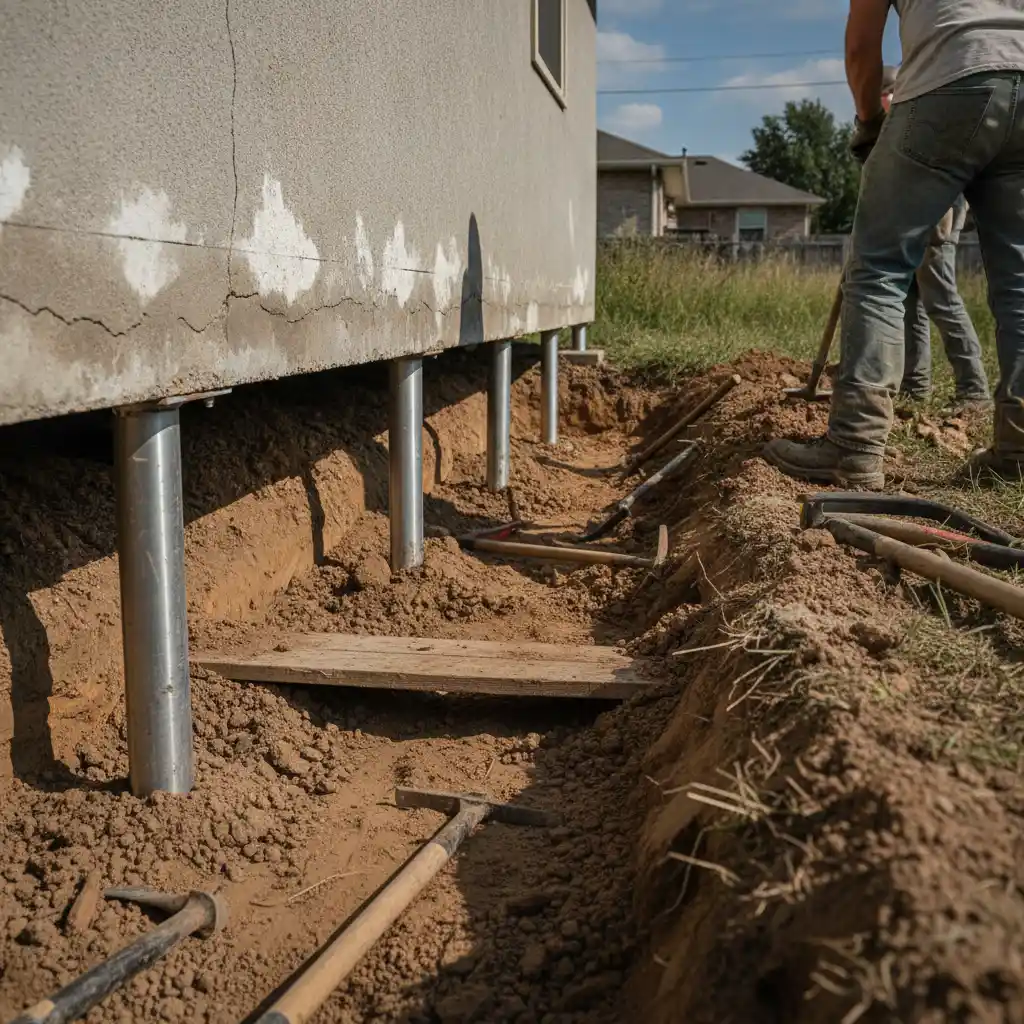
Our team in action — foundation-repair professionals serving Pflugerville
Foundation Patching Methods and Approaches
Polymer-Modified Cementitious Mortar Patching
The most widely used approach for surface cracks, spalling, and shallow delamination on Pflugerville slab-on-grade foundations. Polymer additives increase flexibility and bond strength, making the patch better able to tolerate the minor ongoing movement caused by clay soil cycling. Best applied to defects 1/4 inch to 2 inches deep.
Epoxy Injection
Used for structural cracks that penetrate the full depth of the slab or stem wall where restoring tensile strength across the crack plane is necessary. Low-viscosity epoxy is injected under controlled pressure, filling the crack from its deepest point outward. In Pflugerville homes with post-tensioned slabs, this method is preferred for cracks that do not intersect tendons.
Polyurethane Foam Injection
Ideal for cracks or joints that experience active water intrusion. Polyurethane reacts with moisture and expands to fill and seal the void, making it highly effective during Pflugerville’s rainy periods when water pressure forces moisture through cracks. This method prioritizes waterproofing over structural restoration.
Fiber-Reinforced Overlay
For areas with widespread surface deterioration — common on older garage slabs and commercial floors in Pflugerville’s industrial parks near SH-130 — a fiber-reinforced cementitious overlay is applied over the prepared surface, creating a new wearing layer that bonds to and stabilizes the existing concrete.
Hydraulic Cement Patching
Used for immediate temporary repair of actively leaking cracks or voids in below-grade walls. Sets in three to five minutes and stops water flow, providing a stable base for a permanent repair material applied after water intrusion is controlled.
Ready for Foundation Patching? Get Your Free Estimate Today.
Round Rock Foundation Repair Group serves Pflugerville and the surrounding area — we’ll be on-site within 24 hours.
📞 Call (512) 220-3502Foundation Patching Cost in Pflugerville, TX
The cost of foundation patching in Pflugerville varies depending on the number, size, and depth of cracks, the repair method required, and the accessibility of the damage. Below are representative price ranges based on current material and labor costs in the Pflugerville and greater Austin metro market.
- Single hairline crack repair (epoxy injection, up to 10 linear feet): $300 – $600
- Multiple crack patching — standard residential session (up to 5 cracks): $800 – $1,800
- Full perimeter stem wall patching (100 to 200 linear feet): $1,500 – $4,500
- Polyurethane injection for active water leak: $400 – $900 per crack location
- Fiber-reinforced overlay (per 100 square feet): $600 – $1,200
- Commercial slab patching (light industrial): $2,000 – $8,000+ depending on scope
Several factors can push costs toward the higher end of these ranges in Pflugerville specifically. Properties near the Blackhawk and Falcon Pointe neighborhoods often present post-tensioned slabs where locating and avoiding tendons during crack chasing adds labor time. Homes with minimal yard clearance along the foundation perimeter on smaller lots in the Windermere subdivision may require additional equipment setup time.
Patching costs are almost always significantly lower than the alternative. A full pier installation program for a 2,000-square-foot Pflugerville home typically runs $8,000 to $20,000 or more. Early patching intervention when cracks are still narrow and stable is the most cost-effective strategy available to homeowners. Schedule a free foundation inspection to get an accurate estimate for your specific property.
Pflugerville Neighborhoods We Serve
Blackhawk
This master-planned community in northeast Pflugerville was developed predominantly between 2005 and 2015. Homes here sit on post-tensioned slabs engineered to the standards of that era, but the large lot sizes and extensive tree canopy — including mature live oaks — create localized soil moisture competition. We frequently address the edge-lift cracking pattern associated with root-driven soil desiccation in this neighborhood.
Windermere
One of Pflugerville’s older established subdivisions, with homes dating from the mid-1980s to early 1990s. Conventional reinforced slabs from this era are now 30 to 40 years old and have cycled through decades of Pflugerville’s expansive soil movement. Surface spalling and widened perimeter cracks are common here, and patching combined with drainage correction is our most frequent recommendation.
Falcon Pointe
Located near Lake Pflugerville, this neighborhood’s proximity to the lake creates a more variable soil moisture environment than inland Pflugerville areas. Seasonal lake level changes and the relatively high water table at the eastern edges of the community add moisture cycling stress that accelerates crack development on younger slab foundations built here in the 2000s.
Villages of Hidden Lake
A large subdivision along Dessau Road featuring homes built from approximately 2000 to 2010. Many properties here display the classic symptoms of interior slab cracking driven by center-dome deflection — the phenomenon where perimeter soils retain moisture longer than the interior, causing the slab center to drop relative to its edges.
Foundation Maintenance Tips for Pflugerville Homeowners
- Maintain consistent soil moisture year-round. Use a soaker hose placed 12 to 18 inches from your foundation perimeter during dry periods, running it for 20 to 30 minutes every two to three days. This is especially critical from June through September in Pflugerville when evapotranspiration rates are highest.
- Keep gutters clean and downspouts extended. Route downspout discharge at least 6 feet from the foundation. Pflugerville’s flash-flood-style rainstorms can deposit large volumes of water in minutes, and concentrated downspout flow saturates perimeter soil unevenly.
- Maintain positive lot drainage. The finished grade around your foundation should fall at least 1 inch per foot for the first 6 feet away from the structure. Re-establish this grade annually if soil settling has flattened it.
- Monitor and control tree and shrub root zones. Do not plant large trees within 20 feet of the foundation. Established live oaks and cedar elms — common in Pflugerville landscapes — can extract significant moisture from the soil directly beneath slabs.
- Seal cracks promptly. Even hairline cracks should be sealed with a flexible polyurethane caulk as a temporary measure to prevent water infiltration while you arrange for a professional assessment.
- Inspect your foundation twice yearly. Walk the full perimeter and interior of your home each spring and fall, photographing any cracks you observe. This creates a comparative record that helps distinguish stable historic cracks from actively growing new ones.
- Check plumbing for leaks annually. Plumbing leaks beneath Pflugerville slab foundations are a leading cause of localized soil saturation and subsequent differential settlement. A static plumbing pressure test can detect slow leaks before they cause visible foundation damage.
Why Choose Round Rock Foundation Repair Group for Foundation Patching in Pflugerville
Round Rock Foundation Repair Group has built its reputation serving homeowners and businesses across the North Austin metro, including the full length of Pflugerville from Kelly Lane to Pecan Street and from SH-130 to the Williamson County line. Our crews work daily in the specific soil and climate conditions that affect Pflugerville foundations, which means we bring genuine local experience — not generic procedures — to every job.
We use professional-grade patching materials that meet or exceed ICRI and ACI repair standards, and our surface preparation protocols ensure long-term bond performance even under Pflugerville’s thermal cycling extremes. Every repair begins with a thorough inspection and honest assessment, and we will never recommend more work than your foundation actually needs.
Our service area covers the full Pflugerville community as well as surrounding areas including Round Rock, Cedar Park, Georgetown, Austin, Tech Ridge, Brushy Creek, Jollyville, Avery Ranch, and Forest Creek. Whether you need patching for a single crack or a comprehensive structural foundation repair program, we are the local team ready to help. Call us at (512) 220-3502 for a no-obligation consultation.
Frequently Asked Questions About Foundation Patching in Pflugerville, TX
How much does foundation patching cost in Pflugerville?
For a typical residential property in Pflugerville, foundation patching costs range from $300 for a single small crack repair to $4,500 or more for extensive perimeter patching. The specific cost depends on the number and size of cracks, the repair method required, and the accessibility of the damaged areas. We provide free on-site estimates so you know the exact cost before any work begins.
How long does foundation patching take?
Most residential foundation patching jobs in Pflugerville are completed in a single day. Smaller repairs — one to three cracks — often take two to four hours. Larger scopes involving full perimeter stem wall work or multiple interior slab cracks may require a full eight-hour day. Commercial projects can extend to two or three days. The patched material requires 24 to 72 hours to reach full cure strength before the area should be subjected to heavy loads or water exposure.
Is foundation patching a permanent fix?
Foundation patching is a durable repair when performed correctly with appropriate materials and surface preparation. However, because Pflugerville’s expansive clay soils continue to move seasonally, underlying conditions that caused the original cracking must also be addressed — particularly drainage and soil moisture management — to prevent new cracks from forming adjacent to the patched areas. In some cases, patching is the appropriate and complete solution; in others, it is best combined with foundation restoration measures such as pier installation to address underlying settlement.
Why does Pflugerville have so many foundation problems?
Pflugerville sits on highly expansive Blackland Prairie clay soils (Houston Black clay series, Vertisol classification) that shrink dramatically during the dry summers and expand when wet. Plasticity index values of 40 to 60 are typical in this area, which means the soil volume change is among the highest in the United States. Combined with the increasing frequency of drought-then-flood weather cycles in Central Texas, these soil conditions create a very challenging environment for concrete slab foundations.
Can I patch a foundation crack myself?
Surface cosmetic cracks can be filled with off-the-shelf caulk as a temporary measure to prevent water infiltration, but professional patching is necessary for structural cracks, actively growing cracks, cracks wider than 1/8 inch, or any crack with differential displacement. Improper DIY repairs — particularly on post-tensioned slabs common in Pflugerville — can cause damage to tendons and void any existing structural warranty on the home.
How do I know if a crack needs patching or full foundation repair?
Cracks that are stable, narrow (under 1/4 inch), and show no differential displacement between the two sides typically respond well to patching alone. Cracks that are actively widening, accompanied by door or window binding, visible floor slope, or differential displacement indicate potential structural movement that requires a more comprehensive foundation inspection and possibly pier underpinning in addition to patching. Our free inspection process provides a clear answer.
Do you serve areas near Pflugerville?
Yes. In addition to Pflugerville, Round Rock Foundation Repair Group serves Round Rock, Cedar Park, Georgetown, Austin, Tech Ridge, Brushy Creek, Jollyville, Paloma Lake, Wells Branch, Teravista, Avery Ranch, Forest Creek, Sendero Springs, and many other communities throughout the North Austin corridor.
What is the best time of year to schedule foundation patching in Pflugerville?
Spring and fall are the optimal seasons for foundation patching in Pflugerville because ambient temperatures fall within the ideal range of 50°F to 85°F for cementitious patching material application and curing. Summer work is feasible but requires morning scheduling to avoid surface temperatures that can exceed 100°F on south-facing concrete by midday, which can compromise patch bond strength if not properly managed with curing compounds.
Get Professional Foundation Patching in Pflugerville, TX Today
If you have noticed cracks in your foundation, sticking doors, uneven floors, or any of the warning signs described above, do not wait for the next drought cycle to make the damage worse. Round Rock Foundation Repair Group is ready to provide a thorough, honest evaluation of your Pflugerville property and deliver professional foundation patching solutions that are built for Central Texas conditions.
Call us now at (512) 220-3502 to schedule your free foundation inspection. Our team serves all of Pflugerville and surrounding communities throughout the North Austin metro. You can also contact us online to request an appointment at your convenience. Protecting your foundation today is the most cost-effective investment you can make in your home’s long-term structural health.