Foundation Settling in Pflugerville, TX
Structural Foundation Settling Specialists Serving Pflugerville, TX
Trusted foundation settling repair in Pflugerville, TX. Round Rock Foundation Repair Group fixes slab, pier & beam issues in local clay soils. Call (512) 220-3502.
- Licensed & Insured
- Locally Owned & Operated
- Free Inspection & Estimate
Request Your
Free EstimateFoundation settling is the gradual downward movement of a structure’s base caused by soil compression, moisture changes, or inadequate support beneath the slab or footings. In Pflugerville, TX, this problem is not merely common — it is endemic to the region’s expansive clay-heavy soils, dramatic seasonal rainfall swings, and the explosive residential growth that has brought tens of thousands of homes to subdivisions like Blackhawk, Highland Park, and Verona. When a foundation settles unevenly, it places differential stress on walls, frames, and load-bearing elements throughout the entire structure.
Round Rock Foundation Repair Group brings deep, localized experience to every foundation settling assessment and repair project in Pflugerville. Our team understands the unique geology beneath Travis and Williamson County, the construction timelines of Pflugerville’s various housing waves, and the specific repair methods that perform best in Central Texas conditions. If you suspect your home or commercial property is experiencing foundation settling, call us today at (512) 220-3502 for a professional evaluation.
Understanding Foundation Settling in Pflugerville, TX
Foundation settling refers to the process by which a building’s foundation moves downward into the soil below it. Some degree of initial settling — called uniform settlement — is normal and expected in the months following new construction as the soil below compresses under the weight of the structure. However, when settling becomes differential — meaning one part of the foundation drops more than another — structural damage begins.
Historically, foundation settling has been a documented challenge throughout Central Texas since the region began its urban expansion in the mid-20th century. Pflugerville itself transitioned from a small farming community into a major suburban hub primarily between the 1990s and 2020s. This rapid growth meant that large volumes of homes were built quickly on land that had not been thoroughly assessed for soil bearing capacity. Many subdivisions were graded and developed over former agricultural fields where the topsoil composition and moisture retention characteristics were never optimized for residential construction.
The mechanics of settling involve several soil behaviors. Consolidation occurs when fine-grained soils like clay slowly expel water under pressure over time. Shrinkage occurs during droughts when clay loses moisture and contracts, pulling away from the foundation. Swelling, the opposite process, pushes upward against slabs during wet periods. In Pflugerville, the combination of these active soil behaviors creates a cyclic stress environment that accelerates differential settling far beyond what is seen in regions with more stable sandy or rocky subsoils.
Building types most commonly affected in Pflugerville include post-tension slab-on-grade homes built between 1995 and 2015, pier-and-beam structures in older sections near the historic town center along Pecan Street, and large commercial slab foundations in the retail corridors along FM 685 and SH 45. Multi-family developments constructed rapidly in the 2010s along Pflugerville Parkway also show elevated rates of foundation movement due to the speed of construction and compressed site preparation timelines.
Understanding that foundation settling is a geotechnical and structural challenge — not simply a cosmetic inconvenience — is the first step toward protecting your property’s long-term value and safety.
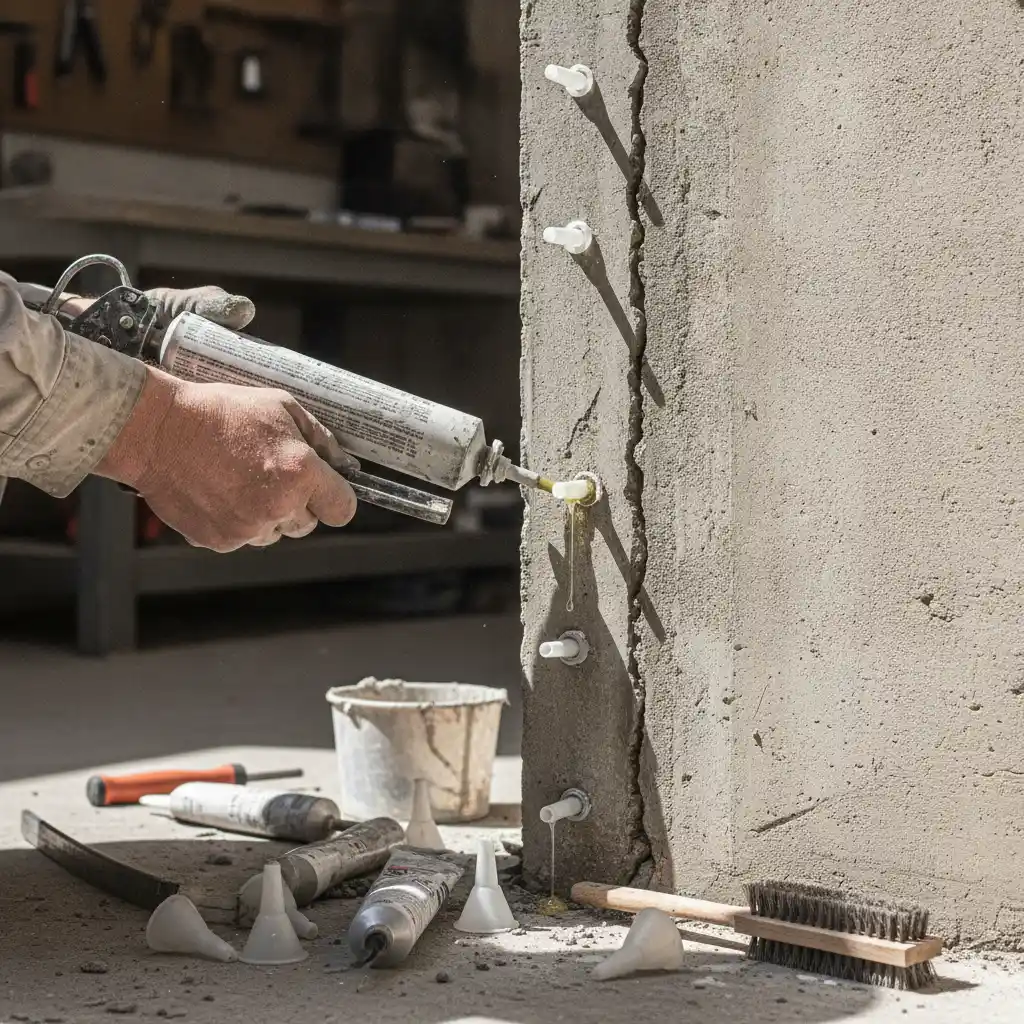
Our team in action — foundation-repair professionals serving Pflugerville
Why Foundation Settling Is Needed in Pflugerville, TX
Expansive Clay Soils: The Core Problem
Pflugerville sits atop the Austin Chalk and Taylor Clay geological formations, the same clay-dominant substrates responsible for foundation problems across the greater Austin metropolitan area. Taylor Clay, in particular, is classified as a highly expansive soil with a Plasticity Index (PI) frequently exceeding 40 — and in some Pflugerville-area soil reports, reaching as high as 55 to 60. The Shrink-Swell Index for these soils can exceed 6 inches of vertical movement over a single annual cycle of wet and dry seasons. That means the ground beneath a Pflugerville home may rise and fall by several inches from summer to winter, subjecting foundation slabs and footings to repeated stress cycles that no concrete structure can endure indefinitely without some form of movement or cracking.
Pflugerville’s Rainfall and Drought Extremes
Central Texas is climatologically prone to what meteorologists call the “Wet/Dry Seesaw” — extended drought periods interrupted by intense rainfall events. Pflugerville’s annual average rainfall is approximately 34 inches, but the distribution is wildly uneven. The historic drought of 2011 — one of the most severe single-year droughts in Texas recorded history — caused catastrophic soil shrinkage across Williamson and Travis Counties. Soil moisture levels dropped to record lows, and foundation repair companies across the Pflugerville area reported a surge in settling claims from neighborhoods including Rowe Lane Estates, Pflugerville Farms, and the early-phase Blackhawk sections built in the late 1990s and early 2000s. Conversely, the record rainfall events of May 2015, when parts of the Austin metro received over 11 inches in a single week, caused rapid soil swelling that uplifted and then dropped foundations as water drained away.
Tree Root Activity and Soil Desiccation
Pflugerville’s mature neighborhoods, particularly those along Pecan Street and in the Pflugerville Lake area, feature large live oak and pecan trees whose root systems extend 30 to 50 feet from the trunk. These roots aggressively extract moisture from the clay soil, creating localized desiccation zones that cause differential settlement directly beneath adjacent foundations. Heritage trees in established Pflugerville neighborhoods are legally protected under the city’s tree ordinance, which means removal is rarely an option — making proactive foundation repair the necessary response.
Rapid Development and Compressed Construction Timelines
Between 2015 and 2022, Pflugerville was one of the fastest-growing cities in Texas by percentage, adding thousands of housing units annually in master-planned communities like Sorento, Carmel, and Cambridge Crossing. The speed of this development meant that many lots received minimal soil pretreatment or compaction testing before slabs were poured. Inadequate site preparation — combined with the native expansive clay — has resulted in measurable settling in homes as young as three to five years old in several of these newer subdivisions, well within normal expectations for structural stability.
Signs You Need Foundation Settling Repair in Pflugerville
Interior Warning Signs
- Diagonal cracks running from the corners of door frames or window frames, often at 45-degree angles
- Doors and windows that stick, fail to latch, or have visibly uneven gaps around their frames
- Floors that feel springy, slope noticeably, or produce creaking sounds under foot traffic
- Cracks in drywall, particularly in stair-step patterns along seams
- Separation between the ceiling and interior walls, or between walls and the floor
Exterior Warning Signs
- Stair-step cracking in brick veneer or mortar joints, a hallmark of differential settling in Pflugerville’s brick-clad homes
- Visible gaps between the foundation beam and the soil level — indicating the foundation has dropped away from the surrounding grade
- Cracks in the concrete slab edge or foundation perimeter beam wider than 1/4 inch
- Chimney leaning or separating from the main structure
Urgency Indicators
Contact a foundation professional immediately if you observe cracks wider than 1/2 inch, doors that cannot be opened or closed at all, visible sloping floors exceeding 1 inch over 10 feet, or any structural element that appears to be pulling away from load-bearing walls. These conditions indicate active and accelerating settling that requires urgent professional evaluation.
Foundation Settling Repair Methods Used in Pflugerville
Steel Push Piers (Helical and Hydraulic)
Steel push piers are driven through unstable clay layers down to load-bearing strata — typically limestone bedrock located 15 to 30 feet below grade in the Pflugerville area. This method is the industry standard for significant differential settlement exceeding 1.5 inches and is particularly effective for heavy slab foundations and commercial structures along Pflugerville’s retail corridors on FM 685 and SH 130. Helical piers are preferred in areas with shallow groundwater or where vibration must be minimized.
Mudjacking (Slab Lifting)
Mudjacking involves pumping a cement-sand slurry beneath a settled slab to lift it back toward its original elevation. This method is cost-effective for localized settling of garage slabs, interior floor sections, and sidewalks in Pflugerville’s newer subdivisions where settling is mild (under 2 inches) and the underlying soil is not severely compromised.
Polyurethane Foam Injection
A faster, lighter-weight alternative to mudjacking, polyurethane foam injection is ideal for void filling beneath settled concrete flatwork and for areas where access is limited, such as beneath decks or in tight crawl spaces. This method is increasingly popular in Pflugerville’s townhome and patio-home communities where minimal invasiveness is a priority.
Crawl Space Pier Repair and Sistering
For pier-and-beam homes in Pflugerville’s older neighborhoods near the historic downtown and the Pflugerville Lake area, we repair or replace deteriorated wood posts and beams, install adjustable steel columns, and address moisture issues in the crawl space that contribute to ongoing settling and wood rot. Learn more about our Crawl Space Repair services
Drainage Correction and Root Barrier Installation
In neighborhoods with mature tree canopy, we install linear root barriers 18 to 24 inches deep around the foundation perimeter to redirect root growth and reduce localized soil desiccation — a Pflugerville-specific adaptation rarely required in less vegetated suburban markets.
Ready for Foundation Settling? Get Your Free Estimate Today.
Round Rock Foundation Repair Group serves Pflugerville and the surrounding area — we’ll be on-site within 24 hours.
📞 Call (512) 220-3502Foundation Settling Repair Cost in Pflugerville, TX
The cost of foundation settling repair in Pflugerville varies significantly based on the severity of settlement, the size of the structure, the chosen repair method, and soil conditions specific to your neighborhood. Below are representative price ranges based on current Central Texas market rates.
Typical Cost Ranges
- Foundation Inspection: $200 to $500 for a professional evaluation with elevation survey and written report
- Mudjacking (Slab Lifting): $800 to $2,500 for localized sections; $3,000 to $6,000 for full perimeter treatment
- Polyurethane Foam Injection: $1,000 to $4,000 depending on the number of injection points and void size
- Steel Push Pier Installation: $1,200 to $1,800 per pier installed; most Pflugerville residential projects require 8 to 20 piers, placing total project costs between $10,000 and $30,000
- Crawl Space Pier Repair: $2,500 to $8,000 depending on the number of piers and extent of moisture damage
- Commercial Foundation Repair: $15,000 to $75,000 or more for large commercial structures
Pflugerville-Specific Cost Factors
Pier depth is a meaningful cost driver in Pflugerville. Because limestone bedrock can be 20 to 30 feet below grade in parts of eastern Pflugerville near Dessau Road and Kelly Lane, pier installation costs trend higher here than in areas of Round Rock or Cedar Park where bedrock is shallower. Post-tension slab engineering coordination adds $500 to $1,500 to project costs. Homes with mature live oaks or pecans may require additional root barrier installation at $15 to $25 per linear foot.
Call us at (512) 220-3502 for a no-obligation estimate. Schedule a Foundation Inspection today
Pflugerville Neighborhoods We Serve
Blackhawk
One of Pflugerville’s largest master-planned communities, Blackhawk features homes built primarily from 1997 through 2015. The earliest sections along Rowe Lane show the highest rates of differential settling due to original soil preparation practices that were standard at the time but are now known to be insufficient for Taylor Clay substrates. We frequently address pier failures and perimeter beam cracking in this neighborhood.
Sorento and Carmel
These newer communities, developed largely between 2015 and 2022 along SH 130 and Pflugerville Parkway, present a different challenge: homes that are only 5 to 8 years old but already showing measurable settling due to the compressed construction timelines and limited soil pretreatment during the rapid development boom. Our work here often involves polyurethane foam injection and perimeter drainage correction.
Pflugerville Farms and Rowe Lane Estates
These established neighborhoods feature a mix of 1980s and early 1990s construction on larger lots. Mature pecan and live oak trees are ubiquitous, and root-related soil desiccation is the primary driver of foundation settling. Our team frequently installs root barriers and completes helical pier work in this area. Explore our Home Foundation Repair services
Highland Park and Villages of Hidden Lake
These mid-2000s communities feature predominantly brick-clad slab homes that show classic stair-step brick cracking as a result of corner settling. The flat topography in these neighborhoods creates drainage challenges that accelerate perimeter soil saturation and subsequent shrinkage cycling.
Foundation Settling Prevention and Maintenance Tips for Pflugerville Homeowners
- Maintain Consistent Soil Moisture Year-Round: In Pflugerville’s extreme wet-dry climate, use a soaker hose system on a timer to keep perimeter soil moisture consistent during drought periods. Run soakers 15 to 30 minutes daily during dry months to prevent the catastrophic soil shrinkage experienced during events like the 2011 drought.
- Ensure Positive Drainage Away from the Foundation: Grade your yard so that the soil slopes away from the foundation at a minimum of 1 inch per foot for the first 6 feet around the perimeter. This is critical in Pflugerville’s relatively flat terrain.
- Clean and Extend Downspouts: Discharge all gutter downspouts at least 4 to 6 feet from the foundation. Concentrated roof runoff is a leading cause of localized soil oversaturation and subsequent settling.
- Monitor and Trim Tree Roots: If you have live oaks or pecans within 30 feet of your foundation, have a certified arborist assess root growth patterns annually and consider installing linear root barriers.
- Inspect Foundation Perimeter Annually: Each spring and fall, walk the perimeter of your home and note any new cracks in the slab beam, brick veneer, or mortar joints. Early detection prevents expensive progressive damage.
- Avoid Excessive Watering Near the Foundation: Overwatering landscape beds adjacent to the foundation can cause soil swelling that is equally damaging. Use drip irrigation and avoid ponding water.
- Check Interior Doors and Windows Seasonally: Note any seasonal changes in how doors latch or windows operate. Seasonal variation is normal; progressive worsening is a warning sign requiring professional evaluation.
Why Choose Round Rock Foundation Repair Group for Foundation Settling in Pflugerville
Round Rock Foundation Repair Group is a locally operated foundation repair company with deep roots in the Central Texas market. We have worked extensively throughout Pflugerville and the surrounding communities of Round Rock, Cedar Park, Georgetown, and Austin, developing an intimate understanding of the Taylor Clay soil conditions, the construction characteristics of each housing era, and the specific drainage and tree challenges that drive foundation settling in this region.
Our team works on residential and commercial properties of all sizes, from single-family homes in Blackhawk to large commercial slabs along the SH 130 corridor. We use only professional-grade materials from established manufacturers, and our repair methods are selected based on engineering principles, not upselling opportunities.
We offer transparent, itemized written proposals before any work begins — no surprises on your final invoice. Our technicians are trained on the specific requirements of post-tension slabs, which make up a significant percentage of Pflugerville’s housing stock, ensuring that repairs are executed safely without compromising existing structural systems.
Call us today at (512) 220-3502 or schedule your foundation inspection online. Learn about our full Structural Foundation Repair services
Frequently Asked Questions About Foundation Settling in Pflugerville, TX
How much does foundation settling repair cost in Pflugerville, TX?
Repair costs in Pflugerville range from approximately $800 for minor mudjacking work to $30,000 or more for extensive steel pier installation on larger homes. The most common residential project in Pflugerville — involving 10 to 15 push piers on a standard slab home — typically costs between $12,000 and $22,000. Factors like pier depth, post-tension slab engineering requirements, and tree root management can increase costs. Call (512) 220-3502 for a free site-specific estimate.
Is foundation settling normal in Pflugerville?
Some initial uniform settlement in the first year or two after construction is considered normal. However, differential settling — where one part of the foundation drops more than another — is not normal and requires professional evaluation. Given Pflugerville’s expansive Taylor Clay soils, differential settling is significantly more prevalent here than in regions with more stable subsoils. If you are seeing cracks or sticking doors, the issue warrants a professional inspection.
How long does foundation settling repair take in Pflugerville?
Most residential foundation settling repair projects in Pflugerville are completed in 1 to 3 days of active work. Larger commercial projects or those requiring deep pier installation in eastern Pflugerville’s deeper clay zones may take 3 to 5 days. The evaluation and proposal process typically adds 5 to 7 business days before work begins.
Will my homeowner’s insurance cover foundation settling in Pflugerville?
Most standard homeowner’s insurance policies in Texas exclude foundation settling caused by soil movement, shrinkage, or expansion — which covers the vast majority of settling claims in Pflugerville. Coverage may exist if settling was caused by a sudden and accidental event, such as a plumbing leak beneath the slab. We recommend reviewing your policy with your insurance agent and, if applicable, we can provide documentation of damage causation to support a claim.
How do I know if my Pflugerville home needs foundation repair or just cosmetic fixes?
A professional elevation survey is the only reliable way to determine whether visible cracking or door problems are the result of true foundation movement or normal cosmetic settling. As a general rule, diagonal cracks wider than 1/4 inch, multiple cracks appearing simultaneously, and doors that progressively worsen over time all suggest structural movement rather than cosmetic issues. Our inspection process in Pflugerville includes a full elevation profile that provides objective data rather than guesswork.
Do you work on post-tension slab foundations in Pflugerville?
Yes. The majority of Pflugerville homes built between 1995 and 2015 use post-tension slab construction. Repairing these foundations requires specialized knowledge to avoid cutting or damaging tension cables. Our team coordinates with structural engineers when necessary and uses cable-detection tools during all pier drilling on post-tension slabs. Learn more about our Concrete Foundation Repair expertise
Can foundation settling get worse if left untreated in Pflugerville?
Yes — and in Pflugerville’s expansive clay environment, untreated settling almost always worsens. Each seasonal wet-dry cycle causes additional incremental movement. What begins as a 1/2-inch differential can progress to 2 or 3 inches over several years, compounding structural damage to walls, plumbing, electrical systems, and finishes. Early intervention is significantly less expensive than deferred repair in every case we have encountered in the Pflugerville market.
Do you serve neighborhoods outside of Pflugerville proper?
Yes. We serve the entire greater Pflugerville area including Teravista in Round Rock, Forest Creek, Behrens Ranch, Sendero Springs, Avery Ranch in Austin, Wells Branch, Tech Ridge, and many other communities throughout Williamson and Travis Counties. View our complete service area
Contact Round Rock Foundation Repair Group for Foundation Settling in Pflugerville, TX
If your Pflugerville home or commercial property is showing signs of foundation settling — cracking brick, sticking doors, sloping floors, or visible gaps in your slab — do not wait for the damage to worsen through another season of Central Texas soil movement. Round Rock Foundation Repair Group is ready to provide a thorough, honest evaluation of your foundation’s condition and a clear path forward.
Our team serves all of Pflugerville and the surrounding communities, and we understand the specific soil, climate, and construction challenges that make foundation care in this region uniquely demanding. We provide written proposals, professional workmanship, and transparent communication from the first call through project completion.
Call us now at (512) 220-3502 to schedule your foundation inspection. You can also contact us online to request a callback or estimate. Book a Foundation Inspection — and take the first step toward protecting your most important investment.