Structural Foundation Repair in Pflugerville, TX
Fast, Reliable Structural Foundation Repair in Pflugerville, TX — Licensed & Insured
Expert structural foundation repair in Pflugerville, TX. Round Rock Foundation Repair Group fixes slab settlement, cracks & soil damage. Free inspection. Call (512) 220-3502.
- Licensed & Insured
- Locally Owned & Operated
- Free Inspection & Estimate
Request Your
Free EstimateStructural foundation repair is the process of diagnosing, stabilizing, and restoring a building’s foundational system to its original load-bearing integrity. In Pflugerville, TX, this service is especially critical due to the region’s expansive clay-rich soils, seasonal drought cycles, and rapid residential growth that has placed thousands of homes on ground prone to significant volumetric soil movement.
At Round Rock Foundation Repair Group, we deliver comprehensive structural foundation repair solutions tailored to the specific geological and climatic conditions of Pflugerville and the greater Austin metro area. Whether you’re dealing with a sinking slab in Pfennig Farms, wall cracks in a Stone Hill Town Center-area home, or settlement issues in a newly built subdivision near Kelly Lane, our crews apply proven methods to stop damage in its tracks and restore your property’s structural soundness.
Call us today at (512) 220-3502 to schedule your foundation inspection.
Understanding Structural Foundation Repair
A building’s foundation is its most critical structural element. It transfers the entire load of the structure — walls, roof, floors, and contents — safely into the earth below. When that transfer mechanism is compromised, every other system in the building is at risk. Structural foundation repair encompasses a broad range of interventions, from targeted pier installation beneath a settled corner to full perimeter underpinning of a large commercial slab.
Historically, foundations in the Pflugerville and central Texas region were built using pier-and-beam construction through the mid-twentieth century, which allowed some tolerance for soil movement. Beginning in the 1980s and accelerating dramatically through Pflugerville’s explosive growth in the 1990s and 2000s, post-tension and conventionally reinforced concrete slab-on-grade construction became the dominant method. These slabs, while cost-effective to pour, are particularly vulnerable to the shrink-swell behavior of the dark, expansive Vertisol soils — locally called “black land prairie” or “black gumbo” clay — that underlie much of Pflugerville’s eastern and central neighborhoods.
When these soils lose moisture during a dry season, they shrink by as much as 10 to 15 percent of their volume, pulling away from the foundation edge and creating voids. When moisture returns, they swell back, exerting uplift pressures that can exceed 5,000 pounds per square foot. Repeated cycles of this movement cause differential settlement — meaning one area of the slab sinks or heaves more than another — and that differential stress fractures the concrete, cracks masonry veneers, and distorts door and window frames.
Structural foundation repair addresses these failures at their source rather than at their symptoms. Patching a crack in drywall without correcting the underlying foundation movement will only delay the inevitable return of that crack, and far worse damage along with it. Professional repair stabilizes the soil-foundation interface, transfers loads to competent bearing strata, and re-levels the slab to within acceptable tolerances — typically within three-eighths of an inch across a twenty-foot span, per industry standards set by the Texas Section of the American Society of Civil Engineers.
Pflugerville’s building stock spans from modest ranch-style homes built in the early 1980s along Farm-to-Market Road 685 to sprawling multi-thousand-square-foot two-story homes in newer master- planned communities. Each building type and era presents distinct structural repair challenges our team is equipped to handle.
Why Structural Foundation Repair Is Needed in Pflugerville, TX
Expansive Clay Soils — The Root Cause
The dominant soil series beneath Pflugerville is the Houston Black clay — a deep, dark, alkaline Vertisol that the USDA Natural Resources Conservation Service has documented across much of Travis and Williamson counties. This soil has a plasticity index often exceeding 40, meaning it is highly plastic and undergoes extreme volume changes with moisture variation. During the historic Texas drought of 2011, parts of the Austin-Round Rock metropolitan area — including Pflugerville — experienced soil moisture deficits not seen in over a century of record-keeping. Foundation repair calls in the region spiked by an estimated 30 to 40 percent in 2011 and 2012 as slabs that had been stable for a decade or more suddenly began cracking and settling under drought conditions.
Drought and Rainfall Extremes
Pflugerville averages approximately 33 inches of rainfall per year, but that rainfall is notoriously erratic. Extended dry periods — such as those experienced from May through September during most years — are frequently punctuated by intense rain events. When 3 to 5 inches of rain falls in a single storm on parched soil, the clay swells unevenly depending on drainage patterns around each individual home. Low areas next to downspout discharge points experience rapid re-wetting, while protected eaves-line areas remain dry. That uneven moisture pattern drives the differential movement that cracks slabs.
Rapid Development and Fill Soils
Communities like Pflugerville Farms, Reserve at Westcreek, and Heatherwilde were developed at extraordinary speed, often requiring engineered fill to level previously agricultural land. Fill soils that were not properly compacted or tested consolidate over time, causing settlement that post-tension slabs — designed to resist tension, not differential settlement — cannot absorb without cracking. Homes built between 1998 and 2008 along the Kelly Lane and Dessau Road corridors are particularly susceptible to this secondary settlement phenomenon.
Tree Root Moisture Competition
Mature live oaks and cedar elms — both extremely common in Pflugerville landscaping — have extensive lateral root systems that can extend two to three times the canopy radius. During dry summers, these root systems extract soil moisture from under foundations in a radius of 30 to 50 feet, accelerating the shrinkage cycle directly beneath slabs. Neighborhoods like Stone Hill and Windermere, which feature mature tree canopies, consistently show higher rates of foundation movement than newer, tree-less subdivisions.
Plumbing Leaks Beneath the Slab
Pflugerville’s aging PVC and copper supply lines — particularly in homes built before 2000 — are subject to cracking when soils shift. A slow slab leak can saturate the clay directly beneath the foundation, causing localized heave that lifts interior sections of the slab 1 to 3 inches above exterior edges. This reverse-differential settlement is a common finding in Pflugerville home inspections and requires both plumbing repair and foundation re-leveling.
Signs You Need Structural Foundation Repair in Pflugerville
Exterior Warning Signs
- Stair-step cracks in brick mortar joints, especially at corners near garage openings
- Horizontal cracks in brick veneer wider than one-quarter inch
- Visible gaps between the foundation beam and the soil surface — gaps exceeding 1 inch require immediate attention
- Cracks in the concrete slab visible at the perimeter grade beam
- Separation between the chimney and the main structure
Interior Warning Signs
- Diagonal cracks running from the corners of door and window frames toward the ceiling
- Doors and windows that stick, jam, or no longer latch correctly — a change in operation is often the first noticed symptom
- Cracks in drywall that return after being patched, particularly in hallways and near load-bearing walls
- Sloping floors measurable with a level — a slope exceeding 1 inch per 8 feet warrants inspection
- Gaps between baseboards and the floor, or between the ceiling and interior walls
Urgent Indicators Requiring Immediate Action
- Cracks wider than one-half inch anywhere in the foundation or masonry
- Sudden new cracking following a heavy rain event or prolonged dry spell
- Water intrusion through foundation cracks during rainfall
- Unexplained increases in water bills suggesting a possible slab leak
Our Structural Foundation Repair Process in Pflugerville
We follow a systematic, transparent process designed to identify the true cause of your foundation problem and deliver a long-lasting solution — not a temporary cosmetic fix.
Comprehensive On-Site Inspection (Day 1 — 2 to 3 Hours)
Our inspector conducts a thorough evaluation of the exterior and interior, measuring floor elevations at a grid of points across the slab using a digital manometer, documenting all visible cracks with photographs, reviewing drainage patterns around the perimeter, and checking for signs of plumbing leaks. In Pflugerville, we pay particular attention to soil separation at the grade beam and tree proximity — two of the most common local triggers.
Root Cause Analysis and Repair Plan (Days 2–5)
Using our inspection data, we determine whether the cause is drought-related settlement, slab plumbing failure, fill soil consolidation, or drainage-related saturation. We prepare a written repair scope, pier layout map, and cost estimate tailored to your specific property and Pflugerville soil conditions.
Site Preparation and Access (Day of Repair, Morning)
Our crew protects landscaping and interior floors, establishes equipment access points, and locates all underground utilities through Texas 811 call-before-you-dig clearances — a critical step given the density of utility lines in growing Pflugerville neighborhoods.
Pier Installation or Repair Method Execution (1 to 3 Days Depending on Scope)
We install the specified pier system or execute the selected repair method (see Methods section below) with precision, working section by section to minimize disruption to the home’s occupied areas. Pier depths in Pflugerville typically range from 12 to 22 feet to reach stable bearing strata below the active clay zone.
Re-Leveling and Load Transfer (Final Repair Day)
Once piers are set, we hydraulically lift the settled portions of the slab to re-establish level or near-level floor planes, monitoring floor elevation readings throughout the lift to prevent over-correction.
Site Restoration and Drainage Improvements
We backfill pier excavations, restore landscaping where disturbed, and provide specific drainage and moisture management recommendations for your Pflugerville property — including soaker hose placement guidance for dry-season maintenance.
Final Documentation and Walk-Through
We provide before-and-after elevation reports, a detailed description of all work performed, and care instructions. You receive full documentation suitable for disclosure to future buyers or for insurance purposes.
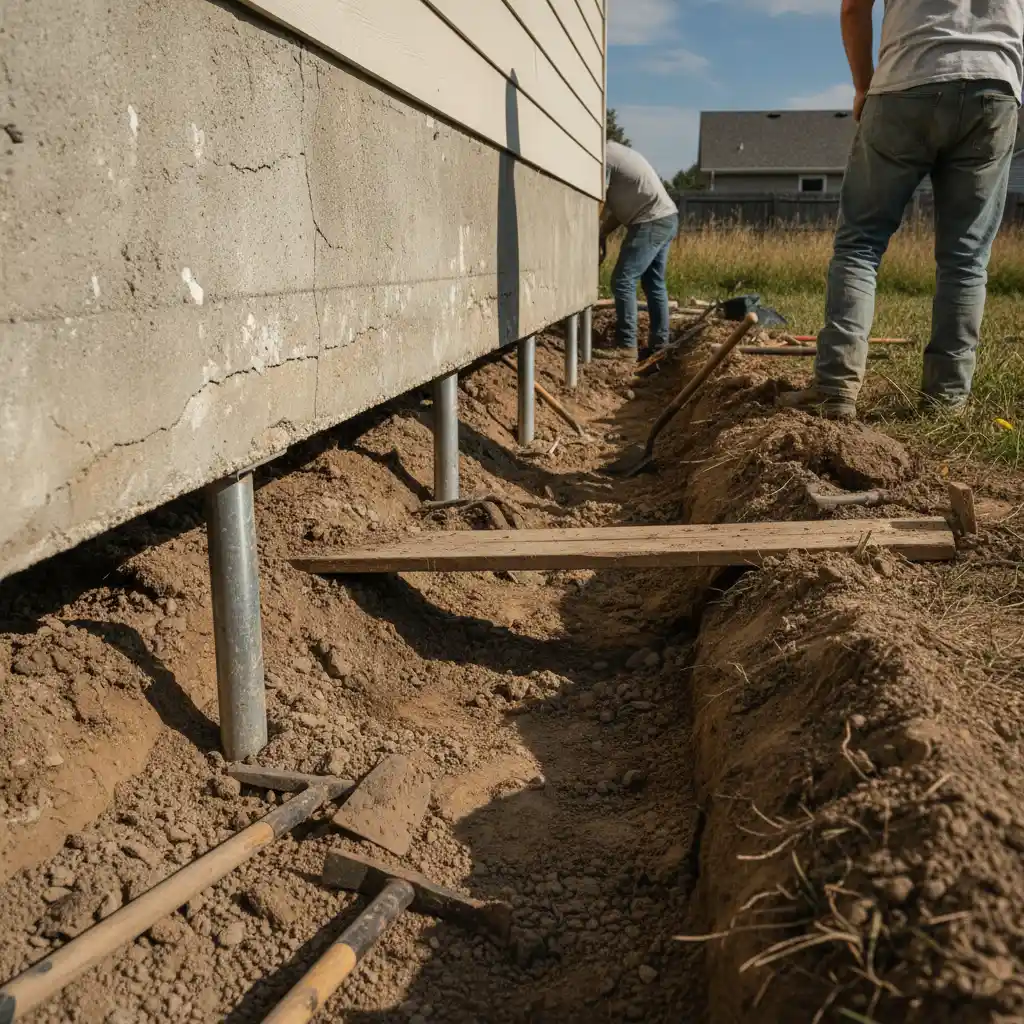
Our team in action — foundation-repair professionals serving Pflugerville
Structural Foundation Repair Methods We Use in Pflugerville
Steel Push Piers (Driven Piers)
Steel push piers are hydraulically driven through unstable soil until they reach load-bearing strata, then used to lift and support the foundation. This is our most commonly used method in Pflugerville for settlement caused by shrink-swell clay movement. Piers typically reach depths of 15 to 22 feet beneath the Pflugerville surface to pass through the active Vertisol layer and bear on the underlying Cretaceous limestone or dense alluvial gravels. Learn more about steel push pier installation
Helical Piers
Helical piers are steel shafts with helical plates that are torque-installed into the soil. They are ideal for lighter structures, additions, porches, and commercial applications where load capacity must be precisely controlled. We use helical piers frequently on Pflugerville pier-and-beam homes that have been converted or expanded, and on commercial properties along the SH-130 toll corridor. Learn more about helical pier systems
Slab Grouting and Void Filling
Where voids have developed beneath a slab due to soil shrinkage, we inject high-density polyurethane foam or cement grout to fill the void and restore uniform slab support. This method is particularly effective in Pflugerville homes where the slab has not significantly settled but shows cracking from lack of sub-slab support during extreme dry periods.
Foundation Patching and Crack Repair
After structural stabilization, we repair cracks in the concrete grade beam and slab using epoxy injection and hydraulic cement to restore structural continuity and prevent water intrusion. Explore our foundation patching services
Interior Drainage and Moisture Management Systems
For crawl space structures and basements, we install interior drainage channels, sump pumps, and vapor barriers to control moisture at the source. While true basements are rare in Pflugerville, pier-and-beam crawl spaces in older homes along FM 685 benefit significantly from these moisture management systems.
Ready for Structural Foundation Repair? Get Your Free Estimate Today.
Round Rock Foundation Repair Group serves Pflugerville and the surrounding area — we’ll be on-site within 24 hours.
📞 Call (512) 220-3502Structural Foundation Repair Cost in Pflugerville, TX
Understanding the cost of structural foundation repair in Pflugerville helps homeowners budget appropriately and evaluate quotes accurately. Costs vary widely based on the extent of damage, the repair method required, and site-specific conditions.
Typical Cost Ranges
- Minor crack patching and void filling: $500 – $2,500
- Partial pier installation (4–8 piers for a settled corner or one side): $3,500 – $7,000
- Full perimeter pier installation for an average 1,800 sq ft Pflugerville home: $8,000 – $18,000
- Full perimeter repair for a larger 2,500–3,500 sq ft two-story home: $15,000 – $30,000
- Commercial foundation repair (SH-130 corridor commercial buildings): $20,000 – $75,000+
- Crawl space repair and encapsulation: $3,000 – $10,000
Factors That Influence Your Pflugerville Repair Cost
- Number of piers required: Determined by the foundation’s perimeter and the pattern of settlement detected in the elevation survey
- Pier depth: In Pflugerville’s eastern areas near Gilleland Creek, softer alluvial soils require deeper piers, increasing material and labor costs
- Access difficulty: Tight side-yards common in newer Pflugerville subdivisions with zero-lot-line setbacks may require specialized equipment
- Concurrent plumbing repair: If a slab leak is identified during inspection, plumbing repair costs ($500 – $3,000) are added to foundation repair costs
- Interior finish restoration: Drywall and flooring repairs are typically quoted separately
We provide free, detailed written estimates following our inspection. Financing options are available. Call (512) 220-3502 to discuss your specific situation. View our complete cost guide for the Pflugerville area
Pflugerville Neighborhoods We Serve
Heatherwilde
Developed primarily in the mid-1990s, Heatherwilde’s homes were constructed on what was previously blackland prairie farmland. The neighborhood’s clay-heavy soils and aging PVC plumbing systems make it one of the more active areas for foundation calls in Pflugerville. We regularly service pier-and-beam conversions and slab repairs throughout this community.
Pflugerville Farms and Reserve at Westcreek
These early-2000s subdivisions along Pecan Street were built rapidly and feature homes ranging from 1,600 to 2,800 square feet on post-tension slabs. Fill soil consolidation has been a documented concern in this area, and we have completed numerous multi-pier repairs for homeowners experiencing perimeter settlement.
Stone Hill Town Center Area
The residential communities surrounding Pflugerville’s Stone Hill Town Center feature a mix of newer construction and established trees. Mature live oaks in this area are a notable foundation moisture-extraction hazard, and we frequently incorporate soaker hose system recommendations alongside structural repairs here.
Villages of Hidden Lake
Located near Gilleland Creek, this neighborhood sits on some of the softer alluvial soils in the Pflugerville area, requiring deeper pier installation — often reaching 20 to 22 feet — to achieve stable bearing capacity. We have extensive experience with the specific soil profiles in this corridor. View all Pflugerville service area details
Foundation Maintenance Tips for Pflugerville Homeowners
Proactive maintenance can significantly extend the life of your foundation and reduce the likelihood of costly repairs. These tips are specifically calibrated for Pflugerville’s climate and soil conditions:
- Run a soaker hose system during dry months. Place soaker hoses 18 inches from the foundation perimeter and run them for 30 to 45 minutes per day during periods when Pflugerville receives less than 1 inch of rainfall per week — typically May through September.
- Maintain consistent soil moisture. Avoid both overwatering (which causes heave) and underwatering (which causes settlement) by monitoring soil moisture visually — soil at the foundation edge should feel damp but not muddy.
- Keep gutters clean and downspouts extended. Discharge downspouts at least 5 to 6 feet from the foundation. Clogged gutters are a leading cause of localized foundation saturation in Pflugerville’s older neighborhoods.
- Maintain positive drainage grading. The soil around your home should slope away from the foundation at a minimum of 1 inch per foot for the first 6 feet.
- Monitor large trees. Trees within 20 feet of your foundation should be inspected annually. Consider root barriers for trees within 10 feet.
- Inspect plumbing annually. Schedule a slab leak detection test every 3 to 5 years for homes built before 2005 in Pflugerville.
- Document crack locations and sizes. Photograph and mark any cracks with tape each season. Growth in crack width over time is a definitive indicator of active movement requiring professional evaluation.
Why Choose Round Rock Foundation Repair Group for Pflugerville Structural Foundation Repair
Round Rock Foundation Repair Group has built its reputation across the Austin metro area — including Pflugerville, Round Rock, Cedar Park, Georgetown, and Austin — by delivering technically precise, honestly priced foundation repair backed by genuine local expertise.
Our crews understand the specific soil profiles of Pflugerville’s neighborhoods, from the deep Houston Black clays of Heatherwilde to the alluvial soils near Gilleland Creek. We don’t use a one-size-fits-all approach — every repair plan is designed for the actual conditions beneath your specific property.
We serve residential homeowners, commercial property managers, and real estate investors throughout Pflugerville and surrounding communities. Our services include structural foundation repair, professional foundation inspections, crawl space repair, concrete foundation repair, and commercial foundation repair.
We offer free inspections, detailed written reports, and transparent pricing with no high- pressure sales tactics. Call (512) 220-3502 today to schedule your free consultation.
Frequently Asked Questions About Structural Foundation Repair in Pflugerville, TX
How much does structural foundation repair cost in Pflugerville, TX?
Costs in Pflugerville typically range from $3,500 for a minor partial repair (4 to 6 piers on one affected corner) to $18,000 or more for a full perimeter repair on an average-sized home. The expansive clay soils and occasional need for deep piers (18 to 22 feet) to reach stable bearing strata can push costs toward the higher end compared to regions with more cooperative soils. We provide free written estimates after our inspection.
How long does foundation repair take in Pflugerville?
Most residential structural foundation repairs in Pflugerville are completed in 1 to 3 days. Larger homes requiring 20 or more piers may take 3 to 5 days. Commercial projects vary considerably based on scope. The inspection and planning phase typically takes 2 to 5 business days before work begins.
Will my homeowner’s insurance cover foundation repair in Pflugerville?
Standard homeowner’s insurance policies in Texas generally do not cover foundation damage caused by expansive soil movement or drought — which accounts for the vast majority of Pflugerville foundation issues. However, if a covered peril such as a slab plumbing leak caused the damage, the resulting foundation repair may be partially covered. We recommend reviewing your policy and can provide documentation to support your claim if applicable.
What is the best time of year to repair a foundation in Pflugerville?
Foundation repair can be performed year-round in Pflugerville, but fall — after summer drought stress has concluded and before winter rains begin — is often ideal. Soil moisture conditions are more stable during this period, allowing for more precise re-leveling and better long-term outcomes. We do not recommend waiting through another full drought season if active movement is occurring.
Do I need a foundation inspection before buying a home in Pflugerville?
Absolutely. Given Pflugerville’s high-risk soil environment, we strongly recommend a dedicated foundation inspection — separate from a general home inspection — before purchasing any property in Pflugerville, particularly homes built between 1995 and 2010 along the Dessau, Kelly Lane, and FM 685 corridors. Schedule a pre-purchase foundation inspection
How do I know if my Pflugerville foundation problem is serious?
Any crack wider than one-quarter inch, any door or window that suddenly stops functioning correctly, or any floor slope measurable with a standard 4-foot level warrants a professional inspection. In Pflugerville’s clay soils, foundation movement tends to accelerate once it begins — catching problems early prevents exponential cost increases.
Can tree roots really damage my foundation in Pflugerville?
Yes. The live oaks and cedar elms common throughout Pflugerville neighborhoods extract significant moisture from the clay soils beneath foundations during dry summers. Root systems can extend 30 to 50 feet laterally, drying soils under slabs 20 to 30 feet from the tree trunk. This is a documented contributor to foundation movement in established Pflugerville neighborhoods like Stone Hill and Windermere.
What areas near Pflugerville do you also serve?
In addition to Pflugerville, Round Rock Foundation Repair Group serves Round Rock, Cedar Park, Georgetown, Austin, Tech Ridge, Brushy Creek, Wells Branch, and communities including Avery Ranch, Forest Creek, Teravista, Behrens Ranch, Sendero Springs, and Paloma Lake. View our complete service area
Get Your Free Structural Foundation Inspection in Pflugerville Today
If your Pflugerville home is showing cracks, sticking doors, sloping floors, or any other warning signs of foundation movement, don’t wait. The expansive clay soils beneath Pflugerville properties mean that small problems can become major structural failures across a single dry season.
Round Rock Foundation Repair Group provides free, no-obligation structural foundation inspections throughout Pflugerville and the surrounding Austin metro area. Our local experts will evaluate your property, explain exactly what is happening, and give you a clear, detailed written estimate — no pressure, no surprises.
Call us now at (512) 220-3502 or submit a service request online to schedule your free inspection. Serving Pflugerville, Round Rock, Cedar Park, Georgetown, Austin, and all surrounding communities.